
You just spent over two hours taking a full Bluebook SAT practice test. You check your score, sigh at the math section, look at the correct answers, and move on. Does this sound familiar?
If you are a parent watching your teen face this cycle of frustration, there is a better way. Here is the good news: the review process is a skill, and you can master it. This is the core problem for millions of students preparing for college admissions. You are wasting hours taking tests without actually reviewing your mistakes. Simply looking at the right answer and nodding along does not build the skills you need for test day. You might understand the solution when you see it, but that does not mean you can recreate that logic under pressure.
To truly improve your digital SAT score, you need a macro-level strategy. You need to identify the underlying concepts or strategic flaws that caused the error in the first place. Thankfully, artificial intelligence has completely changed how students can study.
In this guide, we will show you exactly how to use an AI SAT tutor to review your practice tests, analyze your score reports, and build a personalized study plan that actually works.
What to Do Before Your Next Practice Test
Before diving into review strategies, you need to set up your practice environment for success. To get the most accurate baseline score, follow this quick checklist:
- Set up your Bluebook account: Download the official app from the College Board and log in ahead of time.
- Clear your schedule: Block out a full two and a half hours in a quiet room, free from phone notifications and distractions.
- Prepare an error log template: Have a notebook or digital document ready to track your missed questions right after you finish.
What is the Digital SAT?
Before you can review a test effectively, you need to understand how the test is built. The Digital SAT is not just a computerized version of the old paper test. It is a multistage adaptive test.
This means the test adapts to your performance in real time. Both the Reading and Writing section and the Math section are split into two parts, called modules. Everyone takes the same first module for each subject. Your performance on this first module determines the difficulty of the second module. If you do well, your second module will be significantly harder, but it will give you access to the highest possible score range. If you struggle, your second module will be easier, but your maximum possible score will be capped.
Because of this adaptive digital SAT practice structure, missing "easy" questions in the first module is incredibly costly. It can route you to the easier second module, instantly limiting your score. The College Board provides official full-length exams through their software, which you can find at College Board. Taking these official tests is the first step, but reviewing them is where the real learning happens.
Why Passive Review Holds Students Back (And How to Fix It)
Many students fall into the trap of passive learning. They read the digital SAT answer explanations provided by the College Board, say "Oh, that makes sense," and never think about the question again.
According to educational research from Central Michigan University, active learning requires you to actually do something with the information rather than just consuming it. Passive review creates a false sense of security.
When you use basic homework platforms or community forums, you often get fragmented, question-by-question explanations. You might find out why x equals 4, but you will not learn why you thought x was 5. This is the hidden gap in test prep. If you want to forecast your improvement, you have to understand your specific errors. We discuss this concept deeply in our guide on The Hidden Knowledge Gap: How AI Math Assessments Forecast Your Next Test Score.
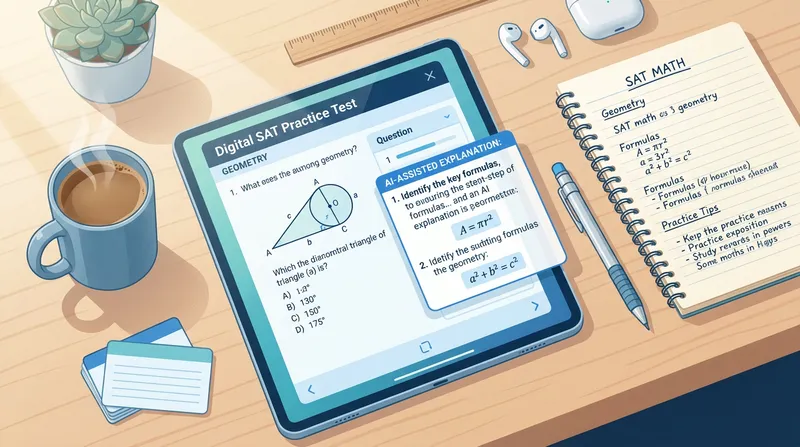
Step-by-Step Digital SAT Answer Explanations: The Holistic Review Method
To fix your mistakes, you need a framework. We call this the Holistic Review Method. Instead of just looking for the right answer, you need to categorize every single question you missed or guessed on.
Whenever you review a Bluebook SAT practice test, categorize your mistakes into one of three buckets:
- Careless Errors: You knew the math concept or grammar rule, but you dropped a negative sign, misread the question, or rushed.
- Time Management Issues: You spent four minutes on one question, panicked, and guessed on the last three.
- Knowledge Gaps: You simply did not know the formula for the area of a sector, or you did not know the definition of a vocabulary word.
Once you categorize your mistakes, you can use AI to fix them. If you have a knowledge gap, you do not just need the answer. You need a tutor to teach you the concept from scratch.
How to Use AI for SAT Math Practice
The math section of the Digital SAT is heavily focused on algebra, advanced math, problem-solving, and geometry. Many students turn to basic scanner apps when they get stuck. While these apps are great for quick calculations, they often fail to explain the logic behind the math.
If you want to master digital SAT math practice questions, you need an app that shows the steps. When you use an advanced AI learning app, the core philosophy is "Snap. Solve. Learn." You can snap a photo of a complicated algebra problem from your practice test, and the AI will break down the exact steps required to solve it.
More importantly, a high-quality AI tutor provides multiple solution methods when applicable. The SAT often rewards students who know shortcuts. For example, you might be able to solve a system of equations by graphing it on the built-in Desmos calculator rather than using substitution. If you are confused by apps that only offer one rigid way to solve a problem, check out our post on Box Method, FOIL, or Grouping? Why Single-Solution Math Apps Confuse Students.
If you find yourself struggling late at night with practice questions, you are not alone. Read our survival guide for The 11 PM Crisis: Finding a Math Homework Help App (That Actually Shows Steps).
Digital SAT Reading and Writing Practice: The Missing Piece
Many popular study apps completely ignore the Reading and Writing section. This is a massive mistake. The Digital SAT combined Reading and Writing into one equally weighted adaptive section featuring short passages with a single question each, covering topics like Rhetorical Synthesis, Transitions, and Inferences.
To review this section effectively, you can use an AI SAT tutor to break down the logic of the text. Just like in math, you can snap a photo of a dense reading passage or a tricky grammar question to get instant, step-by-step contextual breakdowns.
If you missed a "Command of Evidence" question, you can type or snap the passage into an AI tool and ask it to explain why your chosen answer does not directly support the claim. AI is fantastic for breaking down complex grammar rules. If you constantly miss punctuation questions, you can ask the AI to generate ten new practice sentences testing the difference between a semicolon and a colon. For parents looking to support their children in this area, we highly recommend reading What to Look for in an AI Reading Tutor: A 2026 Guide for Parents.
Prompt Engineering for SAT Prep: How to Build Your AI SAT Tutor
The secret to using artificial intelligence for test prep is prompt engineering. If you ask an AI, "What is the answer to question 4?" it will just give you the answer. This robs you of the learning process.
According to the Center for American Progress, intelligent tutoring systems are most powerful when they provide granular, specific feedback that forces the student to engage. You want the AI to act as a Socratic tutor.
Here are the exact prompts you should use when reviewing your practice test:
- For Math: "Act as an expert SAT math tutor. I got this question wrong. My answer was [insert your answer]. Do not give me the correct answer yet. Ask me a guiding question to help me find the flaw in my logic."
- For Reading: "I chose choice B for this reading comprehension question, but the answer is D. Explain why choice B is a 'distractor' answer and what specific word in the text makes choice D correct."
- For Adaptive Practice: "I just missed a question about quadratic functions. Generate three new, highly difficult practice questions on this exact topic to simulate the hard second module of the Digital SAT."
Using prompts like these transforms a simple chatbot into a highly personalized learning experience.
Best AI Tools for High School Students (And Why Dashboards Matter)
There are dozens of homework helpers on the market, but not all are created equal. Some platforms lock their best explanations behind strict paywalls. Others rely on community-generated answers that are often incorrect or poorly explained. Some tools are just calculators that do the work for you, which does not help you on test day.
If you want to know which tool is right for your family, you need to understand the difference between a solver and a tutor. We break this down completely in AI Math Tutor vs. Math Problem Solver AI: Which Tool Does Your Child Actually Need?
For parents, the biggest issue with most apps is the lack of visibility. You want to know if your child is actually learning or just copying answers. This is why TutorAI includes a comprehensive progress tracking system. Parents can access a dashboard to see their child's daily practice streaks, topic mastery, and weak spots. If you are tired of being left in the dark, read The 'Black Box' of Homework Apps: Why Parents Need Dashboards.
For families with multiple students preparing for the SAT or working through homework at the same time, TutorAI offers a Family Plan. This allows siblings to share access while each maintaining their own personalized progress dashboard.
Furthermore, the app is available 24/7. It works online and offline, meaning students can get help exactly when they need it. If you are taking a practice test at a library with spotty Wi-Fi, you can still access your saved explanations and review your missed questions without interruption.
How to Improve Your Digital SAT Score: An Actionable Plan
Ready to put all of this together? Here is your step-by-step game plan for digital SAT prep strategies:
- Take a Full Practice Test: Download the Bluebook app and take a full, timed test in a quiet room. Treat it like the real exam.
- Do Not Look at the Answers Immediately: Take a break. Let your brain rest.
- Attempt the Missed Questions Again: Before looking at the correct answers, try to solve the questions you missed one more time without a timer. If you get it right the second time, it was a time management issue or a careless error. If you still cannot get it, it is a knowledge gap.
- Use an AI Tutor for Step-by-Step Review: Snap a picture of the questions you still do not understand. Read the step-by-step explanations to grasp the core concept.
- Generate Targeted Practice: Use AI to create custom practice questions focused solely on your weak spots. Each time you complete this loop, you are not just preparing for one test. You are building the critical thinking skills that will serve you far beyond test day.
By following this loop, you ensure that every hour of studying actually moves the needle. If you want to explore more free resources to build your study plan, check out Skip the $1,000 Bootcamps: Best Free SAT Prep Courses Online (2026 Guide).
Conclusion
Taking a free digital SAT practice test is only half the battle. If you want to see real improvement in your scores, you have to stop guessing and start reviewing your mistakes with intention. By using the Holistic Review Method and leveraging AI tools for step-by-step guidance, you can turn your weaknesses into strengths.
Ready to study smarter, not harder? Download TutorAI today to get instant, personalized homework help and test prep support whenever you need it. Snap a photo, get unstuck, and build the confidence you need for test day.
Note: Every student learns differently. While these strategies are research-backed, results may vary. Adapt these techniques to fit your unique learning style and circumstances.
Frequently Asked Questions
How do I review a digital SAT practice test effectively?
The most effective way to review a digital SAT practice test is to categorize every mistake into one of three buckets: careless errors, timing issues, or knowledge gaps. Once categorized, use an AI tutor to break down the step-by-step logic of the questions you missed. Do not just look at the correct answer and move on. You must understand the underlying concept to prevent making the same mistake twice.
Can an AI tutor help me improve my digital SAT score?
Yes, an AI tutor can significantly improve your digital SAT score by providing personalized, 24/7 support. Tools like TutorAI identify your specific weak spots, explain complex concepts in simple terms, and generate adaptive practice questions that mirror the difficulty of the real exam. This targeted approach is much more effective than generic studying.
Where can I find detailed answer explanations for Bluebook practice tests?
While the College Board provides basic explanations in their My Practice portal, these are often brief and assume you already understand the core concept. For detailed digital SAT answer explanations, you can use TutorAI. Simply snap a photo of any Bluebook question, and the app will provide a comprehensive, step-by-step breakdown of the solution.
How does the adaptive nature of the Digital SAT work?
The Digital SAT is a multistage adaptive test divided into two modules per subject. Your performance on the first module dictates the difficulty of the second module. Doing well on the first module routes you to a harder second module, which is required to achieve a top-tier score. Missing easy questions early on can cap your maximum possible score.
What is the best way to practice for the Digital SAT Reading and Writing section?
The best way to practice for the Reading and Writing section is to focus on understanding the logic behind grammar rules and reading comprehension questions. Use AI to explain why the incorrect distractor answers are wrong. Understanding why an answer is incorrect is just as important as knowing why the correct answer is right.