
If you are a parent or a teacher of a middle school student, you have likely encountered a very modern frustration. You sit down to help your child with their English Language Arts homework, only to realize they are using an artificial intelligence tool to generate a summary of the book they were supposed to read. Instead of learning how to comprehend complex texts, they are simply getting an app to do the heavy lifting for them.
This is the core problem with many popular homework tools today. They act as answer engines rather than actual teachers. They might write a perfectly structured essay or summarize a chapter in seconds, but they completely fail to teach students how to read, comprehend, and analyze material independently.
Reading comprehension is a foundational skill that impacts every single subject, from history to science, and even math. When students bypass the reading process, they miss out on critical cognitive development. What busy parents and struggling students actually need is a true AI reading tutor for kids, a tool designed to coach, guide, and build lifelong literacy skills.
In this comprehensive guide, we will explore what makes a great AI reading app for middle school, how interactive AI reading tools can transform your child's learning experience, and why choosing a platform that prioritizes real understanding is the key to academic success.
What is the Best AI Homework Helper for Middle School?
When searching for a middle school homework helper AI, it is easy to get overwhelmed by the sheer number of options available. However, not all AI tools are created equal. To find the best fit for your family, you need to understand the difference between an "answer generator" and a "learning companion."
Many popular platforms, such as Chegg or Brainly, rely heavily on community-driven answers or direct AI generation. While these can be helpful for a quick reference, they often lean toward providing the final answer without explaining the "why" behind it. This approach can lead to a false sense of security. A student might get an A on their homework assignment but completely fail the closed-book exam because they never actually learned the material.
If you are concerned about this trend, you can read more in our guide on The 2026 Chegg Crackdown: How to Get Safe AI Homework Help While Building Real Skills.
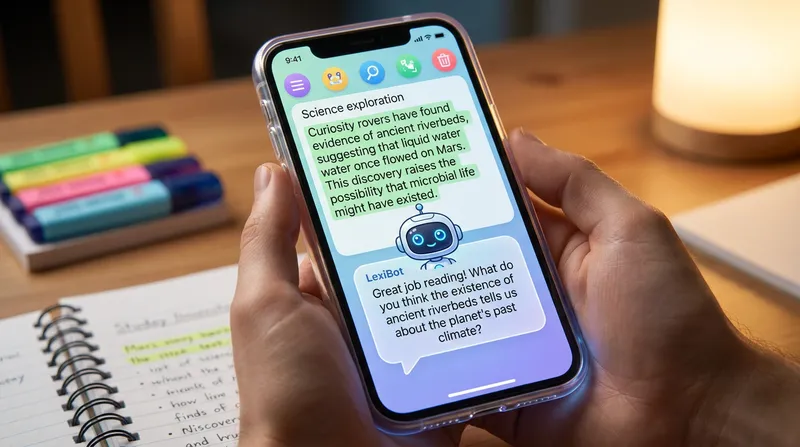
The best AI homework helper is one that uses the Socratic method. Instead of handing over the answers, a Socratic AI tutor for reading will ask guiding questions. It will prompt the student to think critically about the text, identify context clues, and draw their own conclusions.
💡 Actionable Tip: Before downloading any study app, test it with a simple reading prompt. Ask the AI, "What is the main theme of this paragraph?" If the AI simply gives you the answer, it is an answer engine. If it replies with, "Let us look at the repeated words in the first sentence. What do you think the author is focusing on?" then you have found a true learning tool.
How AI Tutors Improve Reading Comprehension
Reading comprehension is not just about decoding words on a page. It requires inference, vocabulary mastery, and the ability to connect ideas. Traditional tutoring is fantastic for this, but human tutors are expensive and not available at 10 PM when a homework crisis strikes.
This is where an AI reading assistant for students steps in. Artificial intelligence has evolved significantly, moving past simple grammar checks to offer deep, interactive literacy support.
According to a study featured by Edutopia, students using a customized AI math tutor scored 127 percent higher on practice problems compared to those without access, while retaining their knowledge on closed-book exams. While this data comes from math tutoring research, the same principle applies to literacy coaching. When AI is used to provide hints and guidance rather than direct answers, student performance skyrockets.
Furthermore, research from the Journal of Learning for Development found that students using an AI-based reading comprehension platform achieved significantly higher scores on the Degrees of Reading Power test compared to a control group. The data is clear: interactive AI reading tools work when designed correctly.
The Power of Real-Time Feedback
One of the biggest hurdles in middle school homework is the delay in feedback. A student might complete a reading assignment on Tuesday, turn it in on Wednesday, and not get it back until Friday. By then, they have forgotten their thought process.
An AI reading coach provides instant, corrective feedback. If a student misunderstands a character's motivation, the AI can gently correct them in the moment, ensuring they do not practice bad habits.
💡 Actionable Tip: Have your child read a chapter of their assigned book and then explain it to their AI tutor. Encourage them to ask the AI, "Did I miss any important details about the main character?" This active recall strategy builds incredible retention.
Math vs. Reading: Why You Need a Dedicated Literacy AI
Many of the most popular homework apps on the market, such as Photomath and Mathway, are strictly focused on mathematics. While these tools are excellent for solving algebraic equations, they are completely useless when your child is struggling to understand a chapter of "To Kill a Mockingbird" or trying to analyze a historical document.
Even more importantly, basic math solvers often fail when presented with complex text. We explore this limitation deeply in our article Beyond Khanmigo and Photomath: Why the Best AI Math Tutor Does Both.
Here is a secret that many educators know but parents often miss: reading comprehension is the key to unlocking math skills. Middle school math introduces complex word problems. If a student cannot comprehend the text of the problem, they cannot set up the equation, no matter how good they are at calculating numbers.
Research highlighted by Purdue University emphasizes that AI tools excel at providing adaptive practice and immediate corrective feedback, which are essential for building reading fluency and automaticity. By improving your child's reading fluency, you are inadvertently improving their ability to tackle STEM subjects.
💡 Actionable Tip: If your child struggles with math word problems, do not just focus on the math. Have them read the problem aloud and explain the scenario to you or their AI tutor before they ever write down a number. Building this literacy habit will drastically reduce math anxiety.
Top Features to Look for in AI Reading Assistants
When evaluating AI tools for reading comprehension, you need to look beyond the basic chat interface. A high-quality AI reading tutor for kids should include specific features designed to support both the learner and the parent.
1. Step-by-Step Explanations and Context Clues
A good homework AI for reading assignments will never just give a summary. Instead, it should break down complex sentences, highlight difficult vocabulary, and explain how to use context clues. It should teach the student how to fish, rather than just handing them a fish.
2. Support for Learning Differences
Middle school is a critical time for students with learning differences like dyslexia or ADHD. Organizations like Learning Ally show how AI empowers students with reading difficulties by providing text-to-speech access, writing scaffolds, and personalized decodable reading practice. Ensure your chosen AI tool offers adaptive text features and audio support to reduce frustration.
3. Parent Progress Tracking
One of the biggest missing pieces in tools like Caktus AI or Brainly is parent visibility. Busy parents need AI literacy tools that offer a dashboard or progress report. You need to know if your child is struggling with vocabulary, main idea identification, or making inferences so you can have informed conversations with their teachers.
4. Offline Capabilities
Homework does not always happen in places with perfect Wi-Fi. Whether you are on a road trip or dealing with an internet outage, your child still needs to study. Look for apps that offer offline support, a premium feature we heavily prioritize and discuss in our guide to the Best Offline AI Study Apps: Get Homework Help Without Wi-Fi. Ensure your chosen app, like TutorAI, offers offline capabilities so learning never stops.
💡 Actionable Tip: Create a checklist of these four features. Before committing to a premium subscription for any educational app, verify that it meets at least three of these criteria to ensure it will actually benefit your child's long-term learning.
Pros and Cons of Using AI for Homework
As with any technology, there are benefits and drawbacks to using AI in education. Understanding these will help you set healthy boundaries for your middle schooler.
The Pros
- 24/7 Availability: AI does not sleep. If your child is stuck on a reading assignment at 9 PM, help is instantly available.
- Judgment-Free Zone: Many middle schoolers are embarrassed to ask questions in class if they do not understand a text. An AI reading coach provides a safe, private space to ask "silly" questions without fear of peer judgment.
- Personalized Pacing: AI adapts to your child's speed. If they need a paragraph explained three different ways, the AI will patiently provide those explanations.
The Cons
- The Temptation to Cheat: Tools that focus heavily on content generation can easily be misused to write essays or bypass reading entirely.
- Over-Reliance: Students might begin to doubt their own abilities if they lean too heavily on the AI for every single assignment.
- Inaccurate Scanning: Some basic apps struggle to read handwritten notes or poorly printed texts, which can lead to frustrating errors. (If you have experienced this, check out our article on Why Math Scanners Misread Handwriting and How to Fix It.)
💡 Actionable Tip: Establish a "Try First" rule in your house. Your child must attempt the reading assignment and write down two of their own thoughts before they are allowed to consult their AI tutor for help.
How to Use a Socratic AI Reading Coach Effectively
At TutorAI, we built our platform specifically to address the pain points parents and teachers face with standard homework solvers. We believe in our core philosophy: Snap. Solve. Learn. We want students to get unstuck instantly, but we insist that they learn for real.
While many families trust TutorAI as a world-class STEM solver (you can see how it compares to other tools in our Gauth vs Photomath breakdown), its advanced natural language processing makes it an equally powerful interactive reading coach.
Imagine your child is stuck on a confusing chapter of a historical novel. Instead of giving up, here is how they can use a Socratic tool, like TutorAI, for their next English assignment:
- Snap a Photo: If they are stuck on a dense paragraph in a novel or a confusing historical document, they can simply take a picture of the text using advanced OCR technology.
- Ask for Guiding Questions: Instead of asking for a summary, teach your child to prompt the AI with, "Help me understand the main idea of this text without giving me the direct answer."
- Review the Step-by-Step Breakdown: The AI will highlight the context clues and break the text down into digestible, logical steps, ensuring your child understands the author's intent.
- Track Progress: Parents can log into the dashboard to see exactly what topics their child is studying, ensuring they are spending their time effectively.
💡 Actionable Tip: Sit down with your child for their first AI study session. Show them how to take a clear photo of their reading assignment and model how to ask thoughtful, open-ended questions.
Actionable Tips: How Parents Can Support Reading at Home with AI
Technology is a tool, but parental involvement is the anchor. Here are several ways you can combine AI literacy tools for parents with hands-on support to boost your middle schooler's confidence.
- Co-Read and Discuss: Have your child read a section of their book. Then, ask your AI tutor to generate three discussion questions based on that chapter. Discuss the answers together at the dinner table.
- Focus on Vocabulary: When your child encounters a word they do not know, do not just give them the definition. Have them use their AI app to find the root of the word and generate three example sentences.
- Monitor the Dashboard: Make it a weekly habit to check the progress tracking features of your educational apps. Celebrate the small wins, like an increase in accuracy or a solid study streak.
- Encourage Debate: Middle schoolers love to argue. Have them read an opinion piece, and then ask the AI to take the opposing viewpoint. Let your child debate the AI to build their critical thinking and rhetorical skills.
Conclusion
Navigating middle school homework does not have to be a nightly battle. While it is frustrating to see tools that encourage students to skip the hard work of reading, the right technology can actually do the exact opposite.
By choosing a Socratic AI tutor for reading that focuses on step-by-step explanations, real-time feedback, and parental visibility, you can empower your child to become a confident, independent learner. Reading comprehension is the foundation of all academic success, and with the right AI reading coach, your student can build skills that will last a lifetime.
If you are tired of watching your child hand their reading assignments to an AI and walk away with nothing learned, it is time for a change. TutorAI is built for exactly this moment. Try it tonight and see the difference between getting an answer and building a lifelong skill. Snap. Solve. Learn.
Note: Every student learns differently. While these strategies are research-backed, results may vary. Adapt these techniques to fit your unique learning style and circumstances.
Frequently Asked Questions
Is an AI reading tutor better than a human tutor?
AI tutors and human tutors serve different, yet complementary, purposes. A human tutor is excellent for building emotional connections, providing deep mentorship, and offering highly specialized interventions for severe learning disabilities. However, an AI reading tutor is available 24/7, costs significantly less, and provides instant, real-time feedback during late-night study sessions. The most effective approach often combines classroom instruction or human tutoring with an AI learning companion for daily, accessible practice.
How can AI help my middle schooler with reading comprehension?
AI helps by breaking down complex texts into manageable pieces. Instead of just summarizing a chapter, a high-quality AI reading assistant will define difficult vocabulary in context, ask Socratic questions to prompt critical thinking, and provide step-by-step explanations of underlying themes and character motivations. This interactive process forces students to actively engage with the text, which prevents them from passively skimming their assignments.
Are AI homework helpers like Chegg and Brainly considered cheating?
It depends entirely on how the student uses the tool and the platform's core design. If a student copies and pastes a prompt to generate an essay they submit as their own work, that is academic dishonesty. However, if they use a platform like TutorAI to get step-by-step explanations, clarify confusing concepts, and test their own knowledge through practice questions, it is a highly effective and ethical study method.
Can AI help with math word problems by improving reading skills?
Absolutely. A significant number of middle school students struggle with math word problems not because they cannot do the calculation, but because they cannot comprehend the text well enough to set up the equation. Dedicated AI reading tools improve overall literacy, vocabulary mastery, and logical inference, which directly translates to better performance in complex STEM subjects.
What is the safest AI reading assistant for middle school students?
The safest tools are those designed specifically for education, featuring robust parental controls, detailed progress tracking, and secure data handling. Look for platforms that prioritize step-by-step learning over instant answer generation. Apps like TutorAI prioritize COPPA compliance and secure data handling, ensuring your child is building real academic confidence in a secure environment without the risk of bypassing the actual learning process.


