
Introduction: The 11 PM Homework Meltdown
We have all been there. It is 11 PM on a Tuesday night, the kitchen table is covered in eraser shavings, and the tension in the room is thick enough to cut with a knife. Your teenager is exhausted, staring blankly at an algebra worksheet that might as well be written in an alien language. You want to help, but it has been decades since you last factored a polynomial.
In a desperate bid for sleep, your student pulls out their phone to find an AI homework helper. This is where the modern homework battle begins.
If they use a strict Socratic AI tutor, the app will refuse to give them the answer, instead asking them endless leading questions. When a student is already tired and stuck, this feels less like teaching and more like an interrogation. On the flip side, if they use a quick scanner app, it just spits out the final answer. The homework gets done, but the student learns absolutely nothing, virtually guaranteeing they will fail the upcoming proctored exam.
Families are caught in a frustrating trap. You are forced to choose between the tears of answer gatekeeping and the empty calories of answer dumping. But what if there was a better way? In this post, we will explore this frustrating dichotomy and introduce a hybrid solution that finally bridges the gap between instant relief and actual learning.
The Two Extremes of AI Math Tutors Today
When searching for the best AI math tutor, parents and students quickly realize that the educational technology market has split into two very distinct, deeply flawed camps.
On one side of the spectrum, you have apps designed purely for speed and convenience. These are the instant gratification tools. On the opposite side, you have apps designed by educational purists. These tools attempt to replicate a strict human tutor who will never simply hand over the answer.
Both philosophies have noble intentions, but they both fail to account for the reality of how middle and high school students actually study.
Comparing the Options
| Feature | Instant Scanners (e.g., Photomath) | Strict Socratic (e.g., Khanmigo) | Hybrid AI (Tutor AI) |
|---|---|---|---|
| Gives Final Answer | Yes | No | Yes |
| Explains Steps | Rarely or Paywalled | Yes (but slowly) | Yes (instantly) |
| Available 24/7 | Yes | Yes | Yes |
| Works Offline | Sometimes | No | Yes |
| Frustration Level | Low initially, high on test day | High when tired | Low |
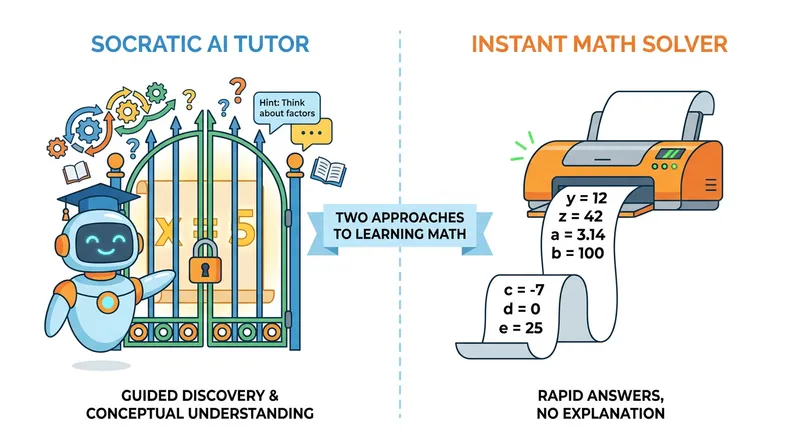
The Answer Dumping Problem (Why Quick Scanners Fail)
Let us start with the most popular category of math apps: the instant scanners. If you are looking for Photomath alternatives, you have likely encountered dozens of apps that operate on a simple premise. You snap a photo, and the app instantly provides the final answer.
We call this "answer dumping."
While this provides immediate relief to a stressed student, the long-term consequences are severe. When a student uses an app just to copy the final number, they are completely bypassing the productive struggle required to build neural pathways. According to research published in the U.S. Department of Education's ERIC database, students who rely heavily on instant math solvers for homework completion often fail to grasp essential concepts. This results in a deficient foundation for future learning and creates a dangerous over-reliance on the application.
This becomes painfully obvious on test day. A student might have a perfect homework grade but completely bomb their midterms because they never learned the "why" behind the math. If you are comparing tools like Gauthmath vs Photomath, you will notice that while some offer steps, those steps are often hidden behind paywalls or ignored entirely by students rushing to finish.
Actionable Tip for Parents: Do a "teach back" test. If your child finishes their math homework suspiciously fast using an app, ask them to explain how they solved just one problem on a blank sheet of paper. If they cannot explain the steps, they have fallen into The 'answer engine' trap: Why quick-fix math solvers fail (and the best Gauthmath alternatives for exams).
The Answer Gatekeeping Frustration (The Socratic Struggle)
Recognizing the dangers of answer dumping, a new wave of educational tools emerged. The most famous of these is the Socratic AI tutor. These tools are programmed to act like strict teachers. If a student asks for help, the AI responds with a question: "What do you think the first step should be?"
While this sounds wonderful in a theoretical classroom setting, it is a nightmare at 11 PM. We call this "answer gatekeeping."
If you are wondering, "is Khanmigo worth it?", you have to consider your child's frustration tolerance. Direct reporting from Chalkbeat highlights this exact issue. In one geometry class, a teacher noted that students found strict Socratic AI tutors deeply frustrating. Because the AI would not give away the answer, students who did not already know what they were looking for simply disengaged.
When a student is hopelessly stuck, asking them "what do you think?" just makes them feel foolish. Furthermore, if you compare Khanmigo vs ChatGPT, a standard chatbot might hallucinate the wrong math steps entirely, while a strict Socratic tutor might trap the student in an endless loop of guiding questions that go nowhere. Any honest Khanmigo review will tell you that while the pedagogy is sound, the user experience can be incredibly taxing for a tired teenager.
Actionable Tip for Parents: Recognize the signs of cognitive overload. If your child is crying or visibly angry while using a strict Socratic app, it is time to pivot. You can find better options in our guide to the 7 Best AI Tutoring Apps for Step-by-Step Explanations (2026 Guide).
What the Research Says About AI and Student Learning
The debate between instant answers and strict Socratic methods is not just anecdotal. Educational researchers are actively studying how teens interact with these tools.
The demand for an AI math tutor for high school is skyrocketing. Data from the Pew Research Center shows that teen use of AI chatbots for schoolwork doubled from 13 percent in 2023 to 26 percent in 2024. Math is also where teens are most divided on whether AI use is even legitimate: 29 percent say using it to solve math problems is acceptable, well behind researching new topics at 54 percent.
However, there is a massive disconnect between how teachers want AI used and how students actually use it. A report from Michigan Virtual gathered feedback directly from classrooms. Educators reported that students struggled to ask Socratic AI tutors the correct questions because they did not even know where to start. Students viewed AI as a workaround to get answers quickly, while teachers wanted it to be a tool to deepen understanding.
This research points to a clear conclusion. You cannot force a tired student to act like an enthusiastic scholar at midnight, but you also cannot let them cheat themselves out of an education.
Actionable Tip for Students: Change your prompt. Instead of typing "solve this," try typing "show me how to start this problem." This small shift forces your brain into an active learning state. For more strategies, check out Beyond Brainly: How to Use AI for Active Homework Practice (Without Cheating).
Finding the Middle Ground: The Hybrid Approach to Math Help
If instant scanners are too fast and Socratic tutors are too slow, what is the solution? Families need a hybrid AI step-by-step math solver. They need a tool that provides the instant anxiety relief of a final answer, but immediately follows it up with mandatory, easy-to-understand explanations.
Even the creators of strict Socratic tools are realizing that speed matters. According to Khan Academy, developers had to implement a faster AI model specifically to reduce their math agent's response time by 0.3 seconds. They noted that less wait time is absolutely required to keep students engaged.
Snap. Solve. Learn.
This is where Tutor AI steps in as the perfect middle ground.
When a student uses Tutor AI, they get the best of both worlds. The app acts as an instant math solver with steps. By simply snapping a photo, the student receives the final answer right away. This immediately lowers their cortisol levels and stops the 11 PM panic attack. However, unlike apps that just dump the answer, Tutor AI provides a complete, step-by-step breakdown of the "why" behind the math.
It does not hold the answer hostage, but it does not leave the student empty-handed when it comes to learning. And while math is often the biggest homework battleground, Tutor AI also covers science subjects including physics, chemistry, and biology, meaning one app can handle the full homework load. If you are looking for apps like Photomath with explanations that actually teach, this hybrid model is the gold standard.
Actionable Tip for Parents: Set a "steps first" rule in your house. Tell your child they are allowed to use an AI solver to check their final answer, but they must copy down and explain the steps provided by the app. Beware of apps that charge you just to see the work, as detailed in The 'Paywalled Steps' Trap: Best Free Math Solver Apps with Steps (2026 Guide).
How to Choose the Best AI Math Tutor for Your Family
With hundreds of apps flooding the app stores, choosing the right one can feel overwhelming. To find the best AI math tutor for your specific household, you need to evaluate apps based on three critical criteria.
First, look for accurate handwriting recognition. The most frustrating experience for a student is snapping a photo of their messy handwriting, only for the AI to solve the wrong problem entirely. A good app should be able to read real human handwriting accurately. If you have struggled with this in the past, you can learn why it happens in our post: Confident But Wrong: Why Math Scanners Misread Handwriting (And How to Fix It).
Second, evaluate the app's offline capabilities. Imagine your child is on a 45-minute bus ride home and wants to get a head start on their algebra homework. With Tutor AI's offline mode, previously accessed problems and explanations are available even without a cellular signal. Your math app should not become a useless brick the moment you lose service.
Third, look for parent visibility. The best apps, like Tutor AI, include a dashboard for parents. This allows you to see exactly which topics your child is struggling with, giving you the power to intervene or hire a human tutor for specific weak spots before report cards come out.
Actionable Tip for Students: Download two or three different apps and test them on the exact same complex math problem. See which app gives you the explanation that makes the most sense to your specific learning style. Delete the rest.
Conclusion: Stop Fighting Over Homework
Homework does not have to be a nightly battle. You do not have to choose between the extreme frustration of answer gatekeeping and the academic danger of answer dumping.
By choosing a hybrid AI homework helper like Tutor AI, you can give your child the instant support they crave while ensuring they actually learn the material they need to pass their exams. It is time to bring peace back to the kitchen table.
Ready to end the homework battles for good? Try Tutor AI free - no credit card required. Your first step-by-step solution is just one snap away.
Note: Every student learns differently. While these strategies are research-backed, individual results may vary. Adapt these approaches to fit your child's unique learning style and academic needs.
Frequently Asked Questions
Is Khanmigo worth the monthly subscription cost?
It depends entirely on your student's patience and learning style. While it is excellent for deep, theoretical learning in a classroom, its strict Socratic method can be highly frustrating for students during late-night homework sessions when they are already exhausted and just need clear directions.
Are there apps like Photomath with explanations that actually teach?
Yes. Hybrid tools like Tutor AI are specifically designed to provide the instant relief of a final answer while offering detailed, step-by-step breakdowns. This ensures the student comprehends the process without feeling like the app is holding the answer hostage.
Is using an AI step-by-step math solver considered cheating?
It is not cheating if the student uses the provided steps to understand the process and learn the underlying concept. It only becomes cheating when a student copies the final answer to finish their homework quickly without reviewing the step-by-step explanation.
How does Khanmigo compare to ChatGPT for high school math?
Khanmigo is built specifically for education with strict guardrails to prevent cheating, meaning it will guide students rather than give answers. A standard ChatGPT prompt, however, might hallucinate mathematical errors or simply give the answer away without ensuring the student actually understands the concept.
What is the best AI math tutor for students with math anxiety?
Students with math anxiety need a tool that balances immediate support with clear, non-judgmental explanations. They need an app that avoids both the stress of staring at a blank page and the guilt of using a cheat app. A hybrid solver like Tutor AI provides the perfect balance by offering immediate answers to lower anxiety, followed by gentle, step-by-step learning.