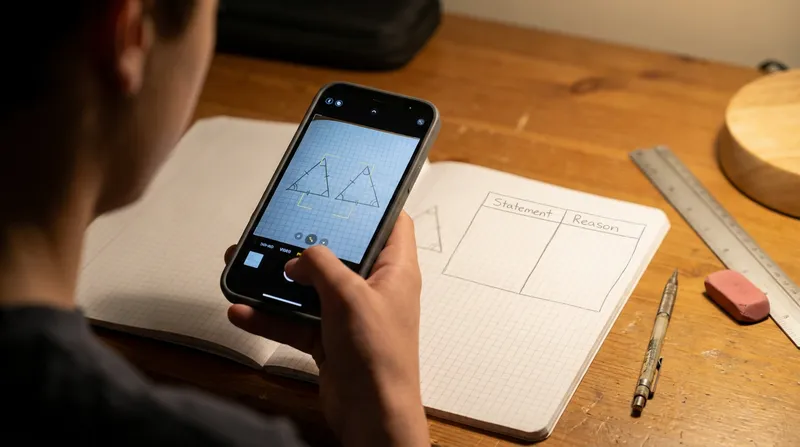
Introduction: Conquering the Blank Two-Column Proof Chart
We have all been there at 10 PM: you are staring at two triangles in your geometry textbook that clearly look identical, you know the "Given" information, and you know the "Prove" line at the bottom. Yet between Step 1 and the finish line sits an intimidating, blank Statements and Reasons table. You freeze because you have no idea which formal postulate, hidden diagram clue, or definition legally bridges the gap without costing you points for notation errors.
If you feel stuck, take a deep breath, because you are definitely not alone. Research by Sharon Senk, published in 1985 in NCTM's journal The Mathematics Teacher, found that only about 30% of students in full-year geometry courses that covered proof reached 75% mastery of proof writing, and about 29% could not write a single valid proof.
The good news is that you do not have to guess your way through high school geometry homework anymore. In this guide, you will learn how to use a step-by-step geometry proof solver to scan problems from a photo, decode hidden diagram markings, and master SSS, SAS, CPCTC, and parallel-line proofs with confidence.
Why Standard Math Scanners and Text Chatbots Fail at Geometry Proofs
When students first hit a wall with two-column proofs, their first instinct is usually to open a traditional math camera app or paste the question into a text chatbot.
Why does that often fall short? Many math camera apps are optimized for problems with a numeric answer, and deductive two-column proofs are a different kind of task. While equation scanners excel at reading linear equations like $3x + 5 = 20$ and solving for $x$, deductive geometry proofs do not ask for a number. They require tracing spatial relationships and building a logical sequence of statements and reasons. As we explain in our guide on why your child needs an adaptive AI math tutor beyond Photomath, fast numeric answers cannot teach the logical sequencing required in upper-level high school math.
Text-only chatbots struggle for a different reason:
- Typing symbols is exhausting: Manually finding and typing symbols like $\angle$, $\cong$, $\parallel$, and $\triangle$ on a phone keyboard wastes valuable study time.
- Diagrams hold silent clues: In high school geometry, half of the "Givens" are never written in the text prompt. They are drawn directly onto the figure as tick marks, angle arcs, right-angle boxes, or shared sides.
- Overlapping shapes confuse text models: Research indexed by ERIC found that many students explain sound reasoning out loud but leave it out of their written two-column proofs, which creates logical gaps.
Breakthrough AI research from Google DeepMind published in Nature on AlphaGeometry demonstrated why standard language models struggle here: solving geometry proofs requires pairing neural pattern recognition with a symbolic deduction engine that understands spatial constructs. That is why step-by-step, photo-based help like Tutor AI's can be useful.
Actionable Check Before You Scan: Before you start any geometry problem, look at the final line of the prompt. If it says "Find $x$" or "Calculate $m\angle ABC$," you are doing an algebraic geometry problem. If it says "Prove $\triangle ABC \cong \triangle DEF$" or shows a two-column table, you need a deductive proof approach.
How to Solve Geometry Proofs from a Photo in 3 Simple Steps
With Tutor AI's "Snap. Solve. Learn." workflow, you can turn a confusing worksheet into a clear, step-by-step lesson in seconds. If you are new to scanning diagrams, check out our complete walkthrough on how to use an AI picture solver for STEM for extra camera tips.
Here is how to use Tutor AI by uploading an image of your geometry proof problem:
Step 1: Snap the Diagram, Givens, and Prove Statement Together
When you open Tutor AI, frame your camera shot so that the entire problem is in the photo. Make sure your photo captures:
- The "Given" and "Prove" text lines at the top or bottom of the problem.
- The entire geometric figure, including all corner letters (vertices) like $A, B, C, D$.
- Every small marking on the drawing, such as single or double tick marks on segments, arcs inside angles, or small arrows on parallel lines.
Step 2: Let AI Read the Problem and Notation
Once you snap the photo, Tutor AI's AI-powered image recognition reads the problem, including printed or handwritten text and math notation, and returns a step-by-step explanation.
Step 3: Review the Step-by-Step Explanation to Learn the Logic
Within seconds, Tutor AI returns a step-by-step explanation. Rather than just copying the steps into your notebook and moving on, use the "Cover and Guess" study trick when working through your two-column table:
- Place your thumb or a sticky note over the right-hand Reasons column on your worksheet or notes.
- Read Statement 1 and Statement 2, then look at your diagram and try to name the postulate or definition that justifies Statement 2.
- Uncover the step-by-step explanation in Tutor AI to check your reasoning.
Practicing this way pays off massively on test day. Research on Carnegie Mellon's Geometry Tutor, an intelligent tutoring system for geometry proofs, found that students who worked one-on-one with the tutor scored more than one standard deviation higher on a final proof test than students in classes taught by the same teacher without it.
The Visual Decoder Cheat Sheet: Translating Diagram Clues into Formal Reasons
The #1 reason students freeze right after writing down the "Given" in Step 1 is that they do not know what legal "Reason" unlocks Step 2. Under the Common Core State Standards for High School Geometry (HSG-CO), students are expected to prove theorems about lines, angles, and triangles using precise definitions and postulates.
Bookmark this Visual Decoder Cheat Sheet and keep it open next to your homework. Whenever you see one of these clues in the "Given" text or the diagram, you immediately know what to write in your next row:
| What You See in the Given or Diagram | What You Write in the Statements Column | What You Write in the Reasons Column |
|---|---|---|
| Word Clue: "$M$ is the midpoint of $\overline{AB}$" | $\overline{AM} \cong \overline{MB}$ | Definition of Midpoint |
| Word Clue: "Ray $\overrightarrow{BD}$ bisects $\angle ABC$" | $\angle ABD \cong \angle DBC$ | Definition of Angle Bisector |
| Word Clue: "$\overline{CD} \perp \overline{AB}$" (or a right-angle square box) | $\angle CDA$ and $\angle CDB$ are right angles; $\angle CDA \cong \angle CDB$ | Definition of Perpendicular Lines; All right angles are congruent |
| Diagram Clue: Two triangles share the exact same side $\overline{AC}$ | $\overline{AC} \cong \overline{AC}$ | Reflexive Property of Congruence |
| Diagram Clue: Two straight lines cross in an "X" (bowtie shape) | $\angle 1 \cong \angle 2$ | Vertical Angles Theorem (Vertical angles are congruent) |
| Diagram Clue: Parallel arrows ($\parallel$) with a "Z" or "N" corner pattern | $\angle 3 \cong \angle 4$ | Alternate Interior Angles Theorem |
| Diagram Clue: Parallel arrows ($\parallel$) with an "F" corner pattern | $\angle 5 \cong \angle 6$ | Corresponding Angles Postulate |
Actionable Rule: Pencil "S" and "A" Directly on Your Drawing. Every single time you write a congruent side in your Statements column, draw a matching tick mark and write a big letter S next to that segment on your worksheet diagram. Every time you prove a congruent angle, draw an arc and write a big letter A. Within three steps, the letters on your drawing will literally spell out the congruence postulate you need!
Mastering Triangle Congruence Proofs: SSS, SAS, ASA, AAS, and HL
To prove that two triangles are congruent, you never need to prove all three sides and all three angles are congruent. You only need three specific matching parts. Whether you are doing homework on your own or checking your work with a study tool, here are the five valid shortcuts:
- SSS (Side-Side-Side): All three pairs of corresponding sides are congruent.
- SAS (Side-Angle-Side): Two sides and the included angle between them are congruent.
- ASA (Angle-Side-Angle): Two angles and the included side between them are congruent.
- AAS (Angle-Angle-Side): Two angles and a non-included side are congruent.
- HL (Hypotenuse-Leg): In a right triangle, the hypotenuse and one leg are congruent.
How to Spot Included vs. Non-Included Angles and Sides
Confusing SAS with SSA, or ASA with AAS, is the most common mistake on high school geometry quizzes. How do you tell the difference between an "included" part and a "non-included" part?
Use the Two-Finger Tracing Trick right now on your paper:
- To test for an Included Angle (SAS): Place your left index finger on the first congruent side and your right index finger on the second congruent side. Slide both fingers toward the corner (vertex) where those two sides touch. If your proven angle sits right at that corner where your fingers meet, it is included, and you have SAS.
- To test for an Included Side (ASA vs. AAS): Place one finger on the first marked angle and another finger on the second marked angle. Look at the single line segment that connects those two corners directly. If the tick mark is on that connecting bridge segment, you have ASA. If the tick mark is on one of the other two sides outside that bridge, you have AAS.
Avoiding the SSA and AAA Traps (And When to Use HL Instead)
Teachers love putting SSA (Side-Side-Angle) and AAA (Angle-Angle-Angle) traps on multiple-choice and proof exams. Keep these two rules in mind:
- AAA never proves congruence: Having three matching angles only proves that two triangles are the same shape (similar triangles, $\sim$), not the same size. Think of a small equilateral triangle and a giant equilateral triangle: both have $60^\circ$ angles, but they are not congruent.
- SSA does not work (unless it is a right triangle): If the congruent angle is not pinched between the two congruent sides, the third side can swing inward or outward like a pendulum to form two completely different triangles.
- The HL Exception: If you trace your diagram and it spells out SSA, check immediately to see if the angle is a $90^\circ$ right-angle box! In a right triangle, SSA becomes valid and is called HL (Hypotenuse-Leg). Crucial grading tip: Before you write "HL" as your final Reason, your two-column proof must include a Statement line explicitly saying "$\triangle ABC$ and $\triangle DEF$ are right triangles" (Reason: Definition of a right triangle).
Worked Examples: Parallel Lines, Transversals, and CPCTC Step by Step
When high school teachers grade triangle congruence proofs step by step, they do not just look at your final line. Common Core's Standards for Mathematical Practice include Practice 3 (construct viable arguments) and Practice 6 (attend to precision), and many teachers grade proofs by checking that corresponding vertices are listed in matching order.
Additionally, as outlined in the open-source curriculum from LibreTexts, every single Statement in the left column must be paired with a justifiable Reason in the right column, and students must respect the difference between equal numerical measures ($AB = CD$) and geometric congruence ($\overline{AB} \cong \overline{CD}$). Skipping intermediate definition steps is the fastest way to lose points, a problem we break down in our article on why instant-answer AI apps cost you crucial method marks.
Let's walk through two classic homework proofs so you can see how parallel lines, transversals, and CPCTC proofs are structured in a table.
Example 1: Parallel Lines and Transversals Proof (The 'Z-Angle' Method)
Problem Setup: Imagine a parallelogram-like figure $ABCD$ split diagonally by segment $\overline{AC}$.
- Given: $\overline{AB} \parallel \overline{CD}$ and $\overline{BC} \parallel \overline{DA}$
- Prove: $\triangle ABC \cong \triangle CDA$
How to Spot the Clues: Take a highlighter and trace from $B$ to $A$, down the diagonal $A$ to $C$, and over from $C$ to $D$. Notice how that forms a sharp "Z" shape! The interior corners of that "Z" ($\angle BAC$ and $\angle DCA$) are Alternate Interior Angles.
| Step | Statements | Reasons |
|---|---|---|
| 1 | $\overline{AB} \parallel \overline{CD}$ and $\overline{BC} \parallel \overline{DA}$ | Given |
| 2 | $\angle BAC \cong \angle DCA$ (Angle) | Alternate Interior Angles Theorem (from $\overline{AB} \parallel \overline{CD}$) |
| 3 | $\overline{AC} \cong \overline{CA}$ (Included Side) | Reflexive Property of Congruence |
| 4 | $\angle BCA \cong \angle DAC$ (Angle) | Alternate Interior Angles Theorem (from $\overline{BC} \parallel \overline{DA}$) |
| 5 | $\triangle ABC \cong \triangle CDA$ | ASA (Angle-Side-Angle) Congruence Postulate |
Example 2: Multi-Step CPCTC Proof (Proving Parts After Triangles)
What if the "Prove" line does not have a triangle symbol ($\triangle$), and instead asks you to prove that two segments or two angles are congruent? That is your cue to use CPCTC (Corresponding Parts of Congruent Triangles are Congruent).
Problem Setup: Two triangles, $\triangle JKL$ and $\triangle MLK$, share base $\overline{KL}$.
- Given: $\overline{JK} \cong \overline{ML}$ and $\angle JKL \cong \angle MLK$
- Prove: $\overline{JL} \cong \overline{MK}$
Golden Rule of CPCTC: You can only write CPCTC after a line that proves the two triangles congruent.
| Step | Statements | Reasons |
|---|---|---|
| 1 | $\overline{JK} \cong \overline{ML}$ (Side) | Given |
| 2 | $\angle JKL \cong \angle MLK$ (Included Angle) | Given |
| 3 | $\overline{KL} \cong \overline{LK}$ (Side) | Reflexive Property of Congruence |
| 4 | $\triangle JKL \cong \triangle MLK$ | SAS (Side-Angle-Side) Congruence Postulate |
| 5 | $\overline{JL} \cong \overline{MK}$ | CPCTC (Corresponding Parts of Congruent Triangles are Congruent) |
A Parent's Guide: Supporting Geometry Homework Without Doing It for Them
If you are a parent sitting at the kitchen table at 9:30 PM trying to remember what "CPCTC" or "Alternate Interior Angles" means after 20 years, we see you. High school geometry looks very different from the math we use in everyday adult life, and hiring a private specialist is not always realistic, especially when you look at how much a math tutor costs in 2026, where private tutoring can cost far more than an app subscription.
You do not need to memorize geometry postulates yourself to help your teen get unstuck. Instead, ask these 3 Kitchen-Table Coaching Questions:
- "Did you write down all the Givens on Line 1 and mark them on the drawing?" (Getting the first line down breaks the blank-page anxiety and earns guaranteed partial credit.)
- "Are the two triangles touching or crossing each other?" (If they share a wall, remind your teen to check for the Reflexive Property; if they cross like an X, tell them to look for Vertical Angles.)
- "Does the Prove line ask for whole triangles ($\triangle$) or just one piece?" (If it asks for one piece, remind them that they need to prove the triangles congruent first, then finish with CPCTC.)
To make sure your teen uses AI to build real test-day skills rather than just copying a chart before bedtime, Tutor AI includes built-in progress tracking and family visibility. You can read more about how this works in our guide on why your teen's AI math tutor needs a parent dashboard to stop the scan-and-copy habit.
Conclusion: Snap, Solve, and Master Geometry Proofs Tonight
Staring at a blank two-column proof table does not have to ruin your evening. Once you realize that high school geometry proofs are just 4-to-6 step puzzles built from a handful of visual clues (and once you know how to mark your diagram with S and A), the fear of the blank chart disappears.
Whenever you hit a roadblock between the "Given" and the "Prove" line, Tutor AI is ready 24/7 to help you bridge the gap. Simply Snap. Solve. Learn.: take a photo of your geometry problem, explore the step-by-step breakdown, and build the confidence you need to ace your next geometry exam. Try Tutor AI today on iOS or Android!
Note: Every student learns differently. While these strategies are research-backed, results may vary. Adapt these techniques to fit your unique learning style and circumstances.
Frequently Asked Questions
Can AI solve geometry proofs from a photo?
Yes. Unlike older equation calculators that only read numbers, a modern AI math tutor like Tutor AI can scan a photo of your geometry problem, including printed or handwritten text and math notation, to give you a step-by-step explanation.
How do you start a two-column proof in geometry when you are stuck?
Always start by copying the "Given" information into Line 1 of the Statements column and writing "Given" in the Reasons column. Next, mark those given parts directly on your diagram with an S (Side) or A (Angle). Then, look for any vocabulary words in the Given (like midpoint or bisects) and check the drawing for a shared side (Reflexive Property) or an X-intersection (Vertical Angles).
When should you use CPCTC in a geometry proof?
You should only use CPCTC (Corresponding Parts of Congruent Triangles are Congruent) after you have already proven that two triangles are congruent using SSS, SAS, ASA, AAS, or HL. In most high school two-column proofs, CPCTC is used on a line following a $\triangle ABC \cong \triangle DEF$ statement.
Why can't you use SSA or AAA to prove triangles are congruent?
AAA only proves that two triangles have the same shape (similar triangles), not the same side lengths. SSA fails because when the known angle is not locked between the two known sides, the third side can swing between two different locations, unless the triangle has a $90^\circ$ right angle, in which case you use the HL (Hypotenuse-Leg) theorem.
What is the difference between equal (=) and congruent (≅) in two-column proofs?
Use the equals sign ($=$) when comparing numbers or measurements, such as segment lengths ($AB = CD$) or angle degrees ($m\angle A = m\angle B$). Use the congruent symbol ($\cong$) when comparing physical geometric shapes, such as segments ($\overline{AB} \cong \overline{CD}$), angles ($\angle A \cong \angle B$), or triangles ($\triangle ABC \cong \triangle DEF$). When switching from one to the other in a proof, your Reason is "Definition of Congruence."