
It is 10 PM on a Tuesday. Your teenager is staring at a worksheet full of algebra problems. In a moment of frustration, they pull out their phone, snap a picture with an app like Photomath, and copy down the answer. The homework is done in five minutes. But fast forward to Friday's math exam, and they fail.
This is the core pain point millions of families face today. Students use math apps that explain steps to finish their homework quickly, but they bomb their exams because they never actually learned the underlying concepts or identified their specific weak spots.
While tools like Photomath, Mathway, and Brainly have revolutionized how students access homework help, they often act more like digital calculators than actual teachers. They provide the destination but fail to teach the journey. If you want your child to build real confidence and achieve lasting academic success, they need more than a quick fix. They need an adaptive AI math tutor.
What is Photomath and How Does it Work?
Before we dive into alternatives, it helps to understand the technology we are moving beyond. Photomath is a popular AI math solver with steps that allows students to scan a math problem using their smartphone camera. Using optical character recognition (OCR) and basic artificial intelligence, the app instantly reads the equation and generates a detailed, mechanical breakdown of the solution.
It is undeniably impressive technology. For a student stuck on a basic arithmetic or algebra problem, it provides an immediate way to get unstuck. However, the way students interact with this technology is often counterproductive to real learning.
Actionable Tip: Take a look at how your teen uses their smartphone during study time. If they are scanning every single problem before even attempting to solve it on paper, they are likely using the app as a crutch rather than a learning tool.
The Pros and Cons of AI Math Solvers
When evaluating any math homework helper AI, it is important to weigh the benefits against the drawbacks.
The Pros of Standard Math Solvers
- Instant Access: Students do not have to wait for a teacher or a human tutor to become available.
- No Typing Required: Scanning complex equations is much faster than trying to type fractions and exponents into a keyboard.
- Step-by-Step Visibility: They show the mechanical process of getting from point A to point B.
The Cons of Standard Math Solvers
- The Illusion of Competence: Reading a solution and understanding a solution are two very different things. Students often think they understand the math because the steps make sense when they read them, but they cannot replicate the process on their own.
- Zero Adaptability: Standard solvers treat every student exactly the same. They do not know if your child struggles with fractions, negative numbers, or order of operations.
- No Conceptual Sensemaking: According to the National Council of Teachers of Mathematics (NCTM), while tools like Photomath can assist with basic computations, they cannot generalize patterns or build conceptual understanding. They calculate, but they do not teach.
Actionable Tip: The next time your child uses a step-by-step math solver free of charge, ask them to explain the final step back to you out loud. If they cannot articulate why the app did what it did, they have not truly learned the concept.
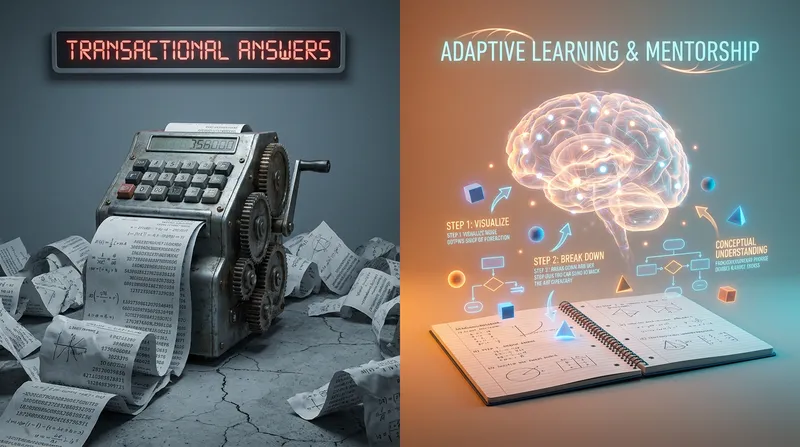
The Hidden Cost of Fast Answers: Why Step-by-Step Math Solutions Are Not Enough
The biggest danger of relying on apps like Photomath is the impact on exam performance. When homework becomes an exercise in copying rather than problem-solving, test anxiety skyrockets. Students sit down for their finals, stare at a blank page without their phone, and panic.
Research published in the Proceedings of the National Academy of Sciences (PNAS) provides hard data on this phenomenon. The study found that students using a standard AI answer generator experienced a 17% reduction in grades when the tool was removed. Conversely, students using an AI tutor designed to provide hints instead of direct answers saw significant performance improvements.
Furthermore, high-level courses require students to show their unique work. Graders look for logical progression, not just the correct final number. A static solver app will often use complex, convoluted methods that a human teacher would never teach, instantly flagging to the grader that the student did not do the work themselves.
Actionable Tip: Shift the focus in your household from "getting homework done" to "understanding the material." Praise your child for wrestling with a tough problem for ten minutes, even if they get it wrong, rather than finishing a worksheet perfectly in two minutes using an app.
Photomath vs Mathway Alternatives: The Rise of Adaptive Learning Math Platforms
If standard apps are failing our students, what is the solution? The answer lies in the shift from static solvers to adaptive learning math platforms.
Competitors like Mathway, Chegg, and Brainly offer massive databases of answers. But they still fall into the trap of being transactional: the student inputs a problem, and the platform outputs a solution.
| Feature | Photomath / Mathway | Adaptive AI Tutor |
|---|---|---|
| Gives instant answers | Yes | No (Provides hints) |
| Identifies weak spots | No | Yes |
| Adapts to learning style | No | Yes |
| Explains the "Why" | No | Yes |
An AI tutor for middle and high school math operates differently. It uses conversational AI and Socratic questioning to guide the student to the answer. Instead of saying, "Here is how you solve for X," an adaptive tutor asks, "What do you think our first step should be to isolate X?"
A recent study from Stanford University demonstrates the value of this approach. Students whose tutors used an AI assistant that suggested guiding questions (rather than just explaining the steps) were up to 9 percentage points more likely to master the topic.
Actionable Tip: When testing a new homework app, intentionally input a wrong step. See how the app reacts. If it simply overwrites your answer with the correct one, it is a calculator. If it gently corrects you and explains why your logic was flawed, it is a tutor.
4 Reasons the Best Alternative to Photomath is an Adaptive AI Tutor
If you are looking for the best alternative to Photomath, you need a platform built around genuine comprehension. Here are four reasons why an adaptive AI math tutor is the superior choice for your family.
1. It Identifies Math Weak Spots Automatically
Math is cumulative. If your child misses a core concept in 7th-grade pre-algebra, they will struggle in 9th-grade geometry. Standard apps solve the problem in front of them, but an adaptive AI tutor analyzes patterns in your child's mistakes. It can actively identify math weak spots and alert the student that they need to review foundational concepts.
2. It Acts as a Personalized Math Practice Generator
Once a weak spot is identified, what comes next? An AI tutor can instantly generate a customized practice set targeting that exact deficiency. This dynamic generation of personalized practice problems ensures that study time is spent efficiently. This aligns perfectly with the science of learning, allowing students to effectively Use the Active Recall Study Method in High School rather than passively rereading textbook chapters.
3. It Prevents the "Scan and Copy" Habit
To truly learn, students must be allowed to fail safely. A randomized experiment by researchers from the University of Toronto and Wharton, involving more than 6,000 middle schoolers, found that students learned more math when an AI tutor walked them through their mistakes and then required them to demonstrate the same skill correctly three times in a row before moving on. By withholding the final answer until the student proves they understand the steps, an AI tutor breaks the cycle of academic dependency. Daily streaks and achievement badges also give students a reason to return and practice independently.
4. It Gives Parents True Peace of Mind
Most parents cannot remember how to factor polynomials or solve quadratic equations. When your child asks for help at 9 PM, it usually ends in frustration for everyone. An AI tutoring app bridges this gap. And unlike scheduling a human tutor, an AI app is available 24/7, even offering offline problem-solving capabilities for late-night homework emergencies. More importantly, platforms designed for families include tracking features. As we explore in our article Stop the Scan-and-Copy: Why Your Teen's AI Math Tutor Needs a Parent Dashboard, giving parents visibility into their child's progress transforms the homework dynamic from adversarial to supportive.
Actionable Tip: Sit down with your teen and incorporate 15 minutes of dedicated "weak spot review" using an adaptive tutor before they start their regular homework assignments.
How to Choose the Right AI Math Tutor for Middle and High School
With so many apps flooding the market, how do you choose the right one? Look for these core features:
- Conversational Interface: The app should talk to your child, asking questions and offering hints before giving away the answer.
- Subject Breadth: The best platforms extend beyond algebra to cover physics, chemistry, and biology, so one app can serve your child across all their STEM courses.
- Parental Visibility: You need to see exactly where your child is struggling so you can offer the right support.
- Curriculum Alignment: Ensure the app explains concepts using methods taught in US schools, rather than obscure mathematical shortcuts.
- Photo-Based Input: It should still offer the convenience of snapping a picture, but pair it with deep learning.
Actionable Tip: Download TutorAI and have your child test it alongside their current math app. Ask them which one makes them feel more prepared for their next quiz.
Frequently Asked Questions
What is the best alternative to Photomath?
The best alternative to Photomath is an adaptive AI math tutor. While standard solver apps simply act as digital calculators that give away the final answer, an adaptive AI tutor actively guides students through the problem-solving process. It identifies specific weak spots and generates personalized practice to ensure long-term retention rather than just a quick homework fix.
Is there a free AI math solver with steps that actually teaches?
Yes, many adaptive learning math platforms offer free tiers that go beyond basic answers. TutorAI provides basic problem solving and access to core features for free, allowing students to experience step-by-step explanations that focus on deep comprehension and Socratic questioning rather than just outputting a final number.
How do AI math tutors prevent students from cheating?
Unlike basic solver apps that spit out instant answers to be copied, true AI tutors act like human teachers. They use conversational AI to provide hints, require the student to engage with the steps, and withhold the final solution until the student demonstrates understanding. Additionally, they offer progress reports to parents to ensure genuine learning is taking place.
Can an AI app help identify my math weak spots?
Absolutely. Advanced platforms track a student's accuracy across different topics over time. If a student consistently struggles with fractions inside algebraic equations, the AI will flag this specific weak spot and generate targeted practice problems to help build that foundational skill before moving on to harder concepts.
What is the difference between Mathway and an adaptive AI math tutor?
Mathway is highly transactional: you type in a problem, and it gives you the solution. An adaptive AI math tutor is fully interactive. It tracks your learning progress, adapts to your specific learning style, provides hints instead of just answers, and focuses on building your long-term academic confidence so you can overcome test anxiety.
Conclusion: Empowering Independent Learners
The era of using a smartphone just to copy down math answers is ending. As education evolves, we must equip our students with tools that build their brains, not just finish their worksheets. By transitioning from basic apps like Photomath to an adaptive AI math tutor, you are giving your child the gift of true understanding.
They will no longer fear the blank page of a math exam. They will have the confidence to tackle complex problems, knowing they have mastered the underlying concepts.
Ready to transform homework time from a nightly battle into a moment of genuine growth? Download TutorAI free today (no credit card required) and experience the difference of an app that says: Snap. Solve. Learn.
Disclaimer: Every student learns differently. While these strategies are research-backed, results may vary. Adapt these techniques to fit your unique learning style and circumstances.