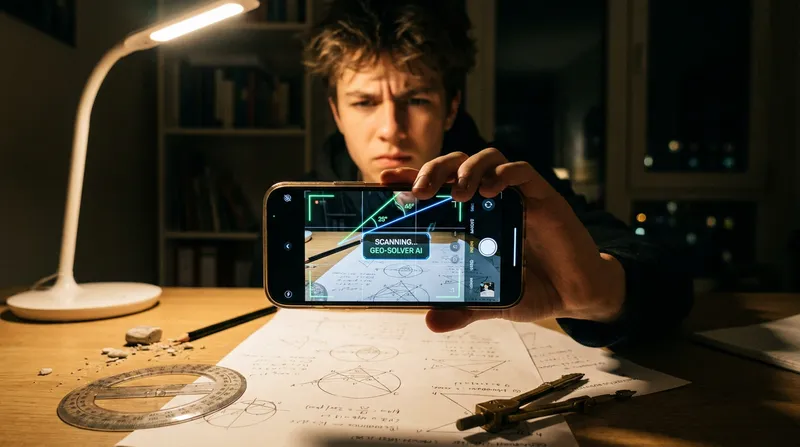
It is 10 PM on a Tuesday night. Your child is staring at a geometry worksheet filled with intersecting lines, shaded triangles, and mysterious tick marks. Wanting to help, you pull out your phone, snap a photo of the problem, and upload it to a popular AI chatbot like ChatGPT. Within seconds, the AI spits out a highly confident, detailed answer.
There is just one problem: the answer is completely wrong.
If you have ever tried to solve geometry homework from a photo using standard AI tools or basic math scanners, you have likely run into this exact frustrating scenario. Students and parents are realizing that while regular AI tools can easily solve basic algebra equations, they completely fail to understand geometric diagrams, spatial relationships, and the logical steps required for high school geometry.
So, why does this happen? And more importantly, how can you find an AI geometry solver that actually works?
In this comprehensive guide, we will explain exactly why standard text-based AI struggles with spatial math, how specialized vision-based AI geometry solvers are fixing the problem, and how your family can use these tools to reduce homework stress and boost academic confidence.
The Core Problem: Why Regular Math Scanners Fail at Geometry
To understand why your go-to AI fails at geometry, we first need to look at how most math scanner apps work.
Most popular homework apps were built for algebra. They use a technology called Optical Character Recognition (OCR) to read text and standard math symbols. If you point a basic math scanner at an equation like "2x + 4 = 10", the OCR reads the numbers and letters, feeds them into a calculator, and gives you an answer.
Geometry is an entirely different language.
Geometry is not just about numbers on a page. It is about visual relationships. A standard OCR math solver cannot "see" the tiny square in the corner of a triangle that indicates a 90-degree angle. It cannot interpret the small parallel tick marks on two separate lines. It does not understand that a line intersecting two parallel lines creates alternate interior angles.
When standard AI tools encounter these visual elements, they simply ignore them. This is why you need to know how to use an AI photo math solver for step-by-step homework help that is specifically designed for complex visual inputs.
ChatGPT's Blind Spot: Spatial Reasoning Explained
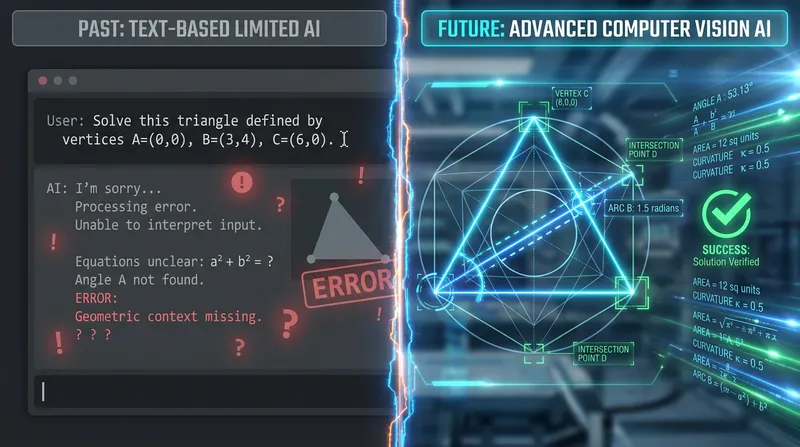
How LLMs Process Images
Large Language Models (LLMs) like ChatGPT are incredible at processing text. They work by predicting the next logical word in a sentence based on massive amounts of written data. However, they do not have "eyes" in the way we do.
When you upload an image of a geometry problem to a standard multi-modal LLM, the AI tries to translate the visual image into text descriptions. If the diagram is complex, the translation fails. The AI will then "hallucinate" (make up) an answer based on the text prompt rather than the actual visual data.
What the Research Shows
This is not just a theory. Recent evaluations by researchers at the Hugging Face MathVerse Benchmark found that Multi-modal Large Language Models often rely heavily on textual clues rather than truly understanding visual diagrams. When the text in a problem does not explicitly state all the geometric properties, the AI simply guesses.
Furthermore, academic studies published on arXiv explain that geometry mathematics problems pose significant challenges for large language models. These problems involve complex visual elements and spatial reasoning that standard text-based awareness cannot process accurately.
In short: asking a text-based AI to solve a complex geometry diagram is like asking someone to navigate a maze while blindfolded.
The Vision-First Approach: How AI That Reads Math Diagrams Actually Works
If standard AI cannot solve geometry, what is the solution? The answer lies in a specialized technology called neuro-symbolic AI.
A true AI geometry solver does not just try to read text. It uses advanced computer vision to actively map out shapes, lines, and angles. Once the computer vision identifies the visual elements (the "neural" part), it hands that data over to a strict mathematical logic engine (the "symbolic" part) to calculate the answer.
This exact approach was validated by industry leaders at Google DeepMind. Their AlphaGeometry project solved 25 out of 30 Olympiad geometry problems by combining a neural language model with a symbolic deduction engine, bypassing the limitations of standard AI.
When you use a dedicated visual math AI, the app is doing several things instantly:
- Scanning the photo for geometric shapes (circles, polygons, intersecting lines).
- Identifying specific notation markers (congruency ticks, parallel arrows, right-angle squares).
- Reading the accompanying text or word problem.
- Combining the visual data and text data to form a complete mathematical understanding.
- Generating a step-by-step geometry solver breakdown that actually makes logical sense.
Tackling the Hardest Part of High School Math: AI for Two-Column Proofs
For many high school students, the transition from algebra to geometry is incredibly jarring. Algebra is about finding the value of "x". Geometry is often about proving why something is true.
Two-column proofs are the ultimate test of logical deduction. Students must list a statement on the left side and the corresponding mathematical reason (like "Alternate Interior Angles Theorem" or "Side-Angle-Side Congruence") on the right side.
Standard math calculators fail miserably at this. If you type a proof question into a basic calculator, it will likely return an error message.
This is where a dedicated geometry math solver becomes a game-changer. An app that solves geometry word problems and proofs must understand the logical progression of theorems. A vision-based tool is designed to assist with these logical deductions. When a student snaps a photo of a proof, the AI helps map out the logical sequence required to prove the statement, serving as a perfect geometry app that shows work.
Solving the Geometry Word Problem Puzzle
Geometry word problems present a unique challenge because they require the student to translate a paragraph of text into a mental image, and then apply mathematical formulas to that image.
Basic word problems are easy, but high school geometry takes it further. For example: "In a diagram where two parallel lines are cut by a transversal, if one interior angle is 45 degrees, what is the measure of the alternate interior angle?"
To solve this, a student must visualize the intersecting lines, recall the properties of transversals, and apply the correct theorem.
When students struggle with these translations, a specialized geometry word problem solver can bridge the gap. It breaks down the text, explains the hidden geometric shapes within the scenario, and walks the student through the formula step-by-step. This deep comprehension approach is much more effective than rote memorization.
How to Solve Geometry Homework from a Photo Using Tutor AI
If you are ready to move past the frustration of hallucinating chatbots and basic calculators, here is how you can use a specialized geometry calculator photo tool to actually learn the material.
Step 1: Capture a Clear Image Make sure the entire geometry diagram, including all text, tick marks, and labels, is visible in the frame. Good lighting helps the OCR math solver accurately read small details.
Step 2: Review the Step-by-Step Breakdown Tutor AI does not just hand over the final answer. It acts as a geometry app that shows work. Read through each step carefully. The AI will explain which theorems are being applied and why.
Step 3: Practice Similar Problems Once the AI geometry solver explains the concept, try solving the next problem on the worksheet independently. Use the AI only to check your work or if you get completely stuck. Previously solved problems are saved in the app, so your child can review them later even without an internet connection.
Step 4: Track Your Progress For parents, Tutor AI offers progress tracking. You can see which specific geometry topics your child is struggling with, allowing you to provide targeted support without doing the homework for them. This is a crucial strategy for managing middle school homework struggles.
Actionable Tips for Parents: Helping Your Child with Geometry
As a parent, you do not need to remember high school geometry to help your child succeed. Here are practical ways you can support their learning using modern tools.
Focus on the Process, Not the Answer When your child uses an AI that reads math diagrams, sit with them and ask them to explain the AI's steps back to you. Teaching a concept to someone else is one of the most effective ways to solidify understanding. As App Store reviewers have put it, the app is "like having a tutor right there with you," and one wrote "no more tears over math homework!"
Manage Math Anxiety Geometry can trigger severe test anxiety because it looks so different from basic math. Remind your child that spatial reasoning is a skill that takes time to develop. If they are feeling overwhelmed before a big test, review resources on how to overcome high school test anxiety together.
Prepare for the Future Building a strong foundation in geometry is critical for upper-level math and standardized tests. The spatial reasoning skills learned now will directly impact their performance on college entrance exams.
Frequently Asked Questions
Can ChatGPT solve geometry problems from a picture?
While ChatGPT and similar large language models can process images, they frequently fail at complex geometry. They rely on text prediction rather than true spatial reasoning. When a diagram includes unstated visual assumptions, intersecting transversals, or hidden shapes, standard AI often guesses or hallucinates the wrong answer.
What is the best AI app for solving geometry?
The best AI for geometry must utilize a vision-first approach. Apps like Tutor AI use computer vision to recognize the whole problem from a photo and focus on step-by-step explanations rather than just a final answer, which makes them a better fit for homework than a general-purpose chatbot.
How do you solve a geometry word problem using AI?
To solve a geometry word problem effectively, use a specialized visual math AI. Simply snap a photo of the text. The AI will identify the geometric concepts hidden in the words, translate them into the correct mathematical formulas, and provide a detailed, step-by-step solution.
Can AI write a two-column geometry proof?
Basic math scanners and standard calculators cannot write proofs, but advanced neuro-symbolic AI can assist with them. Specialized geometry solvers are equipped with logic engines designed to map out the step-by-step logical deductions and theorems required for high school two-column proofs.
Why do regular math scanners fail at geometry?
Regular math scanners use basic Optical Character Recognition (OCR) designed to read linear text and basic algebra equations. They cannot interpret spatial relationships, shapes, or diagram-specific symbols like parallel line markers and congruency ticks.
Is there an app that reads math diagrams and shows the work?
Yes. A dedicated visual AI functions as a complete step-by-step geometry solver. It reads the visual diagram directly from a photo and breaks down the exact mathematical steps and theorems used to reach the solution, ensuring students actually understand the process.
Conclusion: Empowering Your Child's Math Journey
Watching your child struggle with geometry homework late at night is stressful for the whole family. While standard AI chatbots and basic math scanners might seem like a quick fix, their inability to process spatial diagrams often leads to more confusion and incorrect answers.
Geometry requires a different kind of thinking, and it requires a different kind of tool. By utilizing a vision-based AI geometry solver, you give your child access to a 24/7 tutor that actually understands the visual complexities of shapes, proofs, and word problems.
Do not let your child rely on guessing games. Equip them with a geometry app that shows work, explains the concepts clearly, and builds genuine academic confidence. Snap. Solve. Learn.
Ready to transform homework time from a nightly battle into a productive learning session? Download Tutor AI free on iOS and Android today and experience the difference of true visual math AI.
Note: Every student learns differently. While these strategies are research-backed, results may vary. Adapt these techniques to fit your unique learning style and circumstances.