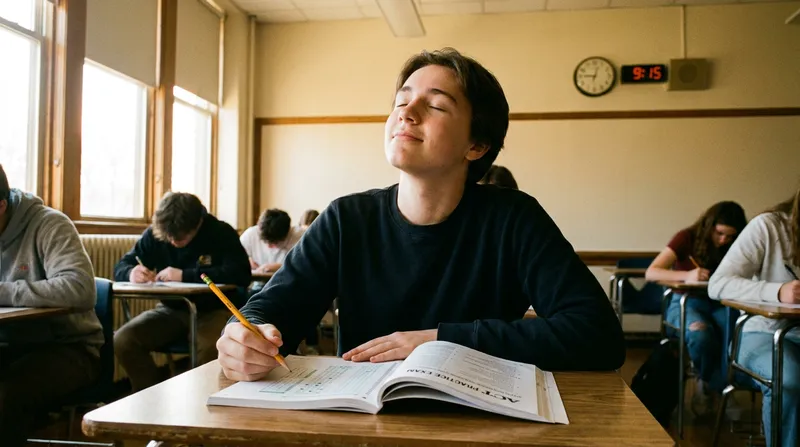
Picture this: It is 9 PM on a Tuesday. You are studying for a massive AP exam. You feel completely prepared. You have reviewed your notes, checked your answers online, and you know the material inside and out. But the next morning, when you sit down at your desk and the teacher hands out the test, something terrifying happens. The safety net of your study aids is gone, your heart starts racing, and your mind goes completely blank.
If this sounds familiar, you are experiencing a core problem that millions of students face today. You know the material while studying at home, but you freeze up and fail during the actual exam because you lack the self-regulation skills needed when digital safety nets are removed. This is the reality of high school test anxiety.
In this comprehensive guide, we will explore how to overcome high school test anxiety using proven, science-backed strategies. Whether you are a student looking for test anxiety coping skills or a parent searching for how to help a teenager with test anxiety, this article covers everything you need to know. We will dive into managing academic stress in high school, specific SAT test anxiety tips, AP exam stress management, and how to calm nerves before a test. Let us break down the science of why your brain panics and how you can take back control.
Key Takeaways
- Understand the Biology: Test anxiety is a biological fight-or-flight response that causes "cognitive interference," temporarily blocking your ability to remember facts.
- Break Passive Study Habits: Relying on simple answer-checking at home creates panic during device-free exams. Build resilience through active problem-solving.
- Regulate Your Nervous System: Learn actionable techniques like box breathing and the 5-4-3-2-1 grounding method to calm physical anxiety symptoms in real-time.
- Support for Parents: Parents can help by acting as a calming presence, praising the study process over the final grade, and providing independent learning tools.
Understanding High School Test Anxiety: Why Your Mind Goes Blank
Test anxiety is not just a fancy term for being nervous. According to the American Psychological Association, test anxiety is categorized as a specific form of performance anxiety. It occurs when the pressure to succeed becomes so overwhelming that it actively impairs your ability to perform.
When you experience test anxiety triggers in teens, your body enters a "fight-or-flight" state. Your brain perceives the exam as a literal threat to your survival. This triggers a cascade of stress hormones. Research from the University of Calgary explains that this intense worry creates "cognitive interference." Essentially, the anxiety takes up so much space in your working memory that you literally do not have enough brainpower left to remember the facts you studied. This is exactly why a student can study for hours, master the material, and still fail the test.
Normal stress can actually be helpful. A little bit of adrenaline keeps you alert and focused. Test anxiety, however, is paralyzing. Overcoming fear of failure in high school requires understanding this biological response so you can stop blaming yourself for "not studying hard enough" and start addressing the root cause: an unregulated nervous system.
Physical Symptoms vs. Mental Symptoms of Test Anxiety
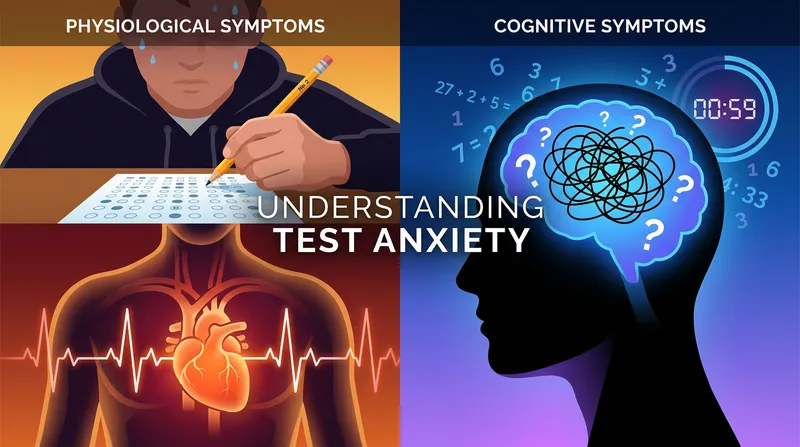
To effectively manage test anxiety, you first need to recognize how it shows up in your body and mind. Test anxiety strategies for students must address both the physical and the cognitive symptoms.
Physical Symptoms of Test Anxiety
When your body goes into survival mode, it prepares to run away or fight. Because you cannot do either of those things in a classroom, the physical energy gets trapped. Common physical symptoms include:
- Rapid heartbeat or palpitations
- Sweating, especially in the palms
- Shallow, rapid breathing or shortness of breath
- Nausea, stomach aches, or digestive issues
- Muscle tension in the neck, shoulders, and jaw
- Shaking or trembling hands
Mental Symptoms of Test Anxiety
The psychological effects are just as intense. The University of Texas at Dallas notes that the mental component of test anxiety involves severe problems with attention and memory. Mental symptoms include:
- The dreaded "mind going blank" phenomenon
- Racing thoughts and catastrophic thinking (for example, "If I fail this test, I will not get into college")
- Difficulty concentrating or reading the same question multiple times without understanding it
- Negative self-talk and intense fear of judgment from parents or peers
Overcoming the Passive Learning Trap
In the modern digital age, students have access to incredible homework solvers. Tools that instantly scan and solve math problems are incredibly popular. However, there is a hidden danger here when it comes to passive learning.
When students rely exclusively on passive answer-checking to do their homework, they never experience the productive struggle of getting stuck and figuring a problem out. They feel confident at home because the answer is always a click away. But when they walk into an SAT, ACT, or AP exam where digital aids are banned, that safety net vanishes. The sudden removal of this crutch triggers massive panic.
This is why managing academic stress in high school requires a shift in how we learn. Instead of using tools that just spit out the final answer, students need resources that teach them how to think. This is the core philosophy behind Tutor AI. With our "Snap. Solve. Learn." approach, Tutor AI acts as a 24/7 personalized tutor. It provides detailed, step-by-step explanations so students understand the "why" behind every step, building genuine academic confidence that translates to the exam room.
If you are struggling with math panic, you can learn more about how an AI math tutor eases middle school math anxiety. By learning the process rather than just copying the result, you build the mental resilience needed to overcome the fear of failure.
Science-Backed Strategies to Calm Nerves Before a Test
Knowing the material is only half the battle. The other half is nervous system regulation. If you want to know how to calm nerves before a test, you need actionable, science-backed test anxiety coping skills.
1. Practice Box Breathing
When you panic, your breathing becomes shallow, which tells your brain that you are in danger. You can reverse this by intentionally slowing your breath. Box breathing is a technique used by professionals to stay calm under intense pressure. Inhale for four seconds, hold for four seconds, exhale for four seconds, and hold empty for four seconds. Repeat this four times before you turn over your test paper.
2. Engage the Vagus Nerve
Your vagus nerve controls your parasympathetic nervous system, which is responsible for resting and digesting. You can stimulate it to instantly lower your heart rate. Simple techniques include splashing cold water on your face in the restroom before the exam, humming quietly to yourself, or taking slow, deep belly breaths right before the test begins.
3. Progressive Muscle Relaxation
The Mayo Clinic recommends progressive muscle relaxation and regular aerobic exercise to counteract the physical tension of test anxiety. Before the exam starts, tightly squeeze the muscles in your toes for five seconds, then release. Move up to your calves, your thighs, your stomach, and all the way up to your shoulders. This forces your muscles to release trapped tension.
4. Use Mindfulness for Test Anxiety
Mindfulness trains your brain to stay in the present moment rather than catastrophizing about the future. If you feel yourself spiraling during a test, use the 5-4-3-2-1 grounding method. Silently name five things you can see, four things you can physically feel (like your feet on the floor), three things you can hear, two things you can smell, and one thing you can taste. This interrupts the anxiety loop and brings your focus back to the paper in front of you.
SAT and AP Exam Stress Management
High-stakes tests like the SAT, ACT, and AP exams bring a unique level of pressure. SAT test anxiety tips and AP exam stress management require specialized preparation because these tests measure endurance as much as knowledge.
Simulate the Testing Environment (Practice Simulation)
Psychologists often use systematic desensitization to help people overcome fears. While formal exposure therapy is a clinical treatment administered by professionals, you can use similar practice simulation techniques for test anxiety. The best way to prevent the shock of a device-free exam is to practice in a device-free environment.
When you take practice tests, do not listen to music, do not check your phone, and strictly enforce the time limits. Sit at a hard desk, not on your bed. This is where tools like Tutor AI's offline mode become incredibly useful, allowing you to access previously saved problems and step-by-step breakdowns without the distraction of an active internet connection. Start by taking short, 15-minute quizzes at home under strict conditions. Gradually increase the time to full-length practice exams. Over time, your brain will learn that the testing environment is safe, reducing the intensity of the fight-or-flight response.
Use the "Two-Pass" Strategy
During a timed exam, getting stuck on a difficult question can cause your anxiety to spike, ruining your pacing for the rest of the test. Use the two-pass method. On your first pass, answer every question you know immediately. Skip anything that takes more than a minute to figure out. On your second pass, return to the harder questions. This guarantees you secure all the easy points and builds your confidence early on.
For specific subject help, check out our guide on how to use an AI math solver to master AP Calculus and SAT Math practice exams.
Test Prep Routines for Anxious Students
A chaotic study schedule breeds a chaotic mind. Test prep routines for anxious students must be highly structured to eliminate the unknown. Follow these four key steps to build a routine that minimizes stress:
- Implement Active Recall and Spaced Repetition: Re-reading notes is a passive study method that creates a false sense of security. Instead, use active recall. Close your book and try to explain the concept out loud. This forces your brain to retrieve the information, which is exactly what you will have to do on the test. Pair this with spaced repetition, reviewing the material over several days rather than cramming the night before. Read more about how to use the active recall study method in high school.
- Prioritize Sleep Over Cramming: The Mayo Clinic highlights that sleep is directly related to academic performance. Pulling an all-nighter spikes your cortisol levels, ensuring you will be highly anxious the next day. A well-rested brain can navigate difficult questions and regulate emotions far better than a sleep-deprived one.
- Fuel Your Brain Properly: What you eat before a test directly impacts your cognitive function. Avoid high-sugar energy drinks or excessive caffeine, which can mimic the physical symptoms of anxiety (like a racing heart) and trigger a panic response. Instead, focus on protein-rich foods and complex carbohydrates that provide sustained energy.
- Create a Step-by-Step Study Schedule: Break your studying down into tiny, manageable chunks. If you have a final exam in a week, do not just write "Study Math" on your calendar. Write "Tuesday: Complete 15 Algebra practice problems using Tutor AI." If you need help organizing your time, we have a complete guide on how to create a study schedule for high school.
How Parents Can Help Anxious Teens
If you are wondering how to help a teenager with test anxiety, the most important thing to remember is that you must act as a co-regulator. Anxiety is contagious, but so is calm.
Focus on the Process, Not the Outcome
Many teens develop test anxiety because they feel their worth is tied to their grades. Shift the conversation away from the final score. Instead of asking, "What grade did you get?", ask, "How do you feel about the effort you put into studying?" Praise their persistence, their study habits, and their resilience.
Provide the Right Tools Without Doing the Work
Parents often feel helpless when their teen struggles with advanced high school subjects. You might not remember how to balance chemical equations or solve quadratic formulas, and that is perfectly fine. Instead of trying to teach them yourself (which often leads to frustration and arguments), provide them with tools that foster independent learning.
Tutor AI is a great resource for families. It offers a dedicated parent dashboard where you can track your child's daily practice, identify their weak spots, and celebrate their progress without hovering over their shoulder. This allows teens to take ownership of their learning while giving parents peace of mind. For more advice on navigating this dynamic, read our post on middle school homework struggles and how to help without doing it for them.
Validate Their Feelings and Know When to Seek Help
Never tell an anxious teen, "It is just a test, do not worry about it." To them, it feels like a life-or-death situation. Validate their stress by saying, "I can see how overwhelmed you are, and it makes sense that you are stressed because you care about your future. Let us take a deep breath together and figure out a plan."
Additionally, if test anxiety is significantly disrupting your teen's daily life, sleep, or overall mental health, please reach out to a school counselor or licensed therapist for professional support.
Frequently Asked Questions About Test Anxiety
What are the most common physical symptoms of high school test anxiety?
When a student experiences test anxiety, their body triggers a fight-or-flight response. The most common physical symptoms include a rapid heartbeat, excessive sweating (especially in the palms), shallow breathing, muscle tension in the neck and shoulders, and digestive issues like nausea or stomach aches.
How can I calm my nerves right before an AP or SAT exam?
The most effective way to calm your nerves immediately before a high-stakes exam is to regulate your nervous system. You can do this by practicing "box breathing" (inhaling for four seconds, holding for four, exhaling for four, and holding empty for four). Additionally, engaging your vagus nerve by taking slow, deep belly breaths or splashing cold water on your face in the restroom can quickly lower your heart rate and bring your focus back.
What is the difference between normal academic stress and test anxiety?
Normal academic stress acts as a motivator. It gives you a slight adrenaline boost that helps you stay focused, meet deadlines, and remain alert during an exam. Test anxiety, on the other hand, is debilitating. It causes severe "cognitive interference," meaning the stress is so overwhelming that it blocks your working memory, making it impossible to recall information you have already studied and mastered.
Why do I go blank during a test even when I studied the material perfectly at home?
Going blank is a direct result of cognitive interference. When you are highly anxious, your brain perceives the test as a physical threat, flooding your system with cortisol and adrenaline. This stress response essentially hijacks the prefrontal cortex (the logical, memory-retrieval part of your brain). Even if you know the material perfectly in a relaxed environment, your brain simply cannot access those files while it is in survival mode.
What are the best mindfulness exercises for test anxiety?
One of the best mindfulness exercises for test anxiety is the 5-4-3-2-1 sensory grounding method. If you feel panic setting in during a test, pause and silently identify five things you can see, four things you can feel, three things you can hear, two things you can smell, and one thing you can taste. This technique interrupts the catastrophic thinking loop and forces your brain back into the present moment.
How can parents help a teenager with severe test anxiety without adding pressure?
Parents can help by acting as a calming co-regulator. Instead of focusing on the final grade, praise the effort, resilience, and study habits your teen demonstrates. Provide them with supportive, independent learning tools like Tutor AI so they can learn at their own pace. Most importantly, validate their feelings. Let them know that their stress is real and understandable, and remind them that their academic scores do not define their personal worth.
Conclusion
Overcoming high school test anxiety is a journey, not an overnight fix. By understanding the biological roots of your stress, avoiding passive study traps, and practicing science-backed relaxation techniques, you can train your brain to stay calm under pressure. Remember, your grades do not define your worth, and with the right strategies, you can take control of your academic success.
If you are ready to build real academic confidence and stop relying on simple answer generators, it is time to upgrade your study routine. Try Tutor AI today to experience step-by-step learning that prepares you for the real exam. Snap a photo, solve the problem, and truly learn the material. Visit our website or download Tutor AI on iOS and Android to get started!
Note: Every student learns differently. While these strategies are research-backed, results may vary depending on individual learning styles and needs.
Disclaimer: This article provides general information and is not a substitute for professional medical or mental health advice. If you or your child are experiencing serious mental health concerns, please consult a qualified healthcare provider. For crisis support, call or text the 988 Suicide & Crisis Lifeline (US).


