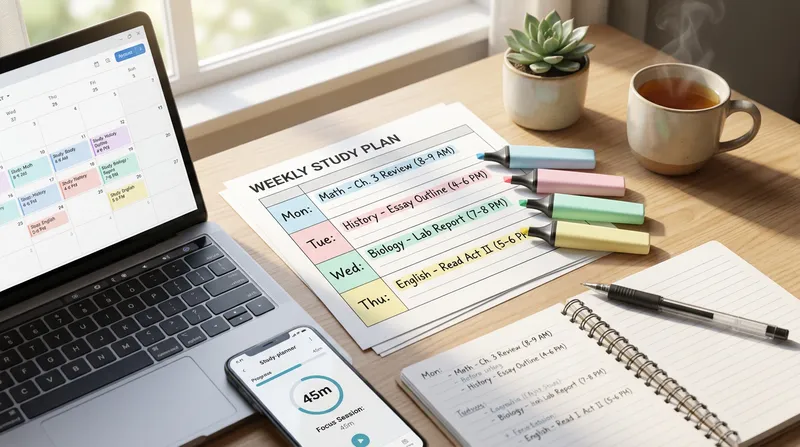
It is 11 PM on a Tuesday. You are staring at a blank screen, feeling completely exhausted, and realizing you still have a math worksheet and a history essay due tomorrow. If this sounds familiar, you are not alone. High school students across the country are chronically overwhelmed and sleep-deprived. Why? Because they rely on reactive, last-minute cramming. Many students simply have not yet discovered the power of a structured, proactive time management system.
Transitioning from middle school to high school brings a massive increase in workload. Without a clear plan, it is easy to fall into a cycle of procrastination and panic. The secret to breaking this cycle is not necessarily working harder. It is about working smarter through a proactive, realistic routine.
In this guide, we will break down exactly how to build a daily schedule for a high school student, provide a customizable study plan template for high school students, and share science-backed time management tips for high schoolers. Let us help you take control of your time, boost your grades, and finally get a good night of sleep.
The Difference Between Doing Homework and Actually Studying
Before we build your schedule, we need to address a common misunderstanding. Many students think that finishing their assigned worksheets means they are done studying. This is a trap.
Homework is a specific task assigned by a teacher. Studying is the proactive process of committing concepts to long-term memory. According to guidance from the University of Queensland, a true study schedule involves actively revising what was learned in class to commit it to memory, which is a distinct and separate task from just completing daily homework.
If you simply rush through your assignments just to get them done, you will find yourself completely lost when exam day arrives. Instead, your schedule needs dedicated blocks of time for review. To make this review time efficient, check out our guide on How to Use the Active Recall Study Method in High School (And Stop Re-Reading!).
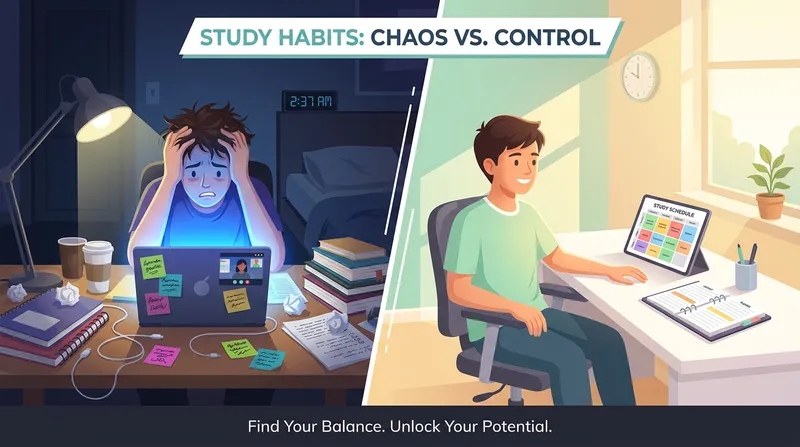
How Many Hours Should a High Schooler Study?
One of the most common questions from both students and parents is exactly how many hours should a high schooler study every day. The answer might surprise you: more is not always better.
Research from Stanford University indicates that homework benefits plateau at about two hours per night, and 90 minutes to 2.5 hours is optimal for high school students. Pushing past this limit often leads to diminishing returns, increased stress, and physical burnout.
Furthermore, sacrificing sleep to study is actively harming your academic performance. According to the sleep center at Robert Wood Johnson University Hospital, 80 percent of adolescents who get an optimal amount of sleep report earning As and Bs in school. Your brain needs rest to process and store the information you learned during the day. A healthy study schedule prioritizes an eight-hour sleep window just as highly as an algebra assignment.
Step-by-Step: Building a Daily Schedule for High School Students
Creating effective study habits for teens requires a system. You cannot just rely on motivation or willpower, because motivation fades when you are tired. Follow these steps to build a bulletproof routine.
1. Master Time Blocking for Students
Time blocking for students is a game-changer. Instead of working from a never-ending to-do list, time blocking involves dividing your afternoon and evening into specific, manageable chunks of time dedicated to single tasks.
For example, instead of saying "I will do my homework tonight", you schedule "4:00 PM to 4:45 PM: Math Homework". When 4:45 PM hits, you stop and move to the next block. This creates a sense of urgency and prevents a single difficult assignment from ruining your entire evening.
2. Prioritize Your Tasks
Not all assignments are created equal. As noted by the College Board, creating a dedicated study time and making a daily to-do list prioritized by importance helps students take control of their time and reduces procrastination. Always tackle your hardest or most important subject first while your brain is still fresh.
3. Figure Out How to Balance Extracurriculars and Academics
Figuring out how to balance extracurriculars and academics is the biggest hurdle for high schoolers. If you have soccer practice until 5:30 PM, your schedule needs to reflect that reality.
Be honest about your energy levels. If you are exhausted after theater rehearsal, schedule your easiest homework for the evening and move your heavy studying to the weekend or an early morning block. Consistency is more important than perfection.
4. Establish an After-School Routine for High Schoolers
The moment you walk through the door sets the tone for the rest of the evening. A strong after-school routine for high schoolers should include a 30-minute decompression block. Get a snack, drink water, and put your phone in another room. Once that 30 minutes is up, transition immediately into your first time block.
High School Homework Schedule Template
To help you get started, here is a high school homework schedule template you can adapt to your own life. This template assumes you get home from school or activities around 4:00 PM.
The Proactive Planner Template:
- 4:00 PM to 4:30 PM: Decompression (Snack, rest, no heavy screens)
- 4:30 PM to 4:45 PM: Planning (Review assignments, prioritize tasks)
- 4:45 PM to 5:30 PM: Deep Work Block 1 (Hardest subject, e.g., AP Calculus)
- 5:30 PM to 5:40 PM: Brain Break (Stretch, walk around)
- 5:40 PM to 6:25 PM: Deep Work Block 2 (Reading, writing, or science)
- 6:25 PM to 7:15 PM: Dinner and Family Time
- 7:15 PM to 8:00 PM: Deep Work Block 3 (Lighter homework or active recall study)
- 8:00 PM to 8:15 PM: Next-Day Prep (Pack backpack, lay out clothes)
- 8:15 PM Onward: Free Time and Wind Down (Protect your sleep!)
Looking at high school study routine examples like this shows that you can get two and a half hours of solid work done and still have your entire evening free after 8:15 PM.
Adjusting for AP, SAT, and ACT Exam Season
When AP exams or SAT and ACT test dates approach, your schedule will need an adjustment. Instead of just doing daily homework, dedicate one of your deep work blocks specifically to standardized test prep or reviewing past AP exams. Consistency over several months is much more effective than cramming the week before the test.
How to Stop Procrastinating Homework
Even with the best schedule in the world, getting started is always the hardest part. Procrastination is not about laziness. It is usually about anxiety or feeling overwhelmed by the size of a task.
The Pomodoro Technique for High School
If you want to know how to stop procrastinating homework, you need to trick your brain into starting. This is where the Pomodoro technique for high school comes in.
Experts at Herzing University explain that working in 25-minute increments with 5-minute breaks combats procrastination by making large tasks feel less daunting to start.
Here is how to do it:
- Pick one specific assignment.
- Set a timer for 25 minutes.
- Work on that assignment with zero distractions until the timer goes off.
- Take a 5-minute break to step away from your desk.
- Repeat.
Anyone can focus for 25 minutes. Once you start, the anxiety drops, and momentum carries you forward.
Best Study Apps for High School Students (Used Responsibly)
Technology can be your best friend or your worst enemy. The best study apps for high school students are the ones that help you learn, rather than just giving you the answers to copy.
Many students fall into the trap of using basic answer bots when they get stuck, which hurts them on test day. Instead, you need tools that act like a digital tutor.
This is where Tutor AI shines. With our "Snap. Solve. Learn." approach, you can take a photo of a complex problem and receive a detailed, step-by-step breakdown of how to solve it. It is available 24/7, meaning you are never stuck waiting for help during a late-night study session. Plus, problems you have already saved stay available offline, so you can keep reviewing even if your Wi-Fi drops.
For specific subjects, you can read our guide on the 10 Best Physics Homework Help Sites & AI Solvers (2026 Guide) or learn How to Use an AI Photo Math Solver for Step-by-Step Homework Help.
A Note for Parents: How to Support Without Micromanaging
Parents, you play a massive role in your teen's academic success, but high school is a critical time for building independence. Nagging a teenager to "go do your homework" usually backfires, leading to arguments and frustration.
Instead of managing their tasks, help them manage their environment.
- Provide the Tools: Help them print out their study plan template for high school students and buy them physical timers for their Pomodoro sessions.
- Protect Their Focus: Try to keep the house relatively quiet during their scheduled deep work blocks.
- Focus on the Process: Praise them for sticking to their schedule, not just for getting an A on a test.
- Offer Support Resources: If you cannot remember how to do Algebra 2, provide them with safe, reliable AI tutoring tools that feature progress tracking and parent dashboards. This way, they can get unstuck independently while you stay informed without micromanaging.
If you are dealing with a younger student transitioning into these habits, read our advice on Middle School Homework Struggles: How to Help (Without Doing It For Them).
Final Thoughts on Your New Routine
Building a high school study routine takes time. You will have days where you mess up, procrastinate, or get off track. That is completely normal. The goal is not perfection. The goal is to build a system you can return to when things get chaotic.
Start small. Try implementing just the 30-minute decompression block and one 25-minute Pomodoro session today. As you build confidence, you can map out your entire week using the templates provided.
Remember, studying smarter means protecting your sleep, balancing your life, and asking for help when you need it.
Ready to stop stressing about homework? Download Tutor AI free on iOS and Android to get instant, step-by-step help any time you get stuck, day or night. Snap, solve, and actually learn.
Note: Every student learns differently. While these strategies are research-backed, results may vary. Adapt these techniques to fit your unique learning style and circumstances.
Frequently Asked Questions
How many hours should a high schooler study every day?
Research shows that the optimal amount of homework and study time for high schoolers is between 90 minutes and 2.5 hours per night. Studying beyond this limit often leads to diminishing returns, increased stress, and sleep deprivation. It is much more effective to study deeply for two hours than to passively review notes for four hours.
How do I balance high school sports and homework?
Balancing extracurriculars and academics requires proactive time blocking. If you have practice until 5:30 PM, your schedule needs to reflect that reality. Utilize your weekends for heavier study sessions or larger projects, and use your limited weekday evening hours for immediate, high-priority assignments. Clear communication with your coaches and teachers is also highly recommended.
What is the best way to stop procrastinating on homework?
The most effective method to stop procrastinating is the Pomodoro technique. Procrastination is usually caused by feeling overwhelmed, not by laziness. By setting a timer for just 25 minutes and focusing on one single task, you lower the mental barrier to starting. Once you begin, momentum usually takes over and carries you through the assignment.
How do I use time blocking for high school classes?
Time blocking involves assigning specific time slots to specific tasks rather than working from a general to-do list. For example, instead of saying you will "do math homework tonight," you schedule a block from 4:30 PM to 5:15 PM dedicated exclusively to math. When the time is up, you take a short break and move to the next subject on your schedule.
What should an after-school routine for a high schooler look like?
A strong after-school routine should start with a 30-minute decompression block to rest, eat a healthy snack, and step away from screens. After this break, transition immediately into a brief planning session to prioritize your tasks for the evening, followed by your first deep-work block focusing on your hardest subject while your energy is still relatively high.


