How to Use the Active Recall Study Method in High School (And Stop Re-Reading!)
We have all been there. It is 10 PM, you have spent three hours reading your biology textbook, and you feel completely prepared. You highlighted the important terms, re-read the chapter summaries, and reviewed your notes. But when you sit down for the exam the next day, you stare at a blank page. The information is simply gone.
This is a painful and exhausting cycle. Students spend hours passively studying, creating a false sense of mastery known as the illusion of competence. When test day arrives, they cannot retrieve the information. This leads to poor grades, severe test anxiety, and frustrated parents who do not understand why their child's hard work is not paying off.
If this sounds familiar, it is time to change how you study for high school exams. The solution is not studying longer. The solution is the active recall study method. In this guide, we will break down exactly how to use this science-backed learning technique to boost retention, increase confidence, and finally see the grades you deserve.
Why Passive Studying Fails: The Science of Recognition vs. Recall
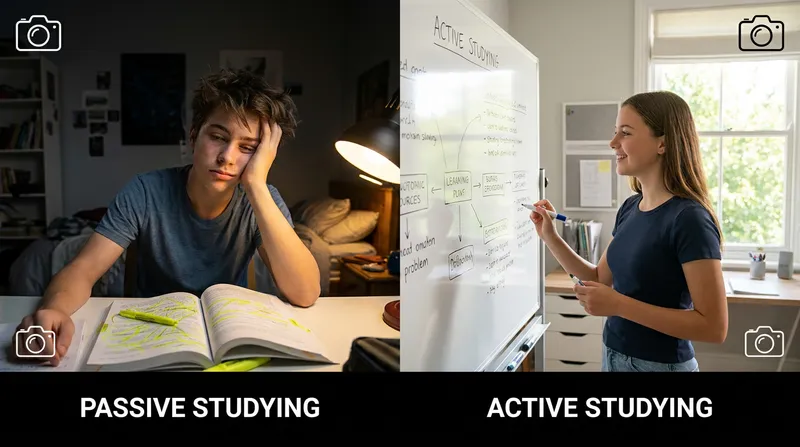
Before we can fix our study habits, we need to understand why our current methods fail. Most high school students rely on passive studying. Passive studying includes activities like re-reading notes, highlighting textbook pages, or watching educational videos without taking notes.
These methods feel productive because they are easy. When you read a highlighted sentence for the third time, your brain recognizes it. Your brain says, "I know this!" However, recognizing information is not the same as remembering it from scratch. This tricks your brain into feeling familiar with the material without actually committing it to your long-term memory.
Active studying is the exact opposite. It forces your brain to work hard to retrieve information without any hints. According to experts at RetrievalPractice.org, over 100 years of cognitive science research demonstrates that a significant amount of learning occurs when students pull information out of their brains, rather than just trying to cram information in.
When you stop passively reviewing and start actively retrieving, you build stronger neural pathways. It feels harder in the moment, but it is the secret to true academic success.
What is Active Recall? (The Science of Memory)
At its core, active recall is the process of testing yourself. Instead of reading a fact, you ask yourself a question about that fact and force your brain to generate the answer.
To understand why this is so important, we have to look at the Ebbinghaus forgetting curve. Discovered by German psychologist Hermann Ebbinghaus in the late 19th century, this curve shows how quickly we forget new information. Research from Auburn University Academic Support validates this concept, proving that students forget approximately 75 percent of what they learned within a day or two of attending a class if they do not actively review it.
So, how do we beat the forgetting curve? By combining spaced repetition and active recall.
Spaced repetition involves reviewing material at gradually increasing intervals: one day after learning it, then three days later, then a week later. When you combine this spacing with retrieval practice techniques (actively testing yourself during those review sessions), you interrupt the forgetting process and lock the information into your long-term memory. To make these review sessions even more effective, try the Pomodoro technique (studying for 25 minutes, then taking a 5-minute break) to maintain your energy and focus.
Best Active Recall Techniques for High School Students
Every student learns differently. What works for a history exam might not work for a chemistry test. The good news is that active recall is a highly flexible, science-backed framework that can be adapted for any subject.
Here are some of the most effective, high-yield study techniques you can start using today.
The Blurting Study Method
The blurting study method is incredibly effective for subjects that require memorizing a lot of interconnected facts, like history or biology. Here is how it works:
- Read a section of your textbook or notes.
- Close the book completely.
- Take a blank sheet of paper and "blurt" out everything you can remember about the topic. Write down definitions, draw diagrams, and connect concepts.
- Open your book again and use a different colored pen to fill in the gaps you missed.
This self-testing study method immediately identifies your weak spots. You will instantly see exactly what you know and what you need to review. Researchers at the Carnegie Mellon University Eberly Center note that attempting to retrieve information and getting it wrong is still more beneficial for long-term retention than passively reading the correct answer.
If you are studying complex science topics and get stuck during your blurting session, you can use AI Biology Solvers: How to Get Step-by-Step Homework Help (Without Cheating) to quickly clarify concepts before you try blurting again.
The Feynman Learning Technique
Named after the Nobel Prize-winning physicist Richard Feynman, this technique is perfect for mastering complex ideas. The core concept is simple: pretend you are teaching the material to a middle schooler or someone who knows nothing about the topic.
When you try to explain a concept in plain, simple English, you quickly realize where your understanding falls short. If you find yourself using confusing jargon or stumbling over your words, you have found a gap in your knowledge.
Parents can be incredibly helpful here. Ask your teen to explain their current science chapter to you. For more tips on how parents can facilitate this without taking over, check out our guide on Middle School Homework Struggles: How to Help (Without Doing It For Them).
Flashcards and Interleaving
Flashcards are the most famous active recall tool, but most students use them incorrectly. If you flip a flashcard over the second you feel stuck, you are cheating your brain out of the active recall process. You must force yourself to guess the answer first, even if you are wrong.
To make flashcards for active recall even more powerful, introduce the interleaving study method. Interleaving (mixing history flashcards with biology flashcards in one session) forces your brain to constantly switch contexts. According to research from Birmingham City University, this improves long-term discrimination between similar concepts, proving much more effective than cramming.
How to Use AI for Active Studying (Without Cheating)
We need to address the elephant in the room. Many students use AI homework solvers to simply copy the final answer. This is the ultimate form of passive studying. It ruins your active recall practice and guarantees you will blank out during your actual exam.
However, when used responsibly, educational technology is a massive advantage. You can learn how to use AI for active studying to check your work, understand your mistakes, and generate custom practice quizzes.
Think of a step-by-step AI app as a 24/7 study buddy. Instead of just handing over the final answer, an AI study companion provides guided hints. This allows you to actively engage with the material. To understand the difference between good and bad AI tools, you can read our comparison of the Best AI Tutors for Students: Socratic AI vs. Answer Bots for Homework Help.
Step-by-Step: Turning Math Homework into a Practice Test
Math requires a specific approach to active recall. You cannot just memorize formulas; you have to practice applying them. Here is how to turn your math homework into a powerful retrieval practice session using a smart AI tutor:
- Step 1: Attempt the problem completely on your own first. Do not look at your textbook examples. Force your brain to try and remember the steps.
- Step 2: Get unstuck carefully. If you hit a wall, do not look up the final answer. Instead, use your AI app to snap a picture of the problem. Look ONLY at the first step of the explanation to get a hint.
- Step 3: Finish independently. Once you have that small hint, put the app away and try to finish the rest of the problem on your own.
This method keeps your brain highly engaged. For a deeper dive into this process, explore How to Use an AI Photo Math Solver for Step-by-Step Homework Help.
A Parent's Guide: How to Encourage Active Recall at Home
Transitioning from passive reading to active recall can be frustrating for students. Because it requires more mental effort, teens often feel like they are doing worse at first. Parents play a crucial role in supporting this transition.
First, change the way you ask about homework. Instead of asking, "Did you finish reading your chapter?" try asking an open-ended question like, "Can you explain the main idea of that chapter to me?" This naturally prompts the Feynman technique.
Second, provide the right tools. Many parents feel helpless when their teens bring home advanced algebra or chemistry. You do not need to relearn high school math to empower your child. By providing them with a step-by-step AI tutor, you give them a safe space to check their work and learn from their mistakes independently. Plus, with features like a parent dashboard, you can check in on your teen's practice sessions and see which topics they are mastering (without hovering over their shoulder). As noted by the National Institutes of Health (NIH), active recall is robustly backed by cognitive psychology to strengthen memory.
If your child struggles with confidence, you might enjoy reading about No judgment, infinite patience: How an AI math tutor eases middle school math anxiety.
Conclusion: Study Smarter, Not Harder
Switching to the active recall study method requires a bit more mental effort upfront, but it is the ultimate shortcut to better grades. It saves you hours of wasted re-reading time and completely eliminates the panic of blanking out during an exam.
You do not need to change all your study habits overnight. Pick just one technique to try this week. Try a five-minute blurting session after reading your history notes, or force yourself to guess the answers to your flashcards before flipping them over.
Want to turn every homework session into a real learning opportunity? TutorAI's step-by-step guidance and 24/7 availability make it the perfect active recall companion. Ready to start preparing for big exams? Check out our guide to AP Calculus & SAT Math (2026): How to Use an AI Math Solver to Master Practice Exams and take control of your academic success. Try TutorAI free today!
Frequently Asked Questions
How many hours a day should a high schooler study using active recall?
Focus on quality over quantity. Because active recall is mentally taxing, 1 to 2 hours of focused active studying is far more effective than 4 hours of passive reading. Use the Pomodoro technique (studying for 25 minutes, then taking a 5-minute break) to maintain your energy.
Does active recall work for math and science?
Yes. Instead of re-reading textbook examples, active recall for math involves doing practice problems from scratch. If you get stuck, use an AI app to check the steps, then try the problem again on a blank sheet of paper.
Why does active recall feel so difficult?
It feels difficult because you are actually building new neural pathways in your brain. Passive reading feels easy because of the illusion of competence, but that ease does not translate to memory retention on test day.
What is the best active recall app for high school students?
Apps like Anki and Quizlet are great for digital flashcards. However, for complex subjects like math and science where you need to understand the process, TutorAI is excellent because it provides step-by-step explanations, allowing students to check their work actively without just copying answers.
How can I combine spaced repetition with active recall?
Create a simple study schedule. Test yourself on new material a day after learning it, then review it 3 days later, then a week later. Use the blurting method or flashcards during these specific review sessions.
Note: Every student learns differently. While these strategies are research-backed, results may vary. Adapt these techniques to fit your unique learning style and circumstances.


