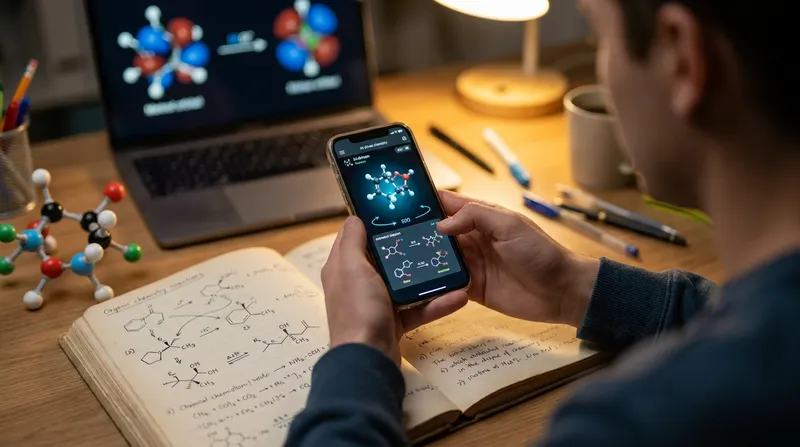
We have all seen the late-night kitchen table scene: it is 10:30 PM, and your notebook is covered in hexagon rings, wedges, dashes, and tangled curved arrows that look more like football plays than science. If you are looking for an organic chemistry reaction mechanism solver that actually explains how electrons move rather than spitting out a confusing wall of text, you have already discovered the biggest secret of advanced chemistry. Organic chemistry is not a math class or a memorization contest; it is a visual, spatial language.
Yet when students and parents turn to mainstream homework apps or generic AI chatbots for help, they hit a massive wall. Tools built for algebra or basic text treat 3D chemical structures like flat sentences. They hallucinate impossible carbon bonds, skip vital carbocation rearrangements, ignore stereochemistry (wedges and dashes), and miss the curved arrows that show why a reaction happens. Even worse, getting a flawed homework answer gives you a false sense of security right up until exam day.
In this step-by-step guide, you will learn how chemical AI reads skeletal structures, how to solve electron-pushing mechanisms and retrosynthesis without getting tricked by AI hallucinations, and how both students and parents can turn late-night chemistry frustration into real exam confidence.
Why General Homework Apps Fail at Organic Chemistry (The "Photomath for Orgo" Reality Check)
When students dive into honors and AP/IB organic units in high school or transition from General Chemistry to Organic Chemistry, their favorite study apps suddenly stop working. In General Chemistry, you spend your time balancing equations, calculating molarity, and solving algebraic rate laws. Standard math scanners handle those numbers effortlessly.
Organic chemistry changes the rules completely. Instead of solving for x, you are tracking how invisible clouds of electrons flow from areas of high density (nucleophiles) to areas of low density (electrophiles) in three-dimensional space.
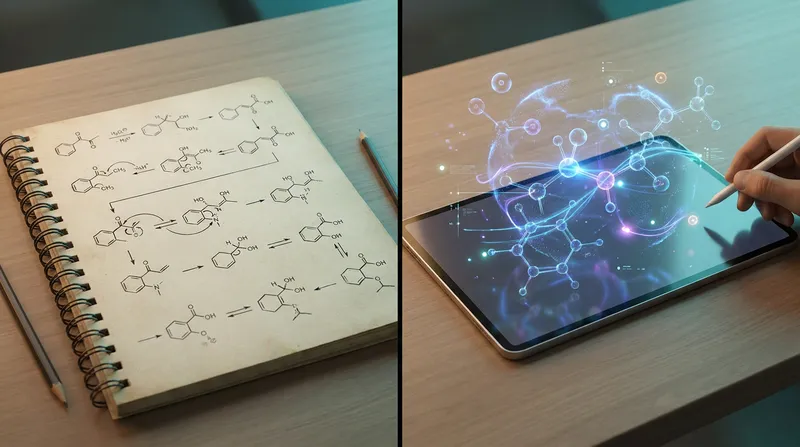
Here is why general AI chatbots and standard homework scanners struggle when acting as an organic chemistry photo solver:
- They Are Blind to 2D Skeletal Geometry: Standard optical character recognition (OCR) is trained to read letters and numbers. When it looks at a benzene ring, a bicyclic bridge, or a dashed wedge indicating a bond pointing away from you, it frequently misreads the vertices, losing carbon atoms in the process.
- They Sound Confident While Drawing Impossible Steps: A peer-reviewed 2024 study in the Journal of Chemical Education evaluated 255 ChatGPT-3.5 explanations of 85 organic reaction mechanisms and found that only about a quarter were fully accurate, even though the explanations sounded sophisticated.
- They Skip the Intermediates: Teachers and professors rarely grade you on the final product alone. Teachers often award partial credit for correctly drawn intermediates, formal charges, and curved arrows.
- Community Answers Contain Peer Errors: Crowd-sourced homework sites often feature rushed student uploads that omit lone pairs or draw arrows backward (pointing from the positively charged atom instead of the electron source).
As we explain in our guide on why mobile photo scanners are safer and more reliable than browser extensions, a purpose-built mobile scanner captures your exact handwritten or printed diagram and breaks the logic down step by step.
Actionable Tip: The 10-Second Photo Prep Check
Before scanning any organic chemistry worksheet with an AI solver, do this quick check to improve recognition:
- Darken your wedges and dashes: Make sure solid wedges are completely filled in and dashed wedges have distinct, separate lines.
- Circle your formal charges: Put a small circle around
+and-signs so the camera does not confuse a minus sign with a stray methyl bond. - Include the reagents above and below the arrow: Never crop out the solvent (like DMSO or ethanol) or the temperature ($\Delta$), because those two details completely change the reaction pathway.
What Is an Organic Chemistry AI Solver (And How Chemical AI Actually Works)?
To understand how specialized chemistry AI works, it helps to peek under the hood. Research-grade chemical AI does not read molecules the way you read English. Instead, it translates a chemical drawing into machine-readable chemical notation, such as SMILES (Simplified Molecular-Input Line-Entry System) or connection tables.
Once a system converts a hexagon drawing into a precise digital graph of atoms and bonds, specialized chemical language models take over. For example, IBM's Molecular Transformer, which treats reaction prediction like translating between SMILES strings, reached about 90% top-1 accuracy on a standard benchmark of patent reactions (USPTO).
For everyday homework support, Tutor AI ("Snap. Solve. Learn.") pairs photo-based problem recognition with step-by-step explanations, so you can see the reasoning behind each step rather than just a final answer.
If you are comparing different platforms for science and math support, check out our breakdown of the 7 best AI tutoring apps that give step-by-step explanations (not just answers) to see how step-by-step scaffolding transforms study time.
How to Solve Organic Chemistry Problems in 3 Easy Steps
Whether you are tackling an introductory functional group worksheet in high school AP Chemistry or working through a mechanism practice set late at night, using an organic chemistry AI solver should follow a structured workflow.
Step 1: Snap a Clear Photo of the Reaction Scheme
Open your Tutor AI app and snap a photo of the problem. You can scan printed textbook pages, PDF problem sets on your laptop screen, or your own handwritten notes. If you are stuck on a "fill-in-the-box" synthesis problem, include the starting material, all reagents over the arrow, and the final target molecule if one is shown.
Step 2: Specify What You Need (Mechanism, Product, or Name)
Organic chemistry questions generally fall into three buckets. Make sure you look at the specific breakdown for your question type:
- "Predict the Major Product": Focus on the regioselectivity (which carbon reacts) and stereoselectivity (wedges vs. dashes).
- "Draw the Complete Electron-Pushing Mechanism": Follow every intermediate step, paying close attention to where each curved arrow starts and ends.
- "Propose a Synthesis": Look at how the explanation connects smaller precursor molecules into the larger target carbon skeleton.
Step 3: Walk Through the Step-by-Step Breakdown
Do not just copy the final structure at the bottom of the screen! Read the explanation for Step 1 first, cover your screen, and try to draw Step 2 on your scratch paper before revealing it. This active recall habit is the exact method we teach in our AP Chem exam practice guide on turning missed questions into a 5.
The 4-Step Mechanism Verification Framework: How to Audit Every Solution
Because organic chemistry requires absolute precision, top students use a simple verification checklist whenever they review an AI solution or check their own handwritten work. According to the National Science Foundation-supported LibreTexts Chemistry guide on reaction mechanisms, every valid polar reaction mechanism must obey strict rules of electron flow, octet limits, and charge conservation.
Use this 4-Step Mechanism Audit on every problem you solve:
1. The Arrow Direction & Octet Rule Check
- Rule: Curved arrows always show the movement of electrons, never atoms. Every arrow must start at an electron source (a lone pair or a chemical bond) and point to an electron sink (an atom that can accept electrons or form a new bond).
- What to Do: Count the bonds around every carbon, nitrogen, and oxygen atom in the intermediate. Second-row elements ($C, N, O, F$) can never have more than 8 valence electrons (4 bonds). If you see a carbon with 5 bonds (a "Texas carbon"), a bond-breaking arrow is missing!
2. The Net Formal Charge Conservation Check
- Rule: Charge cannot appear or disappear out of nowhere. If your reactants have an overall net charge of $-1$, every single intermediate step and the final product mix must also have an overall net charge of $-1$.
- What to Do: Add up the
+and-charges on the left side of the reaction arrow, then add them up in the intermediate. They must match every single time.
3. The Carbocation Rearrangement Check (Hydride & Methyl Shifts)
- Rule: Whenever a reaction forms a carbocation intermediate (such as in $S_N1$, $E1$, or acid-catalyzed alkene hydration), that positively charged carbon will immediately look next door to see if it can become more stable.
- What to Do: If you see a secondary ($2^\circ$) carbocation next to a tertiary ($3^\circ$) or quaternary ($4^\circ$) carbon, ask yourself or your AI tutor: "Does a 1,2-hydride shift or 1,2-methyl shift happen here to form a more stable tertiary carbocation?"
4. The Carbon-Count & Stereocenter Audit
- Rule: Unless you are running a cleavage reaction (like ozonolysis) or adding a carbon chain, your product should have the exact same number of carbons as your starting material.
- What to Do: Number the carbons in your starting chain ($C1, C2, C3...$) and number them in your product. Then check every chiral center (a carbon with 4 different groups attached) to verify whether the stereochemistry stayed the same (retention), flipped completely (inversion), or formed a 50/50 mix of wedges and dashes (racemization).
Conquering the "Big Three" Orgo Grade-Killers
While high school Honors and AP Chemistry courses focus on foundational bonding and functional groups, advanced organic units and introductory college courses introduce three classic problem types that cause the most homework frustration: competing substitution/elimination reactions, 3D stereochemistry, and multi-step retrosynthesis. Here is how to combine structured decision tools and digital resources to master all three.
1. The SN1, SN2, E1, E2 Reaction Decision Matrix
Students often freeze when they see an alkyl halide reacting with a reagent because four different mechanisms ($S_N1, S_N2, E1, E2$) compete at the exact same time. As outlined by Master Organic Chemistry's competing reaction framework, predicting the winner requires evaluating the substrate, the nucleophile/base strength, the solvent, and the temperature in a strict sequence.
When you review a substitution or elimination problem, compare the explanation against this decision matrix:
| Substrate Type | Strong, Unhindered Nucleophile / Weak Base (e.g., $I^-, CN^-, RS^-$) | Strong, Unhindered Base / Nucleophile (e.g., $NaOCH_3, NaOH$) | Strong, Bulky Base (e.g., $KOtBu, LDA$) | Weak Nucleophile / Weak Base in Protic Solvent (e.g., $H_2O, ROH$) |
|---|---|---|---|---|
| Methyl ($CH_3X$) | $S_N2$ Only | $S_N2$ Only | $S_N2$ Only | No Reaction |
| Primary ($1^\circ$) | $S_N2$ (Favored in polar aprotic solvents like Acetone, DMSO, DMF) | $S_N2$ Major | $E2$ (Hofmann product) | No Reaction |
| Secondary ($2^\circ$) | $S_N2$ (With inversion of configuration: wedge flips to dash) | $E2$ Major (Zaitsev alkene product, requires anti-periplanar H) | $E2$ Only (Less substituted Hofmann alkene) | $S_N1 / E1$ Mix (Heat $\Delta$ favors $E1$; watch for carbocation shifts!) |
| Tertiary ($3^\circ$) | No $S_N2$ (Too sterically crowded; slow $S_N1/E1$ if protic) | $E2$ Only (Too crowded for backside attack) | $E2$ Only (Hofmann alkene) | $S_N1 / E1$ Mix (Racemization at chiral center; heat favors $E1$) |
Actionable Study Drill: Work three secondary alkyl halide problems and compare each step-by-step explanation against the decision matrix above. Look specifically at how changing the solvent from polar protic (water, methanol, ethanol) to polar aprotic (DMSO, acetone, acetonitrile) flips the mechanism from $S_N1$ to $S_N2$.
2. Using a 3D Molecular Structure Visualizer for Stereochemistry
One of the hardest mental leaps for students is looking at a flat piece of paper and rotating a molecule in their head to determine (R) vs. (S) configuration or drawing a cyclohexane chair flip. If the lowest-priority group (usually a hydrogen atom) is pointing toward you on a solid wedge instead of pointing away on a dash, it is remarkably easy to mix up clockwise and counterclockwise priorities.
To build your spatial intuition, pair your step-by-step study workflow with a 3D molecular structure visualizer or government conformer database. NCBI's PubChem3D provides computationally derived 3D conformer models (up to 500 conformers per compound) for millions of molecules in the PubChem database, so students and researchers can inspect steric crowding and 3D functional group angles directly.
Actionable Study Drill: Whenever you get a cyclohexane chair conformation question wrong, look up the 3D conformer model and check every axial bond (pointing straight up or down) versus every equatorial bond (pointing out to the sides). Remember the golden rule: the bulkiest group (like a tert-butyl group) always wants to sit in the equatorial position to avoid 1,3-diaxial steric clash!
3. Mastering Multi-Step Synthesis with Retrosynthesis Thinking
Synthesis problems give you a simple starting material (like a 2-carbon alkyne) and ask you to build a complex 6-carbon ketone in four or five steps. Trying to guess this forward is like walking into a maze blindfolded.
Chemists solve synthesis problems backward using retrosynthesis, breaking the target molecule down one step at a time into simpler precursors. University-level AI platforms like the Massachusetts Institute of Technology (MIT) ASKCOS Synthesis Planner use neural networks trained on 12.5 million single-step synthetic reactions and roughly 160,000 generalized reaction rules to rank retrosynthetic disconnections.
When you work through a retrosynthesis problem step by step, follow this two-question workflow:
- Did the carbon skeleton change? Count the carbons in the starting material and the product. If the product has more carbons, your synthesis must include a carbon-carbon bond-forming reaction (like an acetylide ion attack, a Grignard reaction, a Wittig reaction, or a Diels-Alder cycloaddition).
- What is the last functional group created? Look at the final product and ask: "What single reaction makes this functional group?" Work backward one step at a time until your precursor matches your starting material.
If you are also taking high school biology or AP Chemistry courses where functional groups and biological macromolecules overlap, check out our guide to the best AI biochemistry solvers for step-by-step AP Bio and chemistry help.
Core Organic Chemistry Topics from High School AP Chem to College
Understanding how organic chemistry builds from high school into university courses helps students and parents see the bigger picture. Here is a roadmap of how core concepts progress from high school honors and AP chemistry through two semesters of college organic chemistry:
- High School Honors, AP, & IB Chemistry:
- Lewis structures, VSEPR 3D molecular geometry, and hybridization ($sp^3, sp^2, sp$)
- Identifying functional groups (alcohols, aldehydes, ketones, carboxylic acids, esters, amines, amides)
- Introductory IUPAC nomenclature for alkanes, alkenes, and alkynes
- Intermolecular forces (hydrogen bonding, dipole-dipole, London dispersion) and boiling point trends
- Organic Chemistry 1 (Structure & Reactivity):
- Acid-base equilibrium ($pK_a$ predictions using the ARIO rule: Atom, Resonance, Induction, Orbital)
- Newman projections, cyclohexane chair flips, and stereochemistry ((R)/(S), enantiomers, diastereomers, meso compounds)
- Substitution and elimination mechanisms ($S_N1, S_N2, E1, E2$)
- Addition reactions of alkenes and alkynes (hydrohalogenation, hydration, hydroboration-oxidation, halogenation, ozonolysis)
- Radical halogenation and allylic bromination (NBS)
- Organic Chemistry 2 (Synthesis, Carbonyls & Spectroscopy):
- Conjugated dienes and Diels-Alder $[4+2]$ cycloadditions
- Aromaticity (Huckel's $4n+2$ rule) and Electrophilic Aromatic Substitution ($EAS$ ortho/meta/para directors)
- Aldehydes, ketones, and nucleophilic acyl substitution of carboxylic acid derivatives
- Enolate chemistry (Aldol condensation, Claisen condensation, Michael additions)
- Spectroscopy structure determination ($^1H$ NMR splitting and chemical shifts, $^{13}C$ NMR, IR functional group peaks, and Mass Spectrometry)
The "Coach vs. Crutch" Study Workflow: A Guide for Students, Parents, and Tutors
The difference between a student who uses AI to get an A on homework but fails the midterm, and a student who uses AI to score at the top of the class, comes down to how they interact with the explanation. Just like we emphasize in our guide on how to use an AI English solver for homework help without cheating, AI should always act as your 24/7 personal coach, never a shortcut around thinking.
For Students: The "Blank Sheet Redraw" Rule
Never look at a step-by-step explanation on your phone and copy it directly onto your worksheet while looking at the screen. Instead:
- Snap the problem with Tutor AI and read the step-by-step breakdown until the logic makes sense.
- Put your phone face down.
- Wait 60 seconds, then work the entire problem from scratch on a blank piece of paper using only your understanding of the concepts.
- Flip your phone back over and compare. If you missed a formal charge or a proton transfer step, you just discovered the exact spot you would have missed on the test!
For Parents: Supporting Your Teen Without Knowing a Single Functional Group
If you are a busy parent, you do not need to remember how chemical bonding rules work to help your high schooler succeed. Chemistry often triggers intense homework anxiety because one missed concept in Week 3 snowballs by Week 6.
With Tutor AI's Family Ecosystem and Progress Tracking, parents get peace of mind without late-night homework battles:
- 24/7 Availability: When your student gets stuck at 10:30 PM, they do not have to wait days for a private tutor session.
- Progress Reports & Weak Spot Identification: With Tutor AI Premium's parent dashboard, you can see their daily study streaks, topic mastery, and specific weak spots.
- The 1-Minute Parent Check-In: Want to verify your teen actually understood the AI explanation? Point to one step on their worksheet and ask: "Which atom has the extra electrons here, and why is it reacting at that spot?" If they can explain it in plain English, they are ready for the exam.
For Tutors and Teachers: Supporting Independent Review
Teachers can encourage students to use Tutor AI's step-by-step explanations to review missed quiz questions outside class hours. If you want a structured framework for reviewing test errors across subjects, pair this workflow with our guide on how to review test mistakes systematically.
Note: Every student learns differently. While these strategies are research-backed, results may vary. Adapt these techniques to fit your unique learning style and circumstances.
Frequently Asked Questions About Organic Chemistry AI Tools
Is there a free AI that can solve organic chemistry reaction mechanisms step-by-step?
Yes! Tutor AI offers a free tier that allows students to snap a photo of printed or handwritten chemistry problems and receive clear, step-by-step explanations. The free tier includes a limited number of daily questions and is ad-supported; Premium unlocks unlimited questions. Unlike static textbook answer keys that hide behind steep paywalls, a step-by-step AI tutor walks you through the reasoning and reaction rules so you actually learn the process.
Can an AI photo solver read handwritten organic chemistry skeletal structures?
Tutor AI supports photos of handwritten and printed problems. For the best results, draw structures clearly, make solid wedges dark, and keep reagents clearly positioned above or below the reaction arrow.
What details are needed to predict SN1, SN2, E1, and E2 reactions accurately?
Predicting competing $S_N1, S_N2, E1$, and $E2$ pathways requires all three pieces of reaction data: the alkyl halide substrate, the nucleophile/base, and the solvent/temperature. Most mistakes happen when a student crops out the solvent or temperature symbol, which are critical for deciding between substitution and elimination on secondary carbons.
What is the best AI tool for multi-step synthesis and retrosynthesis?
For research-level synthesis trees, university platforms like MIT's ASKCOS and IBM RXN lead the field. For high school students who need curriculum-aligned, step-by-step homework explanations, Tutor AI can walk through the reasoning behind each step.
Why do general AI chatbots make mistakes with stereochemistry and arrow-pushing mechanisms?
General conversational chatbots are built on text prediction, not 3D spatial geometry or valence electron accounting. As a result, they often lose track of (R)/(S) stereocenters during backside attacks, forget 1,2-hydride shifts on carbocations, or violate the octet rule by drawing five bonds to carbon. Always apply our 4-Step Mechanism Verification Framework to audit every step.
How can parents and tutors use an AI tutor to help students study for exams?
Parents and tutors can use Tutor AI's Progress Tracking and Personalized Learning Paths to identify which concepts a student misses most often. Instead of passively reading notes, have the student use the app to check their work on ungraded textbook problems, review step-by-step explanations for any errors, and redraw solutions from memory.
How do you solve NMR, IR, and Mass Spectrometry problems?
Spectroscopy problems require calculating the Degree of Unsaturation (Index of Hydrogen Deficiency) from the molecular formula, matching IR wavenumber peaks to specific functional groups (like a sharp carbonyl peak around $1710\text{ cm}^{-1}$ or a broad alcohol peak around $3300\text{ cm}^{-1}$), and analyzing NMR chemical shifts, integration ratios, and splitting patterns ($n+1$ rule) to assemble the correct molecular structure step by step.
How do I avoid missing carbocation rearrangements like hydride or methyl shifts?
Whenever you work through an $S_N1$, $E1$, or acid-catalyzed alkene addition reaction, always check the secondary ($2^\circ$) carbocation intermediate before moving to the final product step. Verify whether a neighboring carbon is tertiary ($3^\circ$) or quaternary ($4^\circ$). If it is, a fast 1,2-hydride shift or 1,2-methyl shift will occur to create a lower-energy, more stable carbocation before the nucleophile attacks.
What is the difference between a standard math photo scanner and dedicated chemical AI?
Standard math scanners (like Photomath or Mathway) are built on algebraic optical character recognition (OCR) designed to read numbers, variables, and linear equations. Research-level chemical AI systems translate 2D skeletal polygons, wedges, dashes, and lone pairs into digital molecular graphs (such as SMILES strings), allowing them to track stereochemistry and regioselectivity that basic math apps cannot parse.
Can high school AP and IB Chemistry students use Tutor AI for organic units?
Absolutely. High school Honors, AP, and IB Chemistry courses introduce foundational organic chemistry concepts including Lewis structures, VSEPR 3D geometry, $sp^3/sp^2/sp$ hybridization, intermolecular forces, functional group identification, and basic IUPAC naming. Using Tutor AI early in high school builds strong understanding of how valence electrons behave, making both AP exams and future college STEM courses much easier.
Is using an AI chemistry tutor considered cheating?
Using an AI solver to blindly copy answers onto a graded assignment is counterproductive and violates academic integrity, but using an AI tutor as a 24/7 interactive study coach is one of the smartest ways to learn. By scanning practice problems, studying why electrons move from nucleophile to electrophile, and using the "Blank Sheet Redraw" method to test your memory, you build genuine problem-solving skills for closed-book exams.
Ready to Conquer Organic Chemistry Without the Late-Night Stress?
Organic chemistry has a reputation as a tough course, but once you stop trying to memorize thousands of disconnected flashcards and start seeing the step-by-step logic of how electrons move, everything clicks into place. Whether you are mastering functional groups for AP Chemistry or reviewing foundational reaction mechanisms, having step-by-step explanations makes all the difference.
Do not spend another night staring at a blank worksheet in frustration. With Tutor AI ("Snap. Solve. Learn."), you can snap a photo of your chemistry problem, get instant step-by-step explanations 24/7, and track your mastery from your phone or tablet. Download Tutor AI today on iOS or Android, and turn your toughest chemistry homework into your strongest exam score!