
Introduction: Why Grinding Practice Tests Alone Won't Get You a 5
It is Sunday night. You just spent three hours and fifteen minutes grinding through a full-length AP Chemistry practice test at your kitchen table. Your hand hurts from writing out equilibrium expressions, your brain is fried, and when you finally tally up your points, you are staring at a 2 or a 3.
If you have ever felt completely paralyzed after grading a practice exam, you are not alone. The biggest mistake students make during AP Chem test prep is assuming that simply taking more practice tests will magically raise their score. Worse, when you try to review your wrong answers using official scoring keys, the rubrics are often cryptic. They show you the final accepted number or a brief bullet point, leaving you stuck at 11 PM wondering if you missed points because of a deep conceptual gap, a simple math slip, or the wrong wording.
Learning how to get a 5 on AP Chem is not about taking ten practice exams and burning yourself out. It is about what you do in the two hours after you put your pencil down. In this guide, we will walk you through the exact 3-Bucket Error Audit framework to diagnose your mistakes, decode strict Free-Response Question (FRQ) rubrics, and use a 24/7 AI chemistry solver to turn every missed practice question into exam-day points.
Understanding the Current AP Chemistry Exam Format and Unit Weightings
Before you can audit your practice tests effectively, you need to make sure your practice environment matches the real test. According to the College Board's official AP Chemistry Exam overview, the exam lasts 3 hours and 15 minutes and is split evenly between two sections:
- Section I: Multiple-Choice Questions (MCQs): 60 AP Chemistry multiple-choice questions in 90 minutes, accounting for 50% of your total score. That gives you an average of 90 seconds per question.
- Section II: Free-Response Questions (FRQs): 7 questions in 105 minutes, accounting for the remaining 50% of your score. This includes 3 long-answer questions (worth 10 points each, roughly 23 minutes per question) and 4 short-answer questions (worth 4 points each, roughly 9 minutes per question).
Just as important is how you take the test. AP Chemistry uses a hybrid digital exam format. You will read and answer all 60 MCQs digitally inside the College Board Bluebook testing application on your device. For Section II, you will view the FRQ prompts in Bluebook, but you will write all of your calculations, chemical equations, and particle diagrams by hand in a paper exam booklet.
Furthermore, under the College Board's official calculator policies, a scientific or graphing calculator is permitted on both Section I and Section II, alongside the official AP Periodic Table and Equations and Constants sheet.
Actionable Step for Your Next Practice Session: When planning your AP Chemistry unit review, do not give every unit equal study time. Prioritize your error review around the highest-weighted topics on the exam:
- Unit 3: Properties of Substances and Mixtures (18% to 22% of the multiple-choice section): Roughly one out of every five questions tests IMFs, gas laws, solutions, or spectroscopy.
- Unit 8: Acids and Bases (11% to 15% of the multiple-choice section): Titration curves, pH calculations, and buffer systems appear frequently on both multiple-choice and free-response questions.
- Unit 4 (Chemical Reactions), Unit 5 (Kinetics), Unit 7 (Equilibrium), and Unit 9 (Thermodynamics and Electrochemistry): Each accounts for 7% to 9% of the multiple-choice section.
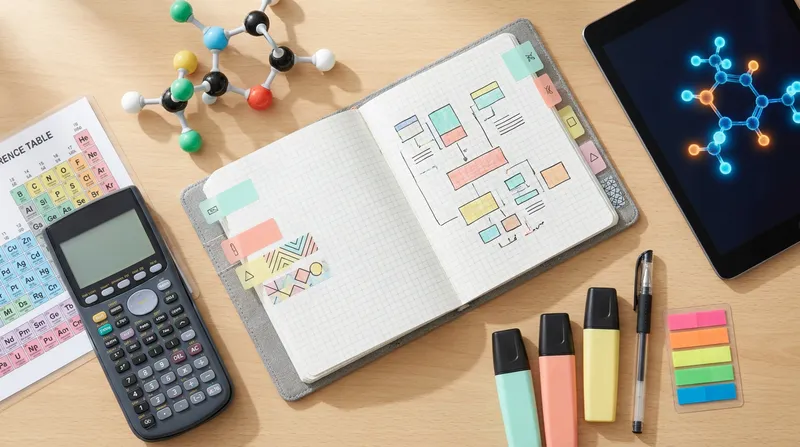
How to Review AP Chem Practice Tests: The 3-Bucket Error Audit
Most students grade a practice test by marking an "X" next to missed questions, reading the correct letter on the answer key, nodding their head, and saying, "Oh, right, I knew that." Psychologists call this the illusion of competence. Recognizing why an answer makes sense when it is right in front of you is completely different from generating that answer under timed pressure.
Just like we recommend in our guide on how to review mistakes on free printable ACT tests, learning how to review AP Chem practice tests requires categorizing why your brain went down the wrong path. In AP Chemistry, every lost point falls into one of three distinct buckets: Conceptual Errors, Calculation/Algorithmic Errors, or Rubric/Communication Errors.
Actionable Step: Build Your 4-Column Audit Tracker Before you grade your next practice section, open a notebook or spreadsheet and draw four columns for every single question you missed or guessed on:
- Column 1: Question # & Unit (e.g., MCQ #14, Unit 3: Properties of Substances and Mixtures)
- Column 2: The Error Bucket (Bucket 1: Conceptual, Bucket 2: Calculation, or Bucket 3: Rubric/Wording)
- Column 3: Why My Brain Went There (Write the exact trap you fell for, such as "Confused intramolecular covalent bonds with intermolecular hydrogen bonds")
- Column 4: Action Step to Fix (What rule, setup, or particle diagram you need to drill so it never happens again)
Bucket 1: Conceptual Errors (Fixing Particle-Level Misconceptions)
A conceptual error happens when you do not have a clear mental movie of what the atoms, ions, or electrons are actually doing inside the beaker. You might know a formula, but when the exam gives you a particulate diagram or asks how a system responds to a disturbance, you have to guess.
For example, one of the most common AP Chemistry mistakes is believing that boiling liquid water breaks the covalent O-H bonds inside the water molecule to create hydrogen and oxygen gas, rather than simply overcoming the intermolecular hydrogen attractions between intact water molecules.
Actionable Step: The "Draw the Beaker" Test Whenever you log a Bucket 1 error during your unit review, put your calculator away and draw a circle representing a microscopic zoom-in of the reaction vessel. Sketch the exact ions, molecules, or dipole arrows before and after the change described in the question. If you cannot draw what is happening at the particle level, you have found a conceptual gap that needs a step-by-step breakdown before you try another question.
Bucket 2: Calculation and Algorithmic Errors (Stoichiometry, Equilibrium, and Units)
Many students who excel in math class are shocked when they miss calculation questions in AP Chemistry. Separating calculation errors from conceptual errors is critical because high school chemistry classes often rely on memorized math routines, what educators call "algorithmic" problem-solving.
When AP Chemistry throws a twist into a calculation, memorized algorithms fall apart. Watch out for these high-frequency Bucket 2 calculation traps:
- Unit mismatches in Thermodynamics: In Unit 9, enthalpy ($\Delta H$) is almost always given in kilojoules ($\text{kJ/mol}$), while entropy ($\Delta S$) is given in joules ($\text{J/mol}\cdot\text{K}$). Plugging them into $\Delta G = \Delta H - T\Delta S$ without converting to the same energy unit ruins the answer.
- Calorimetry mass traps: In $q = mc\Delta T$, students often plug in the mass of the solid salt alone rather than the combined mass of the entire solution.
- Stoichiometry and ICE table setups: Forgetting to convert milliliters to liters before calculating moles from molarity, or forgetting to use balanced stoichiometric coefficients as exponents in $K_{eq}$ expressions. If these setups slow you down, bookmark our targeted walkthrough on AP Chemistry help for stoichiometry and ICE tables.
Actionable Step: Never Write a "Naked" Number Before you touch your calculator on any practice problem, circle the final unit the question asks for (such as $\text{kJ/mol}_{rxn}$ or $\text{g/L}$). Then, write every single unit and chemical formula inside your dimensional analysis fractions (for example, write $0.50\text{ mol NaOH}$, never just $0.50$). If your units do not cancel out on paper to leave the exact unit you circled, your setup is wrong.
Bucket 3: Rubric and Communication Errors (Why Good Chemistry Still Loses Points)
Bucket 3 is the most frustrating category for well-prepared students. You understood the chemistry, you did the math in your head, and you knew the right trend, yet according to the AP Chem FRQ scoring guidelines, you earned zero points.
Why does this happen? Because AP Chemistry graders cannot grade what is inside your head; they can only grade what is written in your booklet. Common Bucket 3 mistakes include:
- Stating a periodic trend as a justification: Writing "Fluorine has a higher ionization energy than oxygen because it is further to the right on the periodic table" earns zero points. A trend is an observation, not a cause. You must explain why using Coulomb's Law, effective nuclear charge ($Z_{eff}$), and shielding.
- Using vague pronouns: Starting a justification with "It has stronger forces, so it takes more energy to break it" leaves the grader guessing whether "it" refers to the molecule, the covalent bond, or the intermolecular attraction.
- Significant figures: Some AP Chem FRQ parts specifically check significant figures alongside the correct mathematical answer, so report your final answers with the right precision.
If you are aiming for pre-med or advanced STEM tracks later on, learning to communicate molecular behavior clearly now will also pay off when you move on to advanced coursework using an organic chemistry AI solver for step-by-step help.
Actionable Step: Ban the Word "It" from Your FRQs During practice tests, force yourself to replace the word "it" or "they" with the exact noun: the $\text{Na}^+$ ion, the valence electron, the London dispersion forces, or the forward reaction rate. Specificity wins rubric points.
Mastering AP Chem FRQ Practice: How to Decode Official Scoring Guidelines
The secret to effective AP Chem FRQ practice is understanding how exam readers actually score your booklet. The College Board's official AP Chemistry Past Exam Questions archive provides released FRQs alongside the exact point-by-point scoring guidelines and Chief Reader reports from previous years.
When you open those official scoring guidelines, you will notice that questions are graded on an additive checklist. You do not lose points for wrong information unless it directly contradicts a correct statement you made. Even better, AP Chemistry uses a rule called consistency points (often called "error carried forward"). If a multi-part question asks you to calculate the moles of gas in Part (a), and then asks you to use that answer to find the pressure in Part (b), you can still earn 100% of the points on Part (b) even if your Part (a) number was completely wrong, provided you show your setup and use your Part (a) value correctly.
To see the difference between a Bucket 3 communication error and a 5-level response, compare these two student answers to a classic intermolecular forces prompt:
- The Prompt: Account for the fact that $\text{CBr}_4$ has a higher boiling point than $\text{CCl}_4$.
- The 0-Point Student Response (Macroscopic & Vague): "$\text{CBr}_4$ has a higher boiling point because bromine is heavier and has a higher molar mass than chlorine, so its bonds are stronger and harder to break when boiling."
- Why It Fails: It confuses molar mass with polarizability, and it states that covalent bonds break during boiling (an instant point deduction).
- The Full-Credit Student Response (Particle-Level): "Both $\text{CBr}_4$ and $\text{CCl}_4$ are nonpolar molecules that experience only London dispersion forces (LDFs). Because $\text{CBr}_4$ has a larger electron cloud with more total electrons than $\text{CCl}_4$, its electron cloud is more polarizable. This results in stronger LDFs between $\text{CBr}_4$ molecules, requiring more thermal energy to overcome the intermolecular attractions during boiling."
Much like the rubric strategies we teach in our guide to mastering AP Environmental Science math and FRQs, training yourself to hit these specific vocabulary checkpoints turns partial credit into full credit.
Actionable Step: Never Leave Part (a) Blank If you are completely stumped on Part (a) of a calculation FRQ during a practice exam or on test day, do not skip the rest of the problem. Write: "Assuming the answer to Part (a) is $0.25\text{ moles}$..." and use $0.25\text{ moles}$ to solve Parts (b), (c), and (d) with clean dimensional analysis. You will forfeit the 1 or 2 points for Part (a) and still unlock up to 8 consistency points on the rest of the question.
How to Use an AI Chemistry Solver to Drill Weak Spots 24/7
So what do you do when it is 10:30 PM, you have filled out your 3-Bucket Error Audit table, and you still cannot figure out why your ICE table gave you a negative concentration or why the official rubric rejected your explanation?
This is where many students turn to the wrong tools. Many camera-based math apps focus on algebra and pure calculation rather than the chemistry reasoning AP graders reward. Meanwhile, crowd-sourced homework sites often paste a wall of unexplained numbers or skip the exact dimensional analysis step where you got lost. As we break down in our comparison of a scanner math solver vs. an AI tutor, getting the final answer without the step-by-step reasoning will not help you when the numbers change on exam day.
Using Tutor AI (Snap. Solve. Learn.) gives you an AI chemistry solver and 24/7 AP Chem tutor right on your phone. Instead of just handing you an answer key, Tutor AI uses optical character recognition to read printed or handwritten problems and walk you through the underlying chemistry concepts step by step.
Actionable Step: The 3-Step Tutor AI Audit Routine Next time you review a missed practice question, use this exact workflow inside Tutor AI:
- Snap the Question: Take a photo of the AP Chemistry problem you missed, and compare Tutor AI's step-by-step solution line by line with your own handwritten attempt to find where your unit conversion, mole ratio, or logic went off track.
- Study the Reasoning: Read the explanation for each step, paying attention to the key concepts and formulas Tutor AI highlights.
- Practice the Weak Spot: Use Tutor AI's personalized practice recommendations to work through similar problems on the same topic until you can solve them on your own.
Need to clear your error log tonight? Try snapping your toughest missed FRQ with Tutor AI on iOS or Android to see every step explained clearly.
For Parents: How to Support AP Chem Prep Without Knowing Molarity
If you are a parent reading this alongside your AP Chemistry student, spring semester can feel stressful. You see your teen staying up late surrounded by review books, feeling discouraged by tough practice tests, and you want to help. The challenge is that most parents have not balanced a redox equation in twenty years, and hiring a specialized private AP Chemistry tutor can be expensive and hard to schedule in the evenings.
The good news is that you do not need to know a single thing about molarity or electron configurations to be your child's best exam-prep partner. Just as we share in our guide on how parents can check high school math homework using AI, your role is to help them manage their process and confidence rather than teaching the material yourself.
Actionable Step: The 10-Minute Sunday Audit Check-In Instead of asking, "What score did you get on your practice test?" (which often triggers defensiveness or test anxiety), ask your teen to show you their 3-Bucket Error Audit table for ten minutes on Sunday evening. Ask two supportive questions:
- "Which bucket had the most tally marks this week: concepts, math setups, or wording?"
- "Did you work through those tricky ones step by step and try a similar practice problem?"
With Tutor AI's progress tracking (including the parent dashboard on Premium), families can see weak spots turn into mastered topics over time. For multi-child households juggling AP Chemistry, AP Calculus, and middle school homework all at once, having a 24/7 AI tutor on hand takes the pressure off family nights and builds independent confidence.
Conclusion: Turn Every Practice Mistake into Exam-Day Confidence
Students, remember this: scoring a 2 or a 3 on an early AP Chemistry practice test is not a final verdict on your chemistry ability. In fact, every wrong answer you uncover in March or April is a gift: it is a spotlight showing you the exact conceptual gap, unit conversion trap, or rubric phrasing you get to fix before it counts in May.
Stick to the game plan for the rest of your exam prep:
- Simulate the real hybrid exam timing with your calculator and reference sheets beside you.
- Sort every missed question into your 3-Bucket Error Audit (Conceptual, Calculation, or Rubric/Communication).
- Drill your mistakes immediately until you can explain the particle-level "why" and solve similar practice problems on your own.
You do not have to figure out complex equilibrium setups or cryptic FRQ scoring rubrics all by yourself at midnight. Ready to study smarter and turn your missed questions into a 5? Download Tutor AI free on iOS and Android today. Just Snap. Solve. Learn. - your 24/7 AP Chem tutor is always ready to help you break through.
Frequently Asked Questions
What percentage do you need on an AP Chemistry practice test to get a 5?
College Board does not publish official cut scores, and the boundary shifts each year. Unofficial score calculators typically estimate that roughly 65% to 75% of the composite points translates to a 5, so you can miss a meaningful share of points and still earn a top score.
Can you use a calculator on both sections of the AP Chemistry exam?
Yes. Under current College Board rules for the AP Chemistry exam format, you are permitted and encouraged to use an approved scientific or graphing calculator on both Section I (Multiple-Choice) and Section II (Free-Response). If you are also preparing for calculus exams where calculator rules differ by section, check out our AP Calculus AB & BC study guide for no-calculator and graphing sections.
How many full-length AP Chemistry practice tests should I take before exam day?
Aim to take 3 to 4 full-length timed practice exams spaced out over the final four to six weeks leading up to the May exam. Taking three practice tests and spending two to three hours thoroughly auditing and drilling your mistakes on each one is far more effective for earning a 5 on AP Chem than rushing through eight practice tests without reviewing why you missed questions.
Why do I understand AP Chemistry in class but fail the multiple-choice questions?
Classroom unit quizzes usually test one skill in isolation right after you learned it, allowing you to rely on short-term algorithmic memory. Official AP Chemistry multiple-choice questions often blend two or three different units into a single experimental scenario or particle diagram. When you use the 3-Bucket Error Audit to connect particle-level concepts with your math setups, that gap disappears quickly.
How do you get partial credit on AP Chemistry FRQs if you don't know the first step?
Take advantage of the College Board's "consistency rule" on the AP Chem FRQ scoring guidelines. If you cannot solve Part (a) of a multi-part question, write down a clear, reasonable assumed number for Part (a) and use that number accurately in your setups for Parts (b) and (c). Graders will award you full credit on the subsequent parts as long as your chemistry logic and math remain consistent with your stated number.
Note: Every student learns differently. While these strategies are research-backed, results may vary. Adapt these techniques to fit your unique learning style and circumstances.