It is 9:30 PM on a Tuesday. Your teenager is staring at a crumpled worksheet covered in systems of equations, quadratic formulas, or trigonometric identities, and the frustration in the room is palpable. You want to step in and rescue them, but there is a glaring problem: you have not factored a polynomial since high school, and you do not have two hours to re-learn Algebra 2 on YouTube.
At the same time, you are understandably hesitant to just hand over an AI math solver with steps for parents or students. Every parent knows the nightmare scenario where a teen scans a worksheet, copies the steps mindlessly to get 100% on homework, and then completely freezes when the unassisted Friday exam arrives.
Here is the good news: you do not need to remember the quadratic formula to be an incredible math coach. By using a step-by-step math homework scanner as a diagnostic tool rather than an answer dispenser, you can check math worksheets from a photo, spot errors in seconds, and guide your teen to the right answer without doing the work for them. Here is your complete parent guide to checking Algebra 1, Algebra 2, and Calculus at home.
Why High School Math Causes So Much Homework Stress (And Why You Should Not Re-Learn It)
When our kids were in elementary school, checking homework took thirty seconds. By the time middle and high school roll around, math transforms into an abstract language of variables, matrices, and derivatives. Even if you remember the basic concepts, classroom teaching methods have evolved significantly, leading to the dreaded kitchen-table phrase: "That is not how my teacher said to do it!"
When parents try to force their way through forgotten algebra, it often backfires. Research led by Sian Beilock and Susan Levine at the University of Chicago found that when math-anxious parents frequently helped with homework, their elementary-school children learned less math over the school year and were more likely to become math-anxious themselves. A follow-up study found that a math story app families used together (Bedtime Math) helped weaken that link.
What to do tonight: Officially retire yourself from the role of "Math Teacher" and promote yourself to "Project Manager." Your job is no longer to calculate the slope or integrate a function. Your job is to manage the workflow, keep calm, and use technology to audit the process.
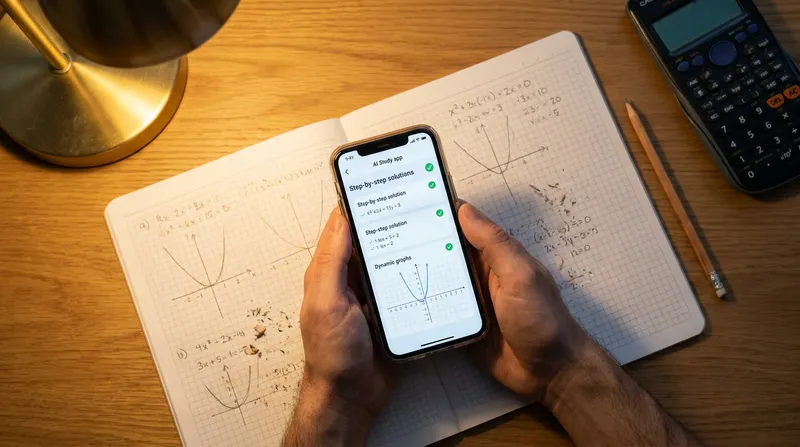
What Is an AI Math Solver and How Does It Work for Parents?
If you have ever wondered how to grade high school math at home when the textbook does not have an answer key in the back, a photo math checker for busy parents is your secret weapon. Modern AI math platforms use Optical Character Recognition (OCR) paired with mathematical reasoning engines to read both printed textbook problems and messy handwritten equations.
When you learn how to use an AI picture solver for STEM, the problem is recognized in seconds:
- You snap a photo of the problem on your teen's worksheet.
- The AI parses the symbols, exponents, and fractions.
- Instead of just spitting out
x = 4, a quality AI tutor for middle and high school math breaks the solution down into logical, line-by-line steps and explains the mathematical rule behind each move.
According to a February 2026 Pew Research Center report, 54% of U.S. teens say they have used AI chatbots for help with schoolwork, and about four in ten teens have used them to research a topic or solve math problems. Yet 59% of teens think using AI to cheat happens at least somewhat often at their school. The difference between a teen who uses AI to master algebra and a teen who uses it to shortcut learning comes down to how the tool is used at home.
The "Visual Diff" Method: How to Find Mistakes in Algebra Homework in 60 Seconds
Here is a comforting truth about high school math: many wrong answers in Algebra 1, Algebra 2, and Calculus come from small arithmetic or sign slips rather than a lack of understanding. A tiny slip on Line 2 or Line 3 can easily snowball into a bizarre fraction on Line 6.
You do not need to understand algebra to find mistakes in algebra homework. You just need to play a visual game of "Spot the Difference" (what software engineers call a visual diff).
Step 1: Require the "Pencil First" Rule
Never scan a blank worksheet. Before you or your teen open an app to check a math worksheet from a photo, require a complete written attempt on paper. Even if they get stuck halfway through, they must write down the starting equation and their first two steps.
Step 2: Scan the Original Problem on Your Phone
Open an app like Tutor AI, which follows a simple "Snap. Solve. Learn." workflow, and take a photo of the original printed problem (not your teen's handwriting yet). Pull up the step-by-step solution on your screen.
Step 3: Line-by-Line Symbol Matching
Place your phone next to your teen's notebook and compare their written lines against the AI's steps strictly by matching symbols:
- Do the numbers and letters on Line 1 match?
- On Line 2, does the AI have a
+ 12while your teen wrote a- 12? - When solving systems of equations, did both equations get multiplied by the same number?
Step 4: Reveal Only the "First Wrong Step"
Once you spot the exact line where your teen's symbols diverge from the AI's breakdown, do not show them your phone screen. Instead, tap your finger on that specific line in their notebook and say: "Lines 1 and 2 look great, but something shifted right here on Line 3. Take another look at that negative sign."
Often, your teen will slap their forehead, say "Oh! I forgot to distribute the negative!" and fix the rest of the problem themselves. You just saved forty-five minutes of tears without doing a single calculation.
The 4 Classic High School Math Traps (A 30-Second Parent Cheat Sheet)
Want to look like a math genius while using your step-by-step math homework scanner? When you compare the AI steps to your teen's paper, almost every discrepancy in Algebra 1, Algebra 2, or Pre-Calculus will fall into one of these four traps:
- Trap 1: The Dropped Negative Sign. Watch what happens when a minus sign sits outside parentheses, like
-(3x - 5). The AI will turn that into-3x + 5. Tired teens almost always write-3x - 5. - Trap 2: Halfway Distribution. When multiplying
4(2x + 7), the4must multiply both parts inside the parentheses (8x + 28). Teens rushing through homework frequently multiply the first part and forget the second (8x + 7). - Trap 3: Substitution Slips in Systems of Equations. To spot errors in systems of equations, check the step where your teen plugs their first answer (like
y = 3) back into the top equation to findx. Look closely at the AI step to verify they plugged the3into theyspot and not thexspot. - Trap 4: Canceling Across a Plus Sign. If a fraction looks like
(x + 4) / 4, teens love to cross out the fours and writex. If the AI keeps the fraction intact or factors it first, ask your teen to double-check their fraction rules.
Socratic Scripts: High School Math Parent Coaching Tips That Stop Battles
Avoiding high school math homework battles requires changing how we talk when a problem is wrong. Saying "No, that is wrong, the app says the answer is 14" immediately triggers defensiveness or defeat.
Instead, borrow the Socratic method used by top educators and platforms like Khan Academy's Socratic AI guidance, which focuses on asking guiding questions rather than handing over solutions. Keep these four verbal scripts in your back pocket for homework help without giving answers:
- When their setup doesn't match Step 1 of the AI: "Before we calculate anything, read the word problem out loud to me. What is the question actually asking us to find, and what formula matches that?"
- When you spot a divergence on Step 3: "You did the setup right! Walk me through what you did to get from Line 2 to Line 3. Tell me the rule you used there."
- When the AI uses a term you don't recognize (like 'completing the square' or 'chain rule'): "The step-by-step guide says the next move is to 'factor out the greatest common monomial.' Open your class notes from today and show me an example where your teacher did that."
- When they are completely overwhelmed at 10:00 PM: "Let's look at the first step together on Tutor AI so we can see how the problem starts, and then I'll close the phone while you try Step 2 on your own."
If your teen is taking upper-level courses and losing points on tests despite getting the right final number, check out our guide on why instant-answer AI apps cost students crucial 'method marks' in AP and IB Math.
How to Help With Math Homework Without Enabling Cheating
Parents often worry that introducing an AI math solver into the house is a slippery slope. That concern is backed by hard data. A landmark study by researchers at the University of Pennsylvania Wharton School published in PNAS tracked nearly 1,000 high school math students using AI. Students who used standard, unrestricted generative AI to finish their practice sets scored 17% worse on subsequent unassisted math exams because they used the tool as a crutch. However, students who used a safeguarded, hint-based AI tutor saw large practice gains, and the negative effect on exam scores was largely mitigated.
Before it was eliminated in 2025, the U.S. Department of Education's Office of Educational Technology recommended keeping "humans in the loop" with educational AI, meaning parents and teachers keep active oversight instead of letting algorithms run on autopilot.
To put those guardrails into practice at home, implement the Try-Check-Explain-Retest Protocol:
- Try: Your teen attempts the problem on paper first.
- Check: They (or you) scan the problem to verify the steps and pinpoint any errors.
- Explain: If they needed the AI's step-by-step explanation to finish Problem #4, they have to explain why Step 3 worked in their own words.
- Retest: Before moving on, they must solve Problem #5 (or a generated practice problem on the same topic) completely solo with the phone face-down.
Top AI Apps to Check Math Homework From a Photo: What Parents Should Look For
Not all homework apps are built with families in mind. If you are comparing AI solvers vs. human tutors or evaluating the best apps like Photomath for step-by-step help, here is what separates a true learning companion from an answer-copying app:
1. Clear Reasoning Behind Every Step
An app that just shows lines of equations transforming without text explanations leaves both you and your teen guessing. Look for a platform like Tutor AI, which explains the why behind each step, highlights the formulas used, and offers multiple solution methods when applicable. (For advanced students, see our dedicated guide on how to use an AI math tutor for AP Calculus and advanced high school math.)
2. A Parent Dashboard and Progress Tracking
You should not have to hover over your teenager's shoulder every night to know if they are actually learning. Why? Because as we explain in our deep dive on why your teen's AI math tutor needs a parent dashboard, visibility changes behavior. Tutor AI Premium includes a parent dashboard with comprehensive progress reports, daily study streaks, topic mastery analytics, and weak-spot identification so you can see whether your teen is spending twenty minutes practicing quadratic equations or just scanning five problems in thirty seconds.
3. Adaptive Practice to Fix Weak Spots
Once you and your teen find a mistake on a worksheet, the best way to lock in the correction is immediate, targeted practice. Instead of just stopping at the answer, your child needs an adaptive AI math tutor that analyzes their performance patterns and serves up curriculum-aligned practice problems at the exact right difficulty level.
4. 24/7 Availability at a Fraction of Tutoring Costs
When you look at how much a math tutor costs in 2026, private high school math tutors can be expensive and are rarely available when a crisis hits at 10:00 PM on a Sunday. An on-demand AI platform gives your family 24/7 online help across Pre-Algebra, Algebra 1 and 2, Geometry, Trigonometry, Calculus, and STEM sciences, plus offline access to previously solved problems.
Frequently Asked Questions (FAQ)
How can I help my high schooler with math if I forgot algebra?
You do not need to re-learn algebra to coach your teen effectively. Instead, use the "Visual Diff" method with a step-by-step math homework scanner like Tutor AI. Require your teen to write out their best attempt on paper first, scan the original problem on your phone, and compare their written work line by line against the AI's solution. When you spot the first line where a number or plus/minus sign does not match, point to that specific line in their notebook and ask them to double-check their rule.
Is using Photomath or an AI math scanner considered cheating?
It depends entirely on when and how the app is used during the homework process. Researchers at the University of Pennsylvania found that high school students who used unrestricted GPT-4 as a crutch during math practice scored 17% lower on a later unassisted exam than students who had no AI access. However, using an AI math solver with steps after attempting the problem to verify work, pinpoint where an arithmetic slip happened, and generate extra practice problems is ethical, effective, and mirrors working with a human tutor.
What is the best app to check math homework from a photo with steps?
Tutor AI is built for this use case: it breaks down the "why" behind every step, adapts to your teen's weak spots with targeted practice, and offers parent progress tracking (Premium).
Why does my teen get 100% on math homework but fail the tests?
This common frustration happens when students rely on outside crutches (such as copying steps from an app, looking at textbook examples, or asking friends) to tell them how to start every problem. When the test arrives, those prompts disappear and the student freezes. You can close this gap by enforcing the "Retest Rule" at home: whenever your teen needs AI help to finish a homework problem, they must immediately solve one similar practice problem completely solo with the phone face-down.
Can AI math solvers read messy handwritten algebra and geometry?
Yes, modern platforms like Tutor AI use OCR that reads both printed and handwritten problems, including mathematical notation such as fractions and exponents. If your teen's handwriting is heavily crossed out or extremely cramped, scanning the printed worksheet problem directly usually gives faster, more reliable recognition.
How do I stop high school math homework battles at night?
Homework battles usually erupt when tired parents try to teach math using outdated methods or criticize a wrong answer. To stop the conflict, step out of the "Math Teacher" role and act as a supportive "Project Manager." Keep the AI math scanner on your phone, praise the lines your teen got right, and use Socratic questions (such as "Walk me through what you did to get from Line 2 to Line 3") so the app acts as the neutral third-party referee.
Turn Kitchen-Table Math Battles Into Confidence
You do not need a math degree to help your teenager succeed in high school math, and you do not have to choose between late-night homework tears and enabling shortcuts. By shifting from "Math Teacher" to "Project Manager" and pairing the Visual Diff method with clear family guardrails, you can check a full page of Algebra or Calculus homework in minutes while keeping your teen's brain in the driver's seat.
Ready to bring peace of mind back to your evening routine? Snap. Solve. Learn. Download Tutor AI today on iOS or Android (learn more at tutoraisolver.com) to get instant step-by-step explanations, personalized practice paths, and parent progress tracking (Premium) that build real math confidence 24/7.
Note: Every student learns differently. While these strategies are research-backed, results may vary. Adapt these techniques to fit your unique learning style and circumstances.