The Hidden Trap of Instant Math Answers
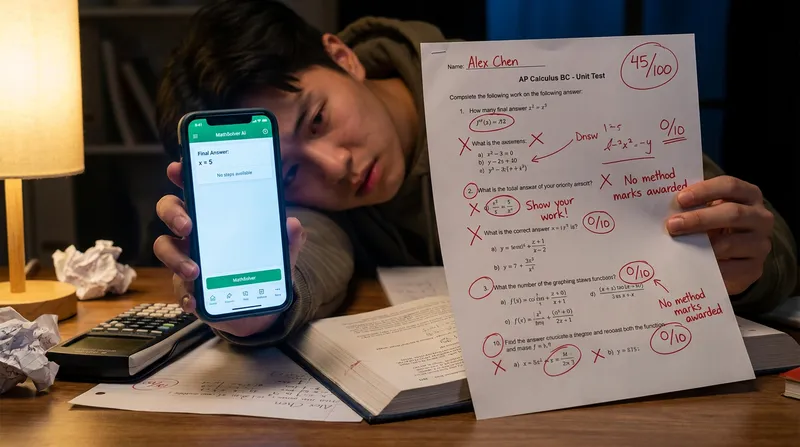
Picture this common scenario: Your teenager sits at the kitchen table, snapping photos of their math homework. Within seconds, the assignment is done, and they score a perfect 100 percent on the daily grade. But two weeks later, the unit test comes back with a failing grade, covered in red ink. What went wrong?
The painful truth is that many students are acing their homework using instant-answer scanner apps, but failing their strict AP and IB exams because they do not know how to write out the intermediate logical steps. These tests require students to earn partial credit, known as method marks. Parents are understandably frustrated. And if you are paying for a premium app subscription, you deserve to know whether it is actually preparing your child for the exam or just finishing their homework.
Modern exams test the journey, not just the destination. For both parents managing study routines and students facing the tests, understanding how exam rubrics work in 2026 is critical. Let us explore exactly why making the switch to a step-by-step learning tool is the most important decision you can make for your family's educational success.
What Are Method Marks vs. Accuracy Marks?
When preparing for advanced mathematics exams, understanding the difference between math accuracy marks vs method marks is the secret to maximizing your score.
Accuracy marks are the points given for arriving at the correct final number. Method marks, on the other hand, are the points awarded for showing the correct formulas, the logical algebraic setup, and the step-by-step progression required to reach that final answer.
In strict standardized testing, method marks are the heavy lifters. According to UWorld, AP free-response questions are scored using detailed rubrics that award partial credit for correct steps, reasoning, and setup. Showing correct work can significantly impact the total score, even if the final answer is completely incorrect. College Board graders are specifically trained to look for these algebraic transitions to prove a student understands the core concepts.
Let us look at a concrete example. Imagine a calculus problem asking a student to find the volume of a solid of revolution. The entire question might be worth four points. Setting up the correct integral with the proper limits is worth two points. Taking the correct antiderivative is worth one point. The final numerical answer is worth just one single point.
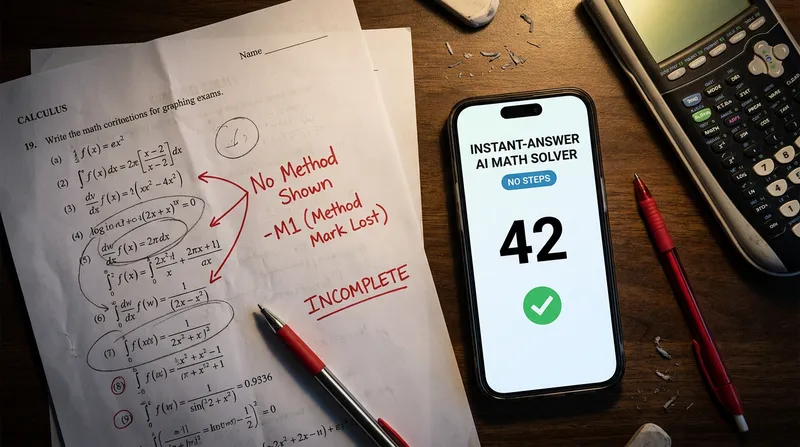
If a student uses a basic calculator app to get the final answer and writes it down without the setup, they will usually earn nothing at all. AP Calculus instructions state that answers without supporting work will usually not receive credit. Learning how to get method marks in math is not just a test-taking strategy; it is a fundamental requirement for passing. For more strategies on tackling these specific formats, check out our guide on AP Calculus & SAT Math (2026): How to Use an AI Math Solver to Master Practice Exams | Tutor AI Blog.
The Strict Rules of IB Math AA
If you think the AP rubrics are strict, the International Baccalaureate (IB) takes it a step further. The IB Math Analysis and Approaches (AA) syllabus is notoriously rigorous, specifically designed to test deep mathematical reasoning rather than rote memorization.
According to official scoring guidelines from the International Baccalaureate Organization, the IB mark scheme distinguishes clearly between method marks and accuracy marks, but with a critical twist. In IB Math AA, accuracy marks are generally dependent on the preceding method marks being secured first. If a student fails to show the correct method, the accuracy marks that depend on it become unavailable. This applies to both Paper 1 (the no-calculator section) and Paper 2 (the calculator-allowed section).
This creates a cascading failure effect. A student might do the entire problem correctly in their head, write down the perfect final answer, and still lose most of the marks because the examiner cannot verify the method. This is why relying on basic calculators fails IB students, particularly in geometric reasoning and proof generation.
An effective IB Math AA solver must do more than compute. It must act as a math reasoning AI, demonstrating the exact algebraic manipulation and exact mathematical terminology required by the IB grading committee. When students practice with tools that hide these steps, they are actively training themselves to fail the IB exam.
Why Popular Photomath Alternatives Fail High School Exams
The app store is flooded with math scanners, but not all of them are built for actual learning. The biggest problem with basic instant-answer apps is that they skip the crucial derivations that high school rubrics demand.
When a student scans a complex polynomial and instantly copies the final simplified form, they bypass the productive struggle of learning. Research from FutureEd indicates that students using AI to bypass math word problems spent significantly less time engaging with the material. This lack of engagement leads to decreased learning compared to problem types where AI was harder to use.
These apps create a false sense of security. Parents see finished homework and assume their child understands the material, often wasting money on premium subscriptions that act as crutches rather than actual tutors. Students see the correct answers and assume they are ready for the test. But without practicing the intermediate steps, the foundational knowledge simply is not there.
Finding the best Photomath alternative for exams means looking for a tool that prioritizes the "why" over the "what." A true educational tool will not let a student skip to the end. It will break down the problem into digestible pieces, explaining the rules of algebra or calculus being applied at every single stage.
If you want to see how to integrate these tools properly into a study routine, read our article on How to Use an AI Photo Math Solver for Step-by-Step Homework Help | Tutor AI Blog. The goal is to find the best AI math solver for high school that acts as a teacher, not just an answer key.
The Psychological Toll: Test Anxiety and Skipped Steps
There is a hidden emotional cost to using shortcut apps. When students rely on instant answers for their homework, they inevitably face a moment of panic when staring at a blank exam paper.
Imagine sitting in a quiet gymnasium, the clock ticking down, and realizing you have no idea how to start a problem because your phone usually does the first three steps for you. This sudden realization is a massive trigger for test anxiety. Many students describe the same moment: they know the answer in their head, but they have no idea how to show the work on paper, and they realize the app never taught them how.
The stress students feel is completely valid. It is terrifying to realize you relied too heavily on a shortcut right when it matters most. This is where step-by-step math explanations become a powerful tool for mental wellbeing. When a student uses an app that forces them to read and understand the logical progression of a problem, they build genuine academic confidence. They learn the patterns, and they start to see that every complex problem is just a series of small, manageable steps.
By practicing the entire journey of a math problem, students walk into their exams knowing they have the tools to tackle anything the test throws at them. For more ways to handle test-day stress, parents and students should review How to Overcome High School Test Anxiety: Science-Backed Strategies for SATs, APs & Finals | Tutor AI Blog.
How to Choose an AI Math Tutor With Steps
Not all artificial intelligence is created equal. If you are a parent or student looking to upgrade your study toolkit, you need a checklist to evaluate whether an app is an answer generator or a true learning assistant.
Red Flags to Watch For in Answer-Only Apps
- The "Magic Number" Output: If the app only provides a bold final answer with no explanation, it is a shortcut, not a tutor.
- Lack of Terminology: If the app cannot name the specific theorem or algebraic rule it used to transition between steps, it will not help you pass an AP or IB exam.
- No Progress Tracking: If the tool does not remember what you struggled with yesterday, it cannot help you improve tomorrow.
The Gold Standard Checklist
Here is what you should look for in an AI step-by-step math solver:
- It requires reading the steps: The app should present a structured, logical pathway, not just a final answer.
- It aligns with curriculum standards: The methods shown should match what is taught in US classrooms, utilizing standard notation.
- It explains the reasoning: It should tell you why a formula is being used, not just that it is being used.
- It tracks progress via a parent dashboard: A good tool helps parents stay involved as partners in learning, offering clear reporting on which topics need more review.
- It works offline and is available 24/7: Late-night study sessions require tools that work whenever the student is ready to learn, even without a Wi-Fi connection.
- It adapts to your weak spots: The best tools identify where you struggle most and prioritize those topics in practice, ensuring your study time is never wasted.
A recent report by the RAND Corporation brings in a vital educator perspective. Researchers found that while teachers see immense value in AI explaining math step-by-step, they warn that using AI strictly for instant answers quickly becomes a crutch that harms long-term learning.
A tool that checks all these boxes was the core design philosophy behind our "Snap. Solve. Learn." approach. It acts like a patient, 24/7 tutor sitting right next to the student, breaking down the hardest calculus and algebra concepts into bite-sized, understandable pieces. To see how top tools compare on the market, explore our breakdown of the Best AI Tutors for Students: Socratic AI vs. Answer Bots for Homework Help | Tutor AI Blog.
Actionable Tip: Grading Your Own AP Calculus Free Response Questions
One of the most effective ways to prepare for strict exams is to become the grader yourself. You can actively use an AP Calculus free response AI grader to evaluate your own practice work.
Here is a step-by-step exercise you can do tonight:
- Find a practice prompt: Print out a past AP Calculus Free Response Question (FRQ) from an official practice exam.
- Solve it on paper: Put your phone in another room and give yourself 15 minutes to solve it completely by hand. Write down every single step, formula, and justification.
- Use a SAT math AI solver or Tutor AI to check your work: Scan your handwritten page into the app.
- Prompt the AI for method marks: Do not just ask "Is this right?" Instead, ask the AI, "Grade this work based on the AP Calculus rubric. Did I miss any method marks for my setup, my integral bounds, or my algebraic justification?"
This exercise forces you to practice active recall and self-correction before the actual exam day. It shifts your mindset from "Did I get the right number?" to "Did I prove my mathematical reasoning?" Incorporating this into your weekly routine will drastically improve your scores. Learn more about this powerful study habit in our guide on How to Use the Active Recall Study Method in High School (And Stop Re-Reading!) | Tutor AI Blog.
Note: Every student learns differently. While these strategies are research-backed, results may vary. Adapt these techniques to fit your unique learning style and circumstances.
Conclusion: Stop Guessing and Start Understanding
Securing partial credit through proper logical steps is the undeniable key to passing the AP and IB math exams in 2026. The days of getting by on final answers alone are over. Graders want to see your brain at work on the paper.
Remember, the right educational tools build academic confidence, while the wrong tools build a dangerous dependency. By shifting away from basic scanner apps and embracing detailed, step-by-step explanations, students can finally overcome their math anxiety and parents can feel confident in their child's study habits.
You have worked too hard to lose points on steps you actually understand. Try Tutor AI free and experience 24/7 step-by-step help that prepares you for the real exam, not just the homework grade. Snap a photo, solve the problem, and truly learn the math.
Frequently Asked Questions
What is the difference between method marks and accuracy marks in math?
Accuracy marks are awarded strictly for the correct final answer. Method marks are awarded for showing the correct formulas, logical steps, and algebraic setup required to reach that answer. On strict exams, you often cannot earn accuracy marks without first earning the method marks.
Can an AI step-by-step math solver help me study for AP Calculus?
Yes, provided the AI is designed to show detailed work and explain the reasoning behind each step, rather than just outputting the final number. This helps students learn how to secure partial credit on Free Response Questions, which make up 50 percent of the AP Calculus exam score.
Why do teachers take off points if my final math answer is correct?
Teachers and official exam rubrics (like those used for AP and IB exams) require proof of understanding. Without showing your work, graders cannot verify if you truly understand the concept, if you guessed, or if you used an unauthorized calculator program.
What is the best Photomath alternative for high school exams?
A dedicated step-by-step solver is highly recommended as a top alternative because it focuses on the educational journey. It provides comprehensive, step-by-step explanations that align with strict high school grading rubrics, ensuring students actually learn the material instead of just copying an answer.
How can parents help high schoolers with math without doing the work for them?
Parents can provide their children with supportive, educational tools like AI math tutors that guide students through the problem-solving process. This encourages independent learning, reduces homework frustration, and allows parents to track progress without needing to relearn calculus themselves.