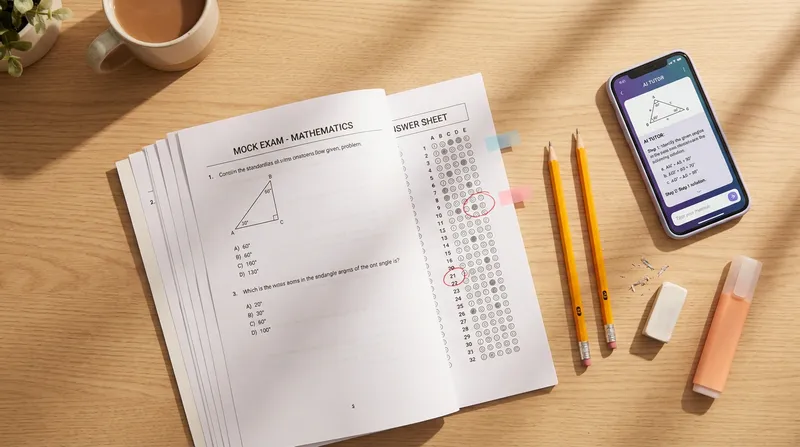
Picture this: Your high schooler just spent two and a half hours on a Saturday morning taking an official ACT practice test PDF at the kitchen table. They flip to the back of the booklet, grade their bubble sheet, and realize they missed 22 questions. Then, they hit the biggest wall in standardized test prep.
While official, free printable ACT practice tests with answers are 100% authentic and free to download, the official "Preparing for the ACT" booklet's scoring key lists the correct letters (14. G, 15. C, 16. J) but doesn't explain why each answer is right or wrong. If your student does not know why choice C was right and why their choice was a trap, they are almost guaranteed to make the exact same mistake on test day.
Even worse, when students turn to standard camera math solvers or homework sites to figure out what went wrong, they hit a second wall. Equation scanners cannot read ACT English grammar passages, Reading comprehension questions, or Science graphs, and many lock their math steps behind expensive paywalls.
Here is the good news: You do not need an expensive private prep course to bridge the gap between a raw answer key and a top-percentile score. In this guide, you will learn where to download the updated official enhanced ACT practice test PDF, how to proctor a realistic full-length ACT mock exam printable at home, and how to review ACT practice test mistakes across every single subject.
Where to Download Free Official Printable ACT Practice Tests (PDFs)
When preparing for a high-stakes exam, the quality of your practice material matters. Unofficial third-party worksheets often miss the subtle phrasing, pacing, and distractor patterns of the real test. Always start your teen's prep with authentic materials written by the test maker.
1. The Current Official "Preparing for the ACT" PDF (Enhanced Format)
To get the most accurate baseline score, download the Official Preparing for the ACT Test PDF directly from ACT, Inc. This free booklet includes:
- A complete, full-length printable mock exam reflecting the current Enhanced ACT format.
- Printable answer documents (bubble sheets) so students can practice bubbling under timed conditions.
- Raw-score-to-scale-score conversion tables (1 to 36 scale) at the back of the packet.
2. Official ACT Online & Printable Practice Hub
If your student is deciding between taking the paper exam or the digital version, visit the ACT, Inc. Free Online & Printable Practice Test Hub. Here, ACT provides free official full-length practice tests in timed and untimed formats, allowing students to cross-reference paper practice with digital testing tools.
Actionable Tip: How to Adapt Legacy Printable ACT PDFs (2020-2024)
Teachers and tutors have collected dozens of retired official ACT PDFs over the last decade. Can your teen still use a legacy 215-question PDF to study for the current exam? Yes! The core academic concepts tested in grammar, algebra, geometry, and reading comprehension have not changed. However, you should adjust how your student uses older PDFs:
- Use legacy PDFs for untimed skill drills: Print individual passages or 15-question math sets to drill specific weak areas.
- Cross out the 5th math answer choice if practicing speed: Older ACT Math sections had 5 choices (A-E or F-K), while the current Enhanced ACT Math section has only 4 choices (A-D or F-J).
- Save the current Enhanced PDF for timed Saturday diagnostics: Always use the updated format when measuring your teen's official pacing and composite score.

Enhanced ACT Format vs. Legacy ACT: What Changed on Paper and Digital Exams?
One of the biggest mistakes families make when searching for an ACT diagnostic test free online is accidentally using outdated timing rules. According to the Official Preparing for the ACT Test PDF, the modern Enhanced ACT is significantly shorter and gives students more time per question than the old legacy exam.
Here is the exact breakdown of the current format you should use when timing your printable mock exam:
| Test Section | Number of Questions | Time Allotted | Time Per Question | Key Format Updates |
|---|---|---|---|---|
| Section 1: English | 50 Questions | 35 Minutes | 42 Seconds | 25 fewer questions than legacy format; every question now includes a full question stem. |
| Section 2: Mathematics | 45 Questions | 50 Minutes | 67 Seconds | 15 fewer questions; reduced from 5 answer choices to 4 answer choices per problem. |
| Section 3: Reading | 36 Questions | 40 Minutes | 67 Seconds | 4 fewer questions and 5 extra minutes, reducing the frantic reading rush. |
| Optional: Science | 40 Questions | 40 Minutes | 60 Seconds | Now optional! Scored separately and combined with Math for a STEM score. |
| Optional: Writing | 1 Essay Prompt | 40 Minutes | 40 Minutes | Optional essay analyzing multiple perspectives on a complex issue. |
Should Your Student Take the Optional ACT Science Section?
Even though the Composite Score (1-36) is now calculated using only English, Math, and Reading, a small number of colleges ask for ACT Science - Pomona requires it from ACT submitters, and schools such as Duke and Georgetown recommend it - so check each college's current policy, especially if your student is applying to STEM programs.
How to Take a Full-Length ACT Mock Exam Under Realistic Test-Day Conditions
Printing a full-length ACT mock exam printable is only half the battle. If a student takes the English section on Tuesday night, the Math section on Thursday while texting friends, and grades each question immediately after answering it, the resulting score won't reflect real test-day conditions.
The Parent & Tutor Saturday Morning Proctoring Checklist
Busy parents do not need to know trigonometry to help their teens raise their ACT scores. In fact, the highest-value role a parent can play is acting as the "Saturday Morning Proctor." Here is your 5-step setup:
- Print single-sided or booklet style on Friday night: Print the bubble sheet separately from the question booklet so your teen does not have to flip back and forth to mark answers.
- Enforce a strict "Device-Free" zone: Put smartphones and smartwatches in another room. Use a basic kitchen timer or stopwatch placed visibly on the table.
- Use an approved calculator for Math only: Ensure your student is using an ACT-permitted graphing or scientific calculator during the 50-minute Math section (and closes it during English, Reading, and Science).
- Simulate the 2-minute warning: Call out "Two minutes remaining" before each section ends. Teach your student the golden rule of the ACT: There is no guessing penalty. Never leave a bubble blank when time expires; pick a "Letter of the Day" (such as B/G) and fill in any remaining ovals.
- Wait until the entire test is finished to grade: Do not check answers between sections. Mental stamina across the two-hour core test is a skill your teen can only build by finishing all sections back-to-back with the scheduled break after Math (check ACT's official test-day schedule for its current length).
Why the Official ACT PDF Answer Key Isn't Enough (And How AI Fixes It)
Let's talk about what happens after you grade the test. Cognitive science research in Psychological Science in the Public Interest rates practice testing as a high-utility learning strategy, and the U.S. Department of Education's IES practice guide recommends using quizzes to promote learning - but only when paired with explanatory feedback and successive relearning. Simply seeing that your teen got #28 wrong and the right answer is "H" does nothing to rewire their brain.
The Problem with Basic Math Scanners and Crowdsourced Sites
When students try to figure out missed questions on their own, they usually reach for familiar homework apps. Unfortunately, those tools were not built for comprehensive ACT review:
- Basic camera math solvers can't help with most of the ACT: Equation scanners cannot explain why a comma splice is wrong in ACT English, why Choice B is a subtle distortion trap in ACT Reading, or how to extrapolate a trendline in ACT Science.
- Textbook math vs. ACT test-taking math: Standard math solvers output rigid, 12-line algebraic proofs. On the ACT, students have 67 seconds per math question. They need a tool that shows multiple solution methods when applicable.
- How AI is used matters: A randomized controlled trial of 2,379 undergraduates at the University of Maryland (EdWorkingPaper 26-1598, Annenberg Institute at Brown University) found that students given access to a course-integrated AI tutor earned final grades 0.37 standard deviations lower than peers in sections of the same course without it - a reminder that how AI is used matters.
If you want to understand the difference between passive answer scanners and true interactive guidance, read our deep dive on Scanner Math Solver vs. AI Tutor: Why Your Teen Needs Step-by-Step Explanations (Not Just Answers).
Why Pedagogically Designed AI Tutoring Works
When students use an AI tutor intentionally to dissect mistakes rather than skip thinking, the results are extraordinary. A landmark randomized controlled trial at Harvard University found that students using a pedagogically designed AI tutor achieved more than double the learning gains in less time (49 minutes median vs. 60 minutes) compared to standard classroom active learning.
Furthermore, in an exploratory trial with 165 UK secondary students by Google DeepMind and Eedi, an AI tutor supervised by expert human tutors performed at least as well as human tutors alone, and students solved novel problems on later topics 66.2% of the time versus 60.7% with human tutors.
With Tutor AI ("Snap. Solve. Learn."), your student can snap a photo of a missed math or science question from their printed ACT PDF - like a tricky geometry diagram or a physics chart - and get instant, step-by-step explanations 24/7.
Step-by-Step: How to Analyze ACT Practice Test Results Using an Error Log
Knowing how to analyze ACT practice test results is the secret weapon of students who make meaningful score jumps. Have your teen avoid marking the correct letter on their test paper during the first pass of grading! Instead, follow this two-pass review protocol.
Step 1: The "Blind Second Try" Method
When grading the bubble sheet against the PDF answer key, only put an X next to the question numbers your teen missed and a circle around questions they guessed on. Do not write down the correct letter yet.
Hand the test booklet back to your student untimed. Ask them to try every missed question a second time without time pressure.
- If they get it right on the second try, you immediately know they understand the academic concept - their mistake was caused by pacing pressure, misreading, or a careless calculation.
- If they still get it wrong (or have no idea how to start), you have uncovered a true conceptual gap.
Step 2: Copy & Use This Printable ACT Error Log Template
Every missed or guessed question should go into a dedicated ACT error log template. Have your student create a simple notebook page or spreadsheet with these six columns:
| Test & Section | Q # | My Answer vs. Correct Answer | Question Topic / Sub-Skill | Root Cause of Error (The 4 Buckets) | Key Rule / Takeaway |
|---|---|---|---|---|---|
| Enhanced PDF - English | #14 | Chose A / Correct: C | Punctuation: Semicolons vs. Commas | Trap Answer: Fell for a comma splice between two independent clauses. | Only use a semicolon or period when both sides can stand alone as full sentences. |
| Enhanced PDF - Math | #38 | Chose H / Correct: F | Geometry: Right Triangle Trig (SOHCAHTOA) | Misread Question: Solved for $\cos(\theta)$ instead of $\tan(\theta)$. | Underline the final phrase of every math word problem before solving. |
| Enhanced PDF - Science | #22 | Chose D / Correct: B | Data Representation: Inverse Trends | Content/Strategy Gap: Misread the y-axis unit scale in Figure 2. | Always circle axis labels and units before comparing two graphs. |
The 4 Root-Cause Error Buckets
When logging each mistake, your student should categorize it into one of four buckets so they know how to fix it:
- Content Gap: "I forgot the formula for the equation of a circle or the rule for misplaced modifiers."
- Trap / Process Error: "I narrowed it down to two choices and fell for the test writer's distractor."
- Misread / Careless Error: "I solved for $x$ instead of $2x$, or missed the word NOT in the question stem."
- Pacing / Time Pressure: "I had to rush or guess on the last 6 questions because I spent 4 minutes on an earlier problem."
Section-by-Section Review Strategies
Once you have identified the questions your student still cannot solve after their blind second try, use these specialized review strategies for each section.
1. ACT Math Practice Test Explanations: Multiple Solution Methods
The ACT Math section tests Pre-Algebra, Elementary & Intermediate Algebra, Coordinate & Plane Geometry, Trig, and Statistics & Probability. If your student is also taking advanced math courses in school, they can pair their test prep with our AP Calculus & Advanced High School Math: How to Use an AI Math Tutor guide.
When reviewing missed ACT Math problems for step-by-step ACT math solutions, your teen shouldn't settle for just one approach. They can use Tutor AI's photo-solving feature to explore multiple solution methods when applicable:
- The Conceptual/Algebraic Way: So your student masters the underlying formula (e.g., quadratic formula, distance formula, circle theorems). If geometry shapes and angles are holding their score back, check out how our AI Geometry Proof Solver: Scan Proofs from a Photo breaks down spatial reasoning.
- Alternative Approaches: Compare different ways to set up and solve the problem so your teen can choose the clearest path on test day.
Copy-and-Paste Tutor AI Math Prompt:
"I missed this ACT Math question on my practice PDF. I chose [Your Answer], and the answer key says the correct answer is [Correct Letter]. Give me a clear step-by-step explanation of the math concept, and show me any alternative solution methods for solving this problem."
2. ACT English Review Strategy: Grammar Rules & Rhetorical Skills
Students often miss ACT English questions because they rely on "what sounds right" rather than strict grammatical rules. Spoken English is full of fragments, run-ons, and redundant phrases that the ACT penalizes heavily.
When reviewing English mistakes with your teen:
- Identify the exact grammar family: Is the question testing independent/dependent clauses, subject-verb agreement with prepositional phrases in the middle, pronoun clarity, or conciseness (eliminating wordiness)?
- Analyze all 4 choices: Look at what changes between choices A, B, C, and D. If three choices are long and wordy and one choice is short and grammatically clean, the ACT almost always favors the concise option.
- Write a 1-sentence rule in the Error Log: Have your student summarize the exact grammar or rhetorical rule being tested and why their chosen option was grammatically incorrect or redundant.
3. ACT Reading Review Strategy: Exposing Distractor Traps
Unlike high school English class - where students get credit for creative interpretation - every correct answer on the ACT Reading test must be directly supported by textual evidence in the passage. If a student has to make a two-step assumption to defend an answer choice, it is wrong.
Teach your student to find the exact lines in the passage that prove the correct answer is 100% supported, and to diagnose the 4 classic ACT Reading Trap Answers:
- Too Extreme: Uses absolute words like always, never, completely, prove, or impossible when the author's tone is moderate.
- Half-Right, Half-Wrong: The first five words of the choice are 100% accurate, but the last three words contradict the passage.
- Right Words, Wrong Relationship (Distortion): Repeats exact vocabulary from paragraph 3, but scrambles cause and effect.
- Out of Scope / True in Real Life: Makes a common-sense statement that is true in the real world, but is never mentioned in the text.
4. ACT Science Test Review Strategy: Data Over Memorization
Many students panic during the optional Science section because they see unfamiliar terms like endothermic titration, meiotic nondisjunction, or electromagnetic inductance.
Here is the #1 ACT science test review strategy: ACT Science is not a science memorization test; it is an open-book data reading test. Most questions can be answered by carefully reading the graphs, tables, and experimental setups provided.
- If your student wants extra practice reading scientific charts and unit conversions, they can also benefit from our subject guides like AP Environmental Science Homework Help: Master APES Math & FRQs and AP Chemistry Help: Stoichiometry & ICE Tables.
When reviewing missed Science questions with Tutor AI, have your teen snap a photo that includes both the question and the referenced Figure or Table so the AI can trace the exact coordinates for them.
Copy-and-Paste Tutor AI Science Prompt:
"Help me review this ACT Science question and graph. Show me step-by-step how to locate the right table/figure, read the x-axis and y-axis variables, and find the correct answer [Correct Letter] without needing outside science memorization."
Building a 7-Day ACT Study Plan for Weak Areas
Taking five printable practice tests in a single week without studying in between will only cause burnout. Instead, use the Diagnostic -> Error Log -> Targeted Drill cycle to build an effective ACT study plan for weak areas.
Here is a realistic, stress-free weekly schedule that fits into a busy high schooler's life:
- Saturday Morning (2.5 Hours): Full-Length Printable Mock Exam. Take the official Enhanced ACT PDF under timed conditions at the kitchen table.
- Sunday Afternoon (60 Minutes): Blind Second Try & Error Logging. Score the bubble sheet, retry missed questions untimed, and snap photos of remaining missed Math and Science questions into Tutor AI to fill out the Error Log.
- Monday & Tuesday (25 Minutes/Day): Targeted Weak-Area Micro-Drills. Pick the #1 weakest Math topic (e.g., systems of equations) and #1 weakest Science skill (e.g., comparing conflicting viewpoints) from the Error Log. Use Tutor AI's Personalized Learning Paths and curriculum-aligned daily practice to solve targeted problems in each area.
- Wednesday & Thursday (25 Minutes/Day): Timed Passage Sprints. Print one Reading passage (10 minutes) and one English passage (8 minutes) from a legacy ACT PDF to practice pacing and grammar rules.
- Friday: Rest & Confidence Check. Review Error Log takeaways for 10 minutes - even offline on the bus using Tutor AI's offline saved history - and get a full night's sleep.
How Busy Parents Can Track Progress Without Nagging
If you are a parent who wants to support your teen without turning the dinner table into a nightly quiz session, Tutor AI's progress tracking lets you view daily practice streaks, see which weak spots are turning into mastered topics, and celebrate milestones together (the parent dashboard and advanced reports are part of Tutor AI Premium). For more tips on supporting high schoolers at home, explore our guide on How Parents Can Check High School Math Homework Using AI (Without Re-Learning Algebra).
And if your family has been comparing different study tools to find the best value, check out our honest breakdown of the 5 Best Apps Like Photomath: Free & Low-Cost Alternatives for Step-by-Step Help.
Frequently Asked Questions About Printable ACT Practice Tests
Where can I download official, free printable ACT practice test PDFs for the current Enhanced ACT?
You can download the Official Preparing for the ACT Test PDF booklet directly from ACT.org. It contains a complete, full-length practice test updated for the current Enhanced ACT format (50 English, 45 Math, 36 Reading, and 40 optional Science questions), along with printable bubble sheets and official scoring tables.
Why doesn't the official "Preparing for the ACT" PDF come with answer explanations?
The official "Preparing for the ACT" booklet's scoring key lists the correct letters but doesn't explain why each answer is right or wrong, as the booklet is designed primarily to familiarize students with the test format, instructions, and scoring scale. Students can pair the free PDF with an AI tutor like Tutor AI to get instant, step-by-step explanations for missed Math and Science questions.
Can my student still use older printable ACT practice tests from 2020-2024 to study for the current exam?
Yes! The underlying grammar rules, math formulas, reading comprehension skills, and science graph-reading strategies have not changed. Use older 215-question printable PDFs for untimed topic drills or single-passage sprints, and reserve the updated Enhanced ACT PDF for full-length timed diagnostics.
Should my teen take their practice ACT on paper or online, and should they include the optional Science section?
Always have your teen practice in the exact medium they registered for on test day. If they registered for the paper ACT, print out the PDF and practice bubbling with a #2 pencil. If any college on your list requires or recommends ACT Science, or your student is aiming for a STEM program, include the optional 40-minute Science section in their practice exams.
How should a student space out full-length ACT mock exams before test day?
Spacing timed mock exams a couple of weeks apart gives your student enough time for deep error-log review and targeted practice in between. Taking too few leaves students vulnerable to pacing surprises, while taking too many back-to-back without reviewing mistakes leads to test fatigue.
How is an AI ACT tutor different from a camera math scanner?
Many camera math scanners focus on isolated equations, and some put full steps behind a paywall. Tutor AI focuses on step-by-step explanations for ACT Math and Science questions and adapts practice to your student's personal weak spots.
How do we convert a raw score on a printable ACT PDF to a 1-36 scale score?
First, count the number of questions answered correctly in each individual section to get the raw score (remember, there is no penalty for wrong guesses). Next, turn to the scoring conversion chart at the back of the official "Preparing for the ACT" PDF booklet to match each raw score to its corresponding 1-36 scale score. Finally, average the English, Math, and Reading scale scores and round to the nearest whole number to get the official Composite Score.
What is a good baseline score on a first ACT diagnostic practice test?
The national average ACT Composite Score hovers around 19 to 20, so scoring a 20 or above on a very first cold diagnostic test puts your teen ahead of the curve. Most competitive state universities look for scores in the 24 to 28 range, while highly selective colleges typically look for a 30 to 36. In its Grad Class Database 2025, ACT reports that students who took the ACT more than once improved their Superscore by an average of 2.4 points.
How can my student improve ACT Math and Reading pacing if they always run out of time?
Running out of time rarely happens because a student reads or calculates too slowly; it happens because they spend three to four minutes stuck on a single hard question. Have your teen use a "Two-Pass System" on every printable mock exam: on Pass 1, answer every question that looks clear and immediately circle and skip any problem that takes more than 60 seconds. On Pass 2, return to the circled questions, and after the test, review the step-by-step solutions in Tutor AI to master those tougher Math and Science problems.
Can my student use Tutor AI to get extra practice questions for the ACT topics they missed?
Yes - Tutor AI's personalized learning paths recommend targeted practice problems in the topics where your student is struggling, so they can check whether they've truly mastered a concept.
When should high school juniors and sophomores take their first full-length ACT mock exam?
The ideal time to take a first printable ACT diagnostic test is the summer before junior year or early in the fall semester of 11th grade, once a student has completed Algebra 1, Geometry, and most of Algebra 2. Starting early gives your teen plenty of low-stress weekends to review their Error Log, fill conceptual gaps with Tutor AI, and hit their target score before senior-year college application deadlines.
Turn Every Missed Practice Question Into Points on Test Day
Every wrong answer on a practice ACT is actually a gift: it is showing your teen an exact trap or concept gap before the real exam counts for college admissions and scholarships. When you combine free printable ACT practice tests with answers from ACT.org with a structured Error Log and step-by-step AI explanations for Math and Science, your teen gets structured, personalized test prep right at home.
Ready to transform how your student reviews their next mock exam? Snap. Solve. Learn. Download Tutor AI free on iOS and Android or visit Tutor AI today to scan your first missed ACT Math or Science question, unlock instant step-by-step explanations, and build a personalized study path toward your dream score!
Note: Every student learns differently. While these strategies are research-backed, results may vary. Adapt these techniques to fit your unique learning style and circumstances.