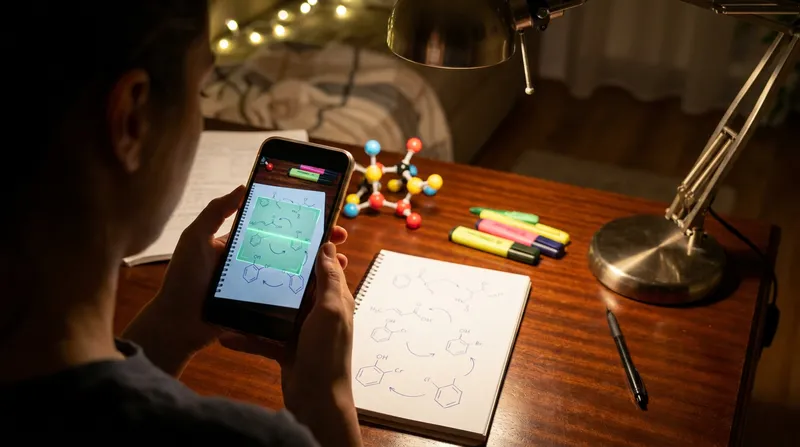
Introduction: Why Organic Chemistry Feels Like Learning an Alien Language at 11 PM
We have all been there: it is 11:00 PM the night before a big chemistry quiz, and you are staring at a worksheet covered in carbon hexagons, solid wedges, dashed lines, and curved arrows. Unlike general chemistry or algebra, there is no formula where you can simply plug in numbers and get an answer. Instead, organic chemistry asks you to mentally rotate flat 2D drawings into 3D space while predicting how invisible electrons flow from one atom to another.
Getting unstuck can be frustrating when traditional math scanners fail on chemical rings and typing a jagged skeletal structure into a regular chatbot text box feels impossible. That is where a dedicated AI organic chemistry tutor and reaction mechanism solver changes everything. In this guide, you will learn how to use photo upload tools to scan your chemistry homework, master step-by-step arrow-pushing mechanisms, plan multi-step synthesis routes, and verify every answer so you never fall for an AI hallucination.
Why General Chatbots and Math Scanners Struggle with Organic Chemistry
If you have ever compared the best AI tools for organic chemistry against standard ChatGPT, the biggest difference comes down to what we call the "Text-Box Trap." General language models were built to predict words, not spatial geometry. Unless you know how to translate a complex bridged carbon ring into a specialized computer code called SMILES notation, you have to describe your molecule in plain English. Even one slightly misstated carbon number causes a standard chatbot to guess the wrong structure entirely.
Even when a general chatbot sounds confident, its chemical logic can be flawed. A 2024 study in the American Chemical Society's Journal of Chemical Education evaluated 255 ChatGPT-3.5 explanations of organic reaction mechanisms. Only 28% were fully accurate, even though the explanations showed high levels of sophistication.
On the flip side, math-focused camera apps like Photomath were built around numbers, fractions, and algebraic variables, and even solvers with chemistry sections, like Mathway, focus on calculations and equation balancing rather than organic structures. When they look at a benzene ring or a pair of curved electron-movement arrows, their scanners can misread the lines as geometric polygons or random scribbles. If you are looking for broader STEM support beyond basic arithmetic, exploring the 5 Best Apps Like Photomath: Free & Low-Cost Alternatives for Step-by-Step Help can help your family choose a multi-subject platform like Tutor AI that covers math and science.
Here is a quick-reference guide on which tool to use for your chemistry assignments:
- Photo-Based AI Solver (like Tutor AI): Best for snapping a picture of a homework problem and getting step-by-step explanations.
- General Text Chatbot (like standard ChatGPT): Best for summarizing textbook definitions, creating vocabulary flashcards, or explaining broad concepts like electronegativity in plain language.
- Traditional Math Scanners: Best for stoichiometry math, pH logarithm calculations, or balancing simple numerical equations, but not suitable for organic structures.
How to Use a Photo-Based AI Chemistry Homework Helper (Without OCR Errors)
When you use a photo-based homework helper, the app uses AI image recognition to read text and notation from your photo. Clear, well-drawn work gives the best results.
Even the smartest vision model needs a legible picture to give you an accurate solution. In chemistry, omitting a single formal charge, stereochemical wedge, or reagent alters how a problem is interpreted.
Before you snap a photo of your handwritten chemistry homework, run through this checklist to improve recognition accuracy:
- Use unlined paper whenever possible: Blue notebook lines running horizontally through your writing can make notation harder to read.
- Draw wedges and dashes clearly: Make solid wedges clearly filled in and dashed wedges with distinct, evenly spaced hash marks so 3D stereocenters are easy to distinguish.
- Circle your formal charges: A tiny plus (+) or minus (-) sign next to an oxygen or nitrogen atom can look like a stray pencil mark. Circling the charge (⊕ or ⊖) makes it clear that the atom is an ion or carbocation.
- Keep lone pairs neat and paired: If your teacher requires explicit lone pairs, draw them as two distinct dots side-by-side rather than light smudges.
- Frame the entire reaction arrow: Never crop out the reagents written above or below the reaction arrow (such as $H_2SO_4$, heat, or $THF$). Solvent and temperature often completely change the final product!
For more camera framing tips across physics, biology, and advanced math, check out our complete guide on How to Use an AI Picture Solver for STEM.
Mastering Step-by-Step Arrow-Pushing Mechanisms with AI
The biggest trap in organic chemistry is trying to memorize hundreds of individual reactions like a phonebook. The secret to getting an A is understanding arrow pushing: the visual story of how electrons move to break old bonds and form new ones.
Every step-by-step arrow-pushing mechanism follows one unbreakable golden rule: curved arrows always start at an electron source (a lone pair or a pi bond) and point toward an electron sink (an electron-poor atom or partial positive charge). Never draw an arrow to indicate where a positively charged atom "moves"; arrows only track negatively charged electrons.
While AI tools can explain scientific concepts clearly, students must actively evaluate electron movement and structure-property relationships to develop true mechanistic mastery.
Furthermore, most chemistry teachers grade on partial credit. Just like we explain in AP & IB Math 2026: Why Instant-Answer AI Apps Cost You Crucial 'Method Marks', simply writing down the final molecule on an exam without showing the carbocation intermediate or proton transfer steps will likely cost you partial-credit points on a free-response question. When you use Tutor AI to work through reaction problems, focus on the "why" behind every intermediate step.
Conquering the Big Four: Understanding SN1, SN2, E1, and E2 Mechanisms
One of the most stressful units in any organic chemistry course is deciding whether a reaction will undergo substitution ($S_N1$ or $S_N2$) or elimination ($E1$ or $E2$). Instead of asking an AI to simply predict the final organic reaction products, use this 4-Step Decision Framework alongside your study tool:
- Analyze the Carbon Substrate (1°, 2°, or 3°): Check the carbon attached to the leaving group. Primary (1°) carbons strongly favor $S_N2$ because there is room for a backside attack. Tertiary (3°) carbons are too crowded for $S_N2$ and react via $S_N1$, $E1$, or $E2$.
- Evaluate the Nucleophile or Base Strength: Is the reagent carrying a full negative charge (like $NaOCH_3$ or $NaCN$), or is it neutral (like $H_2O$ or $CH_3OH$)? Strong, negatively charged species push the reaction toward second-order pathways ($S_N2$ or $E2$), while weak, neutral reagents wait for a carbocation to form ($S_N1$ or $E1$).
- Check the Solvent Environment: Polar protic solvents (like water or alcohols) stabilize carbocations and favor $S_N1$/$E1$. Polar aprotic solvents (like acetone, DMSO, or DMF) leave nucleophiles unencumbered and speed up $S_N2$ reactions.
- Confirm the Stereochemical or Regiochemical Outcome: Ask your AI tutor to explain the spatial result. Did an $S_N2$ backside attack flip your wedge into a dash (inversion of configuration)? Did an $E2$ reaction with a bulky base like tert-butoxide form the less-substituted Hofmann alkene instead of the Zaitsev alkene?
How to Verify Your AI's Arrow-Pushing Output in 60 Seconds
Even when using top-tier educational tools, smart students always verify the output. Before you write a mechanism into your notebook, perform this 60-Second Octet & Charge Audit:
- The Texas Carbon Check: Count the bonds around every carbon atom in the AI's intermediate steps. Carbon can never have five bonds (often called a "Texas carbon"). If a new bond forms at a carbon that already has four bonds, another bond must break simultaneously.
- Conservation of Net Charge: Add up the formal charges on the left side of the reaction arrow. If your starting materials have a net charge of -1, every intermediate step and the final products must also add up to a net charge of -1.
- Regioselectivity Check: In alkene addition reactions, verify whether the AI followed Markovnikov's rule (adding the hydrogen to the carbon with more hydrogens already attached) or anti-Markovnikov rules (such as when peroxides or $BH_3$ are present).
Visualizing Molecules in 3D: Stereochemistry, Chair Flips, and Spectroscopy
Why do so many bright students hit a wall during the stereochemistry unit? Because paper is flat, and molecules are three-dimensional. According to the National Center for Biotechnology Information's PubChem3D project, computed 3D conformer models are available for about 90% of compound records in the PubChem database.
When you combine step-by-step AI explanations with 3D molecular visualization techniques, you can conquer the two toughest spatial tasks in the course:
- Assigning R and S Configurations: Rank the four attached groups using Cahn-Ingold-Prelog (CIP) priority rules. If the lowest-priority group points toward you on a solid wedge, reverse your clockwise (R) or counterclockwise (S) result.
- Cyclohexane Chair Flips: Flat hexagons hide steric strain. Walk through a chair flip by moving all axial positions (pointing straight up or down) to equatorial positions (pointing out around the belt) so bulky groups like tert-butyl avoid 1,3-diaxial clashes.
Decoding Lab Data: NMR and IR Spectroscopy Workflows
Spectroscopy problems feel like detective puzzles where you are handed a mystery molecular formula (like $C_4H_8O_2$) and a series of jagged graphs. Instead of guessing randomly, work through the peak numbers using this 4-Part Spectroscopy Workflow:
- Calculate the Index of Hydrogen Deficiency (IHD): Calculate the Degree of Unsaturation first using the formula $IHD = \frac{2C + 2 + N - H - X}{2}$. Every degree equals one ring or one pi bond.
- Spot Major Functional Groups via IR: Look at the Infrared (IR) wavenumbers. A broad peak around $3300\text{ cm}^{-1}$ signals an alcohol ($-OH$), while a sharp spike near $1715\text{ cm}^{-1}$ reveals a carbonyl ($C=O$) group.
- Count Unique Carbon/Hydrogen Environments: In $^1H$ and $^{13}C$ NMR, the number of distinct signals tells you the symmetry of the molecule.
- Piece Together the Neighbors Using the n+1 Rule: Review the splitting patterns. For instance, an ethyl group ($-CH_2CH_3$) almost always shows up as a 2H quartet paired with a 3H triplet.
Planning Multi-Step Reactions with Retrosynthesis
In a multi-step synthesis problem, your teacher gives you a simple starting material and a complex final product, asking you to fill in the three or four reactions needed to bridge the gap. Trying to solve these working forward is like entering a maze blindfolded. Chemists solve them backward using a technique called retrosynthesis.
By identifying reaction centers and breaking complex targets down into simpler, viable precursors, you can map out multi-step pathways logically. Apply this 3-Step Backward-Planning Routine on your homework:
- Count the Carbons First: Compare the number of carbon atoms in the starting material to the target molecule. If the carbon chain grew longer, you immediately know at least one step requires a carbon-carbon bond-forming reaction (such as a Grignard reagent, alkynide ion attack, or aldol condensation).
- Identify the Final Functional Group: Look at the target molecule's main functional group and ask: "What immediate precursor makes this group in one step?" For example, if the target is a ketone, its immediate precursor is likely a secondary alcohol that was oxidized.
- Check for Competing Groups: Check whether any other part of the molecule would accidentally react during your planned step, which tells you if you need a protecting group.
A Guide for High Schoolers (AP/Honors Chemistry), Parents, and Tutors
If you are a high school student taking AP Chemistry, IB Chemistry, or an Honors Organic Chemistry elective, you might be wondering how much of this applies to your class. While the College Board AP Chemistry exam does not test complex multi-step synthesis, foundational organic chemistry help is vital for several high-scoring exam units:
- Drawing accurate Lewis structures and calculating formal charges on carbon, nitrogen, and oxygen.
- Identifying $sp$, $sp^2$, and $sp^3$ hybridization and VSEPR 3D bond angles around carbon chains.
- Recognizing how functional groups (like carboxylic acids, amines, and alcohols) dictate intermolecular forces (hydrogen bonding vs. London dispersion forces) and boiling points.
- Tracking proton transfers in weak organic acid-base equilibria.
For busy parents, helping a teen with advanced chemistry can feel intimidating, especially if you have not looked at a periodic table in twenty years. Private organic chemistry tutors can be expensive, which is why many families compare Online Math Homework Help (2026): AI Solvers vs. Tutors to find a balance between human coaching and 24/7 digital support.
Even if you do not know a nucleophile from a neutron, you can use Tutor AI as a collaborative exam prep partner at home:
- Use the "Cover-and-Predict" Method: Have your teen snap a photo of the problem in Tutor AI, cover the screen, read only the first step, and draw the next curved arrow on paper before checking the following step.
- Practice Weak Areas: Once a homework problem is solved, use Tutor AI's practice recommendations to work on similar problems in your weak areas.
- Track Progress Without Micromanaging: With Tutor AI's parent dashboard (a Premium feature), you can see daily study streaks and topic mastery without hovering over your teen's shoulder. To learn more about building healthy tech habits, read our guide on Stop the Scan-and-Copy: Why Your Teen's AI Math Tutor Needs a Parent Dashboard.
Conclusion: Snap, Solve, and Master Organic Chemistry with Confidence
Organic chemistry does not have to mean late-night tears or memorizing 500 disconnected flashcards. Once you learn to see molecules in 3D space and track how electrons flow from rich sources to poor sinks, those intimidating carbon hexagons start fitting together like logical puzzle pieces.
Whether you are preparing for an AP Chemistry unit test, tackling an Honors organic module, or working through tough $S_N1/S_N2$ mechanisms at 11 PM, Tutor AI is here 24/7 to help you Snap. Solve. Learn. Ready to turn homework stress into real academic confidence? Download Tutor AI free on iOS and Android or visit Tutor AI today to get instant, step-by-step explanations whenever you need them.
Note: Every student learns differently. While these strategies are research-backed, results may vary. Adapt these techniques to fit your unique learning style and circumstances.
Frequently Asked Questions
Can an AI chemistry solver read handwritten chemistry problems from a photo?
Tutor AI's photo-based solving reads handwritten and printed problems, including chemistry questions. For the best results, write clearly on unlined paper and include all reagents and conditions.
What is the best AI for organic chemistry vs. ChatGPT?
While standard ChatGPT is helpful for summarizing textbook definitions, it struggles with 2D spatial structures and frequently misplaces substituents on carbon rings. A homework platform like Tutor AI combines photo-based problem solving with step-by-step explanations focused on understanding, not just answers.
How can an AI solver help me choose between SN1, SN2, E1, and E2 reactions?
Instead of just guessing the final product, an AI chemistry tutor helps you break the problem into four logical checkpoints: analyzing whether the carbon substrate is primary, secondary, or tertiary; checking the strength and bulkiness of the nucleophile or base; evaluating whether the solvent is protic or aprotic; and reviewing the resulting 3D stereochemistry.
Is there a free organic chemistry AI solver with no sign up for quick homework checks?
Some web-based widgets offer free single-scan IUPAC naming or molar mass lookups with no sign-up, and students sometimes browse crowd-sourced forums (which we compare in our Brainly Review for Parents (2026): Are Brainly AI & Brainly Tutor Worth It?). However, for saving problem history and tracking weak spots over time, a dedicated app like Tutor AI can help. Start with the free tier, and note that features like full offline access and advanced progress reports are part of Premium.
Does AP Chemistry include organic chemistry reactions?
The AP Chemistry exam does not require memorizing complex organic synthesis names, but it heavily tests foundational organic principles. Students must master Lewis structures of carbon compounds, sigma and pi bonding, $sp/sp^2/sp^3$ hybridization, intermolecular forces of organic functional groups, and acid-base proton transfer mechanisms.
How do I use an AI solver to study for organic chemistry exams without just copying answers?
Turn your AI solver into an active-recall coach using the "Cover-and-Predict" method. Snap a photo of a textbook problem, read only the first step of the explanation, and cover your screen while you draw the intermediate structure yourself. Check your work step by step to audit your formal charges and arrow placement.