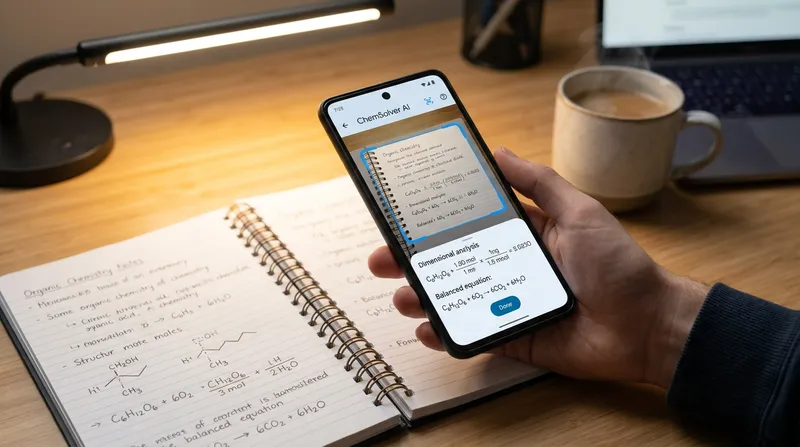
It is 10 PM on a Tuesday, and you are staring at a chemistry worksheet that looks like it is written in an alien language. You understand the basic formulas, but when it comes to setting up the dimensional analysis (those tricky conversion factors), you get completely lost. You are not alone. For most students, the core pain point in chemistry is not the math itself. The real struggle is visualizing the pathway from grams to moles to moles to grams without getting tangled in a mess of numbers.
Students need a tool that visually maps out this pathway, rather than just spitting out a final number. While many standard math apps claim to help, they often fail when faced with chemical subscripts, phase labels, and reaction arrows.
This is where a dedicated AI chemistry solver changes the game. By using advanced photo-solving technology and providing step-by-step explanations, these tools act as a 24/7 tutor for middle and high school students. Whether you are at home or studying at a library with spotty Wi-Fi, the best tools work offline so your saved problems are always accessible. In this guide, you will learn exactly how to set up dimensional analysis, identify limiting reactants, and choose the right AI tool to make late-night study panic a thing of the past.
What is the Best AI Chemistry Solver?
An AI chemistry solver is an educational application designed to read, interpret, and explain chemical equations and word problems. Unlike basic calculators, a high-quality chemistry AI homework solver does not just give you the final answer. It breaks down the methodology, teaching you the underlying concepts so you can succeed on your exams.
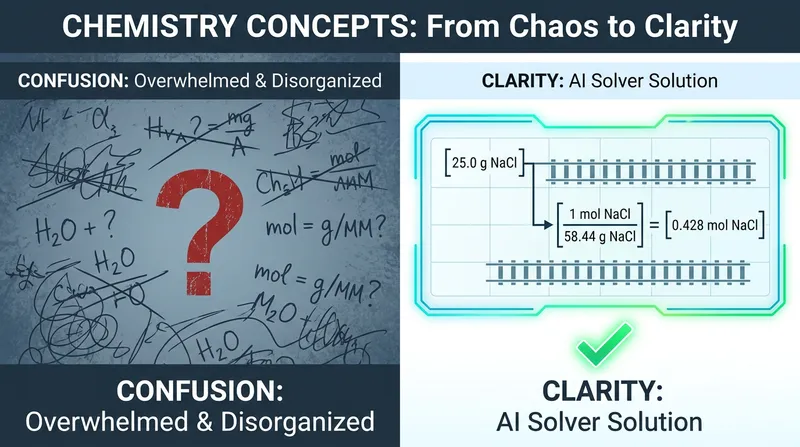
Many students try to use general math apps for their chemistry homework. However, chemistry requires a unique visual language. When you learn Why Standard Math Apps Fail the Hardest High School Exams (And the AI You Should Use Instead), you realize that standard text-based AI cannot format dimensional analysis tables (often called "railroad tracks").
The best AI chemistry tutor must be able to read messy handwriting, understand chemical notation, and provide visual, step-by-step stoichiometry calculations. Tutor AI stands out in this category with its "Snap. Solve. Learn." approach, offering instant photo-based solving that actually teaches you the process.
Actionable Tip: When choosing an app, test it with a complex problem containing subscripts and superscripts. If the app misreads the chemical formula, it will give you the wrong molar mass and ruin the entire calculation.
The Core Problem: Why Standard Math Apps Fail at Chemistry
Chemistry is a physical science, not just a mathematical one. When you ask a generic chatbot to solve a stoichiometry problem, it often generates a dense block of text that is incredibly difficult to follow.
Furthermore, generic AI models frequently make conceptual errors when dealing with chemical reactions. According to a study published by the American Chemical Society (ACS), stoichiometry and electronic structure are the primary topics where students can easily identify persistent mathematical and conceptual errors in generic AI models. This proves the need for specialized AI chemistry solvers rather than basic chatbots.
Math scanners also struggle with handwriting recognition for chemical symbols. To understand this limitation, check out our guide on being Confident But Wrong: Why Math Scanners Misread Handwriting (And How to Fix It). A dedicated chemistry equation scanner is trained specifically to distinguish between a lowercase "l" and a capital "I" in elements like Chlorine (Cl) and Iodine (I).
How to Balance Chemical Equations with AI
Before you can do any stoichiometry, you must have a balanced chemical equation. The Law of Conservation of Mass states that matter cannot be created or destroyed. Therefore, the number of atoms for each element must be exactly the same on the reactant side and the product side.
Balancing chemical equations AI tools can instantly show you the correct coefficients. However, a great AI chemistry tutor will show you the inventory method step-by-step.
Here is how the learning process should look:
- Write the unbalanced equation: Identify your reactants and products.
- Take an atom inventory: Count the number of atoms for each element on both sides.
- Adjust coefficients: Change the numbers in front of the molecules (never change the subscripts) until the inventory matches.
- Verify: Do a final count.
Actionable Tip: Always balance the most complex molecule first, and leave single elements (like O2 or H2) for last. If you get stuck, snap a photo with your solver to see the exact step where your inventory went wrong.
Step-by-Step Stoichiometry Calculations Explained
Stoichiometry is the mathematical relationship between the quantities of reactants and products in a chemical reaction. It is the number one reason students seek out a chemistry problem solver app.
The secret to mastering stoichiometry is visual organization. The best step-by-step stoichiometry calculator will set up a dimensional analysis table for you. Here is the standard four-step pathway to break down these problems:
| Step | Value | Conversion Factor 1 | Conversion Factor 2 | Conversion Factor 3 | Final Answer |
|---|---|---|---|---|---|
| Unit | Grams of Given | 1 Mole / Molar Mass | Mole Ratio (Target/Given) | Molar Mass / 1 Mole | Grams of Target |
| Example | 50 g H2O | 1 mol H2O / 18.02 g | 2 mol H2 / 2 mol H2O | 2.02 g / 1 mol H2 | 5.60 g H2 |
Step 1: Start with the Known Value
Always write down the number and unit you are given in the problem. If you are given 50 grams of water, write "50 g H2O" in the top left corner of your grid.
Step 2: Convert to Moles (Molar Mass Conversion AI)
You cannot compare grams of one substance to grams of another. You must convert to moles first. A smart molar mass conversion AI will automatically calculate the molar mass from the periodic table and show you how to divide your known grams by this mass.
Step 3: Use the Mole Ratio
This is the bridge between your known substance and your unknown substance. You find this ratio by looking at the coefficients in your balanced chemical equation. This is where most students make mistakes, which is why having mole ratio calculation help is crucial.
Step 4: Convert to the Desired Unit
Finally, multiply your new moles by the molar mass of your target substance to get your final answer in grams.
Actionable Tip: Always write your units (grams, moles) and your chemical formulas (H2O, CO2) in every single step of your calculation. If the units on the top and bottom cancel out diagonally, you know you have set up the problem correctly.
Finding Limiting Reactants and Mole Ratios
One of the biggest content gaps in standard homework apps is the failure to connect the math to physical chemistry concepts. When learning about limiting reactants, students often just see a jumble of numbers.
A true limiting reactant AI solver explains the "why" behind the math. Think of it like baking cookies. If a recipe calls for 2 cups of flour and 1 cup of sugar, and you have 10 cups of flour but only 2 cups of sugar, the sugar is your limiting reactant. It dictates exactly how many cookies you can make, regardless of how much extra flour you have.
In chemistry, you must calculate the theoretical yield for both reactants. The reactant that produces the smaller amount of product is the limiting reactant.
Actionable Tip: Do not just guess the limiting reactant based on which starting mass is smaller. A substance with a very low molar mass might actually produce more product than a heavy substance. Always calculate both pathways all the way to the product.
Student Pro Tip: After reviewing the AI's steps for finding a limiting reactant, close the app and try the next problem on your own. Using AI as a learning tool, rather than just an answer machine, is how you build real exam confidence!
Comparing the Top Chemistry Problem Solver Apps
When searching for the best AI for chemistry homework, families have several options. However, it is important to know what you are actually getting. Let us compare the common types of platforms available:
- General Math Scanners: These are great for algebra but often misread chemical symbols (like confusing a lowercase "l" with a capital "I"). They also typically fail to format dimensional analysis tables correctly.
- Community Answer Platforms: These rely on users to upload answers. While helpful, the quality varies wildly, and they often lack standard formatting or step-by-step explanations.
- "Paywalled" Step Solvers: Many popular apps allow you to scan a problem and see the final answer for free, but they blur out the step-by-step explanation unless you pay a hefty monthly fee. You can read more about avoiding this in our guide on The 'Paywalled Steps' Trap: Best Free Math Solver Apps with Steps (2026 Guide).
- Dedicated AI Chemistry Tutors: A specialized app like Tutor AI is designed differently. It provides clear step visibility, accurate handwriting recognition for chemical symbols, and offline access so you can study without Wi-Fi.
Actionable Tip: If you are currently using an app that only gives you the final answer, switch to one that explains the steps. Copying answers will only hurt you when exam day arrives.
How Parents and Teachers Can Use AI Chemistry Tutors
For busy parents, chemistry homework can be a nightmare. Most adults have not balanced a chemical equation in decades. Instead of engaging in stressful homework battles, parents can introduce an AI chemistry solver as a supportive tool.
However, it is vital to use these tools ethically. Educators emphasize that students must learn to treat AI as an interactive learning tool, developing the critical thinking skills needed to evaluate its scientific outputs rather than blindly copying answers. This approach is highly recommended by the American Chemical Society (ACS) for cultivating future AI-ready scientists.
Furthermore, research indicates that AI adaptive learning strategies help stoichiometry-challenged students master fundamental ideas by providing individualized, step-by-step learning experiences. According to academic research published on ResearchGate, these tools cater to a student's preferred learning pace and provide targeted practice.
The benefits extend beyond just getting the right answer. A systematic review published in MDPI shows AI significantly enhances personalized instruction and student motivation.
With a dedicated parent dashboard, families can turn a source of anxiety into a collaborative success story. Here are three ways parents can use these features to support their child:
- Track Progress: Monitor which topics (like mole ratios or balancing equations) are taking the most time.
- Identify Weak Spots: Use the dashboard insights to see where errors consistently happen, helping to guide future study sessions.
- Celebrate Improvements: Recognize when a student successfully masters a difficult concept without needing to rely heavily on the app.
Actionable Tip: Parents should ask their children to explain the AI-generated steps back to them. This "teach back" method ensures the student has actually absorbed the material.
Conclusion: Empowering Your Chemistry Journey
Chemistry homework does not have to end in frustration and tears. By understanding how to properly set up dimensional analysis and utilize the right educational technology, students can master stoichiometry, balance complex equations, and build real academic confidence.
Remember, the goal of using an AI chemistry solver is not to bypass the work. It is to have a patient, 24/7 tutor that can walk you through the toughest problems step-by-step. Whether you are struggling with molar mass conversions or trying to identify a limiting reactant, visual learning is the key to success.
Ready to stop staring at confusing equations? Try Tutor AI free today. Snap a problem, see every step explained, and actually understand chemistry before your next exam.
Note: Every student learns differently. While these strategies are research-backed, results may vary. Adapt these techniques to fit your unique learning style and circumstances.
Frequently Asked Questions
Can AI balance chemical equations?
Yes, specialized AI chemistry solvers can instantly balance chemical equations by analyzing the reactants and products. The best tools will also show you the atom inventory method step-by-step, helping you understand exactly how the law of conservation of mass is applied to each element.
Can standard math scanners solve chemistry problems?
Most standard math scanners struggle significantly with chemistry. They are optimized for pure math and often misinterpret chemical symbols, subscripts, and reaction arrows. Furthermore, they fail to format the dimensional analysis tables (railroad tracks) required for proper stoichiometry calculations.
What is the best app for solving stoichiometry homework?
A dedicated visual stoichiometry photo solver is highly recommended because it reads messy handwriting accurately and generates clear, step-by-step dimensional analysis tracks (grams to moles to moles to grams) rather than just providing a text-heavy final answer.
How do I find the limiting reactant using an AI solver?
You can simply take a photo of your word problem using a chemistry equation scanner. The AI will identify your given starting masses, convert both to moles, use the mole ratio to find the theoretical yield for both, and clearly show you which reactant produces the smaller amount of product.
Is there a free AI chemistry tutor that shows steps?
While many popular apps hide their step-by-step solutions behind a paywall, tools like Tutor AI offer free tiers that allow students to experience basic problem solving with clear, detailed explanations. This ensures that actual learning and comprehension take place without immediate financial barriers.