
It is a familiar scene in households across the country. It is 10 PM on a Tuesday, and your high school student is staring blankly at a multi-part calculus word problem. Hoping for a quick breakthrough, they scan the page with a standard homework app. The app processes the image, thinks for a moment, and then completely freezes, gives a blatantly wrong answer, or simply spits out an error message.
Students and parents are frustrated because standard math apps work perfectly for basic homework equations but completely fail when faced with the complex, multi-step word problems found on actual high-stakes exams. If you have ever wondered why popular apps cannot handle advanced past papers or AP Calculus Free Response Questions, you are not alone.
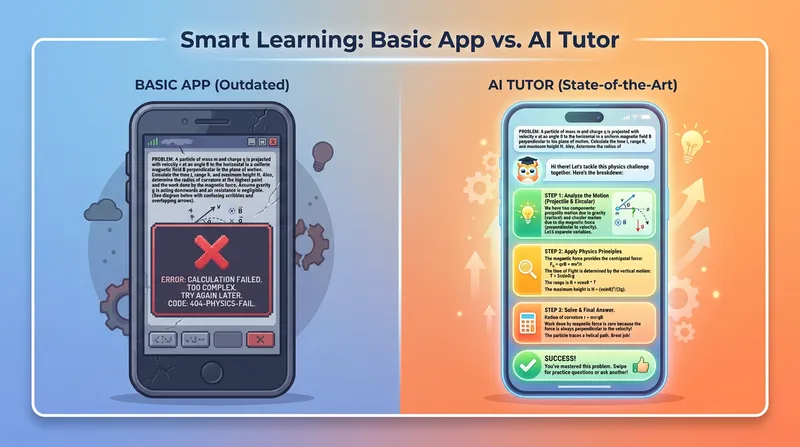
The truth is that most popular homework scanners are essentially digital calculators. They are not designed to understand context, interpret paragraphs of text, or apply high-order thinking. To tackle the hardest high school math exams, students need a multi-step math reasoning AI that acts as a true tutor.
In this guide, we will explore why standard tools fall short, how advanced AI is changing the game, and how to find the best AI math solver for high school students looking to build real academic confidence.
The Calculator vs. Tutor Angle: Why Standard Math Apps Fail
When a student uses a basic scanner tool to solve an equation like "2x + 4 = 10", the software uses Optical Character Recognition (OCR) to read the symbols. It then applies rigid, pre-programmed algebraic rules to isolate the variable. This is symbolic computation. It is fast, accurate, and perfectly fine for middle school algebra drills.
However, high school math is rarely that straightforward. When a student encounters a word problem about related rates in physics or a multi-part geometry proof, there is no simple equation to scan. The student must first translate English sentences into mathematical formulas before any calculating can begin.
Standard math apps fail here because they lack contextual understanding. They look for numbers and mathematical operators. When they see a paragraph of text, they simply do not know what to do.
Furthermore, general artificial intelligence models (like the ones powering popular writing assistants or community Q&A platforms) struggle with math for a different reason. As explained in a detailed technical analysis by Towards AI, standard language models are probability-based machines that predict the most likely next word. This fundamentally conflicts with the exact, deterministic rules required for mathematical truth. This is why general AI often "hallucinates" or invents fake math rules when trying to solve complex equations.
The Exam Reality: Tackling the Hardest High School Math Exams
Real exams test multiple concepts in a single question. If you look at the hardest high school math exams, such as AP Calculus, the SAT, or the ACT, you will notice a pattern. The questions are designed to test high-order thinking and synthesis.
For example, an advanced SAT Math section might require a student to use trigonometry to find an angle, apply geometry to find a maximum area, and then use algebra to solve for a final variable. A basic equation scanner cannot process this because it requires strategic planning across different mathematical disciplines.
This is where an AI for multi-topic math questions becomes essential. A true AI math tutor for word problems does not just look for numbers. It reads the entire question, identifies the underlying concepts, and formulates a step-by-step plan.
If your child is preparing for rigorous STEM testing, relying on basic scanners will leave them unprepared for exam day. For a deeper dive into tools that handle complex science and math, check out our guide on The Best AI for Math and Physics: Top Problem Solvers for High School STEM Classes.
The Hallucination Problem: Why General AI Struggles with Math Logic
Many students try to use general AI chatbots to solve their math homework. While these bots are great for writing essays, they are notoriously bad at advanced mathematical reasoning.
A comprehensive survey published on arXiv validates this exact issue. The research notes that traditional language models achieve breakthrough performance on text tasks but fail on basic reasoning benchmarks, necessitating advanced chain-of-thought protocols for math word problems.
Without this specialized training, an AI will try to guess the answer based on patterns it has seen online. In math, a single wrong assumption in step one ruins the entire problem. This is why community-driven homework platforms that recently integrated basic AI wrappers often provide highly inaccurate answers for complex past papers.
To solve this, researchers developed something called "Chain of Thought" reasoning. According to Google Research, even the largest language models struggle with multi-step reasoning tasks like math word problems because they require decomposing problems into intermediate steps rather than predicting a direct answer.
An effective AI past paper solver must be built specifically with this multi-step architecture. It must verify its own logic at every stage of the calculation to ensure accuracy.
Can AI Solve AP Calculus and Advanced Math Word Problems?
The short answer is yes, but only if you use the right kind of AI.
AP Calculus is notorious for its Free Response Questions (FRQs). These questions require students to show their work, explain their reasoning, and apply theorems to real-world scenarios. A standard app might give you the final derivative, but it will not explain the conceptual reasoning required to earn full credit on the exam.
An AP Calculus AI solver must act like a human tutor. It needs to break down the problem, explain which rule (like the Chain Rule or the Product Rule) is being applied, and show the algebraic simplification steps clearly.
This level of detail is exactly what makes a high-order thinking math AI so valuable. It bridges the gap between getting the answer and actually understanding the material. For parents looking for reliable options that prioritize understanding, we recommend reading our 7 Best AI Tutoring Apps for Step-by-Step Explanations (2026 Guide).
Best Math Apps for High School Students: What to Look For
With so many apps on the market, how do you choose the right one for your family? If you are looking for Photomath alternatives for advanced math, here are the key features you need to prioritize:
Contextual word problem solving
The app must be able to read and interpret paragraphs of text, not just isolated equations. Test it with a related rates problem or a geometry proof to see if it understands the context.
Step-by-step explanations
Answers are useless if the student does not understand how to reach them. Look for an app that provides detailed, logical breakdowns of every single step. The goal is to learn the process so the student can replicate it on a test.
Pedagogical alignment
The best tools do not just hand over the answer. They guide the student. Research published in Frontiers in Education shows that while AI tools can enhance mathematical problem solving, over-reliance on AI hints and misaligned adaptivity can constrain a learner's development of independent problem-solving skills. Your chosen app should foster independence, not dependence.
Curriculum and exam support
If your child is preparing for high-stakes testing in the US, you need an AI tool that recognizes the specific formatting and difficulty of SAT, ACT, or AP Calculus past papers.
How to Use Our Step-by-Step Math Solver
Imagine your student at 10 PM, stuck on a complex AP Calculus word problem with no teacher around to help. This is where the Tutor AI math app steps in to offer immediate support. Designed specifically to overcome the limitations of basic scanners, Tutor AI is a multi-step math reasoning AI built for actual learning.
Our philosophy is simple: Snap. Solve. Learn.
When a student snaps a photo of a difficult question, Tutor AI acts as an on-demand tutor. It identifies the core concepts, breaks the problem into manageable steps, and explains the "why" behind every mathematical decision.
"No more tears over math homework!" (A relieved parent)
For parents, Tutor AI offers incredible peace of mind. You no longer have to worry about re-learning high school pre-calculus to help your child at the kitchen table. The app features a dedicated parent dashboard. The parent dashboard shows you exactly which topics your child is mastering and where they need support, without interrupting their study flow.
Furthermore, Tutor AI is available 24/7. Even without a Wi-Fi connection, students can access previously solved problems and saved explanations in offline mode. If you want to learn more about using AI responsibly to build good study habits, read our guide on Beyond Brainly: How to Use AI for Active Homework Practice (Without Cheating).
Scan and Solve Math Homework Instantly: Actionable Tips for Success
Having the best AI math solver for high school is only half the battle. Knowing how to use it effectively is what truly drives academic success. Here are actionable tips for students and parents to get the most out of AI learning tools:
- Attempt the Problem First: Never scan a problem before trying it yourself. Read the question, write down the given variables, and make an initial attempt.
- Use AI to Check Your Work: Once you have an answer, use the AI to verify it. If you made a mistake, compare your work to the AI's step-by-step breakdown to find exactly where you went wrong.
- Focus on the Explanation, Not the Answer: Treat the AI like a teacher. Read the text explaining the step, do not just copy the numbers.
- Save Difficult Problems for Review: Use the app's history or bookmark feature to save problems that gave you trouble. Review these specific questions before your next big exam.
- Communicate with Teachers: AI is a supplement to classroom learning. If the AI's explanation still does not make sense, that is a perfect question to bring to your teacher the next day.
By following these steps, students transform a simple homework helper into a powerful tool for active recall and deep learning. Educators interested in integrating these tools can explore The Ultimate Guide to AI for Differentiated Instruction in Math & Science.
Frequently Asked Questions
Student-focused questions
How do AI math apps handle multi-step exam questions? Basic apps usually freeze or give incorrect answers because they try to solve the whole problem in one step. Advanced multi-step math reasoning AI uses "Chain of Thought" processing. It breaks the complex problem into smaller, logical chunks, solving and verifying each part before moving on to the next.
Why can't standard apps like Photomath or Mathway solve word problems? These apps excel at what they were designed for, which is scanning and solving formatted equations quickly. The limitation is that they were built as calculators, not reading comprehension tools, so multi-sentence word problems fall outside their design. They lack the natural language processing required to read a paragraph, understand the real-world context, and translate that text into a solvable equation.
Is using an AI math solver considered cheating? It depends entirely on how you use it. If you only copy the final answer to skip the work, it bypasses learning. However, if you use the AI to check your work, understand the step-by-step breakdown, and practice active recall, it becomes a powerful and legitimate study tool.
Parent-focused questions
What is the best AI math solver for AP Calculus and the SAT? For advanced exams, you need an AI that specializes in multi-step reasoning and provides detailed explanations for complex concepts. Tutor AI is specifically designed to handle the rigorous word problems found in AP Calculus and the SAT by breaking down the conceptual logic step-by-step.
Are AI math solvers safe and accurate for high school exams? While general AI chatbots are prone to "hallucinating" or making up fake math rules, specialized math AI solvers are highly accurate. Tools designed specifically for education use deterministic math engines alongside language models to ensure the steps and final answers are logically sound and correct.
Can AI help my child overcome math anxiety? Yes. Math anxiety often stems from feeling stuck and not having immediate help. A 24/7 AI tutor provides instant, judgment-free explanations. Breaking complex problems down into smaller, manageable steps helps reduce overwhelm and builds student confidence over time.
Note: Every student learns differently. While these strategies are research-backed, results may vary. Adapt these techniques to fit your unique learning style and circumstances.
Conclusion: Empowering Independent Learners
The landscape of education technology has shifted dramatically. Standard math apps that merely scan and solve basic equations are no longer sufficient for students facing the hardest high school exams. To truly succeed in AP Calculus, the SAT, or any advanced STEM class, students need tools that understand context, process multi-step logic, and provide clear, empathetic explanations.
By choosing a multi-step math reasoning AI, parents can eliminate late-night homework stress, and students can build the genuine academic confidence they need to tackle any exam.
The next time it is 10 PM and your student is stuck on an AP Calculus word problem, they will not have to wait. Download Tutor AI and give them expert-level help in seconds.


