
It is 10 PM on a Tuesday night. Your child is staring blankly at a complex algebra problem, and frustration is mounting by the minute. As a parent, you want to help, but it has been decades since you last factored a polynomial or worked with basic fractions. The immediate temptation is to turn to the internet for a quick answer. Students want instant help when they are stuck, but parents and teachers share a massive, valid fear: will using an AI homework helper turn into a cheating crutch that destroys critical thinking?
This is the core pain point of modern education. We are caught between the incredible convenience of technology and the vital necessity of actual learning.
For years, platforms have offered quick fixes. However, simply copying a final answer from a forum or a basic scanner app does not build the neural pathways required for academic success. True learning requires a productive struggle. The good news is that technology has evolved, and today we are moving beyond basic answer engines.
In this comprehensive guide, we will explore how to use AI for homework without cheating. We will introduce the best Brainly AI alternatives and show you how to transform late-night panic into active, confident learning.
Is Using AI for Homework Cheating?
The short answer is: it depends entirely on how you use it.
As artificial intelligence becomes a standard tool in education, the line between tutoring and cheating can feel blurry. Many students accidentally cross this line simply because they do not understand the rules. In fact, research from Florida State University highlights that students reported high levels of anxiety regarding academic integrity when instructions for acceptable AI use in assignments were not clearly communicated.
To clear up the confusion, we must look at how top institutions define academic dishonesty. According to guidelines from Yale University, inserting AI-generated text into an assignment without proper attribution or authorization is a direct violation of academic integrity.
Cheating occurs when a tool does the thinking for you. If an app gives you a final essay to submit or a single number to write on your math worksheet without requiring you to understand the process, that is cheating. Conversely, if a tool acts like a patient tutor by breaking down concepts, explaining formulas, and guiding you to find the answer yourself, that is active learning.
Actionable Tip: Before starting any assignment, students should explicitly ask their teachers about the classroom AI policy. Write these rules down in a planner so you always know the boundaries for each specific class.
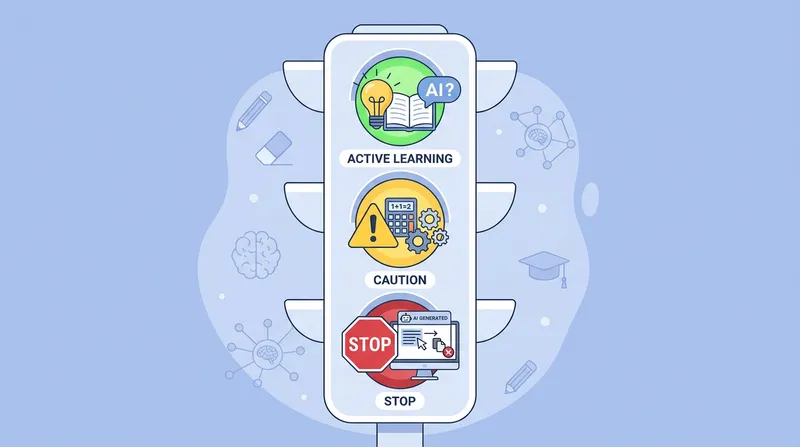
The "Three-Zone Test" for Ethical AI Use for Students
To help students and parents navigate these waters, we recommend using the "Three-Zone Test." This simple framework helps you evaluate whether your use of an AI study guide generator or solver is ethical.
The Red Zone (Cheating)
- Action: Taking a photo of an essay prompt and copy-pasting the generated text.
- Action: Using a basic scanner app to get the final answer to a calculus problem just to finish the worksheet.
- Why it fails: You bypass the learning process entirely. If you were tested on this material tomorrow, you would fail.
The Yellow Zone (Caution)
- Action: Asking an AI chatbot to generate an outline for a history paper.
- Action: Asking AI to rewrite a paragraph of your essay to sound more professional.
- Why it is risky: While getting ideas is helpful, relying on AI to structure your thoughts or polish your words can limit your own creative problem-solving skills. You must ensure you are still doing the heavy lifting.
The Green Zone (Active Learning)
- Action: Using an app to check your final math answer after you have already completed the work.
- Action: Asking a tool to explain the difference between two concepts. (For example, reviewing our Photosynthesis vs. Cellular Respiration: Study Guide & Equations | Tutor AI to understand the underlying biology).
- Why it works: You are using the technology to clarify confusion and build comprehension, exactly as you would with a human tutor.
Actionable Tip: Print out the Three-Zone Test and pin it above your study desk. Before opening any digital tool, ask yourself: "Am I in the Green Zone right now?"
Brainly AI Alternatives: Why Step-by-Step Solvers Matter
For years, platforms relying on community-sourced answers have dominated the homework help market. However, parents and educators are increasingly questioning these methods. If you are wondering about the safety and efficacy of older platforms, you can read more in our guide: Is Brainly Legit? A 2026 Parent's Review of Safety, Accuracy, and Cheating Risks | Tutor AI Blog.
The main issue with traditional Q&A forums is the variance in quality and the temptation to just grab the answer and run. Apps like Brainly for homework often provide a quick fix but fail to address the underlying conceptual gaps.
This is where next-generation learning platforms step in. Built on the philosophy of "Snap. Solve. Learn.", tools like TutorAI are designed to be the ultimate Brainly AI alternative. When you snap a photo of a problem, the platform does not just spit out a final number. Instead, it provides a detailed, step-by-step breakdown of the entire solving process.
By forcing the student to read through the methodology, these tools ensure that the "why" is answered alongside the "what." This is crucial for subjects ranging from middle school fractions to advanced organic chemistry. Missing a single foundational step ruins the entire equation. For a deeper dive into complex subjects, check out The Best AI Organic Chemistry Solvers (That Actually Work) | Tutor AI Blog.
Actionable Tip: When choosing an app, delete any tool that only gives final answers. Replace it with a platform that mandates step-by-step reading. If the app does not explain the "why," it does not belong on your phone.
How to Use AI for Math Homework (The Right Way)
Mathematics is the subject that causes the most tears at the kitchen table. It is also the subject where AI tools are most frequently abused.
Learning math requires cognitive friction. If you remove the struggle, you remove the learning. Guidelines from the State of Montana regarding AI in education specifically state that students depending too heavily on AI may bypass critical thinking and the deeper learning that comes from productive struggle.
So, how do we use an AI math solver step-by-step without bypassing that crucial struggle?
First, attempt the problem independently. Let's say you are learning how to factor polynomials. (If you need a refresher, see our guide on How to Factor Trinomials Step-by-Step: Methods & Examples | Tutor AI Blog). Work through the problem until you hit a wall.
Once you are genuinely stuck, use your AI tool. Snap a photo of your partial work. When the step-by-step solution appears, cover the screen with your hand. Reveal only the first step. Compare it to your work to see if you made a simple arithmetic error or misunderstood the core formula.
By using the tool to find your specific point of failure, you maintain the cognitive struggle while eliminating the frustration of being permanently stuck. This is especially helpful for students dealing with severe stress, which we cover extensively in A Parent's Guide to Math Anxiety: How to Help a Child Struggling with Math | Tutor AI Blog.
Actionable Tip: Implement the "Five-Minute Rule." You must attempt a math problem with a pencil and paper for at least five solid minutes before you are allowed to scan it with an AI helper.
Active Learning with AI: The Socratic Tutor Method
One of the most powerful unique angles for using AI in education is treating it as a Socratic tutor. The Socratic method involves asking a series of questions to lead a student to discover the answer themselves, rather than lecturing them.
When AI is programmed or prompted to act this way, it becomes an incredibly safe AI tool for students. Research from Stanford University demonstrates that AI tutoring tools utilizing Socratic questioning rather than direct answers significantly improve student retention and engagement. Furthermore, data from Pearson shows that a single use of an AI study tool embedded in digital courseware increased the likelihood a student would become an active reader by 23 times.
How do you achieve this at home? It comes down to how you interact with the software. If you are using a text-based AI tutor for middle school or high school, you can control the interaction.
Instead of typing: "Write an essay about the themes in The Giver." Type this: "I need to write an essay about The Giver. I think memory is a main theme. Can you ask me three guiding questions to help me develop my thesis statement?"
This approach forces active reading and critical thinking. It is highly effective for humanities subjects. You can learn more about this specific strategy in our post: How to Use an AI English Solver for Homework & Essays (Without Cheating) | Tutor AI Blog.
Actionable Tip: Start your AI prompts with the phrase: "Do not give me the direct answer. Instead, act as a Socratic tutor and ask me a question that points me in the right direction."
A Parent's Guide: How to Monitor Safe AI Tools for Students
Parents are busy. You cannot stand over your teenager's shoulder every second they are doing homework. However, handing over unfettered access to the internet without guardrails is a recipe for disaster.
The best AI study tools for students bridge this gap by including robust parent ecosystems. You need visibility into what your child is learning, where they are struggling, and how they are using the technology.
When evaluating an app, look for built-in progress tracking and motivation features. For instance, the TutorAI Family Plan features a dedicated parent dashboard alongside student gamification elements like streaks and badges. This allows you to see daily practice tracking, topic mastery, and weak spot identification while keeping your child motivated.
If you notice your child is spending two seconds on a complex physics problem and getting it "right," they are likely just copying the answer. If they are spending five minutes reviewing the step-by-step breakdown, they are actually learning. Having this data changes the conversation at the dinner table.
Furthermore, keeping track of academic progress early on is vital for long-term goals like university entry. Parents can track these milestones rigorously, as seen in our Best SAT & ACT Prep Courses (2026): A Data-Driven Comparison | Tutor AI Blog.
Actionable Tip: Schedule a 10-minute "tech check" every Sunday evening. Sit down with your child, open the parent dashboard of their learning app, and review the week's progress metrics together. Celebrate the effort, not just the accuracy.
Best AI Study Tools for Students: What to Look For
With hundreds of new apps flooding the market every month, choosing the right AI homework helper for high school can feel overwhelming. Many competitors offer fragmented services: one app for math, another for writing, and a third for science.
To build a consistent, active learning routine, you need a unified platform that prioritizes comprehension over shortcuts. Here are the core features you should demand from any educational technology:
- Instant Photo-Based Solving with Explanations: Picture this: your student snaps a photo of a geometry problem and gets not just the answer, but a full explanation of every step. If an app only gives the final number, it is not an educational tool; it is just a calculator.
- 24/7 and Offline Availability: Homework panics rarely happen during business hours. A reliable tool needs to be available at 11 PM on a Sunday. Furthermore, offline capabilities mean a spotty Wi-Fi connection will not leave your student stranded.
- Personalized Learning Paths: The best homework AI chatbot will remember what a student struggled with yesterday and adapt today's practice questions accordingly. This customized approach prevents repetitive frustration.
- Multi-Subject Support: Students do not want to juggle six different apps. Find a platform that handles everything from middle school earth science to high school literature.
- Homework Practice Questions AI: Before a big exam, your student needs fresh ways to test their knowledge. The right tool can generate unique practice tests on demand.
Actionable Tip: Audit your child's phone. Delete the single-function solver apps that encourage passive copying. Replace them with one comprehensive, learning-focused platform to minimize digital distractions.
Conclusion: Empowering the Independent Learner
The narrative that AI is ruining education is incomplete. Yes, tools that simply hand over answers are detrimental to academic growth. However, when used correctly, artificial intelligence is the greatest democratizer of education we have ever seen.
By focusing on ethical AI use for students, enforcing the Three-Zone Test, and utilizing step-by-step solvers that act as Socratic tutors, we can eliminate late-night homework tears. We can transform passive copying into active, engaging practice.
Technology should not do the work for you; it should make your hard work more effective. By combining instant photo recognition with deep, curriculum-aligned explanations and robust parent tracking, we ensure that every time a student gets unstuck, they actually learn.
Ready to turn homework panic into real confidence? See how step-by-step guidance can help your student study smarter. Get TutorAI free on iOS and Android today, and start your journey toward stress-free, active learning.
Note: Every student learns differently. While these strategies are research-backed, results may vary. Adapt these techniques to fit your unique learning style and circumstances.
Frequently Asked Questions
Is using an AI homework helper considered cheating?
It depends entirely on how you use it. If you copy and paste final answers without understanding the process, it is cheating. However, if you use it to break down complex problems step-by-step and learn the methodology, it acts as a digital tutor and promotes active learning.
What is the best Brainly AI alternative for active learning?
The best alternatives focus on the learning process rather than just providing the final answer. Educational platforms should require students to read through step-by-step explanations, ensuring they understand the "why" behind the solution instead of passively copying text from a community forum.
How can parents monitor their child's AI use for homework?
Parents should look for educational platforms that include a dedicated parent dashboard. These features allow you to track daily practice, identify weak spots, and monitor how much time your child spends reviewing step-by-step solutions, ensuring they are truly learning rather than skipping ahead.
Can teachers detect if a student used AI for their homework?
Yes. Many teachers use AI detection software for essays and written assignments. For math and science, teachers can easily spot AI use if a student provides a highly advanced, complex solution but cannot explain the steps or replicate the work during an in-class exam.
How do I use AI to study for a test without just copying answers?
Use AI as a Socratic tutor. Instead of asking for direct answers, prompt the AI to ask you guiding questions, generate practice tests, or explain where you made a mistake in your own calculations. This creates the cognitive struggle necessary for long-term memory retention.