
It's 11 PM. The textbook is open, the problem set is due tomorrow, and you're staring at a reaction that makes no sense. You know a nucleophile attacks an electrophile, but why this atom and not that one? Why does it result in an inversion of stereochemistry? You just need to see the electrons move, to understand the why behind the answer.
This is the core struggle of organic chemistry. It's not just about memorizing facts; it's about understanding a visual, logical language of molecules and electrons. Many students turn to homework helpers, but generic AI tools often provide answers that are confidently incorrect, suggesting reaction mechanisms that look plausible but defy the laws of chemistry. This doesn't just leave you stuck; it actively hurts your learning.
But what if you had a tool designed specifically for this challenge? An AI that doesn't just give you the final product, but walks you through the electron-pushing steps, helps you visualize molecules in 3D, and even plans complex synthesis routes? These tools exist, and they are changing the way students learn. This guide will introduce you to the best AI organic chemistry solvers available today and show you how to use them to build real understanding and confidence.
Need help right now? If you're stuck on a problem, jump down to our top practical picks: IBM RXN for Chemistry for reaction prediction and ChemDoodle for visualizing molecules.
What is an AI Organic Chemistry Solver?
An AI organic chemistry solver is a specialized tool that goes far beyond a simple calculator or a generic question-answering bot. Unlike some math solvers that focus on a single numerical answer, these platforms are built to understand the complex, rule-based, and visual nature of organic chemistry.
They are powered by machine learning models trained on vast datasets of chemical reactions. The best tools don't just match your problem to a database of answers. Instead, they apply learned chemical principles to predict outcomes, visualize structures, and explain processes. Think of it less as a cheat sheet and more as an interactive, 24/7 tutor. A great AI solver helps you learn the material, much like a good AI Tutor can boost your grades and confidence.
Key capabilities include:
- Reaction Prediction: Predicting the likely products when given a set of reactants and conditions.
- Mechanism Visualization: Showing the step-by-step flow of electrons in a reaction.
- Retrosynthesis: Working backward from a target molecule to find a plausible synthesis path.
- Spectroscopy Analysis: Helping to identify a molecule's structure based on its spectral data (like NMR or IR).
- Molecule Visualization: Allowing you to rotate and inspect molecules in 3D to understand their shape and stereochemistry.
Why Use a Dedicated AI for Organic Chemistry?
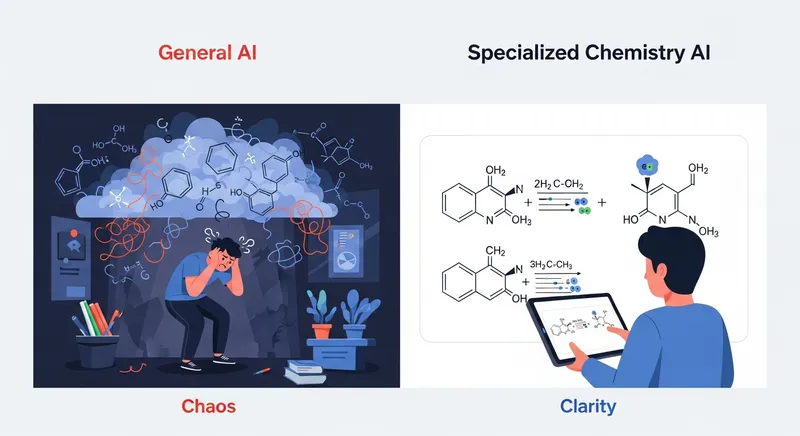
You might be thinking, "Can't I just ask ChatGPT?" While general large language models (LLMs) are impressive, they are a risky choice for organic chemistry homework. They are designed to predict the next most likely word, not to apply the rigorous rules of chemical reactivity. This can lead them to generate mechanisms that look convincing but are fundamentally wrong-a mistake that could be costly on an exam.
Organic chemistry requires precision that general models lack. The difference between an SN1 and an SN2 reaction can hinge on the subtle 3D shape of a molecule, something a text-based AI can easily miss. This is why dedicated tools are essential.
However, the power of specialized AI is staggering. Researchers are developing AI that can understand chemistry on a deep level. For example, a study from the University of Cambridge showed that their machine learning model could predict the outcome of complex reactions with over 90% accuracy, outperforming human chemists. This shows that the right AI can be a super-powered learning aid.
Key Takeaway: Specialized is Better
For a subject as precise as organic chemistry, always choose a specialized tool over a general AI like ChatGPT. Dedicated chemistry platforms are trained on chemical rules and data, leading to far more accurate and reliable results for predicting reactions, visualizing molecules, and understanding mechanisms.
How to Fact-Check Your AI
No matter what tool you use, treat it as a learning partner, not an infallible oracle. Here's how:
- Ask for the 'Why': Don't just accept the final product. Use the tool to understand the mechanism. Does the electron flow make sense based on what you've learned about electronegativity and stability?
- Check the Fundamentals: Does the AI's proposed mechanism obey the law of conservation of mass? Researchers at MIT are building AI models that explicitly incorporate these physical laws to improve accuracy.
- Compare with Your Textbook: Use the AI to visualize a mechanism, then compare it to a similar example in your textbook. Does the pattern match?
- Start with Problems You Know: Test the tool with a reaction you already understand. If it gets that wrong, you know to be skeptical of its answers for problems you're stuck on.
The Best AI Organic Chemistry Solvers: A Quick Comparison
This list includes a mix of practical tools for daily study and a look at cutting-edge research platforms that show the future of chemistry.
| Tool | Best For | Cost | Key Feature |
|---|---|---|---|
| 1. IBM RXN | Retrosynthesis & Reaction Prediction | Free | AI-powered synthesis planning |
| 2. MMLI 'AlphaSynthesis' | Understanding the Future of AI | Academic | Integrates AI with robotic synthesis |
| 3. ChemDoodle | 3D Visualization & Spectroscopy | Paid | 2D-to-3D model generation |
| 4. ACS ChemWorx | Advanced Research & Literature Search | Free (with features for ACS members) | AI-powered paper recommendations |
| 5. Open-Source Models | Seeing How AI Works | Free (requires technical skill) | High-accuracy prediction algorithms |
1. IBM RXN for Chemistry: The Researcher's Choice
Best for: Retrosynthesis and Reaction Prediction Cost: Free
Developed by IBM Research, RXN for Chemistry is a free, web-based platform that puts state-of-the-art chemical AI in your hands. It's a powerful example of how AI is being used in professional chemical research. For students, its most useful features are predicting the products of a reaction and planning a synthesis.
- Key Feature: You can draw your starting materials and reagents, and the AI will predict the most likely product. Or, even more impressively, you can draw a target molecule, and it will generate a full retrosynthesis plan, showing you the steps to create it.
- How to Use for Learning: Use the retrosynthesis feature to challenge yourself. When your textbook gives you a synthesis problem, try to solve it on your own first. Then, enter the target molecule into RXN and compare its proposed path to yours. Where did they differ? Why might the AI's route be more efficient?
2. The Molecule Maker Lab Institute's 'AlphaSynthesis'
Best for: Understanding the Future of Automated Chemistry Cost: Academic / Not Publicly Available
While not a public-facing app you can download today, the work being done by the Molecule Maker Lab Institute (MMLI) is too important to ignore. Backed by the National Science Foundation, this collaboration is building AI platforms like AlphaSynthesis to automate the process of discovering and making molecules. Their work represents the cutting edge and informs the tools that will become available to students soon.
- Key Feature: These platforms integrate AI with robotic systems to not only design a synthesis but physically carry it out. They aim to create a "search engine for molecules."
- How to Use for Learning: Follow the work of MMLI and similar academic groups. Understanding where the research is heading provides incredible context for what you're learning. It answers the question, "When will I ever use this?" by showing you how central these concepts are to modern science.
3. ChemDoodle 2D & 3D: The Visualization Powerhouse
Best for: Molecule Visualization and Spectroscopy Simulation Cost: Paid (with student pricing)
ChemDoodle isn't a single-click solver, but it's an indispensable tool for understanding the visual component of organic chemistry. It's a chemical drawing tool with powerful built-in features that help you connect a 2D drawing to a 3D reality. It helps you see why a bulky tert-butyl group favors an E2 elimination or how chair conformations flip.
- Key Feature: You can draw a 2D molecule and have the software generate a 3D model that you can rotate and manipulate. It can also simulate the NMR and mass spectrometry (MS) spectra for your molecule. This is invaluable for spectroscopy problems.
- How to Use for Learning: When you're given a spectroscopy problem, draw the molecule you think is the answer in ChemDoodle. Then, use the software to predict its 1H and 13C NMR spectra. Does the predicted spectrum match the data you were given? This active learning process is far more effective than just looking up an answer.
4. ACS ChemWorx: The Integrated Research Tool
Best for: Finding and Organizing Chemical Information Cost: Free (with premium features for ACS members)
The American Chemical Society (ACS) is a leading authority in chemistry, and their ChemWorx platform includes tools that leverage AI in practical ways. While designed for researchers, it has features that are useful for advanced students.
- Key Feature: AI-powered literature searching. As you work, the platform can suggest papers and articles relevant to the molecules you are drawing or the topics you are researching. This is a glimpse into how AI helps chemists stay on top of the millions of reactions published.
- How to Use for Learning: For a research project or an advanced course, use the platform to explore a specific reaction. You can see how it has been used in different contexts and find experimental details, connecting textbook theory to practical use, as detailed in journals like ACS Publications.
5. Open-Source Academic Models (e.g., from the Coley Lab at MIT)
Best for: Seeing the Raw Power of Reaction Prediction Cost: Free (requires technical skill)
Many of the most powerful AI models for chemistry are developed in university labs and are often open-source. For example, the Coley Research Group at MIT has produced several groundbreaking models for predicting reaction outcomes. In a foundational 2017 study, their model could correctly predict the major product of a reaction with impressive accuracy.
- Key Feature: These models are often available on platforms like GitHub. While they may require some technical skill to use, they represent the pure, underlying algorithms that power commercial tools. They are designed for one thing: high-accuracy prediction.
- How to Use for Learning: For the computer-savvy chemistry student, exploring these open-source projects can be a fascinating learning experience. You can see the code, read the papers, and understand exactly how the AI makes its decisions. It's the ultimate way to look "under the hood" of chemical AI.
How to Use an AI Solver for Learning, Not Just Answers
An AI solver can be your most powerful study aid or your biggest crutch. The difference is in how you use it. The goal is to foster independence, not dependence. This is a core principle for parents and tutors, as outlined in our Parent's Guide to Homework Apps.
Actionable Tips for Students:
- Solve First, Check Second: Always attempt the problem on your own first. Use the AI to check your work or to get a hint when you're truly stuck. This helps avoid academic burnout by turning frustration into a learning moment.
- Master One Mechanism: When you encounter a new reaction type (like SN1), use an AI visualizer to watch the mechanism over and over. See the bond breaking and forming. Then, draw it from memory until it's second nature.
- Generate Practice Problems: Use a tool to predict the product of a reaction. Then, turn it into a practice problem: can you work out the mechanism that leads to that product?
A Note for Parents & Tutors
The goal is to guide students toward using these tools effectively.
- Focus on the Explanation: When your student uses a tool, ask them to explain the step-by-step solution back to you. The goal isn't the answer, but their ability to articulate the process.
- Use it as a Visual Aid: Many students are visual learners. An AI that can rotate a molecule in 3D is a far better tool for explaining stereochemistry than a flat drawing on paper.
- Set Ground Rules: Establish that the tool is for learning, not for getting quick answers to submit for a grade. Frame it as a way to check your work and build confidence, a philosophy that applies perfectly to chemistry.
The Future is Collaborative
Organic chemistry is challenging, but it's also a gateway to understanding the world at a molecular level. The rise of AI solvers doesn't diminish this challenge; it enhances your ability to meet it. By embracing these specialized tools, you can move past the frustration of being stuck and focus on what really matters: building a deep, intuitive understanding of how molecules interact.
At TutorAI, our philosophy is "Snap. Solve. Learn." We believe the best technology doesn't just give answers; it provides clear, step-by-step explanations that build confidence and mastery. While the tools above are experts in chemistry, our AI is built to help you learn the process behind solving problems in math and other subjects.
Ready to build confidence in your STEM classes? Download TutorAI for free on iOS and Android and get unstuck today!
Frequently Asked Questions
What is the best AI for organic chemistry students?
The best AI depends on the task. For planning synthesis routes and predicting products, IBM RXN for Chemistry is a top-tier, free option. For visualizing molecules in 3D and simulating spectra to solve problems, ChemDoodle is excellent. The key is to use a specialized tool designed for chemistry, not a general AI.
Can ChatGPT do organic chemistry?
Using ChatGPT for complex organic chemistry is risky. General models often produce confident-sounding but incorrect answers, especially for reaction mechanisms and stereochemistry. They lack the specialized training to understand the strict rules of chemical reactivity and can hinder your learning by teaching you wrong patterns.
Can an AI plan a retrosynthesis route?
Yes. This is one of the most powerful applications of AI in chemistry. Tools like IBM RXN for Chemistry are specifically designed for retrosynthesis. You can draw your target molecule, and the AI will work backward to propose a multi-step synthesis pathway.
How accurate are AI chemistry solvers?
They are becoming remarkably accurate. The best models from academic institutions, like the one from a University of Cambridge study, can predict reaction outcomes with over 90% accuracy. However, accuracy varies by tool, which is why it's crucial to use them as a learning aid and always cross-reference with your course material.
What AI can I use to check my chemistry homework?
For checking homework, a process-oriented approach is best. First, solve the problem yourself. Then, use a tool like ChemDoodle to visualize the molecules and confirm stereochemistry. For reaction problems, you can input the reactants into IBM RXN to see if its predicted product matches yours. Use the AI's answer not as the answer, but as a point of comparison.
Is there a photo chemistry solver?
While apps with photo-solving capabilities are common for math, they are less developed for the complex diagrams of organic chemistry. The best tools require you to draw the molecules using a built-in chemical drawing interface. This is actually a benefit, as it forces you to engage with the structures. At TutorAI, our "Snap. Solve. Learn." workflow is about capturing a problem and getting a clear path to the solution. For chemistry, the "capture" step is drawing, but the core principle of receiving a step-by-step explanation to learn from remains the same.