
Is your family caught in the nightly homework battle? Are you a student staring at a problem at 10 PM, feeling completely stuck and overwhelmed? You've heard about AI tutors, but with so many options, you need a trusted guide to understand what actually works and how to use these tools effectively. You're worried about becoming dependent on a tool, losing real skills, or getting in trouble for academic dishonesty.
This is the core problem for so many students, parents, and teachers in 2026. You need a trusted guide to cut through the marketing hype and give you the honest truth. This is that guide.
We'll explore what AI tutors really are, how they work, the real benefits and risks, and most importantly, how to use them ethically to boost grades and build lasting confidence. By the end of this post, you'll have a clear roadmap for making AI a powerful partner in learning, not a crutch.
What Is an AI Tutor?
Think of an AI tutor as a patient, personal academic coach that's available 24/7. It's a software program that uses artificial intelligence to provide students with personalized learning support, instant homework help, and one-on-one instruction, on-demand. Unlike a simple answer key, a true AI tutor's goal is to teach you the process, not just give you the solution. It's designed to guide you to the answer, helping you understand the 'how' and 'why' behind complex problems.
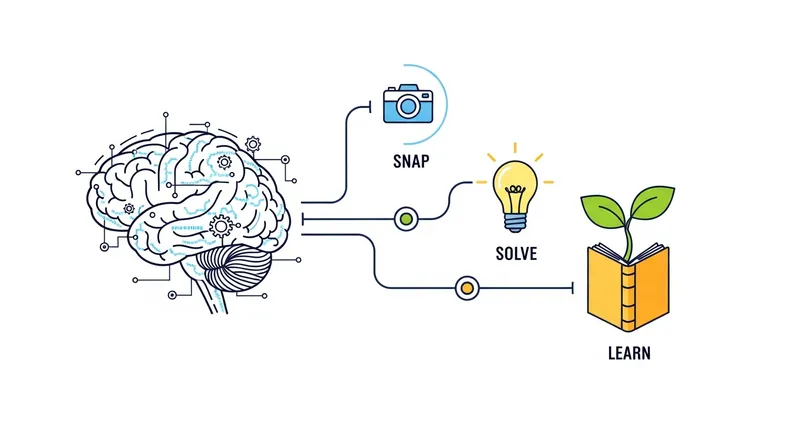
Our own Tutor AI app is built on this philosophy. With features like photo-based problem solving, we make getting help easy, but our focus is always on the detailed, step-by-step explanations that build genuine understanding. Learn more about how our photo solver feature works.
How Do AI Tutors Work? The Tech Explained Simply
AI tutors seem like magic, but they're powered by a few key technologies working together. Understanding them helps you see why they are so effective.
- Smart Personalization: This is the secret sauce. The app learns your strengths and weaknesses in real-time. If you're acing algebra problems, it will introduce more challenging concepts. If you're struggling with fractions, it will provide more foundational practice until you master them. It personalizes the lesson to your specific needs, just like a great human tutor would.
- Plain-Language Conversation (NLP): This lets you talk to the AI like you would a person. When you type "I don't get the Pythagorean theorem," this technology helps the AI understand your query and provide a relevant explanation or a step-by-step problem.
- Photo & Handwriting Recognition (Computer Vision): This is the technology behind tools that let you take a picture of your homework. AI-powered computer vision recognizes handwritten or printed text and symbols, even complex equations, and digitizes the problem so the AI can solve it. This is the core of our "Snap. Solve. Learn." feature and is a game-changer for getting quick help on worksheets or textbook problems. You can see it in action with many of the best math scanner apps.
The Benefits: More Than Just Homework Help
When used correctly, AI tutors offer incredible advantages for students, parents, and even teachers.
- Truly Personalized Learning: Every student learns differently. AI tutors can cater to an individual's pace and style. A 2023 report from the U.S. Department of Education highlights using AI to improve the adaptivity of learning resources as a key way to help students.
- 24/7 Accessibility: The brain-racking question that pops up at 11 PM no longer has to wait for the next day's class. This constant availability reduces late-night homework stress and family arguments. For a deep dive on this, check out A Parent's Guide to Homework Apps.
- Immediate, Judgment-Free Feedback: Making mistakes is a crucial part of learning. AI tutors provide instant corrections and explanations without the fear of judgment that can sometimes occur in a classroom setting, allowing students to try, fail, and try again in a safe space.
- Boosted Confidence: By breaking down complex topics into manageable steps, AI tutors help students achieve small wins. These successes build on each other, turning an "I can't do this" attitude into "I can figure this out."
- Cost-Effectiveness: While a private human tutor can be a significant financial investment, AI tutors offer a more affordable alternative. The rapid growth of the global AI in education market, projected by Engageli to reach over $136 billion by 2035, is making these tools more accessible and powerful than ever.
Actionable Tip for Parents: If you notice your child is consistently struggling in one area, use the progress tracking feature in an app like Tutor AI to see the data. It can help you start a supportive conversation focused on specific topics rather than general frustration.
AI Tutor vs. Human Tutor: Which is Right for You?
This isn't an either/or battle; it's about finding the right tool for the job. Both AI and human tutors have unique strengths.
| Feature | AI Tutor | Human Tutor |
|---|---|---|
| Availability | 24/7, instant | Scheduled sessions |
| Cost | Low monthly fee or free | High hourly rate |
| Pace | Completely self-paced | Adapts, but within a set session time |
| Feedback | Instant and data-driven | Delayed, but emotionally nuanced |
| Personal Connection | None | High (mentorship, encouragement) |
| Subject Coverage | Broad, but can be rigid | Deep, but limited to their expertise |
Bottom line: AI tutors are unbeatable for 24/7 practice and instant help, while human tutors provide mentorship and deep strategic guidance. Using both together gives students the best of both worlds.
The Best of Both Worlds: A Hybrid Approach
Exciting new research shows that the most powerful model may be a combination of both. A 2024 study from researchers at Carnegie Mellon and Stanford University found that students supported by a human-AI hybrid team learned significantly more than those using an AI tutor alone. The AI can handle the repetitive practice and instant feedback, freeing up the human tutor to focus on motivation, strategy, and deeper conceptual hurdles.
Actionable Tip for Students: Use an AI tutor for daily practice and to get unstuck on specific problems. If you're still struggling with the core concepts, bring those specific questions to a teacher or human tutor. This makes your time with them much more effective.
A Day in the Life: Seeing AI Tutors in Action
Let's see how this looks in the real world.
-
10 PM, Maria the High Schooler: Maria is stumped by her AP Physics homework. Her parents can't help, and her teacher is asleep. She takes a photo of the problem with Tutor AI. She doesn't just look at the answer; she follows the step-by-step explanation, which shows her which formula to use and why. The lightbulb goes on. She's able to solve the rest of the problem set on her own.
-
4 PM, David the College Student: David has a calculus exam in two weeks. He feels confident in some areas but weak in others. Using an AI-powered learning platform, he takes a diagnostic quiz that identifies his weak spots. The platform then generates a personalized study plan with practice problems focused on derivatives and integrals. For more on this, see how an AI calculus solver can help you master calculus.
-
7 PM, The Chen Family: Mr. and Mrs. Chen get a notification from their son's AI tutor app. Using the app's Progress Tracking & Reporting feature, they see that he's been struggling with balancing chemical equations. Instead of a generic "How was school?" they can now have a specific, supportive conversation: "Hey, we saw you're working on chemistry. Balancing equations can be tricky. Is there anything we can do to help?" This fosters connection instead of conflict.
The Big Question: Is Using an AI Tutor Cheating?
This is the most important question, and the answer is simple: It depends on your intent.
Using an AI tool to copy an answer you don't understand is cheating. Using that same tool to understand the process so you can solve the next problem on your own is learning.
Think of it like using a calculator. If you use it to find 7 x 8, you're just getting an answer. If you use it to quickly calculate numbers in a complex physics equation, allowing you to focus on the underlying physics concepts, it's a powerful tool.
A Concrete Example: Good Use vs. Bad Use
- Bad Use: Sarah takes a photo of her algebra problem, copies the final answer without reading the steps, and submits her homework.
- Good Use: Sarah takes a photo of the same problem, reads the step-by-step explanation to understand where she went wrong, and then tries the next problem herself without the app.
A Framework for Ethical AI Use:
- Try First: Always attempt the problem on your own before turning to AI.
- Get Unstuck, Don't Outsource: Use the AI tutor to understand a single step that has you blocked, not to do the whole problem.
- Focus on the 'Why': Read the step-by-step explanations. If you can't explain why each step works, you haven't learned it yet.
- Test Yourself: After using the tool, try a similar problem without any help to ensure you've truly grasped the concept.
Tools from respected non-profits like Khan Academy are specifically designed to align with this philosophy, often guiding students with questions rather than just giving answers. For a deeper dive, check out our student's guide to using AI solvers to learn, not cheat.
What This Means for Your Family in 2026
The world of AI tutors is evolving rapidly to support, not replace, great teaching. Global organizations like UNESCO are providing guidance to ensure this technology is used in a human-centered way, bridging gaps rather than widening them.
For your family, this means learning is becoming more flexible and personalized than ever. According to the National Education Association (NEA), the goal is to use AI to empower both students and teachers. AI tutors can handle late-night questions and repetitive practice, which frees up educators to focus on mentoring, creative problem-solving, and direct student support in the classroom. As research from the Brookings Institution shows, this partnership helps students build deeper knowledge that they can apply to new and unfamiliar problems.
Ready to end the homework battle?
Build confidence and understanding with 24/7, stress-free help. Download Tutor AI for free on iOS and Android to get started.
Frequently Asked Questions
Is using an AI tutor considered cheating?
It is not cheating if your goal is to learn, but it is cheating if your goal is just to get the answer. Use AI tutors to understand the process behind a solution, not to copy and paste. A good rule of thumb: if you can't solve a similar problem on your own after using the tool, you're not using it for learning.
What is the difference between an AI tutor and a general AI chatbot like ChatGPT?
An AI tutor is a specialist, trained on specific educational curricula and designed to teach. It provides verified, step-by-step explanations to guide you to the answer. A general chatbot is a generalist; it can provide answers, but they may not be accurate, pedagogically sound, or explained in a way that helps you learn.
How do I choose the best AI tutor for my needs?
Look for these key features: 1) A focus on step-by-step explanations, not just answers; 2) Adaptive learning that adjusts to your skill level; 3) Coverage of the subjects you need help with; and 4) A clear, easy-to-use interface. Start with free versions to see which teaching style works best for you before committing to a subscription.
What subjects can an AI tutor help with?
While math is the most common subject, AI tutors are rapidly expanding. Many now offer robust support for physics, chemistry, and biology, with tools like our AI calculus solver guide covering advanced topics. Some are also branching into humanities by offering writing feedback and grammar help.
Can AI tutors help with test preparation?
Yes, this is one of their biggest strengths. AI tutors can identify your knowledge gaps and create personalized practice quizzes. They provide instant feedback on incorrect answers, helping you learn from mistakes efficiently. This is invaluable for standardized tests like the SAT, which you can read more about in our Digital SAT study plan.
Can an AI tutor replace a human teacher?
No, an AI tutor is a powerful tool, but it cannot replace the mentorship, emotional support, and real-world wisdom of a human teacher. The best results come when AI tutors are used to supplement classroom instruction, allowing students to get extra practice and help whenever they need it.
Note: Every student learns differently. While these strategies are research-backed, results may vary. Adapt these techniques to fit your unique learning style and circumstances.