
Introduction: The 11 PM Calculus Problem We've All Faced
It's 11 PM. You're staring at a calculus problem that looks more like a secret code than math. It's a complex derivative, or maybe an integral that seems impossible to crack. You've checked the back of the textbook, but the answer key just gives you the final solution, offering zero clues about the journey to get there. Panic starts to creep in. Your tutor isn't available, your parents are asleep, and you feel completely alone and stuck.
We've all been there. That feeling of frustration is exactly why so many students struggle with calculus. But what if you had a tool available 24/7 that could do more than just give you the answer? An AI calculus solver, when used correctly, can be a powerful learning partner that helps you truly master the concepts. This guide will show you how to turn your calculus homework helper from a simple answer-getter into your own personal AI tutor.
Why You're Stuck: The Limits of Traditional Study
If you've ever aced your homework but then struggled on the exam, you've experienced the limits of traditional studying. Simply looking up an answer doesn't build the deep conceptual understanding needed to solve new, unfamiliar problems. You're not alone in this; according to the National Center for Education Statistics (NCES), a large percentage of students struggle to reach proficiency in mathematics. The real gap isn't a lack of effort, but a lack of immediate, step-by-step guidance that explains the why behind the what.
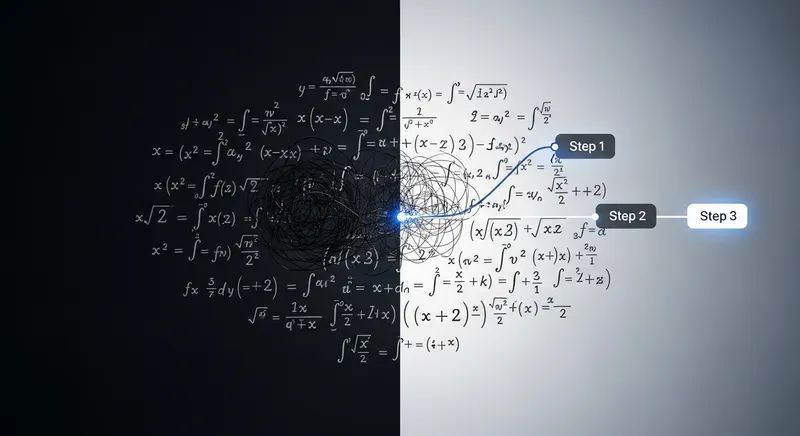
This is where an AI tool can change the game. By providing instant feedback and detailed explanations, it bridges the gap between getting stuck and having that 'aha!' moment of understanding.
The 3-Step Method to Learn Calculus with AI (Not Just Get Answers)
To truly master calculus, you need a strategy. We've developed a simple, actionable framework to transform any AI solver from a potential cheat sheet into a powerful learning tool. The goal is to shift you from a passive role (just getting answers) to an active one where you engage with every step of the problem.
Think of it as a learning cycle: Understand, Practice, and Verify.
This method uses proven learning techniques like active recall and spaced repetition to help you build lasting knowledge, not just find a temporary fix.
Step 1: Use the AI as a Tutor to Understand the 'Why'
When you're completely stuck on a problem, the first step is to get a clear explanation. With an app like Tutor AI, you can just snap a picture of your problem-no typing complex equations required. But don't stop there. Use the AI as a Socratic tutor to dig deeper into the reasoning behind the solution.
Actionable Tip: Once you get the step-by-step solution, go through it line by line. For each step, ask the AI a follow-up question about the concept being used. This active learning approach is proven to work; research from the University of Nebraska-Lincoln found that implementing active-learning strategies significantly raised the success rate in Calculus I courses.
Here are some example prompts you can use:
- "In step 2, can you explain the chain rule in more detail?"
- "Why did you choose u-substitution for this integral instead of integration by parts?"
- "What is the definition of the limit that you used in the first step?"
This process is incredibly effective for all types of problems, including those tricky word problems. As you learn to ask these questions, you'll find yourself thinking like a mathematician, which is the ultimate goal. For more on this, check out our student's guide to AI word problem solvers.
Step 2: Use the AI as a Coach to Check Your Work
Let's address the elephant in the room: cheating. Simply copying an answer from an AI is cheating, and it won't help you learn. But using it to verify your own work is one of the smartest ways to study.
Actionable Tip: After you've used the AI to understand a concept (Step 1), find a similar problem in your textbook or notes. Put the phone or computer away and solve it from start to finish on your own. Only after you have a complete solution should you use the AI to check your answer. The real magic happens when you compare your steps to the AI's steps. Did you apply a rule incorrectly? Did you miss a negative sign? This immediate feedback is what helps you find and fix your specific weak spots before an exam.
This method puts you in control and helps you build independence, a key topic we cover in our parent's guide to homework apps.
Step 3: Use the AI as a Trainer to Generate Practice Problems
One of the most powerful and underutilized features of a good AI tool is its ability to be a limitless source of practice problems. Textbooks only have so many questions, but an AI can generate endless variations targeted to your exact needs.
Actionable Tip: Let's say you've identified that you struggle with the product rule. Instead of hunting for problems, just ask the AI directly.
Try these prompts:
- "Give me 5 practice problems for derivatives that use the product rule."
- "Can you create three hard integral problems that require integration by parts?"
- "Generate a short quiz with 5 questions about limits at infinity."
This allows you to do focused, deliberate practice on the concepts you find most challenging. It's a highly efficient way to study and a practical application of active recall and spaced repetition that strengthens your skills where they're weakest.
Walkthrough: Mastering a Derivative Problem with an AI Tutor
Let's put the 3-step method into action with a common calculus problem.
Problem: Find the derivative of f(x) = (x^2 + 1)^3
-
Understand: You're stuck. You snap a picture of the problem with an app like Tutor AI. It gives you the step-by-step solution, identifying that you need the chain rule. You see the steps, but you're a bit fuzzy on the concept. You ask, "Can you explain the chain rule using an 'outside' and 'inside' function?" The AI explains that the 'outside' function is u^3 and the 'inside' is x^2 + 1, and then walks you through how to differentiate each part.
-
Practice: Now that it makes sense, you find a similar problem in your notes: g(x) = (2x - 5)^4. You solve it on paper, applying the chain rule as you just learned it. You get g'(x) = 8(2x - 5)^3.
-
Verify: You enter your completed problem into the AI. It confirms your answer and steps are correct. Feeling confident, you ask, "Give me three more practice problems that combine the chain rule and the product rule."
In just a few minutes, you've gone from being stuck to mastering a concept and getting targeted practice.
Walkthrough: Tackling a Tough Integral Using Your AI Helper
Integrals can be even more intimidating. Let's apply the same method.
Problem: Find the integral of ∫x * cos(x) dx
-
Understand: You're not sure where to start. You use an AI integral calculator and it shows you the solution using integration by parts. It identifies u = x and dv = cos(x) dx. You're confused about why. You ask, "Why was 'x' chosen for 'u' in this integration by parts problem?" The AI explains the LIATE rule (Logarithmic, Inverse Trig, Algebraic, Trig, Exponential) for choosing 'u', a mnemonic you've never heard before.
-
Practice: This is a breakthrough! You find another problem: ∫x * e^x dx. Following the LIATE rule, you set u = x and dv = e^x dx and solve it on your own.
-
Verify: You use the AI to check your work. It's correct! To solidify your new skill, you ask the AI, "Create two practice problems where I have to use integration by parts twice."
You've now learned not just the 'how,' but the 'why' and a strategy for future problems.
What to Look For in the Best AI for Calculus
Not all AI solvers are created equal, especially when your goal is learning. When choosing a tool, look for features that support this pedagogical approach. Many of the best tools are powered by foundational technologies like the Wolfram Alpha computational engine, but the user experience is what matters for learning.
Tutor AI checks all these boxes. Here's a checklist of what to look for in any tool:
- Detailed Step-by-Step Solutions: The tool must show its work, not just the final answer.
- Concept Explanations: A great AI can explain the theory behind the steps.
- Natural Language Interaction: You should be able to ask follow-up questions in plain English.
- Photo-Based Input: The ability to snap a picture of a problem is much faster than typing complex equations.
For a full breakdown of the top tools, you can explore our guide to the 11 best AI math tutors of 2024.
A Note for Parents & Teachers: Is This Cheating?
This is a critical question for both parents and educators. The fear that students will use AI to avoid learning is valid. A 2024 survey from Michigan Virtual found that educators' top concerns about AI include inappropriate student use and over-dependence on technology. However, banning these powerful tools is not the answer. Instead, we must teach students how to use them responsibly.
The 3-step method outlined here is designed to do exactly that. It frames the AI as a collaborative partner for learning, a principle supported by global organizations. UNESCO has published guidance on the ethical use of AI in education, emphasizing the importance of augmenting, not replacing, human intellect.
Instead of banning AI, guide students on how to use it as a learning partner. For example, you might say: "Use TutorAI to understand the steps, then solve three similar problems on your own before checking your work." By encouraging students to ask 'why,' we can transform a potential cheating tool into an engine for curiosity and independence. Tools that offer progress tracking can also help parents and tutors see which concepts have been mastered and which need more practice.
For more on this topic, see our teacher's guide to ethically using AI in the classroom.
Conclusion: Go from 'Solver' to 'Student'
The true power of an AI calculus solver isn't its ability to give you an answer. It's the power to give you an understanding. By shifting your mindset from just getting through homework to actively engaging with the material, you can turn a moment of frustration into a moment of real learning.
Remember the 3-step method: Understand the 'why' behind each step, Practice on your own to build your skills, and Verify your work to get immediate feedback. This cycle puts you firmly in control of your education, building the confidence and competence you need to ace your next exam.
Ready to turn homework stress into real understanding? Download Tutor AI today and discover a smarter way to learn calculus.
Frequently Asked Questions
Is using an AI calculus solver considered cheating?
It depends entirely on how you use it. If you simply copy an answer without trying to understand the process, then yes, it's a form of cheating that won't help you learn. However, if you use it as a tool for learning-to check work you've already done, to understand the specific steps where you got stuck, or to get more practice-it becomes one of the most effective study aids available. Our guide is built around this ethical, learning-focused approach.
Can an AI math solver help with word problems in calculus?
Absolutely. Many modern AI solvers are designed to interpret the language of word problems and translate them into mathematical equations. The learning strategy is the same: use the step-by-step solution to understand how the problem was set up and which calculus concepts were applied to solve it. This is especially helpful for grasping how abstract formulas apply to real-world scenarios.
How is this different from just Googling the answer?
While Google can find answers, it often leads to scattered forum posts or videos that don't match your exact problem. A dedicated AI tutor like Tutor AI provides a personalized, interactive experience. It gives you a step-by-step solution for your specific problem and allows you to ask follow-up questions to understand the underlying concepts, creating a seamless learning loop that a search engine can't replicate.
What's the best AI for learning calculus?
The 'best' AI for learning is one that prioritizes understanding over just giving answers. Look for these key features: 1) clear, detailed step-by-step explanations, 2) the ability to explain the 'why' behind a concept when you ask, and 3) features for generating targeted practice problems. A tool that acts like a personal tutor, not just a simple calculator, is what you need to truly master the material.
How can I use an AI solver to prepare for a calculus exam?
An AI solver is an excellent exam prep tool. First, use it to review problems from past quizzes or homework where you made mistakes; this helps you diagnose your specific weak spots. Then, ask the AI to generate a custom practice quiz focused on those topics (e.g., 'Give me 10 problems on L'Hôpital's Rule'). This targeted practice is far more effective than randomly reviewing the entire textbook.
Will I become dependent on an AI calculus solver?
This is a common and valid concern. The 3-step method in this guide (Understand, Practice, Verify) is specifically designed to prevent dependency. The goal is to use the AI as a temporary support system to build your own independent problem-solving skills. By always trying problems on your own first and using the AI to check your work and generate practice, you ensure the tool is helping you build skills, not replacing them.
Note: Every student learns differently. While these strategies are research-backed, results may vary. Adapt these techniques to fit your unique learning style and circumstances.


