
Introduction: The End of Math Homework Battles?
It's 10 PM. The kitchen table is a battlefield of crumpled paper, a half-eaten snack, and a math textbook that feels more like a cryptic puzzle. If you're a parent, you've likely felt the helplessness of not knowing how to help with a new type of math. If you're a student, you know the unique frustration of being completely stuck. You are not alone in this struggle. According to the National Center for Education Statistics (NCES), math proficiency for students remains a significant challenge, with levels still below pre-pandemic figures.
This shared struggle has created a need for a new kind of help: one that's available 24/7, affordable, and actually teaches instead of just giving away the answer. Enter the AI math tutor. This guide will cut through the noise, helping you find a true 'learning partner' for your student or yourself, not just a quick 'answer finder'.
What is an AI Math Tutor (and How Is It Different from a Calculator)?
Think of a basic calculator as a tool that gives you the 'what'- the final answer. An AI math tutor, on the other hand, is designed to explain the 'why' and the 'how'. It's a sophisticated learning tool that provides personalized, step-by-step guidance and interactive feedback to help you genuinely understand the material.
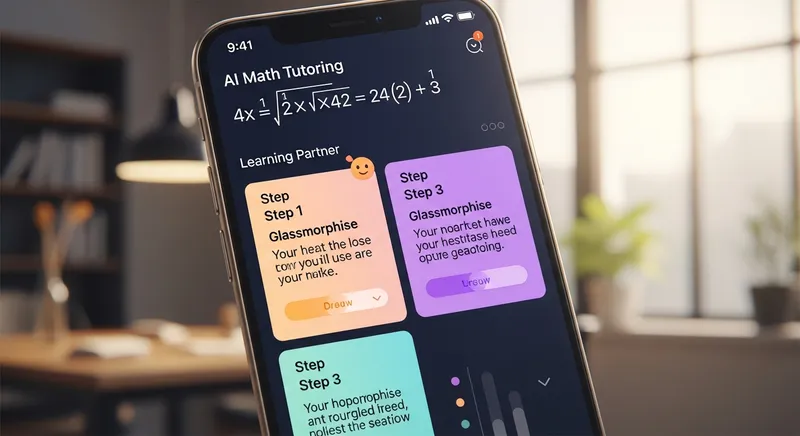
Unlike a simple solver, a true AI learning partner has key features designed for deep learning:
- Personalized Learning Paths: The AI identifies your weak spots and provides targeted practice to help you improve.
- Socratic Questioning: Some advanced tutors will ask you questions to guide you toward the solution yourself, building critical thinking skills.
- Progress Tracking: You (and your parents) can see your improvement over time, boosting motivation and highlighting areas that need more attention.
As researchers at Stanford Graduate School of Education point out, the critical question for any AI tool is whether it builds skills or just enables task completion. The best AI tutors are firmly focused on building skills.
How We Chose the 11 Best AI Math Tutors for 2026
To help you find the best tool, we dove deep into the crowded market, testing and evaluating dozens of apps. We built our list to help you find a true learning partner. Our evaluation was based on five core criteria:
- Pedagogical Approach: Does it prioritize learning over cheating? We looked for tools with detailed, step-by-step explanations.
- Subject Coverage: We sought tutors that cover everything from elementary math to advanced calculus.
- Personalization Features: Does the app adapt to the user's individual needs and track their progress?
- User Experience: Is the app easy to use, even when you're feeling frustrated with a difficult problem?
- Overall Value: Does the tool offer a good balance of features, effectiveness, and cost?
The 11 Best AI Math Tutors of 2026
Here are our top picks for AI math tutors that can transform homework time from a battle into a breakthrough.
Comparison of Top AI Math Tutors
| Tutor | Best For | Price | Parent Features | Key Differentiator |
|---|---|---|---|---|
| TutorAI | Overall Learning | Freemium | Yes (Dashboard) | Deep Explanations & Parent Insights |
| Khan Academy | Curriculum-Aligned Practice | Free | Yes (Dashboard) | Comprehensive, Free Video Library |
| Photomath | Visual Learners | Freemium | No | Animated Step-by-Step Solutions |
| Socratic by Google | Quick Free Explanations | Free | No | Curates Web Resources & Videos |
| WolframAlpha | Advanced Computation | Freemium | No | Unmatched Computational Power |
| Symbolab | Practice & Verification | Freemium | No | Excellent Equation Editor & Practice |
1. TutorAI: Best Overall Learning Partner
TutorAI earns our top spot because it perfectly embodies the 'learning partner' philosophy. It combines powerful, instant-solving technology with a deep commitment to genuine learning. With its "Snap. Solve. Learn." model, it makes getting help easy while ensuring the user understands the process.
- Key Features: Instant photo-based solving, detailed step-by-step explanations, 24/7 availability, offline mode for core features, and a comprehensive progress tracking dashboard for students and parents. Includes motivational streaks and achievements to encourage consistent practice.
- Pros: The parent dashboard is a game-changer, showing topics practiced, accuracy rates, and specific concepts where a child is struggling. The focus on explaining the 'why' is second to none. Its user-friendly interface reduces stress during late-night study sessions.
- Cons: The most advanced features, like the parent dashboard, require a premium subscription.
- Pricing: Free plan includes 5 problem solves per day. Premium subscription unlocks unlimited questions and all features. Available on the iOS App Store and Google Play Store.
2. Khan Academy: Best for Free, Curriculum-Aligned Learning
Khan Academy is a non-profit educational giant, and its AI-powered features make it an incredible free resource. It offers a structured, course-based approach to learning math from kindergarten to college.
- Key Features: Full math curriculum, thousands of instructional videos, practice exercises, and quizzes. The AI-powered guide, Khanmigo, offers hints and Socratic dialogue (requires a donation).
- Pros: Completely free and incredibly comprehensive. The parent and teacher dashboards are robust. Aligned with school standards.
- Cons: The Khanmigo AI tutor is a separate, donation-based feature. Less focused on instant problem-solving from a photo.
- Pricing: Free (donations encouraged for AI features).
3. Photomath: Best for Animated, Visual Explanations
Photomath is famous for its app that can scan a handwritten problem and not only solve it but show you how to solve it with animated, easy-to-follow steps. It's a fantastic tool for visual learners.
- Key Features: Scans both printed and handwritten math, animated step-by-step instructions, multi-method explanations, and a built-in scientific calculator.
- Pros: The animated steps make complex procedures feel intuitive. Excellent for checking homework and understanding the process visually.
- Cons: The deepest explanations and 'Expert-verified' textbook solutions are locked behind the Plus subscription.
- Pricing: Freemium; Plus subscription for advanced features.
4. Socratic by Google: Best Free AI Math Solver with Steps
Powered by Google AI, Socratic is a powerful and free tool that can find explanations for a wide range of subjects, including math. It excels at finding and curating the best educational resources from the web.
- Key Features: Scans problems, provides curated video tutorials, Q&A from the community, and web explanations.
- Pros: Completely free. Covers more than just math.
- Cons: Acts more like a super-powered search engine than a dedicated, personalized tutor; explanations can be inconsistent in quality and style.
- Pricing: Free.
5. WolframAlpha: Best for Computational Power
WolframAlpha is less of a step-by-step tutor and more of a computational knowledge engine. For high-level students and professionals who need to check answers or explore complex mathematical concepts, it is unparalleled.
- Key Features: Massive computational power, provides answers to a huge range of queries, shows some solution steps with Pro subscription.
- Pros: Incredibly powerful and accurate. A staple for STEM professionals and university students.
- Cons: The free version doesn't provide steps. The Pro steps can be too high-level and complex for beginners.
- Pricing: Free for basic answers; Pro subscription for step-by-step solutions.
6. Symbolab: Best AI Math Problem Solver App
Symbolab is fantastic for practicing and verifying work. It shows detailed steps for a vast array of problems from pre-algebra through calculus and beyond, making it a great companion for homework checks.
- Key Features: Excellent equation keyboard, shows detailed steps for a wide range of topics, includes a practice mode with quizzes.
- Pros: Covers a massive range of math topics. The step-by-step process is very clear and well-formatted.
- Cons: The free version has ads and limits on full step-by-step views.
- Pricing: Freemium.
7. Mathway: Best for Broad Subject Coverage
Owned by Chegg, Mathway is a versatile solver that covers everything from basic algebra to advanced calculus and statistics. Its clean interface allows you to type or snap a picture of a problem for a quick solution.
- Key Features: Covers a huge variety of math subjects, including finite math and linear algebra. Simple photo and text input.
- Pros: One of the broadest subject ranges available. Very fast and easy to use for getting answers.
- Cons: Step-by-step explanations require a subscription. Can feel more like an answer engine than a teaching tool.
- Pricing: Free for answers; subscription required for steps.
8. Microsoft Math Solver: Best Free All-Rounder
This free app from Microsoft packs a surprising number of features, including problem scanning, an advanced calculator, and interactive graphs. It's a strong, no-cost alternative for high school and early college students.
- Key Features: Scans and solves problems, provides free step-by-step explanations, interactive graphing, and links to relevant video lectures.
- Pros: Completely free with no ads. The graphing calculator is excellent. Works offline.
- Cons: Can sometimes struggle with complex, handwritten problems compared to paid competitors.
- Pricing: Free.
9. GeoGebra: Best for Geometry Visualizations
Geometry is a visual subject, and GeoGebra excels at it. It allows students to interact with shapes, graphs, and constructions in a dynamic way, making abstract concepts concrete.
- Key Features: Interactive 2D and 3D geometry, dynamic constructions, augmented reality features to place shapes in the real world.
- Pros: Makes geometry intuitive and fun. Excellent for visual learners. Widely used and trusted by educators.
- Cons: Less focused on algebraic problem-solving.
- Pricing: Free.
10. Maple Calculator: Best for Graphing and Verification
Enter an expression and see its 2D or 3D graph instantly. This tool, from the makers of the powerful Maple computational software, is invaluable for understanding the relationship between equations and their visual representations.
- Key Features: High-quality graphing, solves problems, works offline.
- Pros: Powerful and reliable, from a trusted name in mathematics software. The app is free and very capable.
- Cons: The full power is unlocked with desktop software, which is expensive.
- Pricing: The calculator app is free.
11. CameraMath: Best for Diverse Problem Types
From multiple-choice questions to word problems, CameraMath handles a wide variety of formats. Its versatility makes it a strong contender among the best math scanner apps for step-by-step solutions.
- Key Features: Solves word problems, provides multiple solution methods, 24/7 live chat with human tutors.
- Pros: Very versatile, and the option for a live tutor is a great bonus for when AI isn't enough.
- Cons: The best features, including live chat, are part of the premium plan.
- Pricing: Freemium.
Pro Tip: How to Use an AI Tutor to Actually Learn
Having the right tool is only half the battle. The real key to success is knowing how to use these AI tutors effectively. The biggest fear for parents and teachers is that these apps become a high-tech way to cheat. Here's how to ensure the AI serves as a launchpad for learning, not a crutch for copying.
For Students: Your 3-Step Study Method
Don't just snap and copy. Adopt this three-step method to turn every problem into a powerful learning opportunity.
- Understand the 'Why': Use the AI tutor to get the step-by-step breakdown. Don't just glance at it. Read each step and its explanation. Your goal is to understand the logic, not memorize the path.
- Re-work the Problem: Put the app away. On a fresh sheet of paper, try to solve the original problem from memory. This is a form of active recall, a technique proven to strengthen memory.
- Test Your Knowledge: Ask the AI for a similar problem or find one in your textbook. Solve it completely on your own. This tests whether you truly learned the concept.
This method works. A study of over 1,200 students by publisher Macmillan Learning found that students who actively engaged with an AI tutor by using their own words and re-working problems saw significant exam score increases.
Looking for more science-backed study methods? Check out our guide to Acing STEM with Active Recall and Spaced Repetition.
For Parents: A Guide to Partnering with AI
An AI tutor can be your ally in ending homework battles. Here's how you can guide your child to use it effectively:
- Engage with the Explanation: Instead of asking, "Did you finish your homework?" ask, "Show me a problem you were stuck on and walk me through the steps the AI gave you." This turns a check-up into a teaching moment.
- Monitor the Right Things: Use a tool with a parent dashboard, like TutorAI. This allows you to see which topics your child is struggling with, not just how much time they spent on the app. It helps you identify real learning gaps.
- Model Good Behavior: If your child is stuck, use the AI with them. Say, "I'm not sure either, let's figure this out together." This models curiosity and shows that learning is the goal, not just having the answer.
- Talk About Academic Integrity: As the International Society for Technology in Education (ISTE) recommends, it's crucial for families to discuss the ethical and safe use of AI. Remind your child that these tools are for learning, not for passing off AI-generated work as their own on tests or graded assignments.
For more tips on navigating modern schoolwork, see our Parent's Guide to New Math.
AI vs. Human Tutors: Do You Still Need a Person?
Does the rise of effective AI tutors mean human tutors are obsolete? Not at all. The research suggests the future is collaborative. A 2024 study from Carnegie Mellon University found that a hybrid model, where a human tutor supported students using an AI, was the most effective approach.
Think of it this way:
- AI Tutors are best for: Instant help 24/7, unlimited practice problems, step-by-step procedural explanations, and affordability.
- Human Tutors are best for: Motivation, building high-level learning strategies, emotional support, and adapting to a student's unique personality.
They are not enemies. They are powerful allies in a student's educational journey.
Conclusion: Your New Partner in Learning
Choosing the best AI math tutor isn't about finding the app that spits out answers the fastest. It's about finding a true learning partner- a tool that builds confidence, fosters understanding, and transforms frustration into achievement. By focusing on the 'why' behind the answer, engaging with the process, and using these tools to build skills, students can end the nightly homework battle and start winning the war for academic success.
Ready to experience the difference a true learning partner can make? Download TutorAI for free on iOS or Android and turn "I'm stuck" into "I get it!" in under 60 seconds.
Frequently Asked Questions
Is using an AI math tutor considered cheating?
It's all about how you use it. If you simply copy the answer, you're not learning- and yes, that's cheating. However, if you use it as a tool to understand why you're stuck, it becomes a powerful study aid. The goal is to engage with the step-by-step explanations to learn the process, then try to solve the problem yourself. For a deeper dive, read our guide on how to Learn, Don't Cheat.
Which AI math tutor is best for my grade level?
For middle school and building foundational skills, Khan Academy is fantastic due to its structured curriculum. For high school and general homework help, TutorAI offers a great balance of detailed explanations and parent features. For university-level math, WolframAlpha is essential for its computational power, while Symbolab is great for practicing complex problems.
Are there any truly free AI math tutors with steps?
Yes, several tools like Socratic by Google, Microsoft Math Solver, and Khan Academy offer free step-by-step help. Most top-tier, dedicated AI tutors operate on a 'freemium' model. They provide a limited number of solutions for free but reserve unlimited solves and premium features for subscribers.
How effective is AI tutoring compared to a human tutor?
They serve different but complementary roles. AI offers incredible 24/7 access, affordability, and endless patience for practice. However, research shows that human tutors still excel at providing motivation, emotional support, and high-level learning strategies. The most effective model often combines the consistent practice of an AI with the adaptive guidance of a human.
Can an AI math tutor help with higher-level math like calculus or statistics?
Absolutely. The technology has advanced far beyond basic algebra. Many of the best AI tutors, including WolframAlpha, Symbolab, and Mathway, are specifically designed for university-level mathematics. They can handle complex equations, multi-step proofs, 3D graphing, and statistical analysis.
What should parents look for in an AI tutor for their child?
Look for three key things: 1) A focus on step-by-step explanations, not just final answers. 2) Progress tracking features, like in TutorAI, that give you insight into your child's learning patterns. 3) A clear privacy policy. According to Forbes, with a vast majority of students now using AI, understanding how a company handles your child's data is more important than ever.
How can AI tutors help students with math anxiety?
AI tutors provide a private, judgment-free zone for learning. There's no fear of 'asking a dumb question' in front of a class or a tutor. Students can make mistakes without embarrassment and work at their own pace. This patient, persistent, and private support can be instrumental in building the confidence needed to overcome math anxiety and improve mental wellness.
Educational Advice Disclaimer: The information provided in this article is for educational purposes only. Every student learns differently, and the tools and methods discussed may not be suitable for every individual. We encourage parents and students to use these tools responsibly and in accordance with their school's academic integrity policies. Consult with a qualified educator or academic advisor to create a personalized learning plan.


