
It's 10 PM. You've been staring at the same multi-step physics word problem for an hour. The words blur together, the numbers seem meaningless, and frustration is building. You know there are apps that can solve it in seconds, but a nagging question stops you: Is using an AI word problem solver cheating?
This is the core dilemma for modern students, parents, and even teachers. You have incredibly powerful tools at your fingertips, but using them can feel like a guilty secret. What if you could use these tools not as a shortcut to an answer, but as a pathway to real understanding? What if an AI solver could become your 24/7 personal tutor, helping you learn the process so you can solve the next problem all on your own?
This guide will show you exactly how to do that. We'll provide a clear framework for using AI ethically and effectively to build confidence, master complex concepts, and improve your grades the right way.
The Big Question: Is Using an AI Solver for Homework Help Cheating?
Let's address this head-on: The answer is no, it's not cheating- if you use it as a learning tool. Simply copying an answer is a shortcut that hurts you in the long run. But using AI to understand the steps, identify your mistakes, and guide your thinking is a smart study strategy.
Educational authorities agree. The U.S. Department of Education's report on AI encourages leveraging AI to personalize learning, not just automate tasks. The focus is on using technology to enhance, not replace, human thinking. Similarly, the National Council of Teachers of Mathematics (NCTM) argues that AI doesn't remove the need for problem-solving skills. Instead, it creates an opportunity to "reimagine teaching and assessment" and emphasizes that students must be taught how to analyze and vet AI-generated answers. A Teacher's Practical Guide to Ethically Using AI in the Classroom | Tutor AI Blog offers more strategies for educators on this topic.
The difference between cheating and learning is your intent. Are you trying to get an answer, or are you trying to gain understanding? Our framework below will ensure you're always on the path to genuine learning.
How AI Solvers Work (And Why That Matters for Learning)
Ever wonder what happens when you snap a photo of a tricky word problem? With an app like Tutor AI, a few amazing things happen in seconds. First, the AI uses Optical Character Recognition (OCR) to read the text and numbers from your photo, even if they're handwritten. Then, it uses Natural Language Processing to understand the story of the problem- the context, the relationships between objects, and what question is being asked.
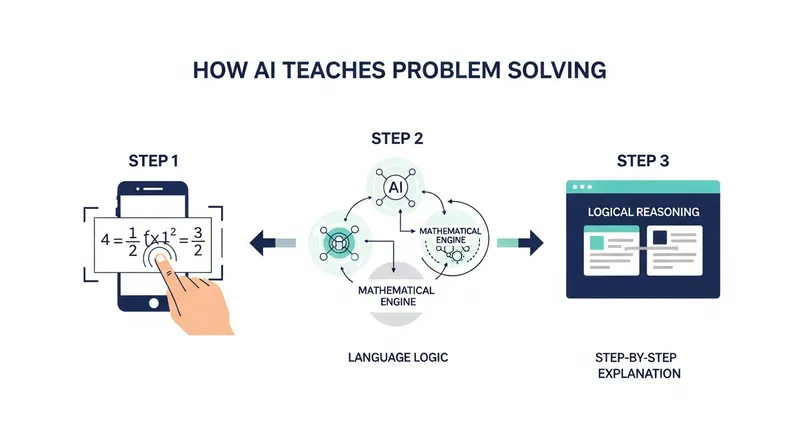
Finally, a powerful math engine translates the words into a solvable equation and works through the solution. This is where the magic happens for learning. The best tools don't just give you the final number; they show you every single step, explaining the 'why' behind the 'what'. This is a key differentiator from a basic calculator or an answer-only app.
Actionable Tip: When looking for an AI solver, prioritize one that provides detailed, step-by-step explanations. Tutor AI is built on this principle, ensuring you can follow the logic from start to finish. For more options, see our guide to the Best Math Scanner Apps for Step-by-Step Solutions (2026 Guide) | Tutor AI Blog.
The 4-Step Framework: How to Use AI to Genuinely Learn
This simple, ethical framework turns any AI solver from a potential cheating device into a powerful study partner. Screenshot this framework and keep it by your desk!
The Learn-Not-Cheat Framework
- Attempt First: Always try to solve the problem on your own before using AI.
- Translate, Don't Solve: If stuck, use the AI to get just the initial equation. Compare it to your own setup to find your error.
- Analyze the Steps: If you're still stuck, review the full step-by-step solution. Pinpoint exactly where you went wrong.
- Go Beyond: After you understand, ask the AI for a similar problem to test your new knowledge.
Step 1: Attempt the Problem First (The Honest Effort Rule)
Before you even think about reaching for your phone, you must try to solve the problem yourself. Read it, identify the knowns and unknowns, choose a strategy, and work through it to the best of your ability. This activates your brain and creates a baseline for learning. You can't learn from a mistake you never made.
Step 2: Use AI to Translate, Not Just Solve
This is the most critical and often-missed step. The hardest part of a word problem is translating the story into a mathematical equation. If you're stuck here, use the AI solver to see only the initial setup or equation. Compare it to your own attempt. Did you misunderstand a key phrase? Did you use the wrong formula? Correcting this misunderstanding is where most learning happens.
Step 3: Analyze the Step-by-Step Solution
Once you have a correct equation, try to solve it again. If you're still stuck, now is the time to look at the full step-by-step solution provided by an app like Tutor AI. Don't just glance at it. Go line by line and pinpoint the exact place where your process differed. Was it a calculation error? A forgotten rule of algebra? This targeted feedback is what makes AI so powerful.
Step 4: Go Beyond the Answer
Finishing the problem isn't the end of the learning process. To truly master the concept, you need to reinforce it. This is where you can use active recall and spaced repetition, techniques crucial for Acing STEM: A Practical Guide to Using Active Recall and Spaced Repetition for Math & Science | Tutor AI Blog.
- Actionable Tip: Ask the AI to generate a similar problem with different numbers. Can you solve it now without help? This is a key feature of advanced AI tutors.
- Actionable Tip: Explain the solution steps out loud to yourself or a friend. If you can teach it, you know it. This is a core part of building a Your Free AI Study System: 5 Steps to Learn Smarter (Ethically) | Tutor AI Blog.
Not Just for Math: AI for Physics, Chemistry, and Beyond
This learning framework isn't limited to algebra. It's a powerful method for any subject involving word problems.
- AI Physics Problem Solver: Use it to set up free-body diagrams, apply kinematic equations, or solve for forces and energy.
- AI Chemistry Problem Solver: Perfect for stoichiometry, balancing chemical equations, or solving gas law problems.
- Advanced Topics: Even complex subjects like calculus or organic chemistry can be tackled. For example, a system from Google DeepMind called AlphaGeometry recently performed near the level of a human gold medalist on International Mathematical Olympiad problems. This shows the incredible potential of AI to handle complex reasoning, and this same power is now becoming accessible in tools that can help you with your own advanced coursework, like in an AP Biology Study Guide 2026: A Teacher's Roadmap to a 5 | Tutor AI Blog.
A Guide for Parents and Educators: Fostering Responsible AI Use
For parents and teachers, the rise of AI can be intimidating. But by embracing it with clear guidelines, you can empower students to use it responsibly.
Actionable Tips for Parents:
- Establish Ground Rules: Discuss the 4-Step Framework with your child. Make it the official rule for using AI for homework.
- Model Good Behavior: Use the tool with them sometimes. Say, "Let's try to set up the equation first, and then we can check it together."
- Focus on the 'Why': When they show you a completed problem, ask them to explain one of the steps. This shifts the focus from completion to comprehension and can help end homework battles, a topic we cover in The Parent's Guide to New Math: End Homework Battles & Build Your Child's Confidence | Tutor AI Blog.
- Track Progress, Not Problems: With a tool like Tutor AI's parent dashboard, you can see which concepts your child has mastered and where they need support- without hovering over their shoulder.
Actionable Tips for Teachers:
- Acknowledge AI: Have an open conversation about AI tools and establish clear classroom policies. Banning them is often ineffective.
- Adapt Assignments: As academic research on AI tutors suggests, create activities that require students to critique an AI's answer or explain the AI-generated steps. This promotes critical thinking over simple answer-copying.
- Embrace the Human Element: Focus on collaborative problem-solving and conceptual discussions in class, areas where human interaction still excels. This human-centered approach is supported by global organizations like UNESCO as essential for the future of education.
Beyond the Answer: Your Personalized Learning Partner
Unlike basic answer-only apps, the best AI tutors do more than just solve. A tool like Tutor AI becomes a true learning partner by tracking your progress over time, identifying your specific weak spots (like fractions or logarithms), and adapting practice problems to your needs. This turns homework from a chore into a targeted, personalized training session.
Your Study Partner for the Future
The next time you're stuck on a difficult word problem, don't feel guilty about reaching for an AI tool. See it as an opportunity. It's not a cheating machine; it's a 24/7 tutor, a patient study partner, and a powerful tool for building real, lasting understanding.
By following the framework of attempting, translating, analyzing, and practicing, you transform a simple solver into a dynamic learning system. You shift from asking, "What's the answer?" to "How do I get to the answer?"- and that question makes all the difference.
Ready to turn homework stress into homework success?
Snap. Solve. Learn. with Tutor AI. Download it free today and get unlimited step-by-step solutions, personalized practice, and 24/7 support that actually helps you learn.
Frequently Asked Questions
Is it really cheating to use an AI to check my homework?
It is not cheating if your goal is to learn. Think of it like checking the answers in the back of a textbook, but far more powerful. Cheating is when you copy the answer without understanding it just to get the assignment done. Using an AI to check your work, find your specific error, and understand the correct process is a smart and ethical study method that builds independence.
Can AI solve very complex, multi-step word problems?
Yes. Modern AI solvers are designed to handle complexity. Using natural language processing, they can understand the story of a problem, identify the different parts, and set up a sequence of equations to solve. For example, a physics problem might require first calculating velocity and then using that result to find kinetic energy. A good AI solver will show you both steps clearly and logically.
Are there any free AI tools that provide step-by-step solutions?
Many AI homework helpers operate on a "freemium" model. They may offer a limited number of free, step-by-step solutions per day or keep basic answers free while charging for more detailed explanations. Tutor AI, for example, allows you to try out the full step-by-step process so you can see the value in its learning-focused approach. Be wary of tools that only provide the final answer for free, as they don't support the learning process.
How do AI word problem solvers handle problems with diagrams or images?
Advanced AI solvers use more than just text recognition. They employ computer vision technology to analyze the entire image. This allows the AI to interpret graphs, geometric shapes, diagrams (like free-body diagrams in physics), and labels within the image. It then incorporates this visual information into the problem-solving process, making it possible to solve problems that aren't purely text-based.
Which AI is best for science subjects like physics and chemistry?
The best AI for science problems is one that has been trained on a massive dataset of scientific knowledge. It needs to understand specific formulas (like F=ma or PV=nRT), be able to handle unit conversions (e.g., grams to moles), and know how to balance chemical equations. A comprehensive, multi-subject AI like Tutor AI is built to handle the unique demands of both chemistry and physics word problems, not just general math.
Will using an AI math solver actually improve my grades?
Yes, when used correctly. A Stanford University study confirmed that AI-assisted learning boosts student performance. By using the tool to understand the how and why behind problems, you build a stronger conceptual foundation. This leads to better retention and higher scores on tests and exams, where you won't have the tool to help you.


