
It's 9 PM. Your child stares at a math worksheet, their frustration growing. You look over their shoulder and see a jumble of number lines and area models-nothing like the math you learned. You want to help, but you feel completely inadequate. This nightly struggle over 'new math' is a core pain point for families everywhere, turning homework time into a source of stress.
But what if you could call a peace treaty? This is your survival guide. It's not about turning you into a math teacher overnight. It's about empowering you to become a confident homework guide who can support your child's learning, reduce their anxiety (and your own), and finally end the homework battles for good.
Why Is Math Taught So Differently Now? The 'Why' Behind the Head-Scratching
If you find yourself asking, "Why did they change math?" you're not alone. The shift away from pure memorization isn't random; it's a deliberate move to build a deeper, more flexible understanding of numbers. Educational leaders, including the National Council of Teachers of Mathematics (NCTM), have championed a move towards teaching practices that prioritize problem-solving and conceptual understanding. The goal is to develop students who don't just know how to get an answer but who understand why the method works.
Old math often taught one rigid way to solve a problem. New math, including the Common Core standards, teaches that numbers are flexible and can be manipulated in different ways to get to the same solution. This develops "number sense," an intuitive grasp of how numbers work, which is crucial for tackling more advanced topics and real-world problems. While it looks different, the destination is the same; it's just a more scenic, exploratory route.
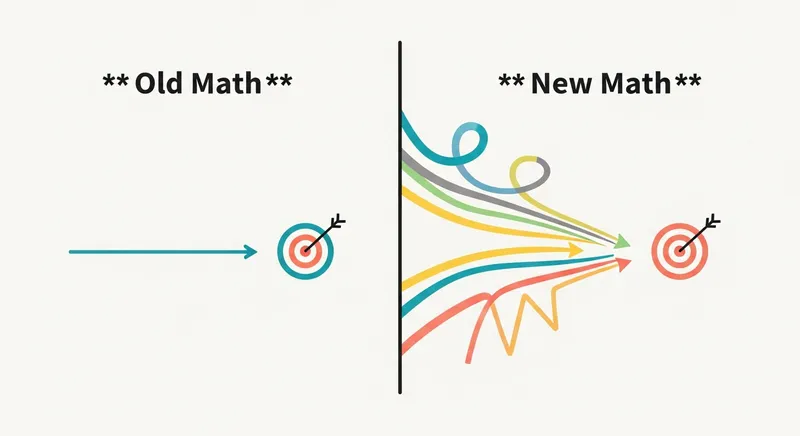
A Parent's Peace Treaty: Translating 'New Math' vs. 'Old Math'
The biggest source of frustration is the language barrier between the math we learned and the math our kids are learning. This section is your translator, directly comparing common 'new' methods with the 'old' methods you know.
Subtraction: 'Borrowing' vs. Decomposing & Number Lines
- Old Math (Borrowing): To solve 52 - 28, you'd cross out the 5, make it a 4, and 'borrow' a 10 to turn the 2 into a 12. It worked, but did anyone ever explain why you were borrowing?
- New Math (Decomposing): Here, kids understand place value. They see 52 as 50 + 2 and 28 as 20 + 8. To subtract, they might break it down like this: 52 - 20 = 32, then 32 - 8 = 24. They are decomposing the numbers into more manageable parts.
- New Math (Number Lines): A child might start at 52 on a number line and make 'jumps' backward. They could jump back 20 to land on 32, then jump back 8 to land on 24. This visualizes the process of subtraction.
Multiplication: 'Standard Algorithm' vs. The Area Model
- Old Math (Standard Algorithm): To solve 14 x 12, you'd stack them, multiply 2x4, then 2x1, add a zero, multiply 1x4, then 1x1, and add the results. It's efficient but abstract.
- New Math (Area Model): This method visually breaks down the problem. Imagine a rectangle divided into four smaller boxes. On the top, you break 14 into 10 + 4. On the side, you break 12 into 10 + 2. The box now represents four smaller multiplication problems:
- 10 x 10 = 100
- 10 x 4 = 40
- 2 x 10 = 20
- 2 x 4 = 8 You then add the areas: 100 + 40 + 20 + 8 = 168. This directly connects to the geometry concept of area and shows why each part is being multiplied.
Understanding the methods is half the battle. The other half? Managing the emotions that come with math struggles-for both you and your child.
Taming the Beast: How to Help a Child with Math Anxiety (and Your Own!)
Does your heart beat faster when you see an algebra problem? You're not alone. Research shared by the National Center for Biotechnology Information (NCBI) indicates that approximately 93% of adult Americans report some level of math anxiety. The problem is, this anxiety is contagious. A groundbreaking study from the University of Chicago found that when math-anxious parents provide frequent homework help, their children learn less math and develop more math anxiety themselves.
Here's how to break the cycle:
- Acknowledge and Address Your Own Anxiety: Say it out loud: "This kind of math is new to me, too, so let's figure it out together." This models a healthy response to a challenge, transforming it from a scary problem into a shared puzzle.
- Separate Performance from Identity: A wrong answer is just a wrong answer. The Child Mind Institute notes that anxiety can impair the working memory needed to solve problems. Frame wrong answers as a starting point for a new strategy, not a verdict on their ability.
- Slow Down: One of the biggest culprits of math anxiety is the association with speed. Professor Jo Boaler emphasizes that there is no link between being good at math and being fast at math. Remove timers and praise thoughtful, careful work over quick, rushed answers.
- Focus on Effort: Praise the process. Say things like, "I love how you kept trying even when it was hard," or "That was a really creative way to look at the problem."
Disclaimer: This article provides general information and is not a substitute for professional mental health advice. If you or your child are experiencing severe anxiety, please consult a qualified professional.
You Can Be the Guide, Not the Teacher
Your most powerful role during homework isn't to know all the answers. It's to ask the right questions and foster a growth mindset. According to advice for parents from Stanford Professor Jo Boaler's YouCubed project, you should never tell a child they are wrong, but instead, try to find the logic in their thinking.
Instead of saying, "That's not how you do it," try asking these guiding questions:
- "Can you explain this problem to me in your own words?"
- "What have you tried so far?"
- "What does the number line show you?"
- "Is there another way you could solve this?"
- "Where do you think you should start?"
Here's how that might sound:
Parent: "Okay, let's look at this one. Can you explain this problem to me in your own words?" Child: "I have to subtract 28 from 52, but I don't know how to do the borrowing part." Parent: "I see. It looks like your teacher showed you a few ways. What does the number line strategy show you? Let's look at that together."
When you're both truly stuck, it's not a moment of failure; it's a chance to learn together. This is where modern tools can be an incredible ally.
Ready to Transform Homework Time?
When you're both stuck, don't let frustration win. Use Tutor AI to get clear, step-by-step explanations you can work through together. You're not cheating; you're getting the support you need to be a better guide.
[Download on the App Store] | [Get it on Google Play]
Grade-by-Grade Guide: What to Expect
Navigating the curriculum can be easier if you know the landmarks. Here's a brief look at what 'new math' looks like in early grades. For a full breakdown, you can explore resources like the Khan Academy's Common Core map.
- Kindergarten: The focus is on building a strong foundation of number sense. This includes one-to-one counting (touching each object as you count), recognizing numbers, and understanding simple addition and subtraction as "putting together" and "taking away."
- 2nd Grade: This is often where parents first notice a major difference. Kids are expected to be fluent in addition and subtraction up to 100. They will be using place value heavily and exploring strategies like number lines and decomposing numbers (making tens).
- 3rd - 5th Grade: This is where the foundation pays off. Expect a heavy focus on multiplication and division strategies (including the area model), the introduction of fractions as numbers on a line, and increasingly complex multi-step word problems that require strategic thinking.
Beyond Worksheets: Making Math Fun
One of the best ways to support your child's learning is to show them that math isn't just something that lives on a worksheet. It's everywhere!
- In the Kitchen: Double a recipe and ask your child to figure out the new measurements. This is fractions in action!
- At the Grocery Store: Give your child a small budget to pick out snacks. Have them estimate the total or compare unit prices.
- During Game Night: Many board games are packed with math: counting spaces, managing play money, and calculating probabilities with dice.
This approach reinforces the core benefit of new math methods: building flexible thinkers who can apply their skills to solve real-world problems.
Your New Role: The Confident Homework Guide
Navigating new math doesn't have to be a nightly battle. By shifting your perspective from 'teacher' to 'guide,' you can transform homework time. Your role is to be a curious, patient, and supportive partner in your child's learning journey. Embrace the new methods as an opportunity to learn together, ask guiding questions, and praise the process, not just the answer.
And for those moments when you're both truly stuck, remember that help is just a snapshot away. Tools like Tutor AI are designed to bridge the gap, providing the clear, step-by-step explanations, 24/7 support, and progress tracking you need to guide the conversation and turn frustration into a moment of genuine understanding. Ready to end the homework wars and build your child's confidence? You've got this.
Frequently Asked Questions
Why did they change the way math is taught?
The primary reason is to develop deeper conceptual understanding and problem-solving skills. Old methods often focused on memorizing a single procedure without explaining why it worked. The new methods are designed to teach students number sense-an intuitive understanding of how numbers work-to create flexible thinkers who can apply mathematical concepts to new problems.
Is Common Core math better than 'old math'?
'Better' is subjective, but it is different by design. Research from institutions like the Harvard Graduate School of Education shows that teaching multiple problem-solving strategies leads to more robust and flexible understanding. While 'old math' is often faster for simple computation, 'new math' is designed to be better at building a foundation for complex thinking.
What is the point of showing work in multiple ways?
This is a core feature of the new approach. When a child can solve a problem using an area model, a number line, AND the standard algorithm, it proves they have a deep, flexible understanding. It's like knowing multiple routes to get to a destination; if one road is blocked, you know another way to go.
How do I help my child if I don't understand the homework myself?
This is the perfect opportunity to model a growth mindset. Say, "Wow, this is new to me too! Let's figure it out together." Your role is not to be the expert, but the co-explorer. Use the guiding questions mentioned in this article. When you're both stuck, use a resource like Khan Academy or an AI-powered tool like Tutor AI not to get the answer, but to see the step-by-step process.
How much does homework help cost?
Traditional tutoring can cost anywhere from $40 to $100 per hour, which adds up quickly. Modern tools offer a more accessible alternative. For example, apps like Tutor AI often have a free version with core features and an affordable premium subscription for unlimited access, making expert-level help available 24/7 for less than the cost of a single tutoring session.
Are tools like Photomath or Tutor AI considered cheating?
They are only cheating if used to bypass learning. If a student simply snaps a photo and copies the final answer, they have cheated themselves. However, when used as a learning tool-to check work, understand the steps after you've tried, or get a hint when you're stuck-they become a 24/7 digital tutor. The key is using them to understand the process, a core part of an ethical AI study system.


