
Does your child's face cloud over the moment they see a math problem that's more than one line long? Do you feel a wave of panic when they ask for help with a word problem, and it looks like a wall of text? You are not alone. For countless students and parents, the hardest part of math isn't the numbers; it's translating the story into a solvable equation. This is the core pain point that most guides miss. They give you steps, but they don't help you build the confidence to turn an intimidating paragraph into a simple, clear plan.
This guide is different. We're going to give you a simple, repeatable 5-step manual process designed to build foundational skills and confidence. Then, we'll show you how to use AI tools like TutorAI not as a shortcut, but as a powerful and ethical way to check your work and learn from your mistakes. This method is perfect for students who need extra help, busy parents who want to support their kids, and even tutors and teachers looking for a structured approach.
Why Math Word Problems Feel So Hard (And How to Beat the Anxiety)
Before we dive into the steps, let's acknowledge the feeling of dread that word problems can create. It's not just you. These problems require two different skills at once: reading comprehension and mathematical translation. Your brain has to process language, identify key information, ignore irrelevant details, and then convert it all into abstract symbols and operations. It's a heavy cognitive load, and it's easy to feel overwhelmed.
The first step to solving a word problem is taking a deep breath and shifting your mindset from "This is too hard" to "This is a puzzle I can figure out." This is a core part of developing a growth mindset in mathematics, a skill that will serve you well far beyond the next test. Every word problem has a solution hidden inside it, and our guide will give you the keys to unlock it. The goal isn't just to find the answer; it's to build a problem-solving muscle that will last a lifetime.
The Core of Problem Solving: Visualization First
If there's one secret weapon for conquering word problems, it's visualization. Many guides list this as an optional tip, but it should be a primary step. As the education experts at Edutopia champion, creating models and visualizing problems transforms complex descriptions into concrete, manageable representations. Before you even think about numbers or equations, your first real task is to see the problem in your mind's eye and get it down on paper.
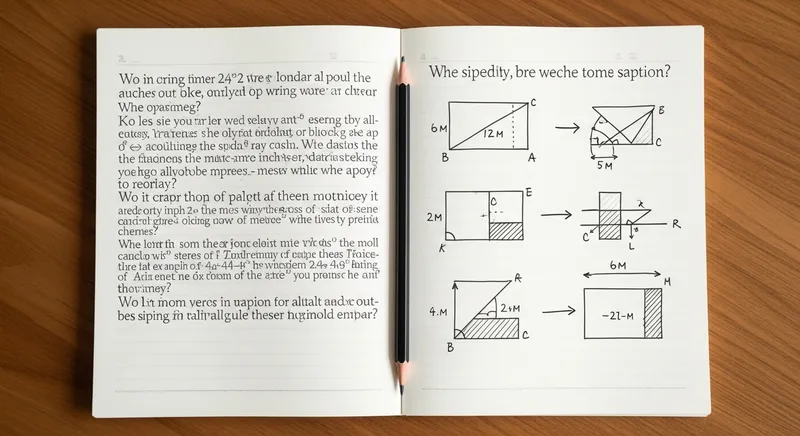
Actionable Tip for Visualization:
- Don't strive for artistry. A simple stick figure, a box, or a line is perfect. The goal is clarity, not a masterpiece.
- For problems involving distance or movement: Draw a simple line or map.
- For problems with multiple groups: Use circles or boxes to represent each group.
- For problems about fractions or parts of a whole: Draw a pie chart or a rectangle divided into sections.
This single step can demystify the most confusing problems and give you a clear path forward. It's a core recommendation from trusted sources like Khan Academy, which advises students to draw pictures to help them understand what the question is truly asking.
Your 5-Step Guide to Solving Any Math Word Problem
Ready to build your confidence? This 5-step method works for everything from simple addition problems to multi-step challenges. Practice it consistently, and you'll find that word problems become far less intimidating.
Step 1: Read and Understand (The CUBES Method)
It sounds obvious, but most mistakes happen because the problem was misread. We need an active reading strategy, not a passive one. A great, actionable tool for this is the CUBES method:
- Circle the numbers. Find all numerical values, including written-out numbers (e.g., "five").
- Underline the question. What are you actually being asked to find?
- Box the math keywords. Words like "altogether," "less than," or "per" are clues for which operation to use.
- Eliminate extra information. Some problems include decoy numbers or details you don't need. Cross them out.
- Solve and check. After you have a plan, solve the problem and check your work.
This method forces you to slow down and analyze the text, which is a key part of effective problem-solving instruction.
Step 2: Visualize and Plan
This is where your drawing from the "Visualization First" step comes into play. Look at your drawing and decide on a plan of attack. Are you doing a single calculation or multiple? For multi-step word problems, this is the most important stage. Write down the steps you'll take.
- Example Plan:
- First, I will add the number of apples and oranges to find the total fruit.
- Then, I will subtract the number of fruits eaten from the total.
Having a written plan makes the process feel structured and manageable.
Step 3: Translate Words to Math
Here is where you translate the puzzle into a solvable equation. Using the keywords you boxed in Step 1, you can start building your number sentence. But be careful: context is everything. Instead of just memorizing words, think about what they mean in the story.
Here is a more detailed table of common keywords and the context to watch out for:
| Operation | Common Keywords | Contextual Example & Translation |
|---|---|---|
| Addition (+) | sum, total, in all, altogether, combined, plus, increase, more than | "Maria has 10 berries, and Tom gives her 5 more. What is the total?" -> 10 + 5 |
| Subtraction (-) | difference, less than, minus, remain, take away, decrease, fewer, how many more | "John has 12 apples. Sarah has 5 fewer apples than John." -> 12 - 5 |
| Multiplication (×) | product, times, of, per, each, twice, total (for groups) | "There are 4 boxes with 6 cookies each. What is the total number of cookies?" -> 4 × 6 |
| Division (÷) | quotient, shared equally, split, average, out of, ratio, each (for distribution) | "A group of 3 friends shared 12 cookies equally. How many did each friend get?" -> 12 ÷ 3 |
Actionable Tip: Don't just look for single words. Read the full sentence to understand the context. The phrase "how many more" often means subtraction (10 - 4), while "5 more than 10" means addition (10 + 5). Understanding the relationship between the numbers is key.
Step 4: Solve the Equation
Now it's time for the math! With your clear plan and equation, this step should be straightforward. Keep your work neat and organized, especially for problems with multiple steps. Showing your work helps you catch errors and makes it easier to review later. If you're working on higher-level math like calculus, this systematic approach is even more critical. For those advanced topics, a tool like an AI Calculus Solver can be a great resource for checking complex steps.
Step 5: Check Your Work and Your Logic
Don't just circle the answer and move on. The final, crucial step is to check your work. This means two things:
- Check the Calculation: Rework the problem to make sure you didn't make a simple arithmetic error.
- Check the Logic: Reread the question. Does your answer make sense in the context of the story? If the question asks how many cookies each friend gets and your answer is 1,000, you might want to re-check your plan. This logical check is a powerful way to build number sense.
This is also the perfect time to use technology as a learning partner. After you've done the work yourself, you can use a tool like TutorAI to get instant feedback. We'll cover exactly how to do that ethically in a moment.
A Parent's Corner: Guiding Without Giving Answers
One of the biggest challenges for helpers is guiding a student without simply giving them the answer. The goal is to foster independence. This aligns with research from the What Works Clearinghouse, a part of the U.S. Department of Education, which emphasizes teaching students to understand a problem's underlying structure. Your role is to be a guide, not a calculator.
Instead of saying, "You need to add 15 and 20," try asking guiding questions:
- "What is the question asking you to find?"
- "Can you draw me a picture of what's happening in this problem?"
- "What do you think that word 'altogether' means we should do?"
- "What do you think the first step should be?"
By asking questions, you empower the student to think critically and build their own problem-solving skills. For more tips on navigating this dynamic, check out this Parent's Guide to Homework Apps.
The Smart Way to Use AI: Checking Your Work Ethically
AI math solvers are powerful tools, but they come with a risk. A recent academic article warns that over-reliance on AI can hinder a student's critical thinking and problem-solving abilities. The United Nations has also published guidance on AI in education that calls for a responsible, human-rights-based approach to ensure technology supports, rather than replaces, cognitive development. So, how do we use these tools ethically?
The rule is simple: Manual work first, AI check second.
Use the 5-step method above to solve the problem entirely on your own. Once you have a final answer, use TutorAI to validate your result and, more importantly, your process.
- Snap a photo of your problem and your handwritten work.
- Compare the Final Answer: Is your answer correct? If yes, great! Your method worked.
- If Your Answer is Wrong, Analyze the Steps: This is where true learning happens. Don't just correct your paper. Look at the step-by-step explanation provided by TutorAI. Where did your process differ? Did you misunderstand a keyword? Did you make a calculation error? Did you miss a step in a multi-step problem?
This approach transforms an AI tool from a potential "cheating" device into a 24/7 personal tutor that helps you identify and fix your own misunderstandings. It's the best way to leverage powerful technology while still building the essential skills you need for success. For more on this topic, explore our student's guide to AI word problem solvers.
TutorAI: Your 24/7 Learning Partner
✓ Snap a photo of your problem and your handwritten work. ✓ Get instant step-by-step explanations to understand the 'why'. ✓ Track your progress over time to see your skills grow. ✓ Available 24/7, whenever and wherever you get stuck.
Ready to Snap. Solve. Learn?
Conquering math word problems is about building a confident, repeatable process. By following these 5 steps, you're not just finding answers; you're developing critical thinking skills that will help you in every subject. When you pair this manual effort with the smart, ethical use of a tool like TutorAI for checking your work, you create a powerful learning loop. You'll transform from dreading word problems to tackling them with confidence.
Ready to build your math confidence? Download TutorAI for free and get 24/7 homework help.
Download TutorAI for free on the App Store
Frequently Asked Questions
Why do I find math word problems so hard?
It's a very common feeling, and it's because word problems require two skills at once: reading comprehension and mathematical reasoning. You have to act as a translator, turning a story into a mathematical equation. This guide's focus on visualization and using methods like CUBES is designed specifically to make that translation process easier and less intimidating.
What is the very first step to solving a word problem?
The very first step is to read the problem carefully without any pressure to solve it immediately. The goal of the first read-through is simply to understand the situation. After that, actively engage with the text by circling numbers, underlining the main question, and boxing keywords (the CUBES method) before you do anything else.
What's a good strategy for multi-step word problems?
Visualization and planning are your best friends here. First, draw a simple diagram of the problem to understand how all the parts relate to each other. Then, write down a mini-plan of the steps you need to take. For example: "1. Calculate the total cost. 2. Calculate the discount. 3. Subtract the discount from the total." This breaks the problem into manageable chunks.
How can I help my child with word problems without giving them the answer?
Become a 'guide on the side' by asking probing questions. Instead of telling them what to do, ask things like, "What do you think you should do first?" or "Can you show me in a drawing what the problem is describing?" or "What does that keyword you found usually tell us to do?" This builds their thinking skills and confidence.
Can TutorAI read my handwritten work?
Yes! TutorAI uses advanced technology to read both printed text and handwritten notes. You can snap a photo of your notebook, and the app will recognize your work. This makes it easy to check your entire process, from your initial setup to your final answer, and get step-by-step feedback on where you might have gone wrong.
How can I use an AI math solver ethically?
Treat it as a checking tool, not a starting tool. Always follow the manual 5-step process to arrive at your own answer first. Then, use an AI tool like TutorAI to check your work. If your answer is wrong, use the AI's step-by-step solution as a learning guide to find where you went astray. This promotes learning, not cheating.