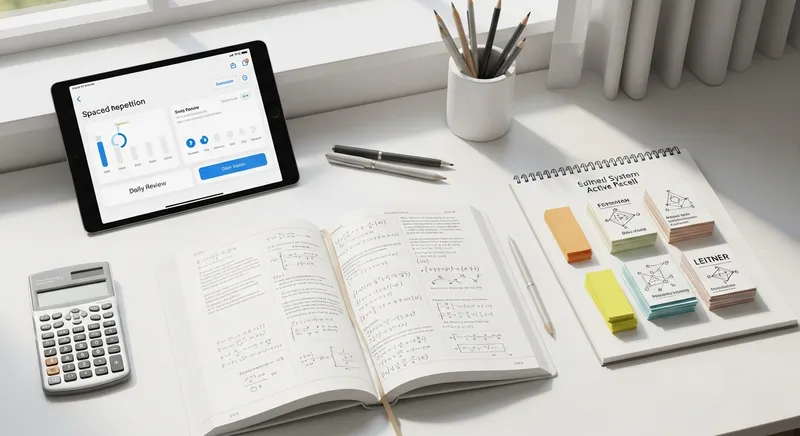
Ever spent hours staring at your physics notes or re-reading a math chapter, only to feel like you've retained nothing during the test? You're not alone. You study hard, but the formulas and problem-solving steps seem to vanish when you need them most. You've probably heard the advice to "study smarter, not harder," and maybe you've even heard of techniques like active recall and spaced repetition.
But here's the real problem nobody seems to address: How do you actually use these methods for a multi-step calculus problem or a complex chemistry concept? It's easy to use a flashcard for a simple definition, but it feels impossible for the kind of deep, procedural knowledge needed in STEM. This guide is here to fix that. We'll go beyond the theory and give you a practical, step-by-step framework to apply these evidence-based study strategies to the unique challenges of math and science, helping you stop forgetting what you studied and start acing your exams.
Key Takeaways
- Upgrade Your Flashcards: Create process-oriented flashcards that ask "how" and "why," not just "what."
- Use the Feynman Technique: Explain complex concepts in simple terms to identify and fill gaps in your understanding.
- Reframe Homework: Treat every practice problem as a closed-book active recall test before checking the solution.
- Follow a Schedule: Use spaced repetition to review new material multiple times over the first week, cementing it in your long-term memory.
The Illusion of Knowledge: Why Passive Learning Fails in STEM
Most students default to passive learning methods because they feel productive and comfortable. These include activities like re-reading textbooks, highlighting notes, or watching lecture videos from start to finish. While these activities aren't useless, they create a dangerous "illusion of knowing." Your brain recognizes the material, which feels like learning, but you haven't actually trained it to retrieve and use the information on its own.
In STEM subjects, this is a recipe for disaster. You don't just need to recognize a formula; you need to know when to apply it, how to adapt it, and what steps to follow. Passive review simply doesn't build that problem-solving muscle. This is why tools that force active problem-solving, like working through step-by-step explanations in apps such as Tutor AI, are more effective than passive video watching.

What is Active Recall? Your Brain's Built-in Search Engine
Active recall, also known as retrieval practice, is the practice of deliberately retrieving information from memory without looking at the answer. Instead of passively reviewing the material, you force your brain to find it. This single shift is one of the most powerful things you can do to improve your long-term retention.
Why does it work so well? Neuroscientists suggest that the cognitive effort required for retrieval practice builds more durable memories. According to research published by the U.S. National Library of Medicine (PMC), each time you successfully pull a piece of information from your brain, you strengthen the neural pathway to it, making it easier to find next time. It's like turning a faint dirt path into a paved highway.
How to Use Active Recall for Math & Science (Beyond Simple Facts)
The biggest hurdle for STEM students is moving active recall from memorizing facts to understanding processes. Here are practical techniques designed specifically for technical subjects.
From Memorizing to Understanding: The Process-Oriented Flashcard
Standard flashcards are often a one-to-one match: a term on one side, a definition on the other. For STEM, you need to upgrade to process-oriented flashcards. These don't ask "what," they ask "how" and "why."
Instead of making a card that says: Front: Quadratic Formula Back: x = [-b ± sqrt(b²-4ac)] / 2a
Create cards like these:
-
Front: I have a quadratic equation. What are the three main methods I can use to solve it, and when is each one most effective?
-
Back: 1. Factoring: Best for simple equations where factors are obvious. 2. Completing the Square: Useful for deriving formulas or when the 'a' term is 1. 3. Quadratic Formula: Works for any quadratic equation, especially when factoring is difficult. (For more on this, check out our guide on how to know if an equation has no solution).
-
Front: What are the step-by-step instructions for solving a related rates problem in calculus?
-
Back: 1. Draw a diagram and label variables. 2. Identify what rates are given and what rate I need to find. 3. Write an equation that relates the variables. 4. Differentiate with respect to time (t). 5. Substitute known values and solve for the unknown rate.
This method forces you to recall the entire problem-solving framework, not just a single formula. It's one of the best learning strategies for technical subjects because it mirrors what you'll actually have to do on an exam.
The Feynman Technique for Deep Understanding
Named after Nobel Prize-winning physicist Richard Feynman, this technique is a powerful tool for dismantling complex ideas. The University of Colorado Boulder outlines it in four simple steps:
- Study: Choose a concept you want to understand (e.g., Newton's Second Law).
- Teach: Write or say out loud an explanation of the concept as if you were teaching it to a 12-year-old. Use simple language and analogies.
- Fill the Gaps: When you get stuck or use complex language, you've found a gap in your understanding. Go back to your source material to clarify it.
- Simplify: Review your explanation and simplify it further. Get rid of any jargon and smooth out your analogies.
As learning expert Scott H. Young advises, you don't need to do this for everything. Use the Feynman Technique when you hit a wall on a key concept that is blocking your progress. For example, if you're struggling with a set of advanced mathematics problems, applying this technique to the core theorem they all rely on can unlock your understanding for the entire chapter.
Reframe Homework as Active Recall
Every practice problem in your textbook is a pre-made active recall challenge. The key is to treat it that way. Don't do your homework with the solutions manual open next to you.
- Attempt every problem on a blank sheet of paper first.
- Struggle with it for a few minutes. This struggle is not wasted time; it's the cognitive effort that builds memory.
- Only when you are truly stuck should you look for help. But don't just find the answer. Seek out a step-by-step explanation. This is where you Snap. Solve. Learn. Tools like Tutor AI are built for this moment. You can snap a picture of the problem and get a detailed walkthrough, helping you pinpoint exactly where you went wrong.
- After understanding your mistake, close the explanation and try to solve the problem again from scratch. This closes the learning loop.
What is Spaced Repetition? Beating the Forgetting Curve
The "forgetting curve," a concept from 19th-century psychology, shows that we forget information at an exponential rate. You can lose almost half of newly learned information within a day if you don't review it. Spaced repetition is the scientifically-proven antidote to this.
Instead of cramming for hours the night before a test (which is called "massed practice"), you space out your review sessions over time. As a comprehensive review on Policy Insights from the Behavioral and Brain Sciences highlights, hundreds of studies confirm that spaced practice leads to far superior long-term learning compared to cramming.
A Practical Spaced Repetition Schedule for Your STEM Class
Knowing you should space out your practice is one thing; doing it is another. Here is a simple, tangible schedule you can adapt to any STEM class, from an AP Biology Study Guide to a university engineering course.
A Sample Weekly Study Calendar
Let's say you learn a new concept in a lecture on Monday:
| Day | Task | Time |
|---|---|---|
| Day 1 (Mon) | Create process-oriented flashcards for the new concepts. | 20-30 min |
| Day 2 (Tue) | First active recall session on Monday's material. | 15 min |
| Day 4 (Thu) | Second active recall session on Monday's material. | 10-15 min |
| Day 7 (Sun) | Larger review of the entire week's material. | 20-30 min |
As you review, also try to mix in problems from previous weeks. This is a related technique called interleaving. Research summarized by SUNY Brockport found that students learning math and science with interleaved retrieval practice scored significantly higher than those who studied in blocks. Mixing different problem types forces your brain to learn which strategy to use, a critical skill in STEM.
The Power Duo: Active Recall + Spaced Repetition
These two techniques are a perfect match. Active recall is the exercise you do (retrieving information), and spaced repetition is the schedule you follow. When combined, their effect is magnified.
In fact, a study with college engineering students featured by RetrievalPractice.org found that using an online quizzing program that combined retrieval, spacing, and feedback boosted final exam scores by nearly a full letter grade. This is how you achieve long-term retention and become one of those students who doesn't have to cram for the final.
Study Tools for Spaced Repetition
Tutor AI's Personalized Learning Path automatically identifies your weak spots and schedules targeted review, combining spaced repetition with personalized practice. By analyzing your performance on practice problems, the app can recommend targeted exercises, creating a natural system of review for the concepts you struggle with most.
If you prefer manual flashcard creation, other apps like Anki and Quizlet also use spaced repetition algorithms to show you cards right before you're about to forget them. You can use them to create the process-oriented flashcards we discussed earlier.
For Parents and Tutors: How to Guide a Student Through Active Recall
If you're a parent or tutor, your instinct might be to give the answer when a student is struggling. To foster real learning, you must resist this urge. Instead, guide them through active recall with thoughtful questions. This can help end those nightly homework battles, a topic we explore more in The Parent's Guide to New Math.
Instead of saying, "The answer is 12," try asking:
- "What is the question asking you to find?"
- "What information do you already have?"
- "What was the first step the teacher showed you for this type of problem?"
- "What do you think you should try next?"
This questioning technique empowers the student to build their own problem-solving pathways, which is far more valuable than simply getting the right answer. You can also use the Parent Insights dashboard in Tutor AI to see where your child is getting stuck and what concepts they are practicing.
Frequently Asked Questions
How do I remember math formulas without just memorizing?
True retention comes from understanding, not rote memorization. Instead of just repeating a formula, focus on deriving it. Work through the proof or the example that introduces the formula. Then, create a process-oriented flashcard that asks, "When and why do I use this formula?" and practice solving different types of problems with it. The act of using the formula in various contexts is a form of active recall that builds much stronger memories.
What is a good spaced repetition schedule for a weekly math quiz?
For a weekly quiz, a simple schedule works best. If you learn a new concept on Monday, your first review should be that same day (Day 1). Your next active recall session should be on Day 2 or 3 (Tuesday or Wednesday). Have another session on Day 5 (Friday), and a final quick review the morning of the quiz. The key is short, frequent sessions rather than one long cramming session.
Is watching someone solve a problem on video active or passive learning?
It's passive. To make it active, pause the video before they start the solution and try to solve it yourself first. Then, watch their explanation to check your work or understand where you got stuck.
Can you use the Feynman Technique for a whole chapter?
Trying to use the Feynman Technique on an entire chapter at once would be overwhelming and ineffective. Instead, identify the 2-3 most critical concepts or theorems in the chapter that everything else builds upon. Apply the technique to each of these core ideas individually. By deeply understanding the foundational pillars, you'll find that the smaller, supporting details naturally fall into place.
How do I use flashcards for a physics concept I can't memorize?
This is where process-oriented flashcards shine. Don't try to put the entire concept on a card. Instead, create cards that test your conceptual understanding from different angles. For example, for Newton's Third Law, you could create these cards:
- Front: A bug hits a car's windshield. Which feels a greater force? Explain why.
- Front: Draw a free-body diagram for a book resting on a table and identify the action-reaction pairs.
- Front: What is the most common misconception about Newton's Third Law?
What's the difference between interleaving and spaced repetition for STEM?
Spaced repetition is about when you study a single topic (spacing it out over time). Interleaving is about what you study in a single session (mixing up different types of problems). Research shared by the U.S. Department of Education's ERIC database shows both are highly effective for learning complex mathematical content.
From Struggling to Acing STEM
Shifting from passive review to a system of active recall and spaced repetition is the single most effective change you can make to your study routine. It moves you from a cycle of memorizing and forgetting to one of genuine understanding and long-term retention. It's not a magic trick; it's a skill that will serve you throughout your academic and professional life.
Ready to transform your study routine? Download Tutor AI free on iOS and Android to get instant, step-by-step help with your toughest STEM problems. Join hundreds of thousands of students who are studying smarter and acing their exams.