
Stuck on a Math Problem That Seems Unsolvable? You're Not Alone.
We've all been there. You're deep into your math homework, carefully following every step of an algebra problem. You substitute, you eliminate, you solve... and then something strange happens. All the variables disappear, and you're left staring at a statement that makes no sense, like 4 = 9. It's a confidence-crushing moment that leaves you wondering, "Did I mess up? Is this a trick question?"
That feeling of confusion is exactly why so many students get frustrated with math. If you're finding yourself struggling with math homework, know that you're not alone. The good news? You can snap a photo of these confusing problems for instant clarification, but first, let's understand what's actually happening. You probably didn't make a mistake.
You've just discovered a special type of system called an "inconsistent system." This guide will turn that confusion into confidence by teaching you exactly how to tell if an equation has no solution, what it means, and how to prove it.
What Does 'No Solution' Actually Mean in Algebra?
In algebra, when we say a system of equations has "no solution," we're talking about an inconsistent system. Think of it like two trains running on perfectly parallel tracks. They might be going in the same direction and look similar, but because they are parallel, their paths will never, ever cross.
In algebra, the "solution" is the point where the lines represented by the equations intersect. If the lines are parallel, they never intersect, so there is no solution.
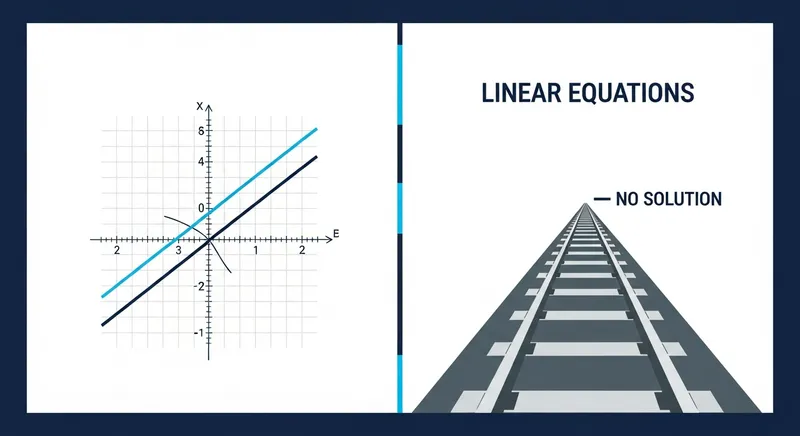
This means there is no single pair of x and y values that can make both equations in the system true at the same time. According to educational resources from Lumen Learning, an inconsistent system is one that has no solution. When you try to solve it, you end up with a contradiction- a statement that is mathematically false, like 0 = 5. This false statement is your proof that no solution exists.
3 Clear Methods to Know If a System of Equations Has No Solution
So, how do you spot these inconsistent systems in the wild? There are three reliable methods that will help you identify when a system of equations has no solution. Each method reveals the answer in a slightly different way, but they all lead to the same conclusion.
Let's walk through them step-by-step. Mastering these will give you the power to solve any system of equations your teacher throws at you.
Method 1: Graphing Linear Equations
The most visual way to identify a system with no solution is by graphing the lines. As a University of Utah math resource explains, solving a system is the geometric equivalent of finding where the lines intersect. If they don't intersect, there's no solution.
Here's the process:
- Take both linear equations in your system.
- Graph each equation on the same coordinate plane.
- Look at the resulting lines. If the lines are parallel and never cross, the system has no solution.
Actionable Tip: You can often spot parallel lines without even graphing! First, convert your equations into slope-intercept form (y = mx + b).
mis the slope (the steepness of the line).bis the y-intercept (where the line crosses the vertical y-axis).
If the slopes (m) are identical, but the y-intercepts (b) are different, the lines are guaranteed to be parallel. Not sure if your graph is perfect? You can snap a photo of your work, and an AI tool like Tutor AI can confirm if the lines are truly parallel or if you have a slight slope error.
Method 2: Solving Systems by Substitution
The substitution method is a fantastic algebraic tool, and it gives a very clear signal when there's no solution. As the CK-12 Foundation notes, when you use substitution on an inconsistent system, the variables will cancel out, leaving you with an untrue statement.
Let's see it in action with an example:
System:
y = 2x + 3y = 2x + 5
Steps:
- Since both equations are already solved for
y, we can substitute the first equation into the second.2x + 3 = 2x + 5 - Now, try to solve for
x. Subtract2xfrom both sides.2x - 2x + 3 = 2x - 2x + 5 - The variables cancel out, and you are left with:
3 = 5
This is a false statement, or a contradiction. It can never be true.
Actionable Tip: The moment your variables disappear and you're left with a nonsensical equation like 3 = 5 or -1 = 10, you can stop. You have successfully proven the system has no solution. This is a common challenge, and learning how to use tools like an AI math solver for word problems can help you practice recognizing these patterns.
Method 3: Solving Systems by Elimination
The elimination method works similarly. You manipulate the equations to eliminate one variable, but in an inconsistent system, both variables end up vanishing.
As explained in Paul's Online Math Notes from Lamar University, inconsistent systems have no solution because it's impossible for a point to be on both lines at once.
Let's try an example with elimination:
System:
x - y = 4-2x + 2y = 6
Steps:
- Multiply the first equation by 2 so the
xcoefficients are opposites.2(x - y) = 2(4)->2x - 2y = 8 - Now, add this new equation to the second equation in the system.
(2x - 2y) + (-2x + 2y) = 8 + 6 - Combine like terms. Notice that both the
xandyvariables cancel out.(2x - 2x) + (-2y + 2y) = 14 - You are left with:
0 = 14
Once again, this is a false statement.
Actionable Tip: Just like with substitution, a false statement is your final answer. If you're ever confused about why the variables disappeared, you can use an AI tool to get a step-by-step breakdown of the elimination process to double-check your work.
Key Takeaway & Practice Tip Practicing these methods with instant feedback helps cement the concepts. The key pattern is simple:
- Variables Cancel + FALSE Statement (
3=5) = No Solution- Variables Cancel + TRUE Statement (
5=5) = Infinite Solutions Apps like Tutor AI can provide unlimited practice problems with step-by-step solutions to help you master identifying all types of systems.
Now that you've seen how substitution and elimination can lead to a contradiction, it's crucial to distinguish this from a similar-looking outcome: infinite solutions.
No Solution vs. Infinite Solutions: A Clear Comparison
A major point of confusion for students is the difference between "no solution" and "infinitely many solutions." In both cases, the variables cancel out. The key is to look at what's left.
As Khan Academy clarifies, the outcome of the final, simplified equation tells you everything you need to know.
Here's a simple cheat sheet:
- One Solution: You can successfully solve for a specific value for
xandy(e.g.,x=3,y=2). Graphically, this is intersecting lines. - No Solution: The variables cancel out, and you are left with a FALSE statement (e.g.,
0 = 5). Graphically, this is parallel lines. - Infinite Solutions: The variables cancel out, and you are left with a TRUE statement (e.g.,
5 = 5). Graphically, this is the exact same line.
Understanding this distinction is a huge step toward mastering calculus, statistics, and linear algebra, as these concepts build on each other.
Real-World Example of an Inconsistent System
These concepts aren't just stuck in textbooks; they appear in the real world. Imagine this scenario:
- Scenario: Two friends are in a charity walkathon. You start 2 miles ahead of the starting line and walk at a steady pace of 3 mph. Your friend starts 1 mile ahead of the starting line and also walks at a steady pace of 3 mph.
Will your friend ever be at the same spot as you?
Let's set up the equations where y is the distance from the start and x is the hours walked:
- Your position:
y = 3x + 2 - Friend's position:
y = 3x + 1
Notice something? The slopes (m) are both 3, but the y-intercepts (b) are different (2 and 1). These are parallel lines. Because you both walk at the same speed but started at different points, the distance between you will always be 1 mile. You will never meet. This is a real-world inconsistent system! Practicing more scenarios like this helps build pattern recognition, and you can even track your progress on different system types to see your skills grow.
Conclusion: Turning Confusion into Confidence
That confusing moment when your math problem seems to break is actually a sign that you've found something important. An equation with no solution isn't a mistake-it's a definitive answer that proves a system is inconsistent.
Remember the key signs: a false statement like 0 = 5 after using substitution or elimination, or two parallel lines on a graph. By learning to recognize these signals, you've turned a point of frustration into a moment of mastery. For extra practice, consider exploring some of the best math solver apps that can provide more examples.
If you ever get stuck, remember that tools like Tutor AI are available 24/7. Just snap a picture of the problem, and you can get a step-by-step explanation that helps you understand the 'why' behind the answer, building your confidence for the next challenge.
Frequently Asked Questions
What is the difference between no solution and a solution of x=0?
This is a fantastic question and a common point of confusion. A solution of x=0 is a perfectly valid, specific answer. It means the point of intersection for the system occurs somewhere on the y-axis. Think of it as a specific address on a map. 'No solution,' however, means there is no possible value for x and y that could ever make the system true-the lines never intersect at all. It's like having two roads that are parallel and never cross.
Can a single equation have no solution?
Yes, absolutely. A single equation like x + 5 = x + 3 is called a contradiction. As materials from Purdue University's math department explain, a contradiction has no solution because no real number can make the statement true. If you try to solve it by subtracting x from both sides, you get the false statement 5 = 3, proving it has no solution.
What do the graphs of inconsistent systems look like?
They always look like parallel lines. This is the key visual giveaway. Because they have the same slope, they are equally steep and travel in the same direction. But since they have different y-intercepts, they start at different points on the y-axis and will maintain a constant distance from each other, never meeting.
If the variables cancel out, does it always mean no solution?
No, and this is the most important distinction to remember. When variables cancel out, you must look closely at what is left:
- If you are left with a false statement (like
0=5or-2=10), it means no solution. - If you are left with a true statement (like
5=5or0=0), it means there are infinitely many solutions (the two equations represent the same line).
What is a contradiction in math?
A contradiction is a statement that is always false, no matter what values you substitute for the variables. An equation like x = x - 1 is a simple contradiction because a number can never be equal to one less than itself. When you're solving a system of equations, this concept reveals itself as a simple false statement (e.g., 0 = -1), which is your definitive signal that the system is inconsistent and has no solution.
Educational Advice Disclaimer: Every student learns differently. While these strategies are research-backed, results may vary. Adapt these techniques to fit your unique learning style and circumstances.


