The 'answer engine' trap: Why quick-fix math solvers fail (and the best Gauthmath alternatives for exams)

It is a frustrating scenario that plays out in households across the country every semester. Your child gets perfect scores on their math homework every single night, but when the in-class exam rolls around, they completely blank out and fail.
If this sounds familiar, you are not alone. Many students and parents are falling victim to the "answer engine trap."
With the rise of smartphone apps that can solve complex equations in seconds, getting the right answer has never been easier. However, there is a massive difference between finishing a homework assignment and actually learning the material. When students rely on quick-fix scanning apps as a crutch, they never commit the formulas or problem-solving methods to their long-term memory.
In this guide, we will break down why popular math solvers often do more harm than good for test prep, explore the cognitive science behind true learning, and reveal the best Gauthmath alternatives designed to build real academic confidence.
What is Gauthmath and how does it work?
Gauthmath, like many other modern math applications, uses advanced optical character recognition (OCR) and artificial intelligence to read math problems through a smartphone camera. A student simply snaps a picture of their homework, and the app instantly provides the final answer along with the steps to get there.
For a student staring at a confusing algebra worksheet at 11 PM, this technology feels like magic. It removes the immediate friction of being stuck. However, this convenience comes at a steep educational cost. By doing all the heavy cognitive lifting, these apps turn students into passive readers rather than active problem solvers.
Actionable tip: The "hide and seek" rule
If you or your child are currently using a scanning app, implement the "hide and seek" rule today. Snap a photo of the problem, but cover the screen with your hand. Reveal only the very first step, hide the screen again, and try to complete the rest of the problem independently.
The illusion of competence: Why you understand the homework but fail the test
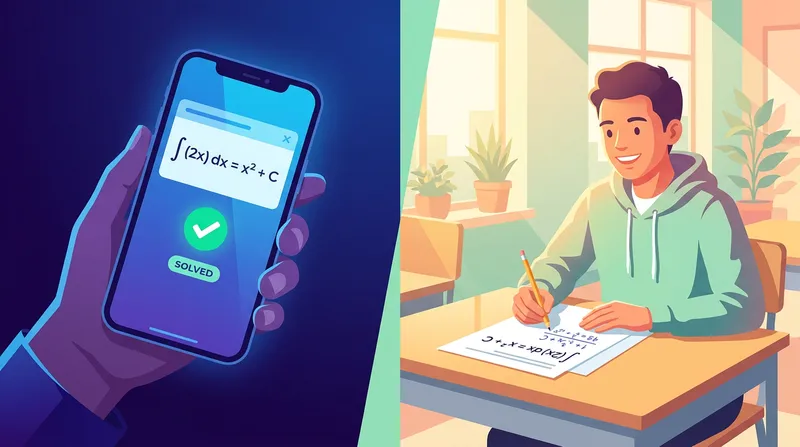
Have you ever read a textbook chapter, felt like you understood every word, but then failed the quiz the next day? This psychological phenomenon is known as the "illusion of competence."
When a student reads a perfectly formatted, AI-generated math solution, their brain easily processes the logical flow. Because the steps make sense in the moment, the student falsely believes they have mastered the concept. According to the U.S. Department of Education, mindlessly practicing procedures leads to an "illusion of competence" where students fail when faced with slightly different problems on exams because they lack conceptual understanding.
During a high-pressure exam, the app is gone. The student is left staring at a blank page, realizing they only knew how to read a solution, not how to generate one from scratch.
Actionable tip: Teach it to a rubber duck
To break the illusion of competence, try the "Feynman Technique." After solving a math problem, explain your steps out loud to a parent, a friend, or even a rubber duck on your desk. If you stumble while explaining why you moved a variable to the other side of the equation, you have found a gap in your understanding.
Answer engines vs. AI tutors: What is the difference?
Not all educational technology is created equal. The biggest mistake parents and students make is treating all AI math tools as the same. We need to distinguish between passive answer engines and active learning tutors.
An answer engine (like a basic calculator or standard scanning app) simply gives you the final destination. It exists to solve the problem, not to teach the student.
An AI tutor, on the other hand, mimics a real human teacher. It guides the student, asks questions, and provides context. Research from the Brookings Institution highlights that effective AI tutoring requires step-level feedback with both verification and elaboration to fill gaps in understanding, rather than just providing answer-level feedback.
Actionable tip: Evaluate your tech stack
Look at the apps currently on your phone. Do they ask you questions? Do they track which topics you struggle with? If the app only ever gives you answers without challenging you to think, it is time to upgrade to a true AI tutoring platform. For more on this, check out our guide on Beyond Brainly: How to Use AI for Active Homework Practice (Without Cheating).
Top AI math solvers for high school students (and where they fall short)
To understand how to study better, we need to look at the most popular tools on the market and identify their weaknesses.
1. Photomath
Photomath is incredibly popular for its exceptional text recognition and clean interface. It has a superior camera scanner for handwritten notes, making it fast for quick homework checks. However, it fosters the exact illusion of competence we discussed earlier. It breaks down equations into sequential steps but lacks active recall features or personalized quizzes to test long-term retention. Students often copy the steps directly onto their homework without absorbing the underlying concepts.
2. Mathway
Mathway covers a massive range of topics and offers a specialized math keyboard that is excellent for manual input of highly complex calculus or physics symbols. The major drawback is that it paywalls its step-by-step explanations behind a premium subscription. Even when you pay, the explanations are highly robotic and lack conceptual context or teaching moments. It does not track student progress or adapt to individual learning gaps.
3. Brainly
Brainly combines crowdsourced peer answers with AI-generated explanations. While the gamified community aspect is fun, the quality and accuracy of peer answers can be highly inconsistent. Furthermore, it often provides the final answer upfront, which encourages academic shortcuts rather than deep learning.
4. Chegg Study
Chegg offers a massive database of textbook-specific solutions. While comprehensive, it requires an expensive monthly subscription that alienates budget-conscious parents. More importantly, it relies on a passive learning approach that does not force students to practice retrieval, making it difficult to transition from homework to exam day.
5. Caktus AI
Caktus AI is an all-in-one platform handling math, coding, and essay writing. While versatile, its math formatting and image scanning are less robust than dedicated math apps. Because it is a generalist AI writing assistant, it acts more like a prompt generator than an adaptive, structured tutoring system. This lack of focus makes it poorly suited for rigorous math exam preparation.
Feature comparison summary
| Feature | Photomath | Mathway | Brainly | Chegg | TutorAI |
|---|---|---|---|---|---|
| Step-by-step explanations | Yes | Paid | Inconsistent | Yes | Yes |
| Active recall features | No | No | No | No | Yes |
| Parent progress tracking | No | No | No | No | Yes |
| Offline access | Yes | No | No | No | Yes |
Actionable tip: Use solvers as a checking mechanism only
If you use these tools, change your workflow. Solve the problem completely on your own paper first. Only open the app to check your final answer. If you are wrong, use the app to find exactly which step you messed up on, then close the app and redo the problem.
How to remember math formulas easily with cognitive science
If quick-fix solvers are the problem, what is the solution? The answer lies in cognitive science, specifically two concepts called active recall and spaced repetition.
Active recall is the process of actively stimulating your memory to retrieve a piece of information. Passive review is reading a formula sheet. Active recall is staring at a blank piece of paper and forcing your brain to write the formula from memory.
Spaced repetition involves reviewing information at gradually increasing intervals over time. This signals to your brain that the information is important and needs to be stored permanently.
According to Khan Academy, active recall reinforces neural pathways and makes information easier to retrieve in the future, proving to be a much more effective way of learning than passive reading or listening.
Actionable tip: Create spaced repetition math flashcards
Do not just make flashcards for history vocabulary. Create math flashcards! Put a complex equation on the front and the step-by-step solution on the back. Review these cards using a spaced repetition schedule (reviewing them 1 day, 3 days, and 1 week after learning them) to guarantee you memorize math formulas fast.
Parent-approved AI: Finding the best Gauthmath alternative
Parents want educational tools that build actual skills, not just apps that help their kids finish homework faster so they can play video games. A true Gauthmath alternative needs to provide transparency, prove the student is learning, and offer personalized support.
This is where TutorAI steps in. Built on the core philosophy of "Snap. Solve. Learn.", TutorAI bridges the gap between instant homework help and genuine academic comprehension.
A randomized controlled study from Harvard University found that students learn more than twice as much in less time when using an AI tutor built on pedagogical best practices compared to traditional active learning classes. TutorAI utilizes these exact pedagogical best practices.
Instead of just handing over the final answer, TutorAI breaks down complex problems into logical steps, explaining the reasoning behind each move. It acts as a 24/7 AI-powered homework helper that adapts to a student's individual weak spots. It even includes specialized support for SAT, ACT, and AP exam preparation, ensuring students are ready for high-stakes standardized tests.
Even without a reliable internet connection, TutorAI's offline access means students are never left stranded mid-study session. To keep students engaged, it replaces the inconsistent community elements of other apps with positive gamification, offering achievement badges and learning streaks that reward consistent practice.
For parents, TutorAI offers a comprehensive progress tracking dashboard. You can finally see exactly which topics your child is mastering and where they need extra support, ending the nightly homework battles for good. If you are dealing with a frustrated student, read our Parent's Guide to Math Anxiety: How to Help a Child Struggling with Math and End Homework Tears.
Actionable tip: Implement weekly progress reviews
Set up a 10-minute weekly check-in with your child using the parent dashboard. Celebrate their learning streaks and gently review the topics where the app identified conceptual gaps. This turns homework from a solitary struggle into a collaborative family victory.
How to solve math problems fast (without cheating)
Speed in mathematics does not come from rushing. It comes from pattern recognition. When you truly understand the underlying concepts, your brain instantly recognizes which formula to apply when looking at a new problem.
To solve problems faster during an exam, you must practice under exam conditions at home.
Actionable tip: The "cover and check" method
When reviewing a practice test, use the "cover and check" method. Look at a problem you solved previously. Cover your work with a blank sheet of paper. Try to write out the first step from memory. If you get it right, slide the paper down one line. If you get stuck, you have pinpointed the exact moment your pattern recognition failed.
Is using an AI homework helper cheating?
This is the most common question teachers and parents ask. The answer depends entirely on how the tool is used.
If a student scans a problem, copies the final answer, and submits it as their own work, that is academic dishonesty. It robs the student of the learning process.
However, if a student uses an AI study assistant to get unstuck on a specific step, to review detailed explanations of concepts they missed in class, or to generate personalized practice problems, that is highly effective studying. Tools designed for education encourage this second, ethical method of learning. For a deeper dive into finding the right tools, explore our 7 Best AI Tutoring Apps for Step-by-Step Explanations (2026 Guide).
Frequently asked questions
Why do I understand my math homework perfectly but fail the exams?
This happens due to a psychological phenomenon called the "illusion of competence." When you use quick-fix solvers, textbooks, or follow along with a teacher, your brain easily processes the logic, making you feel like you understand it. However, because you are not actively retrieving the information from memory on your own, you blank out during exams. You need to practice active recall to build true long-term retention.
What is the difference between an AI homework helper and an AI tutor?
An AI homework helper (often called an "answer engine") simply gives you the final solution and the steps to copy. It does the work for you. An AI tutor mimics a real human teacher. It provides step-level feedback, identifies your specific weak spots, and adapts to your learning style to ensure you actually comprehend the material rather than just copying it.
How can I remember math formulas easily for my final exams?
The most effective way to memorize math formulas fast is by using spaced repetition and active recall. Instead of passively re-reading a formula sheet, create math flashcards. Force yourself to write the formula from memory without looking, and review these cards at increasing intervals (for example: 1 day, 3 days, and 1 week after learning them) to lock them into your brain.
Is using apps like Gauthmath or Photomath considered cheating?
It depends entirely on how you use them. If you scan a problem, copy the final answer, and submit it as your own work, that is academic dishonesty. However, using these tools to check your completed work, understand a specific step you missed, or generate personalized practice problems is an ethical and highly effective way to study.
What is the best Gauthmath alternative that actually helps you study?
The best alternative is a true AI tutoring platform that focuses on genuine learning rather than just providing quick answers. Look for apps that combine instant photo-based problem solving with detailed explanations, personalized learning paths, offline capabilities, and progress tracking for parents. This ensures students build real academic confidence and are fully prepared when test day arrives.
Stop copying, start learning
The convenience of modern math solvers is undeniable, but the "answer engine trap" is actively harming student test scores. By mindlessly copying steps from a screen, students skip the productive struggle required to build true mathematical proficiency.
It is time to transition from passive homework completion to active learning. By embracing cognitive science techniques like spaced repetition and utilizing pedagogically sound AI tutors, students can eliminate test anxiety and build lasting academic confidence.
Ready to study smarter, not harder? Get unstuck instantly and learn for real with TutorAI. Download the app today to experience 24/7 personalized homework help that actually improves your grades.
Note: Every student learns differently. While these strategies are research-backed, results may vary. Adapt these techniques to fit your unique learning style and circumstances.