It's 10 PM. You're staring at a differential equations problem, and it might as well be written in another language. You turn to an AI math solver for help, only to have it give you a basic algebra answer. If you've felt that sinking feeling, you're not alone. It's a common frustration for university students and educators. While many AI tools are great for high school math, they often hit a wall when faced with the abstract reasoning and complex proofs of upper-division mathematics.
This guide tackles that core problem head-on. We're here to give you a realistic, 2026-focused look at which AI tools can genuinely handle advanced mathematics. We'll explore what works, what doesn't, and how students, parents, tutors, and teachers can use these powerful new technologies to support real learning, not just find answers.
Why Most AI Math Solvers Fail at University-Level Math
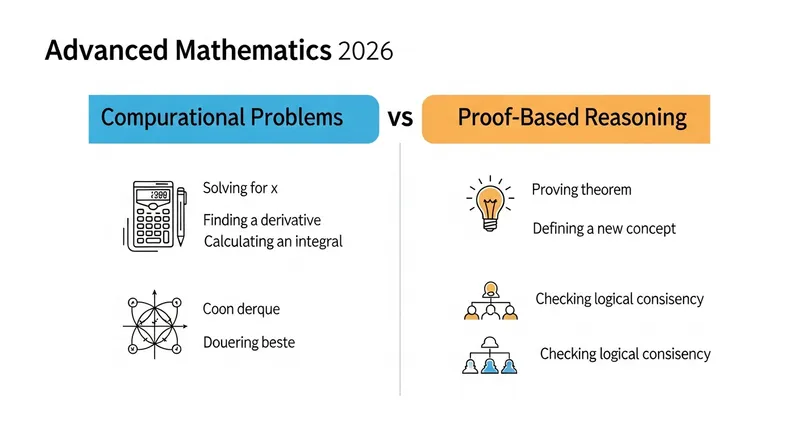
Here's the thing: not all math is created equal, and the same is true for AI. The reason your favorite photo-solving app might ace a calculus 1 integral but fail at a linear algebra proof lies in a fundamental difference: computation vs. reasoning.
Most standard AI math solvers are brilliant computational engines. They are fantastic at following set rules and algorithms to solve problems with a clear, numerical answer. However, advanced mathematics is less about calculation and more about abstract reasoning, logic, and constructing formal proofs. This is where many tools fall short.
According to Stephen Wolfram, the creator of Wolfram|Alpha, there's a key distinction between large language models (LLMs) like ChatGPT and computational knowledge engines. In his analysis, Wolfram|Alpha as the Way to Bring Computational Knowledge Superpowers to ChatGPT, he explains that LLMs predict statistically likely text, while tools like Wolfram|Alpha perform structured, verifiable computations. An LLM might generate a plausible-sounding proof, but it doesn't understand the underlying logic. An academic paper on arXiv from Cornell University notes this is a major drawback, as these models are pattern-matchers, not true logical engines, which can lead to confident but incorrect answers.
Actionable Tip: Test an AI's reasoning ability yourself. Instead of giving it a problem to solve, ask it a conceptual question like, "Why is the derivative of a constant always zero?" or "Explain the geometric interpretation of a matrix determinant." A good tool will explain the concept; a poor one will just give you a formula or a wrong answer.
The Tiered Ranking: Best AI Tools for Your Math Level in 2026
Instead of a single 'best' tool, it's more useful to think in tiers based on the type of math you're working on. Here's our tiered guide to the AI landscape for 2026.
Tier 1: Foundational University Math (Calculus, Linear Algebra, Statistics)
For first and second-year courses, the primary need is for accurate, step-by-step solutions to computational problems. This is where many well-known tools shine.
- What they do well: These tools are excellent for solving integrals, differentiating functions, finding matrix inverses, and calculating statistical probabilities. They provide step-by-step breakdowns that help you check your work and understand the process. If you're struggling with math homework, these can be lifesavers.
- Key Players:
- Wolfram|Alpha: The gold standard for pure computation and data visualization. It's less of a 'tutor' and more of a 'computational expert.'
- TutorAI: Designed for learning, TutorAI's Snap. Solve. Learn. model is perfect for these subjects. By taking a photo of a problem, you get a detailed, step-by-step explanation that focuses on the 'why' behind the answer. It's like having a 24/7 tutor ready for those late-night study sessions, helping you build the foundational skills needed for more advanced courses.
- Mathway & Chegg: These platforms offer broad coverage for textbook-style problems and are among the 10 best AI homework solvers in 2026.
- Limitations: They are not designed for writing or verifying formal proofs and can struggle with highly abstract or theoretical questions.
Actionable Tip: Use a tool like TutorAI to check your homework. First, attempt the problem on your own. Then, snap a photo of the problem to get the step-by-step solution. Compare your method to the AI's explanation to find gaps in your understanding. This turns a simple answer-checker into a powerful learning tool.
Tier 2: Advanced & Proof-Based Math (Abstract Algebra, Real Analysis, Topology)
This is where most commercial tools fail and where the future of AI in math is most exciting. For upper-division courses, you need an AI that can handle logic, structure, and abstract concepts.
- The Challenge: Writing and understanding proofs is a creative and logical process that, until recently, was exclusively human. There is no simple algorithm for it.
- The Breakthrough: The game is changing. Researchers at Google DeepMind developed AlphaGeometry, an AI that can solve complex, Olympiad-level geometry problems. It uses a smarter AI that combines language understanding with logical reasoning to find a proof. While not yet a commercial product, it proves that AI is capable of high-level mathematical reasoning.
- Current Best Approach: For now, the most effective strategy is to combine tools. Using ChatGPT-4 (with the Wolfram plugin enabled) allows you to use natural language to ask questions, which ChatGPT then translates into precise, formal queries for Wolfram|Alpha to compute. This combination is currently the most powerful option for tackling problems in differential equations or advanced modeling.
Actionable Tip: When using ChatGPT for an advanced problem, be extremely specific. Instead of "Solve this differential equation," try a prompt like this:
"Using the methods of ordinary differential equations, find the general solution for the second-order linear homogeneous equation y'' - 3y' + 2y = 0. Explain each step, including how you form and solve the characteristic equation."
This guides the AI toward the correct methodology and forces it to show its work.
The Educator's & Tutor's Guide: Using AI in the Advanced Math Classroom
For teachers and tutors, AI presents both a challenge and an incredible opportunity. The key is to integrate it ethically to foster critical thinking, not replace it.
The National Science Foundation (NSF) is actively funding opportunities to advance AI in education, showing a top-down commitment to its integration. Furthermore, the American Mathematical Society (AMS) is holding sessions dedicated to AI's role in teaching, signaling its importance within the academic community.
Actionable Tips for Educators and Tutors:
- Create "AI-Proof" Assignments: Shift focus from problems with a single, computable answer to those requiring explanation. Ask students to "Critique the AI-generated proof for this theorem," "Explain the conceptual error in this AI's solution," or "Compare two different AI-generated methods for solving this problem." This teaches critical evaluation skills.
- Use AI as a Lesson Planner: Struggling to find good example problems for abstract algebra? Ask an AI to generate five distinct examples of non-Abelian groups or three practice problems for the First Isomorphism Theorem. Use this as a starting point to save time.
- Leverage Learning Analytics: For parents and tutors, this is a game-changer. Tools like TutorAI offer progress tracking dashboards. This allows you to see where a student is struggling without having to look over their shoulder. You can identify weak spots in topics like integration by parts or vector spaces and provide targeted support. This data is invaluable in the debate of AI vs. Human Math Tutors.
The 2026 Readiness Report: What's Next for AI in Mathematics?
Looking ahead to 2026, the field is evolving rapidly. Researchers have explored various subject domains where generative AI has been used, with significant focus on STEM-related subjects. The consensus from a recent Stanford University symposium on AI and mathematics is that while AI is reshaping how math is done, the core human skills of defining concepts and understanding why a proof works remain essential.
Key Trends for 2026:
- Rise of Neuro-Symbolic Tutors: Expect more tools that combine the language skills of LLMs with the logical rigor of symbolic engines. These will be far more reliable for advanced subjects.
- AI as a Research Assistant: For graduate students and researchers, AI will become an indispensable tool for exploring conjectures, analyzing large datasets, and suggesting pathways for proofs.
- Smarter Curriculum Integration: Educational platforms will offer more deeply integrated AI that adapts to a student's learning pace, providing personalized problem sets and explanations that align with their specific course syllabus.
Actionable Tip: The most important skill for students and educators to develop is critical AI literacy. Learn to use AI as a collaborator, not a crutch. Practice evaluating its outputs, questioning its methods, and understanding its limitations. This is a core component of building your free AI study system.
Your Partner in the Age of AI
The world of AI and mathematics is changing fast, but our goal remains the same: to help you learn and succeed. The key is using the right tool for the right job. For foundational calculations and step-by-step learning, a dedicated tutor like TutorAI is your best friend. For exploring the frontiers of abstract math, combining tools like ChatGPT and Wolfram|Alpha is the smartest approach.
Ready to stop feeling stuck and start understanding? Download TutorAI for free today on iOS and Android. Turn frustration into mastery with step-by-step explanations that actually make sense.
Frequently Asked Questions
Can any AI solve advanced mathematical proofs?
No, not in a fully reliable way that's available to the public yet. While research from places like Google DeepMind shows that AI can solve Olympiad-level geometry proofs, these are specialized systems. For the average university student, general AI tools like ChatGPT can help outline a proof or check logic, but they can also make confident-sounding errors. They are best used as an assistant to help brainstorm or structure your own work, not as a final authority. Always verify an AI-generated proof with your own knowledge and course materials.
What is the best AI for linear algebra and differential equations?
For these subjects, a combination approach is best. Use a powerful computational engine like Wolfram|Alpha for the heavy calculations: solving systems of linear equations, finding eigenvalues, or solving complex integrals in differential equations. Then, use a conversational AI like ChatGPT (ideally with the Wolfram plugin) to get conceptual explanations. For example, you can ask it to explain the meaning of eigenvalues in the context of your problem after Wolfram|Alpha has calculated them. Tools like TutorAI are also excellent for getting step-by-step walkthroughs of foundational problems in these subjects.
Is Wolfram Alpha or ChatGPT-4 better for university-level math?
They serve different purposes and are best used together. Wolfram|Alpha is a computational expert; it is superior for accuracy, precision, and solving problems with a definitive numerical or symbolic answer. ChatGPT-4 is a conversational expert; it excels at explaining concepts in plain language, brainstorming approaches, and structuring written arguments. For the best results, use ChatGPT-4 to formulate your question and understand the concepts, then rely on Wolfram|Alpha (or the plugin) to perform the actual computation.
How can math teachers use AI tools effectively in the classroom?
Educators should focus on using AI to foster higher-order thinking. Instead of banning AI, integrate it. You can create assignments where students must critique an AI-generated solution, identify its flaws, and explain the correct method. AI can also be a valuable assistant for teachers, helping to generate varied practice problems, draft lesson plans on complex topics, or create multiple versions of a quiz. This saves time and allows educators to focus on teaching concepts rather than just checking answers.
What is the most accurate AI for solving complex calculus problems?
For pure accuracy in solving complex computational problems in calculus (e.g., multi-variable integrals, series convergence), Wolfram|Alpha is widely considered the industry leader. Its entire system is built on a foundation of formal mathematics, making it less prone to the errors that language-based AIs can make. For learning the process, a tool like TutorAI is ideal because it provides clear, step-by-step explanations designed to teach the method, not just give the final answer.
Note: Every student learns differently. While these strategies are research-backed, results may vary.


