
It's 10 PM on a Tuesday. Your child is staring at their algebra homework, frustrated and stuck. You want to help, but the concepts are a distant memory, and the thought of hiring a $60-per-hour tutor feels overwhelming.
You've heard about AI tutors, but you're worried. Are they safe? Do they just give answers, or do they actually teach? How can you trust a robot with your child's education and their long-term student confidence?
If you feel caught between the high cost of traditional tutoring and the uncertainty of new technology, you are not alone. This guide is here to clear the confusion. We'll break down the real costs, proven effectiveness, and critical safety considerations so you can make the best choice for your family, your budget, and your child's success.
AI Tutors in 2026: More Than Just Calculators
Forget the clunky problem-solvers of the past. Today's AI tutors are sophisticated learning companions. Powered by advanced artificial intelligence, these tools aim to replicate the one-on-one tutoring experience with a focus on understanding, not just answers.
When you see your child using an app like TutorAI, they aren't just getting a final number. They're getting a patient, step-by-step guide through the entire problem-solving process. For example, one 9th grader (name changed to protect privacy) used an AI tutor for her geometry homework and went from failing to a B+ in six weeks—not because the app did her work, but because she finally understood the process behind it.
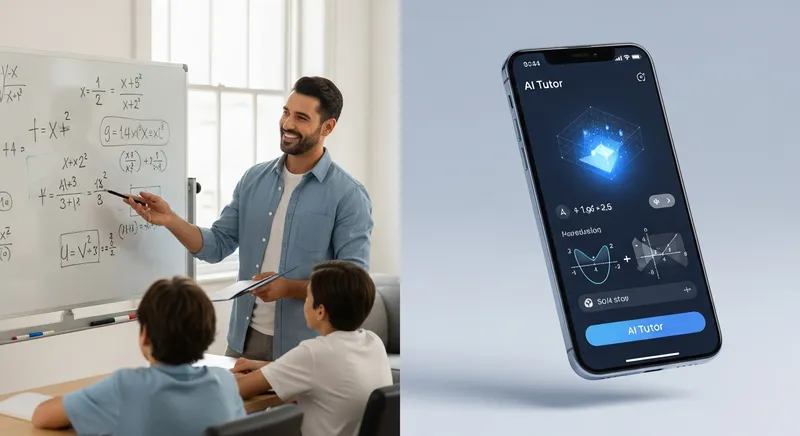
These platforms use AI to analyze a student's work, identify weak spots, and offer personalized practice. Leaders in the space, like the non-profit Khan Academy, are developing their AI, Khanmigo, to act as a Socratic guide that asks questions and encourages critical thinking. This is the new frontier of educational technology: instant, personalized support that fosters genuine learning.
AI Tutor vs. Human Tutor: A Head-to-Head Comparison
Choosing the right support depends on your child's specific needs, your budget, and your goals. Here's how the two options stack up in a direct comparison.
| Feature | ✅ AI Tutors | ✅ Human Tutors |
|---|---|---|
| Cost | Unbeatable Affordability. While private math tutors cost between $30 and $60 per hour, a premium AI app might cost that much for an entire year. | Significant Investment. Costs can quickly add up, making it inaccessible for many families. |
| Availability | 24/7/365. An AI tutor is available at 11 PM on a school night or 8 AM on a Sunday, removing scheduling conflicts and reducing late-night study stress. | Limited by Schedule. Sessions must be booked in advance and are confined to the tutor's working hours. |
| Patience | Infinite. An AI can explain a concept a dozen times in a dozen different ways without a hint of frustration, which is ideal for mastering tough skills. | Human. Even the best tutors have limits. Students may feel anxious asking for the same explanation repeatedly. |
| Emotional Intelligence | None. An AI cannot read body language, sense frustration, or provide the genuine encouragement needed to push through a tough problem. | High. A great human tutor builds confidence and provides mentorship. This personal connection is something AI cannot replicate. |
| Adaptability | Data-Driven. AI adapts based on a student's mistakes, offering targeted practice on weak spots. | Truly Creative. A human can connect a concept to a student's personal interests, creating unique analogies that make the material click. |
| Environment | Pressure-Free Zone. For shy or anxious students, an AI provides a judgment-free space to learn at their own pace without fear of looking "slow." | Structured Accountability. The act of having a scheduled appointment provides a level of structure that a self-directed app often can't match. |
Effectiveness: Does AI Tutoring Actually Work?
This is the million-dollar question for parents: will my child actually learn and gain student confidence? The research is increasingly pointing to yes, with some important caveats.
A groundbreaking study from Harvard, cited in a World Bank report, found that students using an AI tutor learned material more effectively than those in a traditional classroom setting. Similarly, Khan Academy's own efficacy studies show that consistent use of their platform leads to significant learning gains.
The key is the type of AI tool. Apps that simply provide answers can encourage cheating. However, platforms designed for learning, which provide homework help by emphasizing the problem-solving process, are powerful educational aids.
Actionable Tip: When evaluating an AI tutor, prioritize those that offer detailed, step-by-step explanations (like TutorAI and Photomath), track progress, and focus on building conceptual understanding.
Of course, effectiveness means nothing if you can't trust the tool with your child's data and wellbeing.
A Parent's #1 Concern: Is AI Tutoring Safe for Children?
As the U.S. Department of Education has noted in its 2023 AI report on the future of teaching and learning, responsible implementation is critical. Here are the key areas of concern for parents:
- Data Privacy: What happens to your child's learning data? Reputable tools should have a clear, easy-to-understand privacy policy. Look for validation from organizations like Digital Promise, which offers certifications for responsibly designed AI products.
- Inappropriate Content: Some generative AI chatbots are not designed for tutoring and can give flawed advice. Research from trusted sources like Common Sense Media, which provides AI safety ratings, is essential. They found some AI companions gave teens poor life advice, highlighting the need to use tools built specifically for education.
- Cheating vs. Learning: The fear that AI will become a high-tech cheating tool is valid. This is where parental guidance and the app's design are crucial. Platforms that require a user to review the steps before seeing a final answer encourage learning over copying.
Actionable Tip: Create a family tech agreement. Discuss the goal of using AI tutors: to understand the process, not just get answers. Review the app's privacy policy together and check for reviews on sites like Common Sense Media.
AI for Students with Learning Disabilities: A Powerful Supplement
For students with learning differences like ADHD or dyslexia, AI tutors can be a game-changer, but they are not a silver bullet.
A systematic review published by PMC found that AI-based interventions for students with learning disabilities showed overwhelmingly positive results. The infinite patience and non-judgmental nature of AI can reduce anxiety and allow students to learn at their own pace.
However, experts caution that technology is a supplement, not a substitute, for specialized human support. Research from Stanford University's SCALE initiative emphasizes that the most effective tools are co-designed with individuals who have learning differences. An AI cannot replace the diagnostic and adaptive expertise of an educational psychologist or a specially trained tutor.
Actionable Tip: Use AI as a tool for supplemental practice and skill reinforcement, but rely on a qualified human professional to create the primary learning strategy for a child with learning disabilities.
The Hybrid Approach: The 2026 Solution for Smarter Tutoring
The debate shouldn't be AI vs. human. The most effective and cost-efficient solution for most families in 2026 is the hybrid model: using AI for daily support and human tutors for high-level guidance.
Your Hybrid Tutoring Blueprint:
- Daily Homework Support (AI): Your child uses a trusted AI app when they get stuck on a problem. This resolves immediate frustration and allows them to complete assignments with understanding. They can simply Snap. Solve. Learn. by taking a picture of any problem-from basic algebra to advanced topics like calculus or statistics-and learn the process.
- Bi-Weekly Concept Review (Human Tutor): Schedule a 30 or 60-minute session with a human tutor once every two weeks. Instead of spending time on basic problems, this session is focused on strategy. Use progress reports from the AI app to show the tutor exactly which concepts your child is struggling with, making the human tutor's time more efficient.
- Test Preparation (AI + Human): Use the AI for high-volume practice, running through dozens of problems and practice tests. For high-stakes exams like the SAT, this can be incredibly effective. Then, use a short session with the human tutor to review strategy and problem areas identified by the AI.
This model provides comprehensive support while keeping costs manageable.
Frequently Asked Questions
Is an AI tutor actually better than a human tutor? Neither is universally "better." AI is superior for cost, 24/7 availability, and patient repetition. Humans are superior for emotional support, motivation, and creative, in-depth teaching. The best approach often combines both in a hybrid model.
How much does an AI math tutor really cost in 2026? The cost ranges from free for basic versions to around $10-$30 per month for premium subscriptions. This is a fraction of the cost of a human tutor, which averages $30-$60 per hour.
Is it safe to let my child use an AI tutor? Safety depends on the platform. Prioritize educational tools specifically designed for students, not general-purpose AI chatbots. Look for apps with clear privacy policies and reviews from trusted sources like Common Sense Media. Reputable apps are designed as closed systems to prevent exposure to inappropriate content and protect user data.
Can an AI tutor help with ADHD? Yes, as a supplemental tool. The AI's patience and lack of pressure can be very helpful for students with ADHD. However, it should not replace guidance from a specialized educator or therapist who can create a holistic learning strategy.
Is using an AI tutor considered cheating? It depends on the intent. If a student uses it to copy answers without understanding the steps, it's cheating. If they use it to learn the process, it's a powerful learning tool-much like a calculator. It's all about how you use it.
What is the best AI math tutor for a subject like Algebra? The best AI tutor for algebra is one that focuses on explaining the step-by-step process. Algebra is foundational, so understanding how and why an equation is manipulated is crucial. Look for tools that provide detailed, line-by-line explanations for every problem. You can explore a comparison of top tools in our guide to The Best Math Solver Apps for 2026.
How can I track my child's progress with an AI tutor? Choose an app that includes a parent dashboard or progress reporting. The best tools are designed with a family ecosystem in mind, allowing you to see which topics your child is excelling in and where they need more support without having to hover over their shoulder.
The Best of Both Worlds
Choosing how to support your child's education is one of the most important decisions you'll make-and it doesn't have to be an either/or choice. The rise of high-quality, education-focused AI has created an opportunity to build a support system that is both effective and affordable.
Your child deserves to feel confident, not defeated, when they sit down to study. The right support system, one that fits your budget and their learning style, can make all the difference.
By embracing a hybrid model, you can use AI tutors for what they do best: providing instant, patient, and accessible help for daily work. This frees up precious time with a human tutor to focus on what they do best: providing mentorship, building confidence, and fostering a deep, lasting love of learning.
Ready to build a smarter, stress-free support system for your child? See how TutorAI's step-by-step explanations and progress tracking can be the perfect foundation. Download it for free on iOS and Android today!
Disclaimer: This article is for informational purposes only and does not constitute professional educational or medical advice. For students with learning disabilities or mental health concerns like ADHD, it is crucial to consult with qualified professionals such as educational psychologists, therapists, or special education teachers to develop a comprehensive support plan. AI tools should be used as a supplement to, not a replacement for, professional guidance.


