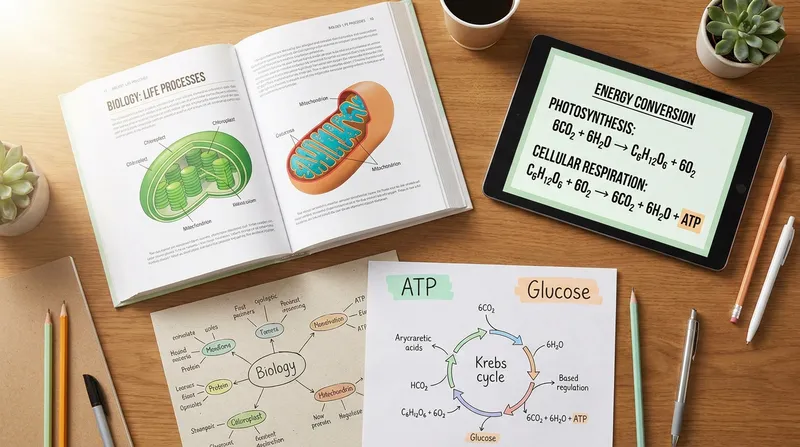
Are you a student staring at your biology textbook late at night, trying to make sense of complex chemical pathways? Or perhaps you are a busy parent or private tutor trying to help, only to find that standard, answer-only resources skip the biological context behind the equations. You might be piecing together fragmented answers from Q&A websites, leaving you more confused than when you started. It is time to stop guessing.
Welcome to your ultimate high school biology study guide. We know that finding reliable, unified information can be frustrating. Many students turn to Brainly alternatives because they are tired of resources that do not explain the "why" behind the science.
In this comprehensive guide, we will break down the differences between photosynthesis and cellular respiration. We will also explore the equations using a unique math-meets-biology approach and provide a clear photosynthesis vs cellular respiration chart. Whether you are prepping for a standard quiz or need a deep AP biology review, we have you covered.
What is Photosynthesis?
To understand how life on Earth survives, we first need to look at autotrophs and heterotrophs as energy sources. Autotrophs, like plants and algae, are organisms that can make their own food. Heterotrophs, like humans and animals, must consume other organisms for energy.
Photosynthesis is the miraculous process used by autotrophs to convert light energy from the sun into chemical energy stored in glucose (a type of sugar). This process takes place in the chloroplasts of plant cells and occurs in two main stages:
- Light-dependent reactions: These reactions require direct sunlight. Taking place in the thylakoid membrane of the chloroplast, they capture solar energy and use it to split water molecules. This releases oxygen as a byproduct and creates ATP (energy) and NADPH (an electron carrier).
- Light-independent reactions (The Calvin Cycle): Also known as the dark reactions, these do not require light. Taking place in the stroma of the chloroplast, this phase uses the ATP and NADPH produced earlier to capture carbon dioxide from the air and build glucose molecules.
Actionable Tip: To master this concept, draw a simple picture of a leaf. Draw arrows pointing in (sunlight, carbon dioxide, water) and arrows pointing out (oxygen, glucose). Visualizing the inputs and outputs makes memorization much easier!
What is Cellular Respiration?
While plants make the food, all living things (including plants) need to break that food down to use it. Cellular respiration is the process of breaking down glucose to release energy in the form of ATP (adenosine triphosphate), which is the primary energy currency of the cell.
Before we dive into the steps, we must understand the difference between aerobic and anaerobic respiration. Aerobic respiration requires oxygen and produces a massive amount of energy.
Anaerobic Respiration (Fermentation)
Anaerobic respiration occurs without oxygen and produces much less energy. In animals, this results in lactic acid buildup, like when your muscles burn during a heavy workout. In yeast and some bacteria, this process results in alcoholic fermentation.
The Stages of Aerobic Respiration
Aerobic cellular respiration happens in three main stages:
- Glycolysis: Occurring in the cytoplasm, this step breaks one glucose molecule into two molecules of pyruvate, producing a small net gain of 2 ATP.
- The Krebs Cycle (Citric Acid Cycle): Moving into the mitochondria, the pyruvate is broken down further. This releases carbon dioxide and transfers high-energy electrons to carrier molecules (NADH and FADH2).
- The Electron Transport Chain (ETC): This is where the magic happens. The electron carriers drop off their electrons at the inner mitochondrial membrane. As electrons move down the chain, they power the creation of a massive amount of ATP. Oxygen acts as the final electron acceptor, combining with hydrogen to form water.
Actionable Tip: Create a timeline in your notes showing the journey of a single glucose molecule. If you get stuck on the specific steps, remember that understanding what an AI tutor is can help. You can use the Tutor AI app to snap a photo of a specific pathway question and get a step-by-step breakdown.
Photosynthesis and Cellular Respiration Equations
Many students try to memorize chemical equations without understanding the biological reality of what those numbers mean. Let us look at the photosynthesis and cellular respiration equations through a math-meets-biology lens.
The Photosynthesis Equation: 6CO2 + 6H2O + Light Energy -> C6H12O6 + 6O2 (Carbon Dioxide + Water + Light -> Glucose + Oxygen)
The Cellular Respiration Equation: C6H12O6 + 6O2 -> 6CO2 + 6H2O + ATP (Energy) (Glucose + Oxygen -> Carbon Dioxide + Water + Energy)
Look closely at these two equations. Do you notice a pattern? According to LibreTexts, the equation for cellular respiration is the direct opposite of photosynthesis. This demonstrates the cyclical nature of energy and matter in the biosphere. The products of one process are the exact reactants needed for the other.
Actionable Tip: Treat these equations like an algebra problem where you are balancing both sides. Write the photosynthesis equation on one side of an index card and the cellular respiration equation on the back. Flip it back and forth until you memorize how they mirror each other.
Reactants and Products Compared
To make studying easier, we have organized the reactants and products of photosynthesis and cellular respiration into a clear format.
Photosynthesis:
- Reactants (Inputs): Carbon Dioxide (CO2), Water (H2O), Light Energy
- Products (Outputs): Glucose (C6H12O6), Oxygen (O2)
Cellular Respiration:
- Reactants (Inputs): Glucose (C6H12O6), Oxygen (O2)
- Products (Outputs): Carbon Dioxide (CO2), Water (H2O), ATP (Energy)
Actionable Tip: Parents and tutors, take a screenshot or print this specific section. Having a quick-reference list of the reactants and products is incredibly helpful for last-minute quiz reviews.
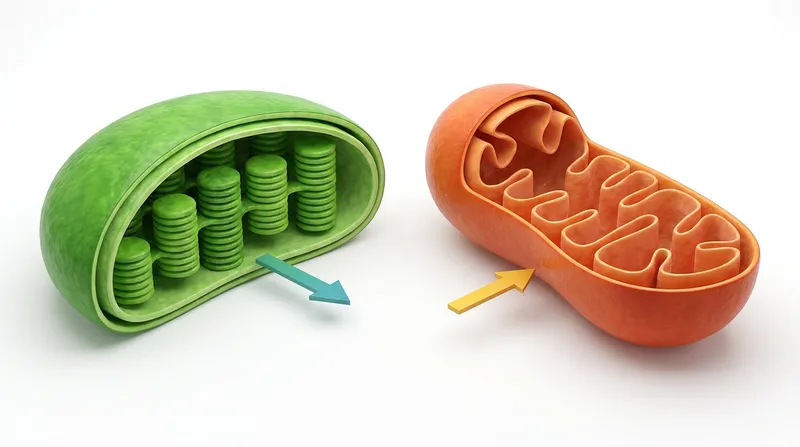
Chloroplasts vs Mitochondria: The Powerhouses
Understanding the differences between photosynthesis and cellular respiration requires understanding where these processes happen.
Chloroplasts (The Solar Panels):
- Found only in plant cells and some algae.
- Contain chlorophyll, the green pigment that absorbs sunlight.
- Structured with stacks of thylakoids (called grana) surrounded by a fluid called stroma.
- Function: Build glucose by capturing solar energy.
Mitochondria (The Power Plants):
- Found in almost all eukaryotic cells (both plants and animals).
- Structured with an outer membrane and a highly folded inner membrane called cristae, which increases surface area for energy production.
- Function: Break down glucose to release ATP.
Actionable Tip: Draw a Venn diagram comparing chloroplasts and mitochondria. Put "double membrane" and "contains its own DNA" in the overlapping middle section, as both organelles share these unique traits!
The Carbon Cycle and Energy Flow
You cannot fully grasp high school biology without understanding the carbon cycle and energy flow. These two processes are the engine that drives life on Earth. Plants pull carbon dioxide out of the atmosphere to build physical mass (leaves, stems, roots).
When animals eat those plants, they digest the glucose and breathe out carbon dioxide, returning it to the atmosphere. This is a perfect, closed-loop recycling system. Data from the National Oceanic and Atmospheric Administration highlights that the ocean holds about 50 times more carbon than the atmosphere, acting as a critical storage reservoir.
Understanding these global systems is a massive part of environmental science homework, showing how cellular biology impacts planetary ecology.
Actionable Tip: Next time you step outside, look at a large tree. Realize that the solid wood of the tree was built almost entirely from invisible carbon dioxide gas pulled from the air through photosynthesis. It is a great way to make an abstract concept feel real.
AP Biology Cellular Respiration Review
If you are taking advanced placement classes, you need to go beyond the basics. This AP biology cellular respiration review section is tailored for you. In AP Biology, you must understand the exact ATP production in cellular respiration.
While glycolysis produces 2 net ATP and the Krebs cycle produces 2 ATP, the vast majority of energy comes from the final stage. As detailed by Khan Academy, oxidative phosphorylation produces the vast majority of ATP during cellular respiration. This is powered by the electron transport chain in the inner mitochondrial membrane.
Here is what you need to memorize for the AP exam:
- Chemiosmosis: The movement of hydrogen ions (protons) across the mitochondrial membrane creates a concentration gradient.
- ATP Synthase: This enzyme acts like a tiny molecular turbine. As protons flow through it, it spins, physically joining ADP and a phosphate group to create ATP.
- Total Yield: Under ideal conditions, one molecule of glucose can yield up to 36 to 38 ATP.
- Real-World Yield: In real-world cellular conditions, the yield is often closer to 30 to 32 ATP due to the energy costs of transporting molecules into the mitochondria.
Actionable Tip: AP Biology questions often present scenarios where a specific enzyme or stage is blocked by a toxin. Practice tracing the pathway to see what builds up and what gets depleted.
Key Differences Between Photosynthesis and Cellular Respiration
To summarize, let us look at a clear photosynthesis vs cellular respiration chart of differences:
| Feature | Photosynthesis | Cellular Respiration |
|---|---|---|
| Function | Stores energy | Releases energy |
| Location | Chloroplasts | Mitochondria |
| Organisms | Autotrophs (plants, algae) | All eukaryotes (plants, animals) |
| Timing | Requires light (mostly daytime) | Happens 24/7 |
| Reactants | Carbon Dioxide, Water, Light | Glucose, Oxygen |
| Products | Glucose, Oxygen | Carbon Dioxide, Water, ATP |
| Electron Carriers | NADPH | NADH and FADH2 |
Similarities Between Photosynthesis and Cellular Respiration
Despite their differences, the similarities between photosynthesis and cellular respiration are striking. Both rely on complex electron transport chains to move energy. Both utilize a proton gradient to power ATP synthase through chemiosmosis.
Additionally, both processes take place inside organelles that feature a double membrane and contain their own distinct DNA. Finally, both are essential, interdependent components of the global carbon cycle.
Actionable Tip: When studying, do not just memorize facts in isolation. Always ask yourself how specific mechanisms (like electron transport chains) operate similarly in both processes. Connecting the dots builds true long-term memory.
Final Thoughts: Mastering Biology with Confidence
Understanding the intricate dance between photosynthesis and cellular respiration is a major milestone in high school biology. By viewing these processes not as isolated lists to memorize, but as an interconnected cycle that sustains life on Earth, you will find the concepts much easier to grasp.
If you or your child are feeling overwhelmed by complex science homework, remember that you do not have to struggle alone. The anxiety of late-night study sessions is real, much like the stress covered in our parent's guide to math anxiety.
When standard apps fail to explain the biology behind the equations, Tutor AI is here to help. With our "Snap. Solve. Learn." approach, you can take a photo of any confusing biology pathway or chemical equation. We provide instant, step-by-step explanations available 24/7.
Study smarter, not harder. Download Tutor AI today on the App Store or Google Play Store, and turn homework frustration into academic confidence!
Note: Every student learns differently. While these strategies are research-backed, results may vary. Adapt these techniques to fit your unique learning style and circumstances.
Frequently Asked Questions
What is the main difference between photosynthesis and cellular respiration?
The primary difference lies in their overall purpose and energy flow. Photosynthesis captures sunlight to synthesize glucose, effectively storing energy. In contrast, cellular respiration breaks down glucose to release that stored energy in the form of ATP, which powers cellular activities.
Do plants undergo cellular respiration as well as photosynthesis?
Yes, plants absolutely undergo cellular respiration. While they rely on photosynthesis to produce their own food (glucose), they still need mitochondria to break down that glucose into usable ATP energy. Without cellular respiration, plants could not survive.
How are the equations for photosynthesis and cellular respiration related?
The chemical equations for these two processes are exact opposites. The reactants required for photosynthesis (carbon dioxide, water, and light energy) produce glucose and oxygen. These products (glucose and oxygen) are the exact reactants needed for cellular respiration.
What are the reactants and products of cellular respiration?
The reactants for cellular respiration are glucose (sugar) and oxygen. During the process, these are converted into the products: carbon dioxide, water, and ATP (cellular energy).
Why are photosynthesis and cellular respiration considered opposite processes?
They are considered opposites because they reverse each other's chemical and biological work. Photosynthesis is an anabolic process that builds complex molecules and stores energy. Cellular respiration is a catabolic process that breaks down complex molecules to release energy.
How much ATP is produced in cellular respiration?
During aerobic cellular respiration (which uses oxygen), a single glucose molecule can produce between 30 and 38 molecules of ATP. If oxygen is absent, anaerobic respiration occurs, yielding only 2 ATP molecules per glucose molecule.