
Introduction: Navigating the Complex World of STEM Homework
It is 11 PM. You are staring at a physics problem that looks more like Greek mythology than high school homework. You type the question into a standard AI chatbot, hoping for a lifeline. The AI confidently spits out an answer. You write it down, turn it in, and the next day, you find out the AI calculated a negative time for a falling object.
This is the exact frustration millions of students and parents face when using generic AI homework helpers for STEM subjects. When it comes to advanced math and science, standard chatbots often provide completely wrong mathematical steps or physically impossible answers. You need a reliable, accurate tool that actually understands complex formulas, physical constraints, and the intersection of both.
In this guide, we will explore how to find the best AI math solver and AI physics problem solver to get accurate, step-by-step help without the late-night headaches.
Why Standard AI Struggles with Math and Physics
Have you ever wondered why a chatbot can write a brilliant essay but completely fail at basic algebra? The answer lies in how these systems are built. Standard language models are designed to predict the next logical word in a sentence, not act as computational engines. When you ask them to solve an equation, they are guessing what the numbers should look like based on patterns in their training data.
This leads to a major issue known as AI hallucinations. According to research published by Computerworld, AI hallucinations in standard language models are mathematically inevitable due to statistical and computational limits. When an AI does not know the exact answer to a complex physics problem, it does not admit defeat. Instead, it confidently invents a mathematically correct-sounding but physically impossible answer.
For example, if you ask a generic AI to calculate the time it takes for a ball to hit the ground, it might ignore the laws of gravity or forget to account for friction. It might even give you a negative number for time, which is impossible in classical physics. To solve physics problems with AI safely, you must use specialized tools designed for accurate AI for advanced mathematics. These specialized tools understand that numbers represent real-world physical properties, not just text on a screen.
ChatGPT vs Wolfram Alpha for Math: Finding the Right Balance
When choosing a step-by-step AI math tutor, you will likely encounter two main types of technology: generative AI like ChatGPT and computational engines like Wolfram Alpha. Understanding the difference between ChatGPT vs Wolfram Alpha for math is crucial for advanced high school students who cannot afford simple calculation errors.
Generative AI is highly conversational. It is excellent at explaining concepts in plain English, breaking down the theory behind a formula, and acting as a virtual tutor. However, as we discussed, it struggles with exact computations. On the other hand, Wolfram Alpha is a computational powerhouse. It calculates exact answers, generates graphs, and handles complex calculus flawlessly. But it is not always the friendliest tutor. Its explanations can be rigid, highly technical, and difficult for high school students to digest.
The secret to success in STEM classes is finding a tool that combines both. As noted in a report by Edutopia, combining the conversational fluency of generative AI with the mathematical integrity of a computational engine provides the best of both worlds. The best AI for high schoolers will seamlessly blend these technologies. This ensures you get an answer that is mathematically perfect, explained in a way that actually makes sense to a human being.
Top Features to Look for in an AI Calculator for Calculus and Physics
Not all study apps are created equal. If you are hunting for a free AI math solver or a premium AI calculator for calculus and physics, you need to look for specific features that handle the heavy lifting of STEM coursework.
Here is a checklist of must-have features for a reliable STEM solver:
- Step-by-Step Breakdowns: An answer key is useless if you do not understand how to get there. Your AI tool must show every single step of the calculation, explaining the "why" behind the math.
- Unit Awareness: In physics, a number without a unit is meaningless. The AI must understand the difference between meters per second and miles per hour, and it must convert them accurately.
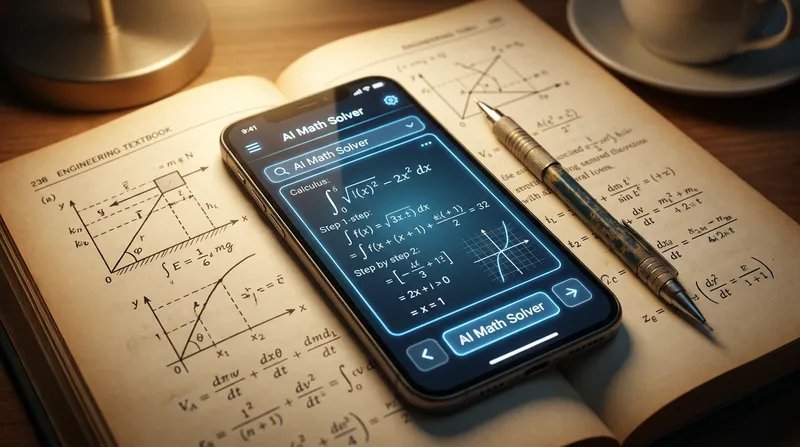
- AI Physics Scanner: Typing out complex formulas with exponents, integrals, and Greek letters is tedious. A high-quality AI physics scanner allows you to simply snap a photo of your textbook or worksheet and instantly translates the image into solvable text, bringing the "Snap. Solve. Learn." concept to life.
- Graphing Capabilities: Visualizing a function is often the key to understanding it. Look for tools that can generate accurate graphs for calculus and kinematics problems.
- Offline Availability: Students often study in areas with limited connectivity. A great app provides offline capabilities so learning never stops.
Before trusting a new tool with a major assignment, test it with a problem you already know the answer to. This is a great way to verify its accuracy. For more recommendations on specific tools, check out our guide on The Best AI Math Solvers for College (Calculus & Linear Algebra) in 2026.
How to Accurately Solve Physics Problems with AI
Math is the language of physics, but physics brings real-world constraints that pure math does not have. To accurately solve physics problems with AI, you have to treat the AI differently than you would for a pure algebra test. An AI physics problem solver needs physical context.
In a math class, "x" is just a variable. In physics, "x" might be distance, "v" is velocity, and "a" is acceleration. If you do not tell the AI what these variables represent, it might use the wrong mathematical formula entirely.
You have to be specific about the environment of the problem. Is the object in a vacuum? Is there air resistance? Is it on an incline? Providing this context helps the AI select the correct physics principles before it even begins the mathematical calculations.
Writing the Perfect Prompt for Math Word Problems
Word problems are notoriously difficult for students and AI alike. The best AI app for math word problems is only as good as the prompt you give it. If you want accurate results, you need to learn how to translate a word problem into a structured prompt.
Here is a step-by-step template for feeding math and physics word problems into an AI:
- Define the Goal: Start by telling the AI exactly what you need to find (example: "Find the final velocity of the car").
- List the Known Variables: Extract all the numbers from the word problem and label them clearly (example: "Initial velocity = 0 m/s, Time = 5 seconds, Acceleration = 9.8 m/s^2").
- State the Constants Explicitly: Never assume the AI knows the constants. Explicitly state things like the speed of light or the gravitational pull of Earth to prevent the AI from guessing.
- Request Dimensional Analysis: Ask the AI to verify its own work by checking the units at the end of the calculation.
According to a study highlighted by The Hechinger Report, standard chatbot methods for math are frequently wrong, but accuracy improves significantly when students use structured, highly specific prompts. By breaking the problem down, you force the AI tools for high school math to follow a logical path.
For strategies on tackling other complex science topics, you might find our guide on The Best AI Organic Chemistry Solvers (That Actually Work) helpful.
Overcoming Math Anxiety with a Supportive AI Tutor
STEM classes do not just challenge the mind, they often take an emotional toll. Math anxiety is a real hurdle that causes students to freeze up and parents to feel helpless during evening study sessions. When a student is afraid of making a mistake, they often stop asking questions in class.
"No more tears over math homework! This app has been a game-changer." — App Store review
This is where a patient, 24/7 AI homework helper for STEM becomes a game-changer. A dedicated AI tutor never gets frustrated, never judges a "silly" question, and is always available, even at midnight. It allows students to explore concepts at their own pace. They can ask the AI to explain a concept five different ways until it finally clicks, without the social pressure of holding up a classroom.
Research from the University of Wisconsin-Madison highlights that students are widely adopting generative AI for brainstorming and exploring complex STEM concepts, which helps level the playing field for those who might not have access to private tutoring. By framing the AI as a supportive learning companion rather than just a quick answer key, parents can help their children rebuild their academic confidence.
For Parents: How to Support Without Solving
As a parent, watching your child struggle with advanced math can be incredibly frustrating, especially when the material is beyond what you remember from high school. You do not need to relearn calculus to help them succeed. By utilizing tools with built-in progress tracking and parent dashboards, you can monitor their confidence and mastery over time. These features allow you to see which topics require more practice, helping you guide their study sessions without having to solve the equations yourself.
If your family is struggling with homework stress, read our comprehensive resource: A Parent's Guide to Math Anxiety: How to Help a Child Struggling with Math and End Homework Tears.
Actionable Tips for High School STEM Success
Having the best AI tutor for science on your phone is a massive advantage, but you have to use it responsibly to actually learn the material. Relying too heavily on AI without understanding the foundational concepts will hurt you when exam day arrives.
Here is a practical checklist for using AI responsibly in your STEM classes:
- Always try the problem first: Give your brain a chance to struggle with the concept. Productive struggle is how neural pathways are built.
- Use AI to check your work, not do it: After you solve a problem, use the AI to verify your answer. If you got it wrong, ask the AI to pinpoint exactly where your logic went off track.
- Follow personalized learning paths: Use apps that offer progress tracking to identify your weak spots and focus your practice on those specific areas.
- Generate practice problems: If you are struggling with a specific type of equation, ask the AI to generate five similar problems for you to practice on.
- Read the step-by-step explanation: Never just copy the final number. Read through the methodology so you can replicate it yourself on a test.
Advanced AI systems are incredibly powerful. In fact, a study published by arXiv demonstrated that AI is now being used to accelerate mathematical discovery in theoretical physics. But for high school students, the goal is mastering the basics. For more step-by-step learning strategies, explore our guide on How to Factor Trinomials Step-by-Step (a=1 & a>1): Methods & Examples.
Conclusion: Work Smarter in Your Toughest Classes
Navigating advanced math and physics does not have to be an isolating, frustrating experience. By choosing a specialized AI math solver and AI physics problem solver rather than a generic chatbot, you can ensure that the help you get is accurate, contextual, and genuinely useful.
The right AI tool is one that builds real understanding and confidence, acting as a tireless tutor that is always in your corner.
Ready to eliminate homework tears? Download Tutor AI today on iOS or Android and experience the power to Snap. Solve. Learn. Start studying smarter and master those tough STEM subjects for real.
Looking for help outside of STEM? Check out our tips on How to Use an AI English Solver for Homework & Essays (Without Cheating).
Frequently Asked Questions
What is the best AI app for math word problems?
The most effective apps for word problems are those that combine natural language processing with a strict computational engine. Natural language processing allows the AI to read the paragraph and understand the context, while the computational engine ensures the underlying math is solved without calculation errors. The ideal tools provide a step-by-step breakdown, showing you exactly how the words were translated into a mathematical formula.
Can ChatGPT solve physics problems accurately?
Standard ChatGPT can struggle significantly with physics problems. While it is great at explaining physics concepts or defining terms, it often hallucinates when asked to perform complex calculations or apply physical constraints like friction, gravity, or negative time. For accurate results, it is highly recommended to use specialized STEM AI tools or plugins that connect generative AI to a dedicated math engine.
Is there a reliable free AI math solver for calculus?
There are several free tools available that can handle basic calculus functions like derivatives and simple integrals. However, advanced calculus often requires premium features to unlock the full step-by-step explanations necessary for true learning. Many top-tier apps offer a free scanning feature to check your final answer, alongside premium tutor features that walk you through the entire calculus problem from start to finish.
How do I stop AI from giving me the wrong math answers?
To prevent AI from making mistakes, you need to be highly specific in your prompts. Break the problem down into smaller parts, explicitly state any scientific rules or constants, and ask the AI to show its work step-by-step. Additionally, you should always cross-reference the AI's final answer with a trusted computational calculator to ensure no simple arithmetic errors were made during the process.
Is using an AI physics problem solver considered cheating?
Using AI becomes cheating when you simply scan a problem, copy the final answer, and submit it as your own work without understanding the material. However, using an AI physics problem solver is not cheating when you use it as a personal tutor. If you attempt the problem first, use the AI to check your work, and carefully read the step-by-step explanations to learn the methodology, you are using the tool to actively enhance your education.
Note: Every student learns differently. While these strategies are research-backed, results may vary. Adapt these techniques to fit your unique learning style and circumstances.


