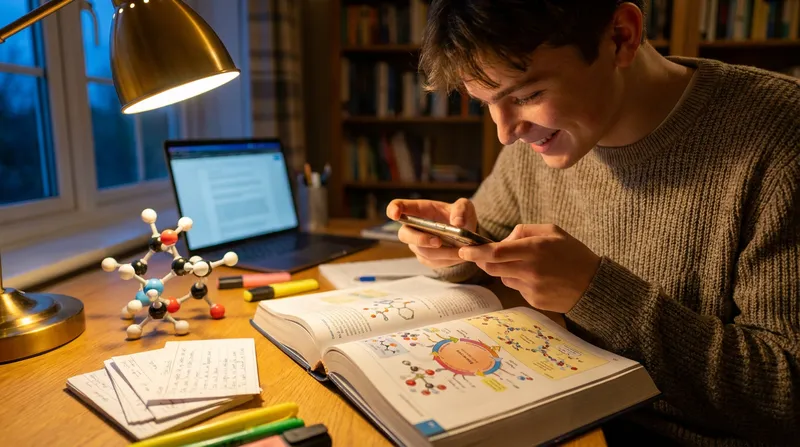
We have all been there: it is 10:30 PM on a Tuesday, and your kitchen table is covered in highlighters, crumpled scratch paper, and an open AP Biology textbook. One page asks for a quantitative calculation of enzyme reaction rates, while the next demands a complete breakdown of electron carriers in the Krebs cycle. Welcome to biochemistry, the subject that sits at the intimidating intersection of visual memorization (metabolic pathways, macromolecule folding) and quantitative math (enzyme kinetics, pH buffers, Gibbs free energy).
For students and parents, finding reliable AP Biology biochemistry homework help is uniquely frustrating. Traditional math photo-solvers like Photomath and Mathway freeze up the moment they see a biological concept or an amino acid chain. Legacy homework sites like Chegg and Brainly either hide their step-by-step explanations behind expensive monthly paywalls or clutter the screen with ads and unverified community guesses. Worst of all, generic text chatbots frequently hallucinate chemical bonds and fail to teach the step-by-step "why" required to pass high school and AP exams.
The good news? A new generation of multimodal AI tools is bridging the gap between chemistry equations and biological systems. In this complete guide, we will break down how an AI biochemistry tutor works, compare the top apps on the market, share copy-paste prompts for mastering cellular respiration and enzyme kinetics, and give parents a stress-free playbook for verifying homework without needing a science degree.
What is an AI Biochemistry Solver (And Why Traditional Math Apps Fail)?
An AI biochemistry solver is a specialized learning tool that combines Optical Character Recognition (OCR), chemistry problem-solving, and biological reasoning models. Instead of forcing you to type out complex chemical formulas or describe a 10-step metabolic cycle in words, a photo chemistry and biology solver lets you snap a picture of your worksheet and walks you through both the math and the molecular mechanisms.
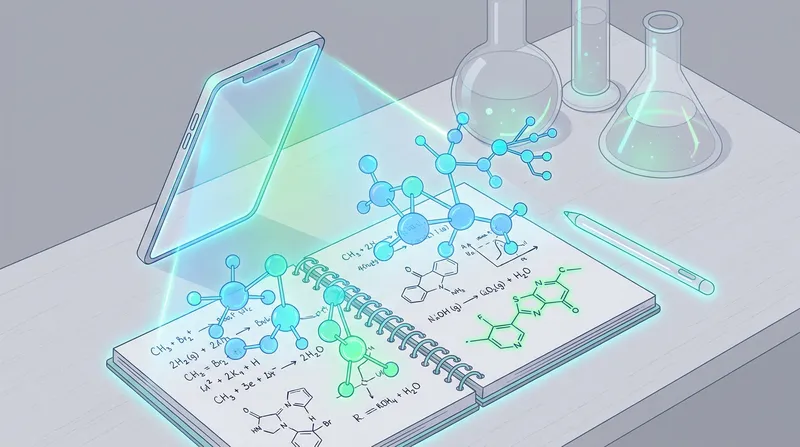
Why do standard apps fail so badly here? Because biochemistry speaks two different languages at once:
- The Visual Language of Biology: You need to recognize functional groups (hydroxyl, carboxyl, amino, sulfhydryl), trace carbon skeletons through glycolysis, and read feedback inhibition arrows on pathway charts.
- The Quantitative Language of Chemistry: You have to calculate molarity, use the Henderson-Hasselbalch equation for cellular buffers, determine Gibbs free energy ($\Delta G$), and solve Michaelis-Menten rate laws.
If you scan a Lineweaver-Burk plot with a pure math scanner, it only sees a generic $y = mx + b$ line. It has no idea that the y-intercept represents $1/V_{max}$ or that a steeper slope with an unchanged y-intercept indicates competitive enzyme inhibition. We explore this exact limitation in our guide on Scanner Math Solver vs. AI Tutor: Why Your Teen Needs Step-by-Step Explanations (Not Just Answers).
Furthermore, relying on an unspecialized text chatbot to draw or interpret molecules can backfire. In a June 2026 study published in Biochemistry and Molecular Biology Education via NCBI, researchers asked 25 students to illustrate an alanine-cysteine dipeptide using only generic ChatGPT; 100% of the AI-generated structural representations contained chemical errors, which students copied uncritically onto their worksheets. That is why choosing a purpose-built AI biochemistry tutor and verifying structures carefully is essential.
Actionable Takeaway: Before relying on any homework app for biochemistry, test its accuracy on foundational concepts. Ask the tool to help you identify the alpha-carbon, the amino group, the carboxyl group, and the R-group side chain of a standard amino acid from your textbook.
Key Features to Look for in a Science AI Tutor
Whether you are a high schooler prepping for Unit 1 (Chemistry of Life) and Unit 3 (Cellular Energetics) in AP Bio, or a parent looking for reliable support, look for these four non-negotiable features when evaluating the best AI for AP Chemistry and Biology:
- Accurate Text & Notation OCR: The app must be able to read printed and handwritten text and mathematical notation from your worksheets without forcing you to type out complex formulas.
- Reliable Quantitative Support: Language models can struggle with raw arithmetic. Look for tools that clearly lay out every step of logs, exponents, and unit conversions so you can verify the math.
- Rubric-Aligned Step-by-Step Breakdowns: According to the U.S. Department of Education's 2023 report "Artificial Intelligence and the Future of Teaching and Learning" (published by its former Office of Educational Technology, which was eliminated in 2025), effective educational AI must adapt to a student's learning process as it unfolds step-by-step while keeping humans at the center, rather than simply marking final answers right or wrong.
- Transparent Access Without Predatory Paywalls: Nothing increases late-night homework anxiety faster than scanning a problem, waiting 30 seconds, and being hit with a blurred-out screen demanding $19.99 a month just to see Step 2.
For a broader look at how educational platforms stack up across all subjects, check out our roundup of the 7 Best AI Tutoring Apps That Give Step-by-Step Explanations (Not Just Answers).
Actionable Takeaway: Always check if a platform offers a functional free tier with daily questions before you commit to a family subscription.
Top AI Tools for Biology and Chemistry Homework Help (2026 Comparison)
Here is how the leading homework platforms compare based on their published features for high school and AP biochemistry assignments, including macromolecule identification, Gibbs free energy math, and pathway tracing.
1. Tutor AI (Best All-in-One Photo & Step-by-Step Biochemistry Tutor)
Core Approach: "Snap. Solve. Learn."
Tutor AI is built to help students bridge the gap between science concepts and quantitative problem-solving. Students can snap a photo of a printed or handwritten problem from their textbook or worksheet and receive immediate, curriculum-aligned step-by-step biochemistry solutions.
- Why It Wins for Biochemistry: Unlike split platforms that force you to choose between a "math calculator" and a "text chatbot," Tutor AI covers math, chemistry, and biology in one app. It adapts to your grade level, tracks weak spots across topics, and includes a dedicated parent dashboard (Premium) so families can monitor progress.
- Best For: Middle school, high school, and AP Biology/Chemistry students who want 24/7 photo-based explanations, personalized practice paths, and stress-free homework support.
2. Caktus AI
Core Approach: Text-based STEM writing and study assistant.
Caktus AI offers dedicated study assistants for Biology and Chemistry alongside flashcard generators and citation tools.
- Pros: Good for generating study guides and summarizing college-level articles.
- Cons: Forces students to switch between separate Biology and Chemistry tools rather than offering a unified biochemistry workspace. It relies heavily on typed prompts and lacks a streamlined mobile camera scanner.
3. Chegg Study
Core Approach: Legacy Q&A archive paired with automated AI hints.
Chegg boasts millions of pre-solved textbook questions covering advanced organic chemistry and biochemistry.
- Pros: High likelihood of finding exact matches for older college textbook problems.
- Cons: Aggressive paywalls blur out solutions unless you pay a hefty monthly fee. Furthermore, when high school students upload custom teacher worksheets or new problems not already in Chegg's archive, the automated AI responses often hit dead ends.
4. Brainly
Core Approach: Crowdsourced community Q&A with an AI companion.
Brainly ranks for thousands of middle and high school biology multiple-choice questions.
- Pros: Fast for quick definitions of mitosis, photosynthesis, or organelles.
- Cons: Community answers frequently contain math errors in enzyme kinetics or thermodynamics. The interface is heavily cluttered with ads and daily view limits, and explanations rarely go deep enough for AP Free Response Questions (FRQs).
5. Mathway & Photomath
Core Approach: Camera-based math and formula calculators.
Photomath and Mathway are household names for algebra and calculus, and Mathway includes a specialized chemistry formula keyboard.
- Pros: Fast, reliable numeric calculations for balancing chemical equations or finding molar mass.
- Cons: Photomath does not support chemistry or biology at all. Mathway handles basic chemistry math but locks all step-by-step explanations behind a premium paywall and has zero conceptual biology support: it cannot explain protein folding, macromolecules, or cellular respiration.
Quick Comparison Matrix: Biochemistry Homework Solvers
| Platform | Biology Diagram OCR | Enzyme Kinetics Math | Metabolic Pathway Explanations | Free Step-by-Step Tier | High School / AP Alignment |
|---|---|---|---|---|---|
| Tutor AI | Text & math notation (printed & handwritten) | Yes (Full Step-by-Step) | Yes (step-by-step) | Yes (limited daily questions) | High (AP Bio & Chem Ready) |
| Caktus AI | Limited (Text-Heavy) | Moderate | Yes (College-Level Text) | No (Trial/Paid) | Moderate (Geared to College) |
| Chegg | Yes (Archive Match) | Yes (Paywalled) | Yes (Paywalled) | No (Blurred Answers) | Moderate |
| Brainly | Yes | Low (Prone to Errors) | Shallow (Multiple Choice) | Limited (Ad-Heavy) | High (Basic Bio) |
| Mathway | No (Formulas Only) | Numeric Answer Only | No | No (Steps Paywalled) | Low (No Bio Support) |
| Photomath | No | No | No | Yes (Math Only) | None for Science |
Actionable Takeaway: If you already use a math scanner for algebra, keep it for math, but switch to a multi-subject solver like Tutor AI when your homework combines chemistry calculations and biological reasoning.
How to Solve Enzyme Kinetics and Pathway Problems Step-by-Step
Let's get practical. The two areas where students lose the most points in biochemistry are quantitative enzyme kinetics and tracing metabolic pathways. Here is how to use an AI solver to master both.
Mastering the Michaelis-Menten Equation & Lineweaver-Burk Plots
When enzymes catalyze biological reactions, their rate ($v_0$) depends on substrate concentration ($[S]$), maximum velocity ($V_{max}$), and the Michaelis constant ($K_m$, the substrate concentration at which the reaction reaches half of $V_{max}$):
$$v_0 = \frac{V_{max}[S]}{K_m + [S]}$$
Why do students struggle here? Because teachers love to ask what happens to $V_{max}$ and $K_m$ when a competitive versus non-competitive inhibitor is added, or they ask you to calculate exact rates from a double-reciprocal Lineweaver-Burk plot.
When solving a Michaelis-Menten equation step by step, follow this 4-step workflow:
- Snap the Problem: Use Tutor AI's photo solver to capture the problem from your worksheet or textbook.
- Verify Your Units First: Check whether substrate concentration is in millimolar ($\text{mM}$) or micromolar ($\mu\text{M}$). Unit mismatches are a common source of calculation errors.
- Isolate $V_{max}$ and $K_m$: Have the AI solver show you how to find the y-intercept ($1/V_{max}$) and x-intercept ($-1/K_m$) step by step.
- Connect the Math to the Biology: Ask the AI to explain why $K_m$ increases during competitive inhibition (because the inhibitor competes for the active site, requiring more substrate to reach half-maximal velocity).
If you want more practice turning tricky quantitative chemistry mistakes into top exam scores, read our AP Chem Exam Practice Guide: How to Turn Missed Questions into a 5.
Decoding Glycolysis, the Krebs Cycle, and Cellular Respiration
Memorizing every enzyme in glycolysis and the citric acid (Krebs) cycle by brute force is a recipe for burnout. Instead of treating pathways like a random phone book of names, use an AI tool to explain the Krebs cycle and glycolysis through the lens of carbon accounting and energy accounting.
When you need help with macromolecules and cellular respiration, train your eye on three things:
- Carbon Tracking: Start with glucose (6 carbons) entering glycolysis, splitting into two pyruvate molecules (3 carbons each), converting to Acetyl-CoA (2 carbons + 1 $\text{CO}_2$ released), and entering the Krebs cycle.
- Redox Carriers ($\text{NAD}^+$ and $\text{FAD}$): Every time a carbon molecule is oxidized, electrons are stripped away to form $\text{NADH}$ and $\text{FADH}_2$, which carry energy to the electron transport chain.
- Regulatory Checkpoints: Focus on allosteric enzymes like phosphofructokinase-1 (PFK-1). High levels of ATP and citrate inhibit PFK-1, while high AMP activates it. Understanding this single feedback loop unlocks dozens of AP Biology exam questions!
The Copy-Paste Prompt Playbook for High School & AP Bio/Chem
Why do some students get vague, confusing answers from AI while others get crystal-clear tutoring? A technology report in the October 2026 issue of the Journal of Chemical Education describes implementing a course-specific chatbot in undergraduate biochemistry to better align AI support with classroom materials.
After you snap a photo of your problem in Tutor AI, use these four copy-paste prompts to turn your app into a personalized high school biochemistry study guide:
- 1. The Metabolic Pathway Carbon-Tracker Prompt:
"Explain this metabolic pathway step-by-step at an AP Biology level. For each step, track: (1) how many carbons the molecule has, (2) whether ATP is used or produced, and (3) whether $\text{NADH}$ or $\text{FADH}_2$ is formed. Do not skip intermediate steps."
- 2. The Enzyme Kinetics & Inhibition Prompt:
"Solve this enzyme kinetics problem step-by-step. First, list all given values and verify the units. Second, show the formula rearrangement before plugging in numbers. Finally, explain in plain English whether this inhibitor is competitive, non-competitive, or uncompetitive based on how $K_m$ and $V_{max}$ changed."
- 3. The Macromolecule & Functional Group Decoder Prompt:
"For this monomer question, identify the monomer class (amino acid, nucleotide, monosaccharide, or fatty acid), point out the specific functional groups present, and explain how a dehydration synthesis reaction forms the covalent bond between two of these monomers."
- 4. The AP Bio Free-Response (FRQ) Self-Grader Prompt:
"Here is an AP Biology Free Response Question about cellular energetics and my draft answer. Do not rewrite my answer for me. Instead, grade my draft against standard AP rubric criteria (Identify, Describe, Explain, Predict) and tell me which biochemical mechanism I forgot to connect." (For more FRQ mastery strategies across STEM, see our guides on AP Environmental Science Homework Help: Master APES Math & FRQs and AP Physics 1 & C Exam Practice: Master FRQs with Worked Solutions.)
The Hallucination Safety Checklist: How to Verify AI Biochemical Structures
Even the smartest AI can occasionally misread a blurry pencil sketch or miscount an atom in a complex ring structure. Before you write down a molecular structure or pathway yield from any AI tool, run through this 60-second Hallucination Safety Checklist:
- The Carbon Octet Rule (4 Bonds Max): Count the lines attached to every carbon atom. Carbon forms a maximum of 4 covalent bonds. If an AI-generated diagram shows a carbon with 5 bonds (a "Texas carbon") or a nitrogen with 5 bonds, flag it immediately.
- Peptide Bond Backbone Check: In a protein or dipeptide chain, the backbone must follow a strict repeating pattern: Nitrogen - Alpha-Carbon - Carbonyl Carbon (N-C-C). The peptide bond always forms between the carboxyl carbon of one amino acid and the amino nitrogen of the next, releasing one water molecule ($\text{H}_2\text{O}$).
- ATP & Electron Carrier Net Yields: Check whether the question asks for gross or net ATP yield. In glycolysis, 2 ATP are invested in the preparatory phase and 4 ATP are produced in the payoff phase, making the net yield 2 ATP (plus 2 $\text{NADH}$ and 2 pyruvate) per glucose.
- pH vs. pKa Protonation Check: When checking amino acid charges at cellular pH ($7.4$), remember the rule: if the solution pH is higher than the pKa, the group loses its proton (deprotonated). If the pH is lower than the pKa, the group holds onto its proton (protonated).
The Parent & Tutor Playbook: Helping Your Teen at 11 PM Without a Science Degree
If you are a parent, watching your teenager stress over AP Biology or honors chemistry late at night can make you feel helpless, especially if you haven't thought about the Krebs cycle since your own high school days. Fortunately, you do not need a PhD in molecular biology to be an incredible study partner.
Here is how busy parents and tutors can use a 24/7 tool like Tutor AI to support independent learning without doing the homework for them:
- Use the "Snap & Explain Back" Technique: When your teen hits a wall on a worksheet, have them snap a photo of the problem in Tutor AI. Once they read the step-by-step explanation, ask them to close the phone and explain the reason for Step 2 to you in plain English. If they can explain it to a non-scientist parent, they truly understand it.
- Verify Work Without Buying Multiple Subscriptions: Instead of paying for separate math scanners and textbook Q&A archives that blur out answers, use a single family-friendly platform that covers math, chemistry, and biology under one roof.
- Track Progress & Weak Spots Over Time: Use Tutor AI's Progress Tracking & Reporting parent dashboard (Premium) to see which topics your child is mastering and where they are spending the most time. If you notice accuracy dropping on enzyme kinetics or stoichiometry, you can spot the gap days before the Friday unit test, eliminating last-minute homework battles.
Tips for Using AI Ethically for AP Bio and Chemistry Exams
With AI adoption skyrocketing, how students use these tools determines whether their grades soar or plummet on test day. According to Microsoft's 2025 AI in Education Report, the share of US students who say they use AI often for schoolwork jumped 26 percentage points in a single year, and a randomized study by Cambridge University Press & Assessment and Microsoft Research found that note-taking, alone or combined with AI, produced better comprehension and retention than using AI alone.
Why does active practice matter so much? Because copying AI answers on take-home worksheets leaves you stranded during proctored exams. Additionally, the College Board's AP Biology Course and Exam Description mandates that 25% of instructional time be spent in inquiry-based laboratory work, testing students heavily on visual models, experimental design, and quantitative skills using the official AP Biology Equations and Formulas Sheet.
To stay 100% ethical and exam-ready:
- Try First, Scan Second: Always write down your own hypothesis or setup before scanning the problem.
- Redraw Pathways by Hand: After the AI breaks down glycolysis or the Calvin cycle on your screen, close the app and sketch the pathway from memory on blank paper.
- Practice Error Analysis: Use AI to diagnose why you missed a practice problem rather than just grabbing the final letter choice. We share more ethical study workflows in our guides on How to Use an AI English Solver for Homework Help (Without Cheating) and Free Printable ACT Tests: How to Review Mistakes.
Note: Every student learns differently. While these strategies are research-backed, results may vary. Adapt these techniques to fit your unique learning style and classroom guidelines.
Frequently Asked Questions (FAQs)
Is there an app like Photomath for biochemistry and AP Biology?
Tutor AI covers math, chemistry, and biology. Snap a picture of a printed or handwritten problem to get a step-by-step explanation.
Can AI accurately solve Michaelis-Menten enzyme kinetics problems step by step?
Yes. Tutor AI provides step-by-step explanations that show the reasoning behind each step, helping you understand both the algebra and the biological concepts of enzyme inhibition.
What is the best free biochemistry AI solver that doesn't paywall explanations?
Many legacy platforms like Chegg and Mathway show you a blurred screen or only the final number unless you pay a monthly subscription. Tutor AI offers a free tier with basic photo-based problem solving and a limited number of daily questions; Premium adds unlimited questions, an ad-free experience, and advanced progress reports.
How can I scan a Krebs cycle or glycolysis problem for an AI explanation?
Simply open the Tutor AI mobile app on iOS or Android, tap the camera button, and snap a clear photo of your textbook problem or worksheet. Tutor AI will provide a step-by-step explanation of the problem.
Why do generic AI chatbots make mistakes with chemical structures and metabolic pathways?
General-purpose text chatbots are designed to predict conversational words, not audit chemical valency or count covalent bonds. A 2026 study in Biochemistry and Molecular Biology Education found that every dipeptide structure ChatGPT generated for students contained errors. Using a curriculum-aligned STEM solver and checking structures with our Hallucination Safety Checklist helps prevent these mistakes.
Can an AI biochemistry tutor help with Henderson-Hasselbalch and pH buffer calculations?
Yes. A dedicated AI biochemistry tutor like Tutor AI breaks down acid-base and cellular buffer problems step by step. When you scan a buffer question, the solver identifies the weak acid ($\text{HA}$), its conjugate base ($\text{A}^-$), and the given $pK_a$ value, then shows you how to plug them into the Henderson-Hasselbalch equation ($pH = pK_a + \log([\text{A}^-]/[\text{HA}])$) while explaining how the buffer resists pH changes in living cells.
How does a photo chemistry and biology solver read handwritten problems?
A photo chemistry and biology solver uses Optical Character Recognition (OCR) to read printed and handwritten text and mathematical notation from your notes or lab worksheets, turning them into digital text so the AI can generate a step-by-step explanation.
What is the best way to study for AP Biology Unit 1 (Chemistry of Life) and Unit 3 (Cellular Energetics) with AI?
Start by completing your class practice problems on your own, then scan any missed questions to review the step-by-step biochemistry solutions. Use the AI to quiz you on "what-if" scenarios that appear on AP Free Response Questions (FRQs), such as predicting what happens to ATP production if a specific complex in the electron transport chain is blocked or if cellular pH drops.
Can AI calculate Gibbs free energy ($\Delta G$) and explain coupled reactions in biochemistry?
Absolutely. By snapping a photo of your thermodynamics problem, the solver will walk you through calculating $\Delta G = \Delta H - T\Delta S$ (paying close attention to converting temperature to Kelvin and matching kilojoule units). More importantly, it explains the biological meaning: how cells couple unfavorable endergonic reactions ($+\Delta G$) with favorable exergonic ATP hydrolysis ($-\Delta G$) to drive metabolism forward.
How can high school students and parents use an AI biochemistry solver ethically?
Treat your AI solver like a 24/7 human tutor sitting next to you, not an answer-copying machine. Students should attempt the problem on their own first, use the step-by-step breakdown to find the exact step where their reasoning went off track, and then solve a similar practice problem independently. Parents can use Tutor AI's photo scanner and parent progress dashboard (Premium) to verify whether their child's steps match the curriculum-aligned breakdown and ask their teen to explain the key concept back in plain English.
Ready to Turn Late-Night Biochemistry Stress into Confidence?
Biochemistry doesn't have to mean late-night tears over metabolic charts or enzyme math. When you have the right tool in your pocket, those intimidating problems transform into logical, step-by-step puzzles you can master on your own schedule.
With Tutor AI, you can Snap. Solve. Learn. anytime, anywhere, whether you are decoding macromolecules for 9th-grade biology, calculating Gibbs free energy for AP Chemistry, or reviewing cellular respiration at 11 PM before a big unit exam. Download Tutor AI free today on iOS or Android, and learn more at tutoraisolver.com to experience stress-free homework help built for real understanding!