
Introduction: Why AP Physics 1 and C FRQs Make Smart Students Freeze
We have all been there. It is 11 PM, and you are staring at an AP Physics Free Response Question (FRQ) that contains zero numbers. Instead of familiar values, the page shows two blocks connected by a pulley on a frictionless ramp and asks you to "derive an expression for the acceleration of the system in terms of $m_1$, $m_2$, $g$, and $\theta$."
When you check the official scoring rubric for AP Physics 1 FRQ worked solutions, it skips four algebraic steps you do not understand. Worse, when you scan the page with a basic math calculator app, it struggles to explain the underlying physics laws or lab procedures. Both students and parents end up feeling helpless watching hours of study turn into a low score on practice tests.
If you feel blindsided by this class, you are not alone. According to the College Board 2025 AP Score Distributions, AP Physics 1 historically had one of the lowest pass rates of any AP exam, and although the 2025 redesign raised the pass rate to 67.3%, nearly one in five students still scored a 1. The exam does not reward memorizing formulas; it tests whether you can translate physical diagrams into symbolic stories.
In this guide, we will show you how to score a 5 on AP Physics 1 and AP Physics C by decoding the 4 exact FRQ types on the exam, walking through real step-by-step worked solutions (including Unit 8 Fluids and calculus derivations), and using an AI physics problem solver step by step to turn late-night frustration into real confidence.
Decoding the AP Physics 1 & C Exam Format and Scoring Guidelines
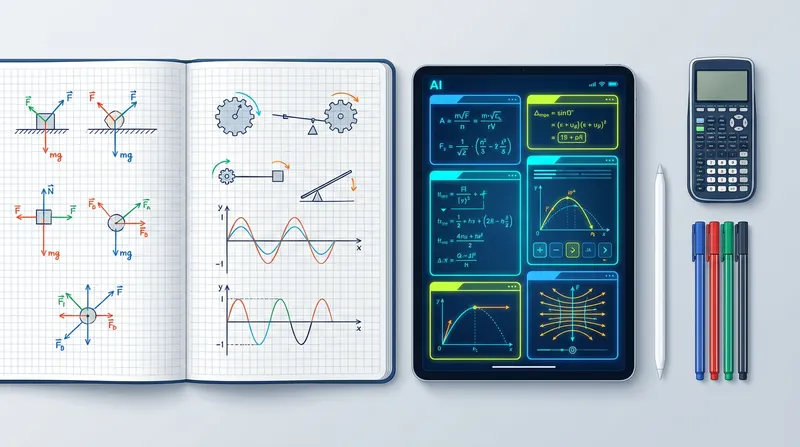
Before diving into practice problems, you need to understand how AP graders actually award points. Following the exam updates from the College Board (AP Central), starting with the May 2027 exam, both AP Physics 1 and AP Physics C: Mechanics have 42 multiple-choice questions in Section I (85 minutes) and 4 free-response questions in Section II (95 minutes), each worth 50% of the score.
Here is the secret hidden inside the AP Physics 1 scoring guidelines: on most AP Physics FRQs, the final answer is only a small part of the available points; much of the credit goes to setup, diagrams, and justified reasoning.
Novice students often immediately hunt for formulas to plug numbers into, while high-scoring problem solvers start with qualitative analysis and visual diagrams. When you skip the setup and write down a random kinematic equation, you miss out on valuable points from the AP Physics free response rubric.
Actionable Strategy: Build the "First-Step Habit" Whenever you start a calculation or derivation on an FRQ, make your very first line a fundamental law directly from the official AP equation sheet:
- For forces: Always write $\sum \vec{F} = m\vec{a}$ before breaking vectors into components.
- For energy: Always write $E_i + W_{ext} = E_f$ or $\Delta E = 0$.
- For momentum: Always write $\vec{p}i = \vec{p}f$ or $m_1v{1i} + m_2v{2i} = m_1v_{1f} + m_2v_{2f}$.
Writing a relevant starting equation from the equation sheet often earns setup credit, even if you make an algebra mistake later. Just like we cover in our AP Chem Exam Practice Guide: How to Turn Missed Questions into a 5, training yourself to think like an AP grader is the fastest way to boost your score alongside regular AP Physics 1 multiple choice practice.
How to Master the 4 AP Physics FRQ Types (Step-by-Step)
When you organize your study sessions using AP Physics 1 past FRQs by topic, you will notice that the College Board (AP Central) no longer surprises you with random formats. Every Section II exam features the exact same four question archetypes in the exact same order.
Knowing what each question asks for removes test-day panic and gives you a repeatable checklist for earning points.
1. Mathematical Routines (MR) and Symbolic Derivations
Question 1 is a 10-point AP Physics 1 mathematical routines FRQ that tests your ability to carry out multi-step symbolic derivations and calculate values.
The biggest trap on this question is leaving an unapproved variable in your final boxed answer. For example, if a prompt asks for acceleration in terms of $m$, $g$, and $\theta$, and your final answer includes Tension ($T$) or Normal Force ($F_N$), you will lose the final answer point.
Actionable Strategy: The "Forbidden Variable Check"
- Before you start solving, circle the allowed variables and constants listed in the prompt (such as $M$, $L$, and $g$).
- Write out your system of equations.
- Before moving to the next part, check every letter in your final expression against your circled list. If an uninvited guest like $T$ or $v$ is still there, use your second equation to substitute it out.
2. Translation Between Representations (TBR)
Question 2 is worth 12 points and tests how smoothly you can translate a physical scenario between four different representations: words, visual diagrams (like free-body diagrams or energy bar charts), equations, and graphs.
Practicing with visual tools like the University of Colorado Boulder PhET Interactive Simulations Project can help you see how physical models (such as force vectors or fluid particles) connect directly to mathematical equations and graphs.
Actionable Strategy: The "Slope and Area" Reflex Whenever an FRQ gives you a graph or asks you to sketch one, immediately ask yourself two questions:
- What is the slope? Divide the y-axis unit by the x-axis unit ($\frac{\Delta y}{\Delta x}$). On a velocity-time graph, the slope is acceleration. On a momentum-time graph, the slope is net force.
- What is the area under the curve? Multiply the y-axis unit by the x-axis unit ($y \cdot x$). On a force-displacement graph, the area is work ($W = \int F , dx$).
3. Experimental Design and Analysis (LAB)
Question 3 is the 10-point AP Physics 1 experimental design FRQ. You will be asked to design a lab procedure using standard classroom equipment to test a physics relationship, or to linearize a set of student data.
Students often lose easy points here by writing vague instructions like "measure the velocity with a ruler and stopwatch" (a stopwatch and meterstick only measure distance and time, which gives average speed, not instantaneous final velocity!).
Actionable Strategy: Memorize the "S-Q-U-A" Lab Checklist Every time you write an experimental procedure, check off these four items:
- S - State the quantities you will directly measure and give each one a symbol (e.g., "Measure the mass $m$ of the cart and the hanging mass $M$").
- Q - Specify the equipment used for each measurement (e.g., electronic balance for mass, meterstick for distance $d$, photogate or motion sensor for instantaneous velocity $v$).
- U - Use multiple trials and vary the independent variable (e.g., "Repeat for 5 different hanging masses, doing 3 trials per mass to reduce random error").
- A - Analyze by linearizing: State exactly what to plot on the vertical and horizontal axes so the graph forms a straight line whose slope yields the target constant. If you also take APES, you will recognize this structured approach from our guide on AP Environmental Science Homework Help: Master APES Math & FRQs.
4. Qualitative/Quantitative Translation (QQT)
Question 4 is the 8-point qualitative quantitative translation AP Physics 1 question. It asks you to make a conceptual prediction about a system, derive an equation for that system, and then prove in words that your equation agrees with your physical reasoning.
Actionable Strategy: The "Claim-Equation-Match" Template When the final part asks, "Does your equation in part (b) agree with your qualitative reasoning in part (a)?", never just say "Yes, they both increase." Use this exact three-sentence template:
- State the match: "Yes, my derived equation agrees with my reasoning in part (a)."
- Point to the fraction: "In my equation $a = \frac{M g}{M + m}$, the variable $m$ is in the denominator."
- Connect the math to the physics: "Therefore, as $m$ increases, the denominator grows larger, which causes the overall acceleration $a$ to decrease, matching my physical prediction."
AP Physics 1 FRQ Worked Solution: Unit 8 Fluids Breakdown
One of the biggest challenges for students searching for AP Physics 1 past FRQs by topic is finding practice for Unit 8 (Fluids). Because the College Board (AP Central) moved Fluids from AP Physics 2 into AP Physics 1, older Physics 1 practice tests do not include hydrostatic pressure, buoyancy, or Bernoulli's equation.
Let's walk through a realistic AP Physics 1 Unit 8 fluids FRQ with step-by-step worked solutions so you can see exactly where every rubric point is earned.
Sample FRQ Prompt: A solid cube of volume $V$ and density $\rho_c$ is completely submerged in a large open tank filled with water of density $\rho_w$ (where $\rho_w > \rho_c$). The cube is held stationary underwater by a light vertical string tied to the bottom of the tank.
- (a) Draw a free-body diagram showing and labeling all forces exerted on the cube.
- (b) Derive an expression for the tension $T$ in the string in terms of $V$, $\rho_c$, $\rho_w$, and physical constants.
- (c) Water now drains from a horizontal pipe at the bottom of the tank. The pipe narrows from cross-sectional area $A_1$ to $A_2$ (where $A_2 = \frac{1}{2}A_1$). If the water enters $A_1$ at speed $v_1$ and pressure $P_1$, derive an expression for the pressure $P_2$ in the narrower section in terms of $P_1$, $\rho_w$, and $v_1$.
Step-by-Step Worked Solution & Rubric Breakdown
Part (a): Free-Body Diagram (2 Points)
- Draw a single dot representing the cube.
- Draw one upward arrow labeled $F_B$ (Buoyant Force). [+1 Point]
- Draw two downward arrows: one labeled $F_g$ (or $mg$) for gravity, and one labeled $T$ for tension. Because the cube is at rest in static equilibrium, the upward arrow $F_B$ must be visibly longer than either individual downward arrow so that $F_B = F_g + T$. [+1 Point]
Part (b): Symbolic Derivation for Tension (4 Points)
- Start with Newton's Second Law for a system in equilibrium: $$\sum F_y = 0 \implies F_B - F_g - T = 0$$ [+1 Point for applying Newton's Second Law]
- Substitute the definitions of buoyant force ($F_B = \rho_{fluid} V g$) and weight using density ($m = \rho_{cube} V$): $$\rho_w V g - \rho_c V g - T = 0$$ [+2 Points: +1 for correct buoyant force substitution, +1 for expressing mass of the cube in terms of $\rho_c V$]
- Solve for $T$ and factor using only allowed variables: $$T = (\rho_w - \rho_c) V g$$ [+1 Point for final expression with no forbidden variables]
Part (c): Continuity and Bernoulli's Equation (4 Points)
- Apply the Continuity Equation to find the speed $v_2$ in the narrow section: $$A_1 v_1 = A_2 v_2$$ Substitute $A_2 = \frac{1}{2}A_1$: $$A_1 v_1 = \left(\frac{1}{2}A_1\right) v_2 \implies v_2 = 2v_1$$ [+1 Point for using continuity to find $v_2 = 2v_1$]
- Apply Bernoulli's Equation for a horizontal pipe ($y_1 = y_2$, so the $\rho g y$ terms cancel out): $$P_1 + \frac{1}{2}\rho_w v_1^2 = P_2 + \frac{1}{2}\rho_w v_2^2$$ [+1 Point for stating Bernoulli's equation with $y_1 = y_2$]
- Substitute $v_2 = 2v_1$ and solve for $P_2$: $$P_1 + \frac{1}{2}\rho_w v_1^2 = P_2 + \frac{1}{2}\rho_w (2v_1)^2$$ $$P_1 + \frac{1}{2}\rho_w v_1^2 = P_2 + 2\rho_w v_1^2$$ $$P_2 = P_1 - \frac{3}{2}\rho_w v_1^2$$ [+2 Points: +1 for squaring the $(2v_1)$ term properly, +1 for the correct final answer]
(Note: Whether you are studying fluid mechanics or orbital gravitation in our guide on Stuck on Space Science? The Best Astronomy Homework Help Tools & AI Tutors for Students, breaking formulas into step-by-step physical definitions keeps you from dropping coefficients like $\frac{1}{2}$ or squaring errors!)
AP Physics C: Mechanics Practice Test & Calculus Derivations Worked Solution
(Taking algebra-based AP Physics 1 only? Feel free to skip ahead to the next section on how to use an AI physics solver for your homework and test prep!)
If you are taking an AP Physics C: Mechanics practice test, you will face the same 4 FRQ types, but with one major upgrade: calculus. Instead of constant acceleration, AP Physics C tests time-varying forces, rotational inertia integrals ($I = \int r^2 , dm$), and differential equations.
As taught in the university-level curriculum at MIT OpenCourseWare (8.01 Classical Mechanics), mastering classical mechanics requires setting up differential equations symbolically and applying boundary conditions before plugging in numbers.
Let's solve the most famous question in AP Physics C calculus derivations practice: an object experiencing a velocity-dependent resistive drag force.
Sample AP Physics C FRQ Prompt: A skydiver of mass $m$ falls vertically from rest ($v = 0$ at $t = 0$). In addition to gravity, the skydiver experiences an upward resistive drag force given by $F_{drag} = -bv$, where $b$ is a positive constant and $v$ is the downward speed.
- (a) Write, but do not solve, a differential equation that could be used to find the speed $v(t)$ of the skydiver as a function of time $t$.
- (b) Determine an expression for the terminal velocity $v_T$ in terms of $m$, $g$, and $b$.
- (c) Use integration to derive an expression for $v(t)$ as a function of time $t$ in terms of $m$, $g$, and $b$.
Step-by-Step Calculus Worked Solution
Part (a): Writing the Differential Equation (2 Points)
- Choose downward as the positive direction ($+y$). Start with Newton's Second Law: $$\sum F_y = ma = mg - bv$$
- Replace acceleration $a$ with its calculus definition, $\frac{dv}{dt}$: $$m\frac{dv}{dt} = mg - bv$$ [+2 Points: +1 for $mg - bv$, +1 for writing $a$ as $\frac{dv}{dt}$]
Part (b): Finding Terminal Velocity (1 Point)
- At terminal velocity ($v = v_T$), acceleration is zero ($\frac{dv}{dt} = 0$): $$0 = mg - bv_T \implies v_T = \frac{mg}{b}$$ [+1 Point]
Part (c): Separating Variables and Integrating (5 Points)
- Separate the variables so all $v$ terms are on the left with $dv$, and all $t$ terms are on the right with $dt$: $$\frac{dv}{mg - bv} = \frac{dt}{m}$$ (Alternatively, factor out $-b$ first: $\frac{dv}{v - \frac{mg}{b}} = -\frac{b}{m}dt$) [+1 Point for correct separation of variables]
- Set up definite integrals using the initial condition ($v = 0$ at $t = 0$) to time $t$ and velocity $v$: $$\int_{0}^{v} \frac{dv'}{mg - bv'} = \int_{0}^{t} \frac{dt'}{m}$$ [+1 Point for showing integration with correct limits]
- Integrate both sides (remembering the chain rule factor of $-\frac{1}{b}$ on the left side!): $$\left[ -\frac{1}{b} \ln(mg - bv') \right]_{0}^{v} = \frac{t}{m}$$ [+1 Point for correct antiderivative with $-\frac{1}{b}$]
- Plug in the upper and lower bounds ($v$ and $0$): $$-\frac{1}{b} \left( \ln(mg - bv) - \ln(mg) \right) = \frac{t}{m}$$ Use the log rule $\ln(A) - \ln(B) = \ln\left(\frac{A}{B}\right)$ and multiply by $-b$: $$\ln\left(\frac{mg - bv}{mg}\right) = -\frac{b}{m}t$$ [+1 Point for applying bounds and logarithm rules]
- Exponentiate both sides ($e^x$) and isolate $v(t)$: $$1 - \frac{b}{mg}v = e^{-\frac{b}{m}t}$$ $$v(t) = \frac{mg}{b}\left(1 - e^{-\frac{b}{m}t}\right)$$ [+1 Point for final exponential expression]
If your calculus skills need a quick refresher before tackling differential equations, check out our NCEA Level 2 Calculus & Algebra Excellence Guide to solidify your derivatives and antiderivatives.
Why Basic Math Scanners Struggle with Physics (And How to Use an AI Physics Problem Solver Step-by-Step)
If you have ever tried scanning an AP Physics worksheet with a standard calculator app, you know how frustrating it can be. Many basic math apps are built for typed or printed equations and may not explain the physics reasoning an AP rubric rewards.
On the other hand, if you search for the question on a community Q&A forum, you often find a rushed numerical answer that skips the symbolic setup, earning zero points on an AP rubric. We break down why this hurts long-term test scores in our comparison of a Scanner Math Solver vs. AI Tutor: Why Your Teen Needs Step-by-Step Explanations (Not Just Answers).
Instead of getting stuck at 11 PM, you can use Tutor AI ("Snap. Solve. Learn.") as your personal AI physics problem solver step by step.
The 3-Step Study Workflow with Tutor AI
- Snap the Problem: Use Tutor AI's photo-based problem solving to snap the text and equations of the problem, whether handwritten or printed.
- Review the Symbolic Step-by-Step Breakdown: Instead of spitting out a single number, Tutor AI breaks the problem into logical steps, explaining the reasoning behind each step and highlighting the key concepts and formulas used.
- Master the Underlying Concepts: Still confused about why normal force equals $mg\cos\theta$ instead of $mg\sin\theta$, or why a step in the official AP Physics 1 FRQ worked solutions canceled out mass? Review Tutor AI's step-by-step explanation, which shows the reasoning behind each step and the key concepts and formulas used, any time, 24/7.
Stuck on a brutal FRQ derivation tonight? Do not stare at a blank page for an hour. Try Tutor AI to snap a photo of your physics problem and see every step explained clearly so you can build real test-day confidence.
How to Take a Free AP Physics Mock Exam at Home (For Students and Parents)
For parents watching their teen stress over AP Physics, it is natural to wonder how to support them without having a physics degree yourself. Even if you have not taken physics in twenty years, you can help your student run an AP Physics 1 mock exam free at home over a weekend. Here is a simple, low-stress 4-step routine:
- Download an Official Past FRQ Set: Grab a released Free Response packet (2025 or later sets match the current question types) from College Board (AP Central) and print it out along with the official AP Physics equation sheet.
- Simulate Real Timing: Give your student 95 minutes (about 24 minutes per FRQ, matching the May 2027 timing) in a quiet room with a scientific or graphing calculator and no phone distractions.
- Grade Together Using the Checklist Below: Compare the work against the scoring guidelines, and use Tutor AI to review any algebraic or calculus steps that do not make sense.
- Log the Error Type: Just as we recommend in our guide to Free Printable ACT Tests: How to Review Mistakes, write down why each point was missed (e.g., "Forgot to draw force arrows starting on the dot" or "Left $T$ in the final answer").
Copy-Pasteable Self-Grading FRQ Checklist
Use this quick checklist after every practice FRQ before looking at the answer key:
- Free-Body Diagrams: Does every force arrow start directly on the dot, point in the right direction, and have a clear label (like $F_g$, $F_N$, $f_k$) with NO component dashed lines drawn on the grading diagram?
- Starting Equations: Did I explicitly write the fundamental law ($\sum F = ma$, $E_i = E_f$, or $L_i = L_f$) on line one?
- Forbidden Variables: Does my final boxed expression contain only the variables listed in the prompt and physical constants ($g$, $G$, etc.)?
- Graphs: Are both axes labeled with variables and units, and did I draw a smooth best-fit line or curve instead of connecting the dots?
- QQT Justifications: Did I explicitly reference my derived equation from the previous part when explaining my physical reasoning?
Conclusion: Turn AP Physics FRQ Panic into Confidence
Scoring a 4 or 5 on AP Physics 1 or AP Physics C does not require being a human calculator. It comes down to slowing down, drawing clean diagrams, writing your fundamental conservation laws first, and practicing with real AP Physics 1 FRQ worked solutions so the exam structure feels like second nature.
Whether you are a student tackling your first symbolic derivation or a parent supporting your teen through exam season, you do not have to figure out complex equations or derivations alone at midnight.
Ready to make AP Physics click? Download Tutor AI on iOS or Android, or visit Tutor AI today. Snap. Solve. Learn. Get instant, step-by-step explanations for your toughest physics homework and practice FRQs 24/7!
Note: Every student learns differently. While these strategies are research-backed, results may vary. Adapt these techniques to fit your unique learning style and circumstances.
Frequently Asked Questions
Why do so many students struggle with AP Physics 1?
AP Physics 1 is often the very first AP science course high schoolers take, and many students expect it to work like regular math class where you simply plug numbers into a formula. Instead, the exam tests deep conceptual reasoning, experimental design, and multi-step symbolic derivations where zero numbers are given. Students lose points when they skip the conceptual setup or fail to justify their reasoning using fundamental physics laws.
Is Unit 8 Fluids tested on the AP Physics 1 FRQ section?
Yes. Following the College Board curriculum update that moved Fluids from AP Physics 2 into AP Physics 1, AP Physics 1 Unit 8 fluids FRQ and multiple-choice questions account for 10% to 15% of the exam. You should be ready to combine density, hydrostatic pressure, buoyancy ($F_B = \rho V g$), the continuity equation ($A_1v_1 = A_2v_2$), and Bernoulli's principle with earlier mechanics concepts like forces and conservation of energy.
Do I lose all my points on AP Physics FRQs if my final answer is wrong?
No! On most AP Physics FRQs, the final answer is only a small part of the available points; much of the credit goes to setup, diagrams, and justified reasoning. Even better, AP graders award "consistency points" on later parts of a question if you correctly use an expression you derived in an earlier part.
What is the biggest difference between AP Physics 1 and AP Physics C: Mechanics FRQs?
While both exams share the exact same 4-FRQ structure (Mathematical Routines, Translation Between Representations, Experimental Design, and QQT) and core mechanics topics, AP Physics 1 relies solely on algebra and trigonometry. An AP Physics C: Mechanics practice test requires you to set up and solve calculus-based derivatives and integrals, such as integrating variable forces to find work, calculating moments of inertia, or solving differential equations for resistive drag forces.
How can I use an AI solver to study for AP Physics without hurting my test prep?
Never use an AI tool just to copy down the final expression on a worksheet. Instead, attempt the FRQ on paper under timed conditions first. When you get stuck, snap a picture with a step-by-step app like Tutor AI (featured in our guide to the 7 Best AI Tutoring Apps That Give Step-by-Step Explanations (Not Just Answers)) to see the full solving process, compare it to your own work, and then re-solve a similar problem on your own.