
The Late-Night Biology Breakdown: Why You Need a Tutor, Not Just an Answer Key
We have all been there. It is 11 PM on a Tuesday, and you are staring blankly at a diagram of cellular respiration. The words "glycolysis" and "Krebs cycle" are starting to blur together. Your teacher is asleep, your parents have not taken a high school biology class in twenty years, and frustration is quickly turning into panic.
For many students, this is the exact moment they turn to the internet for a lifeline. Biology is notoriously dense. It is packed with complex vocabulary, multi-step processes, and abstract concepts that can overwhelm even the most dedicated learners.
However, this late-night desperation introduces a massive problem. Students are overwhelmed by dense biology concepts, often hitting a wall when help is unavailable. Meanwhile, parents and educators are terrified that using digital tools will lead to students just copying answers, failing their in-person exams, and missing out on actual learning.
This is where an AI biology homework helper comes into play. When used correctly, these tools act as 24/7 digital tutors that guide you through tough concepts. The secret to academic success is not finding a faster way to copy the final answer. It is about learning how to use these powerful tools to get step-by-step guidance, build your confidence, and truly understand the material.
What is an AI Biology Solver (And How Widespread Are They)?
An AI biology solver is an educational technology tool designed to help students work through science problems. Unlike a basic search engine that just spits out a webpage, these specialized apps allow you to snap a photo of your homework and receive instant, structured help.
These tools are incredibly advanced. A good biology question solver uses optical character recognition (OCR) to read printed text, handwritten notes, and even complex scientific diagrams. Once it understands the question, it breaks down the solution into digestible, logical steps.
If you are a parent wondering if your child is the only one using these tools, you can put that fear to rest. Recent educational surveys show that a majority of students use digital tools weekly for homework and projects, with most believing it significantly improves their learning efficiency.
However, not all AI tools are created equal. Generic chatbots are prone to giving incorrect information or simply handing over the final answer without explanation. This is why finding the right guide to safe homework help sites is so important. You need an app that is specifically designed with educational guardrails, ensuring the focus remains on teaching rather than just answering.
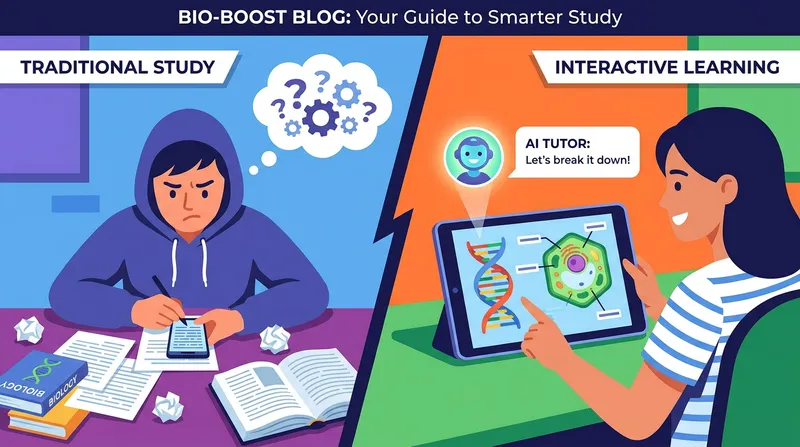
The Danger of 'Cognitive Surrender': Why Copying Answers Backfires
Let us address the elephant in the room. When you are tired and stressed, the temptation to just copy and paste the final answer is incredibly strong. It feels like a quick fix to a painful problem.
But taking this shortcut creates a dangerous phenomenon known as the "illusion of learning." When you copy an answer, your brain tricks you into feeling a false sense of accomplishment. You look at the completed worksheet and think you understand the material.
Then, test day arrives. You sit down in the classroom without your phone, look at the first question, and draw a complete blank. This exact scenario is a growing concern among top educators.
Experts emphasize that while digital tools present unprecedented possibilities for individualized tutoring, unrestricted use can trigger "cognitive surrender." This happens when students fall back on technology at the very first hint of an academic struggle, completely bypassing the productive frustration that builds memory and comprehension.
Struggling through a problem is not a sign of failure. It is the actual process of your brain building new neural pathways. When you outsource that struggle to a machine, you are outsourcing your learning. This is a core part of the AI cognitive debt crisis. To succeed in biology, you must use AI to assist your thinking process, not replace it.
How to Get Step-by-Step Biology Answers (Without Cheating)
So, how do we draw the line between getting helpful tutoring and committing academic dishonesty? It all comes down to how you ask for help.
Cheating is asking an AI to do the work for you. Tutoring is asking the AI to help you do the work yourself. This distinction is critical. Research into academic integrity highlights a strong link between unsupervised usage and cheating.
To avoid this trap, you need to master the art of ethical prompting. If you are wondering if using AI for homework is cheating, the answer lies in using prompt templates that force the AI to act like a Socratic tutor.
Here are some actionable, copy-paste prompts you can use to get step-by-step biology answers ethically:
- The "Check My Work" Prompt: "I am working on this biology problem about enzymes. My answer is [insert your answer]. Please do not give me the correct answer. Just tell me if I am on the right track, and point out any specific mistakes in my logic."
- The "Explain Like I Am Five" Prompt: "I do not understand the difference between active and passive transport. Please explain it to me using a simple real-world analogy, like a crowded room or a water slide."
- The "Step-by-Step Guide" Prompt: "I need to map out the light-dependent reactions of photosynthesis. Please walk me through this one step at a time. Ask me a question after each step to make sure I understand before moving on."
By using these strategies in a dedicated science homework AI app, you guarantee that your brain is doing the heavy lifting. You are still getting the support you need, but you are earning the knowledge.
Tackling Tough Topics: Using a Genetics Problem Solver
Genetics is consistently ranked as one of the most difficult topics in high school biology. Between tracking dominant and recessive traits, understanding alleles, and memorizing pedigree charts, it is easy to get lost in the weeds.
Many students try to use a genetics problem solver just to get the final phenotypic ratios. But a Punnett square is a puzzle, and you need to learn how to put the pieces together. Consider a high school sophomore struggling with dihybrid crosses. Instead of copying the final grid, she can use a digital tutor to break down the setup one allele pair at a time, which is what actually moves a test score.
Actionable Tips for Genetics Homework:
- Identify the Parents First: Ask the AI, "Based on this word problem, what are the genotypes of the two parent organisms? Please explain how you figured that out from the text."
- Set Up the Grid: Once you know the parents, draw the Punnett square on your own paper. Fill it out yourself.
- Verify Your Work: Snap a picture of your hand-drawn square and ask, "Did I distribute the alleles correctly in this Punnett square?"
- Clarify Complex Rules: If you are dealing with special cases, prompt the AI with, "Can you explain the difference between incomplete dominance and codominance using flower colors as an example?"
Breaking Down Cell Biology and Ecosystems
Cell biology and ecology require a completely different type of studying. These topics are less about math-like problem solving and more about understanding massive, interconnected systems.
When you are looking for cell biology step-by-step help, you are usually trying to memorize sequences. Mitosis, meiosis, and the stages of cellular respiration are classic examples.
Actionable Tips for Systems and Cycles:
- Create Custom Flashcards: Take a picture of a dense textbook paragraph about the cell cycle. Ask the AI, "Please turn this information into five digital flashcards highlighting the most important vocabulary words."
- Visualize Food Webs: If you are stuck on an ecology assignment, ask the AI to help you trace the flow of energy. "If the primary consumer in this ecosystem is removed, what are the step-by-step impacts on the apex predator?"
- Request Memory Aids: Ask your AI tutor to generate a mnemonic device to help you remember the taxonomic classification system (Domain, Kingdom, Phylum, Class, Order, Family, Genus, Species).
Features to Look for in the Best AI for Biology
Not all digital tools are equipped to handle the nuances of life sciences. If you are searching for the best AI for biology, you need an application built specifically for student success. Instead of just looking at technical specifications, ask these crucial questions when evaluating an app:
- Does it have advanced photo-solving capabilities? Biology homework is highly visual. You need an app that can read diagrams, charts, and handwritten notes. Learn more about how this technology works in our guide on how to use an AI picture solver for science.
- Can it work offline? Late-night study sessions often happen when the Wi-Fi is spotty. Having a tool with offline capabilities ensures you are never stuck without help.
- Does it offer accurate scientific breakdowns? The tool must provide factually correct, curriculum-aligned explanations that match what is taught in US middle and high schools.
- Does it have conversational memory? A good AI tutor remembers what you asked two minutes ago. This allows you to have a continuous back-and-forth conversation until you fully grasp the concept.
- Is it AP Biology ready? For advanced students, an AP biology AI helper needs to handle complex, multi-part free-response questions (FRQs) and grade practice responses against standard rubrics.
A Parent's Guide: Supporting High School Science at Home
If you are a parent reading this, take a deep breath. It is completely normal to feel out of your depth when your child asks for help with mRNA translation or genetic mutations. Science curriculums have evolved significantly, and you are not expected to be a substitute teacher.
Your role is not to know the answers. Your role is to guide how your child finds the answers.
Educators are deeply concerned about the misuse of technology, noting that students who rely too heavily on automated answers for take-home projects frequently score poorly on in-person exams due to the illusion of learning.
To prevent this, parents must actively manage how these tools are used at home. You can also read up on changing school AI policies to stay informed about district rules.
Actionable Checklist for Parents:
- Set the Ground Rules: Have a clear conversation with your child about the difference between using an app to learn versus using it to cheat.
- The "Teach Me" Test: After your child uses an AI biology homework helper, ask them to explain the concept back to you. If they can teach it to you simply, they have actually learned it.
- Monitor Progress, Not Just Completion: Use apps that offer parent dashboards to see which subjects your child is spending the most time on. This helps you identify their weak spots.
- Encourage Scratch Paper: Insist that your child works out problems on physical paper while consulting the app, rather than just staring at a screen.
Master Biology with the Right Digital Study Buddy
Biology does not have to be a source of late-night tears and frustration. By shifting your mindset from "getting the answers" to "understanding the process," you can completely transform your academic experience.
Remember, an AI biology solver is a powerful tool, but you are the one in the driver's seat. Use it to break down complex text, check your Punnett squares, and generate creative analogies. Never settle for just copying the final line.
Ready to study smarter and build real academic confidence? Download Tutor AI for free on iOS and Android to try it on your next tough biology assignment. Snap a picture, get a step-by-step breakdown, and learn for real.
Note: Every student learns differently. While these strategies are research-backed, results may vary. Adapt these techniques to fit your unique learning style and circumstances.
Frequently Asked Questions
Is using an AI biology question solver considered cheating?
It depends entirely on how you use it. If you snap a picture, copy the final answer, and turn it in as your own work, that is academic dishonesty. However, if you use the AI to explain a concept you do not understand, check your completed work for errors, or generate practice questions, you are using it ethically as a study aid.
Can AI draw or solve a Punnett square for me?
Yes, an advanced AI can calculate genetic probabilities and explain the setup step-by-step. However, to actually learn the material, you should attempt to draw and solve the Punnett square on paper first, and then use the AI to verify your ratios and explain any mistakes.
What is the best AI app for step-by-step biology answers?
The best apps are those designed specifically for education, like Tutor AI. Rather than just giving away the answers, these platforms prioritize Socratic teaching methods, breaking down complex biological processes into easy-to-understand steps and tracking your learning progress.
Can an AP biology AI helper assist with free-response questions (FRQs)?
Absolutely. A strong educational AI can help you brainstorm key vocabulary to include in your essays, outline the structure of your response, and even grade your practice answers against standard AP rubrics to help you improve your writing before exam day.
How can parents make sure their child is actually learning from AI homework tools?
The most effective method is the "teach-back" strategy. After your child finishes their homework using an AI tool, ask them to explain the core concept to you without looking at their phone or notes. If they can clearly articulate the idea, they have successfully internalized the material.