
It is a scenario playing out in homes everywhere. Your teenager gets straight As on their daily math homework, perfectly formatting every algebra assignment. You breathe a sigh of relief. But when midterm season arrives, the results are shocking. They fail the in-person exam, unable to solve the very problems they breezed through at the kitchen table.
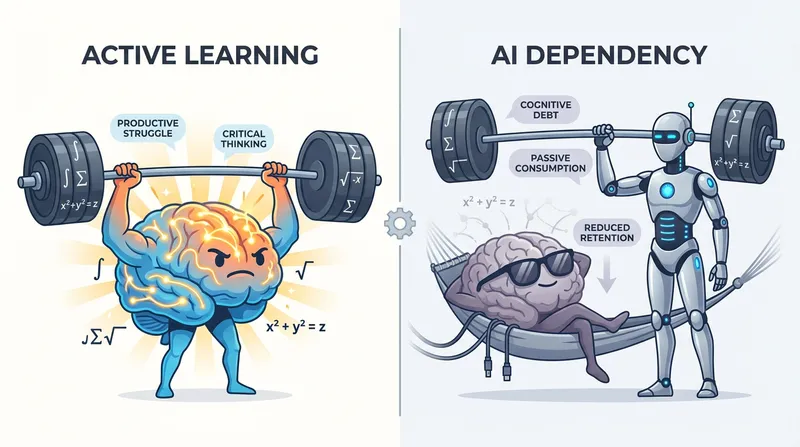
If this sounds familiar, you are not alone. Students are increasingly using basic AI chatbots to rush through assignments, creating a dangerous illusion of competence. Educators call this emerging trend "AI cognitive debt", meaning students borrow answers today at the expense of their brain power tomorrow.
Recent findings back up what teachers have been warning us about. According to research from the MIT Media Lab, participants using AI models consistently underperformed at neural, linguistic, and behavioral levels. The MIT study revealed that students heavily relying on AI displayed significantly reduced neural engagement as measured by EEG activity compared to those who did not use these tools.
Technology should be a supportive tutor, never just an answer key. Let us explore exactly how these tools are changing student brains and what you can do to protect your child's academic future.
The Homework Trap: Understanding AI Cognitive Debt
Every time a student encounters a difficult math problem, their brain is presented with an opportunity to grow. Wrestling with a complex equation forces neurons to fire, connect, and strengthen. However, when a student scans a problem with a standard solver and instantly copies the output, that growth process is entirely short-circuited.
AI cognitive debt accumulates slowly. At first, it just looks like a helpful shortcut on a busy weeknight. But over time, this dependence means the student loses the ability to initiate problem-solving on their own. They forget how to break a large problem into smaller, manageable steps.
How Standard Math Solvers Are Deskilling Students
The concept of AI deskilling students is becoming a major concern for educators. Deskilling happens when a person loses a previously held skill because a machine has taken over the task. In education, the instant gratification provided by basic solvers completely bypasses the productive struggle required for deep learning.
When a student uses an app that just spits out the final answer, they are not practicing math. They are practicing data entry. They are learning how to prompt a machine rather than how to manipulate fractions or balance chemical equations.
Actionable Tip for Parents: Ask your child to explain the steps of a completed homework problem out loud to you. You do not need to understand the math yourself! Just say, "Can you walk me through how you got from step two to step three?" If they cannot explain the logic, they have likely relied too heavily on a solver.
The Science of Cognitive Offloading
To understand why this happens, we have to look at the neuroscience of AI cognitive offloading. Cognitive offloading is the act of using external tools to reduce the mental effort required to perform a task.
Not all offloading is bad. Using a calculator to multiply large numbers so you can focus on a complex calculus concept is helpful offloading. However, harmful offloading occurs when you let the AI do the core reasoning for you.
According to research published by the National Institutes of Health (NIH), over-reliance on AI reduces the mental effort needed for deep learning. This can severely impair a student's ability to develop independent higher-order thinking skills. The brain is like a muscle. When an AI does the heavy lifting every single night, the student's neural pathways naturally weaken.
The Danger of False Mastery in AI Education
One of the most insidious side effects of standard solvers is false mastery AI education. False mastery is the illusion of competence. When a student reads a perfectly formatted, step-by-step AI answer, it usually makes logical sense to them in the moment. They nod along and think, "Yes, I understand this."
But recognizing a correct answer is not the same thing as generating one from scratch. This leads to a common fear among parents: does ChatGPT ruin critical thinking? The answer depends entirely on how it is used. If it is used as an answer machine, it absolutely degrades independent thought.
If you are worried your child is falling into this trap, you can read our guide on Is Using AI for Homework Cheating? How to Beat Homework Imposter Syndrome to help them build healthier study habits.
Actionable Tip for Parents: Spot the signs of false mastery by looking for the "recognition versus recall" gap. Have your child close their book and put away their phone, then ask them to write down the core formula they just used. If they cannot recall it without looking at the screen, they have not truly mastered the concept.
The Reality Check: ChatGPT Hurting Test Scores
The most painful realization of cognitive debt usually happens on report card day. Parents are often baffled by the massive disconnect between high homework grades and low exam scores.
This is not just an anecdotal problem. It is a documented trend. In a large-scale randomised trial run by Wharton School researchers, high school students given an unrestricted ChatGPT interface during maths practice scored 17% worse on the follow-up exam than classmates who never had access at all, even though they had performed far better during practice itself. ChatGPT hurting test scores is a direct result of students using technology as a crutch rather than a learning tool.
School districts are waking up to this reality. Many are implementing strict guidelines to protect students from unrestricted AI access. To understand how these changes might affect your household, check out our breakdown of The 2026 School AI Bans: What the NYCPS and LAUSD Policies Mean for Your Child's Homework.
Actionable Tip for Parents: Set up a "mock exam" environment at home. Once a week, have your child complete five practice problems at the kitchen table with zero digital devices allowed. This low-stakes practice will reveal their true retention level before the actual test day arrives.
Safe Photomath Alternatives for Parents
We know that parents are incredibly busy. You cannot always sit down and help your teenager with advanced trigonometry or AP Chemistry. You might not have looked at these formulas in twenty years! Because of this, educational technology is absolutely necessary. But you need tools that actually teach.
When searching for Photomath alternatives for parents, you must look for apps that prioritize the learning process over the final result. Safe AI homework help requires built-in pedagogical guardrails.
Here are the non-negotiable features you should look for in any learning app:
- Forced Engagement: The app should require the student to do some of the work, not just hand over the answer.
- Step-by-Step Breakdowns: It must explain the "why" behind the math, not just the "what."
- No Instant Final Answers: The tool should guide the student to the finish line, rather than teleporting them there.
For a deeper look at how different educational tools compare, read our detailed analysis in Is Photomath Plus Worth It? Mathway vs. Photomath vs. Gauth Plus (2026 Review).
Why a Step-by-Step AI Math Tutor Rebuilds Neural Pathways
The antidote to cognitive debt is active learning. A Socratic AI homework solver works by asking guiding questions and breaking complex problems into bite-sized pieces.
Instead of saying, "The answer is x = 4," a true step-by-step AI math tutor will say, "To isolate x, what should we do with the number 7 on this side of the equation?" Whether your teen is tackling Common Core geometry, AP Calculus, or SAT/ACT prep, this forces the student's brain to engage, firing crucial neural pathways and building real memory.
This student-AI collaborative approach is scientifically proven to be more effective. Research from the Association for Information Systems (AIS) shows that forcing students to contribute their own initial reasoning before an AI provides answers significantly reduces cognitive offloading and increases active learning.
Furthermore, this structured method makes step-by-step AI tools incredible for neurodiverse students. Teens with ADHD or specific learning differences often feel overwhelmed by a massive wall of text or a complex multi-step equation. By breaking the problem down into a guided, interactive sequence, we reduce cognitive overload and make learning accessible and stress-free.
If you want to explore more tools that prioritize learning over cheating, take a look at our guide to Need Help With Math Homework? Safe, Step-by-Step Online Tools (That Aren't Cheating).
Actionable Tip for Parents: Teach your child how to use AI strictly for checking their work. Have them solve the problem on paper first. Then, they can use an app like Tutor AI to snap a photo and verify their steps. If they made a mistake, the step-by-step explanation will show them exactly where they went wrong, turning a failure into a powerful learning moment. Plus, because these tools are available 24/7, they act as an on-demand safety net during late-night study sessions when you are unavailable.
How to Prevent AI Homework Cheating at Home
Banning technology completely is not a realistic solution. AI is here to stay, and knowing how to use it responsibly is a crucial skill for the future. The goal is to prevent AI homework cheating while still leveraging the benefits of personalized tech support.
Start by having an open, collaborative conversation with your teen. Acknowledge that homework is stressful and that it is tempting to use shortcuts. Then, explain the concept of cognitive debt, a term gaining traction in educational psychology circles, in simple terms. Let them know that you care more about them learning the skills than you do about a perfect homework grade.
Next, create a family media plan that outlines acceptable AI use.
Here are some healthy boundaries you can set together:
- Brainstorming is okay: Using AI to generate ideas for an essay topic is acceptable.
- Checking work is okay: Using an app to verify a completed math problem is encouraged.
- Generating answers is not okay: Asking a chatbot to write a paragraph or solve a blank math worksheet is off-limits.
By utilizing purpose-built educational apps, you get built-in pedagogical guardrails. You do not have to worry about your child asking open-ended chatbots for direct answers because true educational AI is designed to teach, not to cheat. With features like a parent progress tracking dashboard, you can finally have peace of mind knowing your child is actually learning.
Ready to help your child study smarter and build real academic confidence? Snap. Solve. Learn. Try Tutor AI free on iOS and Android today to experience the difference between an answer key and a true digital tutor.
Frequently Asked Questions
What is AI cognitive debt in education?
AI cognitive debt is an emerging term that occurs when students repeatedly use AI to bypass the mental effort of solving problems. Over time, this lack of practice weakens their neural pathways, leaving them unable to perform independently on in-person exams.
Does using ChatGPT ruin a student's critical thinking skills?
ChatGPT itself does not ruin critical thinking, but using it as an instant answer machine certainly does. When students use AI for harmful cognitive offloading rather than as a Socratic tutor, their analytical and problem-solving skills naturally degrade.
Are there safe Photomath alternatives for parents?
Yes. Parents should look for step-by-step AI math tutors that use a Socratic teaching method. These tools force students to engage with the material and understand the process before revealing the final answer, ensuring real learning takes place.
How can a step-by-step AI math tutor help neurodiverse students?
Step-by-step AI tools break overwhelming problems into manageable, bite-sized pieces. This structured, predictable approach reduces cognitive overload and anxiety, which is especially helpful for students with ADHD or specific learning differences.
How can parents prevent AI homework cheating without banning technology?
Parents can prevent cheating by maintaining open communication and setting clear boundaries on how AI can be used. For example, allow AI for brainstorming or checking completed work, but not for generating answers. Utilizing purpose-built educational apps like Tutor AI with built-in learning guardrails and parent tracking features is the safest approach.
Note: Every student learns differently. While these strategies are research-backed, results may vary. Adapt these techniques to fit your unique learning style and circumstances.


