
You just submitted your math assignment and got a perfect score. But instead of feeling proud, your stomach drops. You secretly wonder if you are a fraud. If you had to take an in-person exam right now, without your smartphone or laptop, would you pass?
This hidden anxiety is the core of a growing concern known as AI homework guilt. It is a familiar pattern: a student earns an A on a physics assignment, then privately feels like a fake because an app did the heavy lifting. Many students quietly share a feeling of imposter syndrome because they rely on instant answer bots to get good grades. They are terrified that they have lost their ability to think critically. Meanwhile, parents are equally anxious. They lack clear guidelines on how to navigate this new technology safely without hindering their child's cognitive development.
If you or your child are feeling this way, take a deep breath. You are not alone, and you are not failing. Let us explore how to shift from feeling guilty to feeling empowered, and how the right tools can help you build genuine academic confidence.
The AI Homework Dilemma: Why Students Are Stressed
Homework has always been a source of stress, but modern technology has added a complicated new layer. AI tools are everywhere, and they are incredibly easy to use. However, this convenience comes with a heavy emotional cost.
According to a recent study by the RAND Corporation, 62 percent of students currently use AI for their homework. Surprisingly, the same study reveals that 67 percent of teens worry that this increased reliance on AI will harm their critical thinking skills.
Students are caught in a frustrating trap. On one hand, the pressure to maintain high grades makes the instant answers provided by chatbots incredibly tempting. On the other hand, relying on these shortcuts creates a nagging fear that true learning is not happening. This disconnect between earning a good grade and actually understanding the material is exactly what triggers high school imposter syndrome.
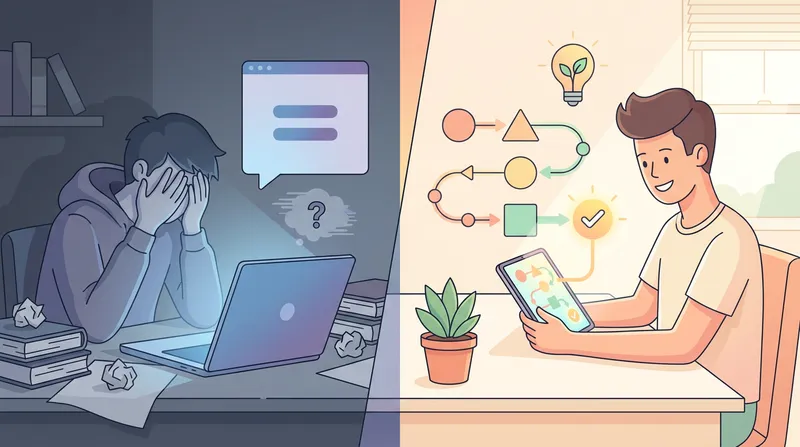
Is Using AI for Homework Cheating? The Honest Truth
The most common question students and parents ask is whether using AI for homework is considered cheating. The honest truth is that it depends entirely on how you use it.
Research published in Frontiers in Computer Science highlights that students often misuse AI not out of malicious intent, but due to academic pressure and a lack of clear institutional messaging about ethical boundaries. When schools fail to provide clear rules, students are left guessing where the line is drawn.
Here is a simple way to look at ChatGPT academic integrity: using an AI tool to bypass the learning process is cheating. If you copy a prompt, paste it into a bot, and submit the final output as your own work, you are crossing the line. However, using AI as a personalized tutor to explain difficult concepts is not cheating. It is a smart study strategy.
If you want to ensure you are staying on the right side of academic integrity, check out our guide on Need Help With Math Homework? Safe, Step-by-Step Online Tools (That Aren't Cheating) | Tutor AI Blog.
Understanding AI Homework Guilt and High School Imposter Syndrome
Imposter syndrome is the persistent inability to believe that your success is deserved. In the digital age, this has evolved into a specific phenomenon. A fascinating working paper published on the arXiv repository (currently under peer review) establishes "AI Guilt" as a documented psychological phenomenon. This guilt undermines student self-efficacy, creating an internal conflict between the convenience of technology and the desire for academic authenticity.
When a student uses an app that just spits out the final answer, they miss the productive struggle required to learn. They get the "A" on the homework, but they live in fear of the upcoming pop quiz.
Actionable Tips to Overcome AI Guilt:
- Acknowledge the feeling: Feeling guilty actually means you care about your education. It is a sign that you want to learn, not just perform.
- Change your goal: Shift your focus from "getting the assignment done" to "understanding the concept."
- Test yourself: After using an AI tool to understand a problem, close the app and try to solve a similar problem completely on your own.
A Parents Guide to AI Homework: Keeping Kids Safe
For busy parents, navigating the world of educational technology can feel overwhelming. You want your child to succeed, but you also want to protect their mental health and cognitive development.
The American Psychological Association (APA) emphasizes the mental health implications of AI chatbots for adolescents. They note that teens are particularly vulnerable to over-relying on these tools, making active parental guidance essential. Human connection cannot be replaced by an app.
Actionable Steps for Parents:
- Have an open conversation: Ask your child how they use technology for school. Do not approach it as an interrogation. Approach it with curiosity.
- Focus on the process, not the grade: Praise your child for working through a difficult problem, even if they got the wrong answer initially.
- Use tools with parent dashboards: Look for educational apps that offer progress tracking. This allows you to see where your child is struggling so you can offer targeted support.
- Set healthy boundaries: Encourage tech-free study breaks to help reduce screen fatigue and academic anxiety.
Does AI Ruin Critical Thinking?
The fear that AI will ruin critical thinking is valid, but it is not an inevitable outcome. The key difference lies in outsourcing thought versus augmenting thought.
Outsourcing thought happens when you let the machine do the heavy lifting. If you ask a bot to write your history essay or solve your calculus problem without reading the steps, your critical thinking skills may weaken over time.
Augmenting thought happens when you use technology to push your understanding further. For example, you can ask an AI to critique your essay thesis or explain a complex calculus theorem in simpler terms. This actually enhances your problem-solving skills. For more strategies on using AI to prepare for rigorous exams, read our post on AP Calculus AB vs BC: The 2026 Guide to GPA Weighting and AI Study Strategies | Tutor AI Blog.
AI Tutoring vs Cheating: Finding the Right Balance
To find the right balance, we need to understand the difference between an instant answer generator and a genuine tutoring platform. Many popular platforms focus entirely on content generation or instant math solutions. These tools fuel imposter syndrome because they bypass the learning process.
Instead, students need a Socratic AI tutor. The Socratic method involves asking guiding questions to help a student arrive at the answer themselves. A good educational tool acts like a patient human tutor. It will not just give you the answer. It will break down the steps, explain the formulas, and help you understand the "why" behind the solution.
Parents looking for safe options should explore our comprehensive resource: Best Free Online Homework Help: A Parent's Guide to Safe Sites & Apps (2026) | Tutor AI Blog.
How to Use AI for School Without Cheating
You can absolutely use AI to improve your grades without compromising your ethics. It requires discipline and a commitment to actual learning.
Actionable Rules for Ethical AI Use:
- Use it for brainstorming, not drafting: Ask AI for essay outlines or topic ideas, but write the actual paragraphs in your own voice.
- Ask for concept breakdowns: If you do not understand a textbook chapter, ask the AI to explain it like you are a middle schooler.
- Generate practice quizzes: Ask the AI to create a 10-question multiple-choice quiz based on your study notes. Advanced platforms can automatically identify conceptual weak spots and generate personalized practice paths to help you master them.
- Never copy and paste: Make it a hard rule that you will never copy text directly from an AI chat into your assignment.
For specific examples of how to apply these rules to humanities subjects, check out Beyond flashcards: The smart guide to social studies homework help | Tutor AI Blog.
Mastering an AI Math Solver Step by Step
While these rules apply to all subjects, STEM homework often requires a unique approach to avoid crossing the line into cheating. Math anxiety is incredibly common, and staring at a blank page at 11 PM is a terrible feeling.
This is where an AI math solver step-by-step feature becomes a game-changer. With TutorAI, the philosophy is simple: Snap. Solve. Learn. When you snap a photo of a tough algebra equation, the app does not just give you "x = 4." It provides a detailed, step-by-step breakdown of how to isolate the variable.
To master this tool, read through every single step. Write them down on your own paper. If you do not understand step three, pause and review the formula used. This transforms a moment of panic into a personalized tutoring session. You can learn more about applying this to science classes in The Best AI Science Solvers of 2026: Step-by-Step Homework Help for Physics, Chemistry, and Biology | Tutor AI Blog.
Conclusion: Build Genuine Confidence with TutorAI
Technology should be a tool for empowerment, not a source of guilt or anxiety. The fear that AI is ruining your skills is only true if you allow the machine to do the thinking for you. True academic confidence comes from understanding the material deeply, knowing that you can solve the problem on your own when the time comes.
By shifting your mindset and choosing the right tools, you can conquer homework imposter syndrome. With TutorAI's 24/7 availability, personalized learning paths, and step-by-step explanations, you are never alone in your learning journey. You get the targeted, personalized help you need to understand the "why" behind every answer.
Ready to study smarter and build real confidence? Download TutorAI on the App Store or get it on Google Play today and experience stress-free, ethical learning.
Frequently Asked Questions
Is using ChatGPT to explain a math problem cheating?
No. Using AI to break down complex concepts or explain formulas is like asking a teacher for help. Cheating only occurs when you copy and paste the final answer without understanding the steps involved. When you use AI to understand the "why" behind a problem, you are actively learning.
How can parents tell if an AI tool is helping or doing the work?
Parents should look for tools that offer step-by-step explanations and guiding questions. If an app only outputs a final answer with no context or breakdown of the process, it is likely doing the work for the student rather than teaching them. A good tool acts like a tutor, not an answer key.
What is a Socratic AI tutor?
A Socratic AI tutor is designed to teach by asking questions and providing hints. Instead of just giving the answer, it encourages the student to think critically and arrive at the solution themselves. This mimics the approach of a great human teacher and ensures active participation in the learning process.
Can teachers detect if I used AI for my homework?
While detection tools do exist, the biggest indicator to teachers is the knowledge gap. If a student uses AI to cheat on homework, they will likely fail their in-person exams. A sudden drop in performance during offline testing is the most obvious sign of AI misuse, making true comprehension your best defense.
How do I overcome AI homework guilt?
The best way to overcome this guilt is to transition from using instant answer bots to educational tools focused on learning. By focusing on understanding the steps and testing yourself without the app, you will rebuild your academic confidence and prove to yourself that you truly know the material.
Disclaimer: This article provides general information and is not a substitute for professional medical or mental health advice. If you or your child are experiencing serious mental health concerns, please consult a qualified healthcare provider. For crisis support, contact the National Suicide Prevention Lifeline at 988.
Note: Every student learns differently. While these strategies are research-backed, results may vary. Adapt these techniques to fit your unique learning style and circumstances.


