
Choosing between AP Calculus AB and BC is one of the biggest academic decisions your family will face this year. You have questions, and we have answers. Students and parents are often anxious about making the wrong choice. On one hand, taking the fast-paced AP Calculus BC course might impact a carefully protected weighted GPA. On the other hand, playing it safe with AP Calculus AB might not look rigorous enough to top-tier universities.
Add in late-night homework struggles and the very real parent concern that teenagers using AI math solvers are just skipping the learning process, and it is easy to see why this topic causes anxiety. We hear these concerns every day. You are not alone, and we are here to clear the confusion. This guide will break down exactly how to choose the right AP Calculus path, how it impacts your GPA, and how to use modern AI study tools to actually learn the material for the 2026 exams.
Navigating the High Stakes of High School Math
Selecting high school math courses can feel like navigating a minefield. For students aiming for top-tier colleges, the pressure to take the most rigorous courses available is immense. The most common dilemma students face in their junior or senior year is choosing between the steady, manageable pace of AP Calculus AB and the rigorous, accelerated sprint of AP Calculus BC.
Making this choice requires understanding more than just your current math grade. It requires a deep look at your study habits, your college goals, and your mental health. A course that looks great on a transcript is not worth it if it causes severe burnout or overwhelming anxiety.
In this comprehensive guide, we will compare the two courses side by side, explain the math behind GPA weighting, and provide actionable AI study strategies for 2026. Whether you are a student trying to map out your academic future or a parent trying to support your child through late-night study sessions, this breakdown will give you the clarity you need.
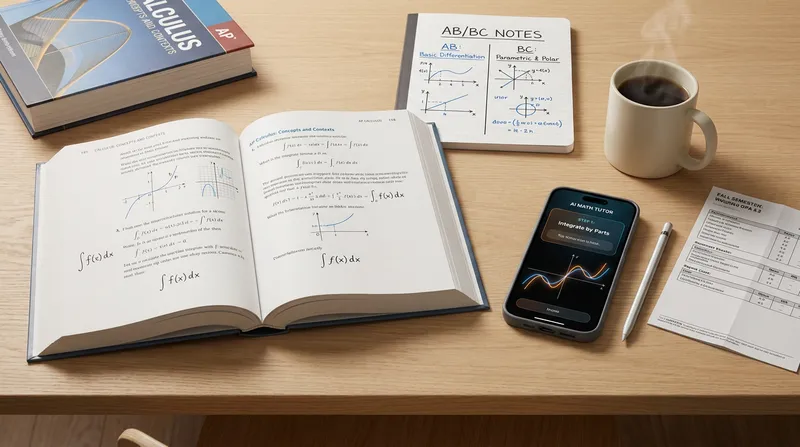
What is the Difference Between AP Calculus AB and BC?
To make an informed decision, you first need to understand how the College Board structures these two exams. While they share a name, their pacing and depth are significantly different.
According to the College Board, AP Calculus AB is designed to be the equivalent of a first-semester college calculus course. It covers the foundational concepts of calculus, including limits, derivatives, and basic integration. The pacing allows teachers to spend ample time on each topic, ensuring students build a strong conceptual understanding before moving forward.
AP Calculus BC, however, is the equivalent of both first and second-semester college calculus combined into a single academic year. It covers every single topic from the AB curriculum, plus highly advanced topics like:
- Parametric equations, polar coordinates, and vector-valued functions
- Advanced integration techniques (like integration by parts and partial fractions)
- Infinite sequences and series (including Taylor and Maclaurin series)
The biggest difference is not necessarily the difficulty of the math itself, but rather the speed at which it is taught. BC moves twice as fast as AB. Students must master complex concepts in half the time, which requires exceptional time management and independent study skills.
How Does AP Calculus Affect Your Weighted GPA and College Admissions?
One of the biggest sources of anxiety for families is the fear of ruining a perfect GPA. To understand why AP Calculus is so valuable, we have to break down how a weighted GPA actually works.
In a standard unweighted GPA system, an "A" in any class is worth 4.0 points, a "B" is worth 3.0 points, and so on. However, most high schools use a weighted GPA system to reward students for taking difficult classes. In a weighted system, an AP class receives an extra point. Therefore, an "A" in AP Calculus becomes a 5.0, and a "B" becomes a 4.0.
This means that getting a "B" in an incredibly difficult class like AP Calculus BC carries the same mathematical weight as getting an "A" in a standard math class. Colleges actively look for this. They want to see that students are willing to challenge themselves rather than taking the easy way out to protect a 4.0.
For students applying to competitive STEM majors (like engineering, computer science, or physics), taking AP Calculus BC is highly recommended. According to recommendations from MIT Admissions, elite engineering programs frequently expect applicants to challenge themselves with the highest level of math available at their high school.
However, it is worth weighing academic rigor against your child's overall wellbeing. If a student is staying up until 2 AM every night stressed over homework, the extra GPA point is simply not worth the cost of burnout. A strong, confident "A" in AP Calculus AB is vastly superior to a miserable, exhausted "C" in BC.
Will AP Calculus Earn You College Credit?
Beyond college admissions, AP exams offer a massive financial benefit: college credit. Scoring a 3, 4, or 5 on your AP exam can translate directly to college credits, potentially saving families thousands of dollars in college tuition.
AP Calculus AB typically grants credit for Calculus I. AP Calculus BC can grant credit for both Calculus I and Calculus II.
One of the most reassuring facts for students taking BC is the "AB subscore." When you take the BC exam, the College Board grades the entire test, but they also pull out the questions that overlap with the AB curriculum to generate a separate AB subscore. This means that even if a student completely bombs the advanced BC topics (like Taylor series), they can still earn a 4 or 5 on their AB subscore and receive college credit for Calculus I.
Always check specific university policies before making your final decision. While state schools often accept a score of 3 for credit, highly competitive private universities usually require a 4 or a 5.
The 2026 Guide to AI Study Strategies for AP Calculus
Artificial intelligence is fundamentally changing how students prepare for AP exams. The U.S. Department of Education has confirmed that AI is becoming an unavoidable part of the educational landscape, requiring structured guidance rather than prohibition.
The secret to success in 2026 is transitioning from using AI as a quick homework solver to using it as an interactive learning partner. Parents play a crucial role here by helping their teens set healthy boundaries with technology during study sessions.
If you want to explore the top tools available this year, check out our guide on the Best AI math solver apps: How AI tutors are replacing expensive math help.
Why Traditional Math Solvers Fail Advanced Students
For years, students have relied on basic photo-scanning math apps or crowdsourced forums to get through late-night homework. While these might work for basic algebra, they completely fall apart when faced with advanced calculus.
Basic scanners struggle with complex BC topics like series convergence tests or vector calculus because the visual notation is too dense. Furthermore, standard text-based AI models are notorious for "hallucinating" math. They will generate incredibly confident, beautifully formatted derivations that are fundamentally, structurally wrong.
Advanced students need specialized, step-by-step calculus solvers that verify answers and teach the underlying concepts. For a deeper dive into why community-driven answers are risky for high-stakes exams, read our post: Is Crowdsourced Homework Help Reliable? What Parents Need to Know About Verified Answers and AI Tutors.
How to Master Free Response Questions (FRQs) with an AI Tutor
The AP Calculus exam is split into two sections: Multiple Choice and Free Response Questions (FRQs). The FRQ section is where most students fail because it requires you to show your work, justify your reasoning in plain English, and apply theorems correctly.
This is where an AI tutor shines, provided you use it correctly. Research highlighted by Edutopia suggests that students who use AI merely to copy answers perform significantly worse on closed-book tests. However, students who use a prompted AI tutor with learning guardrails score much higher on practice sets.
Here are exact prompt templates you can use with an AI tutor like Tutor AI to master FRQs:
- For Concept Mastery: "Explain the Fundamental Theorem of Calculus to me using a real-world analogy about driving a car. Do not use complex jargon yet."
- For Error Checking: "I am going to upload a photo of my work for this related rates problem. Do not give me the final answer. Instead, point out the exact step where my logic went wrong and give me a hint on how to fix it."
- For FRQ Justifications: "In AP Calculus, how exactly do I need to phrase my justification for the First Derivative Test to get full points on an FRQ? Give me a template to memorize."
Ready to master FRQs? Download Tutor AI free on iOS and Android to get step-by-step guidance right on your smartphone.
By treating the AI as a teacher rather than an answer key, you build the deep conceptual understanding required to pass the closed-book exam. To learn more about this specific study method, explore The AI Feynman technique: How to use an AI tutor to master complex STEM homework.
A Stress-Free Roadmap for AP Calculus Exam Prep 2026
Cramming for AP Calculus does not work. The concepts build on each other too heavily. To protect your mental health and guarantee a passing score, you need a structured timeline.
Here is a month-by-month roadmap for your spring semester:
January and February: Foundation and Gap Filling Use these months to identify your weak spots. If you are struggling with the chain rule or integration by substitution, you must fix it now. Use Tutor AI to snap photos of your past failed quizzes and ask the AI to walk you through the correct steps.
March: International Practice and Stamina Building Begin incorporating rigorous practice exams into your weekends. To build resilience and expose yourself to different problem-solving formats, try using international exams. Read our guide on How to Ace AP & SAT Exams: Using HSC & VCE Trial Papers with a Step-by-Step AI Solver. Though these are Australian state exams, their calculus sections offer elite practice problems that perfectly prepare you for the hardest AP questions.
April: Full-Length Timed Tests and FRQ Rubrics Your focus should shift entirely to the clock. Take full-length, timed practice tests every Saturday morning. Spend your Sundays reviewing the exact College Board scoring rubrics for the FRQs. Use your AI tutor to grade your written responses against the official rubric.
Track Your Progress with Tutor AI Use Tutor AI's progress dashboard to identify which topics are costing you the most points on practice tests. Then, let the personalized learning path guide your review sessions to focus exactly where you need the most help.
May: Final Review and Rest In the two weeks before the exam, stop learning new material. Review your formula sheets, practice basic derivatives to keep your mind sharp, and prioritize sleep.
Conclusion: Making the Right Choice for Your Math Journey
Ultimately, the choice between AP Calculus AB and BC should be based on your current math foundation, your college goals, and the amount of time you can realistically dedicate to studying without sacrificing your well-being. Both courses are highly respected by colleges and offer fantastic opportunities for growth.
Remember that with the right study strategies and modern tools, any student can succeed in advanced math. You do not have to struggle through confusing homework assignments alone in the dark.
Ready to study smarter and reduce your homework stress? Download Tutor AI free on iOS and Android for 24/7 step-by-step calculus support. Snap a picture, solve the problem, and actually understand the math before exam day.
Frequently Asked Questions
Is it better to get an A in AP Calculus AB or a B in AP Calculus BC?
While colleges certainly love academic rigor and favor the BC track for STEM applicants, preserving a high GPA and protecting a student's mental health is equally important. A strong, confident "A" in AB is generally better than struggling immensely for a low "B" or "C" in BC, unless you are applying to highly competitive, top-tier engineering programs that explicitly require BC.
Can I take AP Calculus BC without taking AB first?
Yes, absolutely. The BC curriculum is designed to cover all the material from AB during the first semester. However, skipping AB requires a very strong foundation in Precalculus and a willingness to learn new, complex material at a highly accelerated pace.
How do colleges view AP Calculus for non-STEM majors?
Taking any AP Calculus course looks fantastic on a high school transcript for humanities, arts, or business majors. It shows academic bravery, strong analytical skills, and a willingness to challenge yourself. For non-STEM students, the AB track is usually more than sufficient to impress admissions officers.
Does the AP Calculus BC exam include an AB subscore?
Yes, it does. The College Board provides an AB subscore based on the AB-aligned questions embedded within the BC exam. This allows students to potentially earn college credit for Calculus I even if they struggle with the advanced BC-specific material on the test.
What is the best AI tool for AP Calculus exam prep?
We recommend avoiding basic photo-scanners that only provide final answers, as these will not prepare you for the closed-book AP exam. Instead, we recommend step-by-step solvers like Tutor AI that act as interactive tutors. These tools help students understand the "why" behind the math, which is critical for mastering the Free Response Questions.
Note: Every student learns differently. While these strategies are research-backed, results may vary. Adapt these techniques to fit your unique learning style and circumstances.
Disclaimer: This article provides general information and is not a substitute for professional medical or mental health advice. If you or your child are experiencing serious academic burnout or mental health concerns, please consult a qualified healthcare provider. For crisis support, contact the National Suicide Prevention Lifeline at 988.


