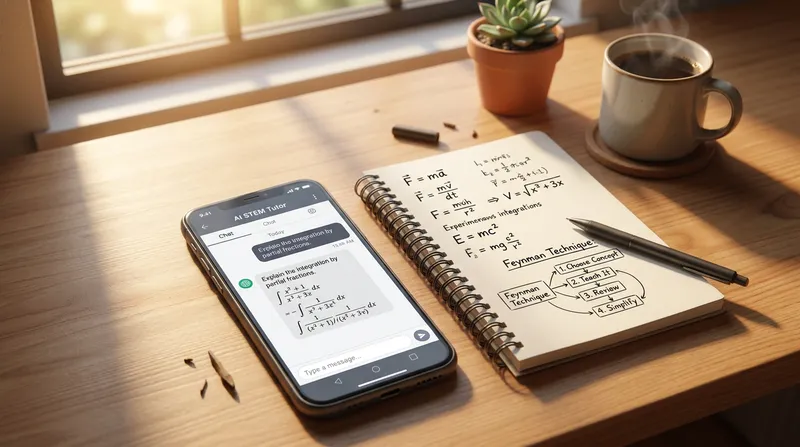
It is 11 PM on a Tuesday. Your child is staring blankly at a complex algebra worksheet, completely stuck. In a moment of frustration, they pull out their phone, snap a picture of the problem using a basic answer generator, copy down the final number, and go to sleep. Fast forward to the exam on Friday, and they fail the test.
Why does this happen so often?
For Parents: If you are managing a multi-child household, you know how quickly evening study sessions can turn into stressful battles. This guide will show you how to turn AI into a safe, patient tutor that builds your child's confidence and lightens your load.
Millions of students are using artificial intelligence to finish their homework quickly, but they are falling victim to the "Illusion of Competence." This is a psychological trap where a student believes they understand a complex STEM concept simply because an AI tool solved it for them. They have the answer, but they lack the underlying comprehension. When the test arrives, the safety net is gone, and the panic sets in.
If you want to stop the cycle of late-night homework battles and poor test scores, the solution is not to ban technology. Instead, the secret lies in combining modern technology with one of the most powerful learning frameworks ever created: the Feynman Technique.
By using an AI tutor for STEM as an interactive study buddy rather than a simple answer key, students can achieve deep comprehension. Let us explore exactly how to use the AI Feynman Technique to overcome STEM study struggles and build real academic confidence.
What is the Feynman Technique?
Named after the Nobel Prize-winning physicist Richard Feynman, this study method is built on a very simple premise: if you cannot explain a concept in simple terms, you do not truly understand it.
According to an authoritative guide from Fairmont State University, the Feynman Technique is a structured approach focusing on deep comprehension rather than surface-level memorization. It forces learners to break down complex ideas into plain language.
Traditionally, the technique involves four steps:
- Choose a concept to learn.
- Teach it to a child (or pretend to).
- Identify your knowledge gaps when you get stuck.
- Review the source material and simplify your explanation.
While this method is highly effective, it has one major flaw for modern students. When a student gets stuck at home, they often do not have an expert available to correct their mistakes or guide them through their knowledge gaps. This is exactly where an interactive AI study buddy comes in.
The Illusion of Competence: Why Traditional AI Tools Fail Students
Many popular homework apps act as simple transaction machines. You give them a math problem, and they give you the final answer.
This creates a massive problem for students. When the answer appears instantly, the brain skips the productive struggle required for actual learning. If you want to know Why a Basic Math Scanner App Isn't Enough: Finding an AI Math Solver That Actually Teaches, the answer comes down to cognitive scaffolding.
Research from Lehigh University highlights the importance of scaffolding in AI education. Their researchers found that AI learning systems are most effective when they adapt to provide scaffolding. This keeps the intellectual work on the student to promote actual learning rather than just providing a shortcut.
To master complex STEM homework, students must move away from passive reading and embrace active recall AI tools that challenge them to think.

The Reverse Tutor Method: Turning AI into a Listener
The most unique and powerful way to use ChatGPT for homework (or specialized apps like TutorAI) is to flip the script. Do not ask the AI to teach you. Instead, ask the AI to act as a confused student while you act as the teacher.
We call this the Reverse Tutor Method. By using a specific Feynman technique AI prompt, you force yourself to retrieve information from your brain, which is the core principle of active recall.
According to City University of New York (CUNY), Socratic prompting transforms AI from an "answer machine" into a tool for cultivating reasoning. It does this by asking progressive, thought-provoking questions that help learners clarify concepts and spot knowledge gaps.
Action Step: The next time you sit down to study, do not type "explain photosynthesis." Instead, type: "I am going to teach you about photosynthesis. Act like a 12-year-old student who has never heard of this before. Ask me one question at a time to test my understanding."
The 4 Steps to Mastery with the AI Feynman Technique
Ready to put this into practice? Here is the step-by-step guide to using an AI homework helper for deep comprehension.
Quick Reference: The 4 Steps
- Choose and study the concept.
- Teach it to the AI using Socratic prompts.
- Fill the gaps with AI feedback.
- Simplify and use spaced repetition.
Step 1: Choose and Study the Concept
First, identify the exact concept that is causing trouble. STEM subjects build on previous knowledge, so you must isolate the specific formula or theory you do not understand.
For example, if you are preparing for advanced placement exams, you can read our guide on How to Pass AP Statistics: Master Hypothesis Testing FRQs with an AI Math Solver. Review your textbook, class notes, or the step-by-step explanations provided by your AI tutor to get a baseline understanding.
Step 2: Teach it to the AI Using Socratic Prompts
This is where the magic happens. Use a carefully crafted prompt to initiate the Feynman Technique.
Copy and paste this exact Feynman technique AI prompt into your AI study buddy:
"I am trying to learn [Insert STEM Topic]. I want to use the Feynman Technique to master it. I will explain the concept to you in simple terms. Your job is to act as a beginner who knows nothing about this topic. If I use complex jargon, ask me to simplify it. If my explanation is confusing or incorrect, ask me Socratic questions to guide me to the right answer. Do not just give me the answer. Ask me one question at a time."
Pairing Generative AI with Socratic Questioning is highly effective. The National Institutes of Health (NIH) validates that using AI for Socratic questioning allows students to estimate their zone of proximal development. It guides them to formulate answers through logical reasoning rather than direct information retrieval.
Step 3: Fill the Gaps with AI Feedback
As you explain the concept, the AI will naturally point out where your logic breaks down. When you hit a wall, you have found your knowledge gap.
At this point, you can switch the AI back to "tutor mode" and ask it to explain the specific missing piece. For instance, you can use this follow-up prompt: "I am stuck on this step. Please switch back to tutor mode and explain what I am missing in one simple paragraph."
If you are struggling with a complex physics problem, taking a photo with an AI solver will provide a detailed breakdown of the exact step where you got lost. For more on this, check out our post on Can AI Do My Science Homework? How to Use Step-by-Step Solvers for Real Learning.
Step 4: Simplify and Use Spaced Repetition
Once you have successfully explained the concept to the AI without getting stuck, it is time to lock that information into your long-term memory.
Ask the AI to act as an AI flashcard generator and create study questions based on the topic you just mastered. You will then review these questions over the next few days and weeks.
According to Birmingham City University, spaced repetition is based on the forgetting curve and has been scientifically proven to significantly improve learning and reduce the total time spent studying compared to cramming.
Best AI Study Tools for Students and Parents
Not all AI tools are created equal. When looking for the best AI study tools for students, you need platforms that prioritize deep comprehension study methods over quick answers.
Look for tools that offer step-by-step explanations, Socratic prompting, and progress tracking for parents. TutorAI was built specifically with this educational philosophy in mind. When a student snaps a photo of a math problem, TutorAI does not just spit out a number. It provides a comprehensive, step-by-step explanation that breaks down the reasoning behind each phase of the solution. This aligns perfectly with the Feynman Technique, giving students the foundational knowledge they need to teach the concept back.
If you want to see how personalized learning paths are changing the educational landscape, read our comprehensive guide on the Best AI math solver apps.
[Download TutorAI Today to Experience Learning-Focused AI]
Overcoming STEM Study Struggles and Math Anxiety
For many parents, watching a child struggle with math or science is heartbreaking. Math anxiety is a very real condition that can cause students to freeze up during tests, completely forgetting what they studied.
Note: Math anxiety is a real condition. If your child's anxiety significantly impacts their daily life or wellbeing, please consult a qualified healthcare provider or contact the 988 Suicide & Crisis Lifeline.
Traditional tutoring is expensive and often requires scheduling days in advance. Furthermore, generic crowdsourced answers can be inaccurate. The beauty of an AI tutor for STEM is that it provides a completely judgment-free learning environment. A student can ask an AI to explain a basic fraction ten times in a row, and the AI will never get frustrated or impatient.
This is particularly helpful for neurodivergent learners. As detailed in our article on AI Math Help for ADHD & Dyscalculia: Why Traditional Solvers Fail (And What Actually Works), the ability to break problems into micro-steps and use conversational AI reduces cognitive overload.
Parents can use TutorAI's progress tracking features to monitor their child's daily practice. Instead of fighting over unfinished worksheets, parents can look at the dashboard, see the exact topics causing friction, and celebrate the milestones their child achieves.
Preparing for High-Stakes Exams
The AI Feynman Technique is not just for daily homework. It is a game-changing strategy for standardized test preparation.
When preparing for the SAT, ACT, or AP exams, students face a massive volume of complex information. Rote memorization will not work for these tests, as they are designed to evaluate critical thinking and applied logic.
To build stamina for these exams, students should combine active recall with realistic practice environments. You can learn more about this in The Weekend Digital SAT Mock Test Strategy: How to Build Stamina with Full Practice Tests.
When reviewing your incorrect answers from mock tests, use the Reverse Tutor Method. Explain to the AI why you chose the wrong answer, and let it guide you to the correct logical path.
Frequently Asked Questions
What is the Illusion of Competence in studying?
The Illusion of Competence occurs when you confuse recognizing information with actually understanding it. When an AI or calculator solves a problem for you, your brain recognizes the correct steps and tricks you into thinking you can replicate them, which often leads to blanking out during exams.
How do I use ChatGPT for the Feynman technique?
To use ChatGPT for the Feynman Technique, you must use reverse-prompting. Do not ask the AI to explain a topic to you. Instead, tell the AI to act as a beginner, and type out your own explanation of the topic. Ask the AI to point out any confusing parts or knowledge gaps in your explanation.
What is the best AI prompt for active recall?
The best active recall AI prompt focuses on Socratic questioning. Try this: "Test my knowledge on [Topic]. Ask me one open-ended question at a time. Wait for my answer before providing feedback. If I am wrong, give me a hint instead of the direct answer."
Can the Feynman Technique be used for subjects other than STEM?
Absolutely. While highly effective for math and science, the Feynman Technique works perfectly for history, literature, and social sciences. Explaining the causes of a historical event in simple terms is a great way to ensure deep comprehension and retention.
How do I know if an AI math solver is accurate?
While basic AI chatbots can hallucinate math answers, dedicated AI math solvers like TutorAI use specialized computational engines and step-by-step verification to ensure accuracy. Always review the step-by-step breakdown rather than just copying the final number to verify the logic.
Is it safe for my child to use AI for homework?
Yes, provided they are using educational AI tools designed for learning, not just answer generation. Apps like TutorAI include guardrails, focus on step-by-step comprehension, and offer parent dashboards to monitor progress and ensure the tool is used constructively.
At what age should students start using AI study tools?
Middle school (ages 11 to 13) is an ideal time to introduce AI study tools under parent supervision. At this stage, students are tackling more abstract STEM concepts like algebra and can learn how to use AI as a Socratic tutor rather than a shortcut.
How can I use an AI tutor without cheating?
Using an AI tutor becomes cheating when you submit the AI's direct output as your own work without understanding it. To use it ethically, treat the AI like a human teacher. Ask for step-by-step explanations, request practice problems, and use the Feynman Technique to ensure you can solve similar problems on your own.
Can AI help my child overcome math anxiety?
Yes. AI provides a private, judgment-free zone where students can ask "silly" questions without fear of embarrassment. Tools like TutorAI break intimidating problems into small, manageable steps, which helps reduce the overwhelming feeling associated with math anxiety.
Conclusion: Study Smarter, Not Harder
The days of staring blankly at a textbook and hoping the information sticks are over. By combining the timeless wisdom of the Feynman Technique with the incredible power of modern AI, students can finally break free from the Illusion of Competence.
Remember, the goal of homework is not just to get it done. The goal is to learn. By using the Reverse Tutor Method, Socratic questioning, and spaced repetition, you can transform study time from a frustrating chore into an engaging, interactive experience.
Ready to get unstuck and learn for real? [Download TutorAI Today] With our 24/7 photo-based problem solving and detailed step-by-step explanations, you will have the perfect study buddy to help you master even the toughest STEM subjects.
Note: Every student learns differently. While these strategies are research-backed, results may vary. Adapt these techniques to fit your unique learning style and circumstances.


