
The Late Night Math Meltdown: Why Basic Scanner Apps Fall Short
It is 11 PM on a Tuesday. Your teenager is staring blankly at an algebra worksheet, and the frustration in the room is palpable. You desperately want to help, but modern math curriculums look like a completely foreign language compared to how you learned it. In a moment of sheer exhaustion, you both reach for a math solver app to just get the assignment done.
While finding the best math scanner app might feel like a lifeline in the moment, it often creates a much deeper anxiety for parents. You are likely terrified that letting your child use a simple answer-only scanner app means they are just blindly copying answers. Sure, the homework gets turned in, but what happens when they sit down for a proctored, high-stakes exam? If they have not actually learned the material, those instant answers will inevitably lead to failing test grades.
This is a common struggle for families across the country. Getting an instant answer might finish the immediate assignment, but it leaves the student completely unprepared for future tests. If you have ever experienced The 11 PM Crisis: Finding a Math Homework Help App (That Actually Shows Steps), you know that a basic tool is not enough. You need a platform that transitions from just handing over the final number to actually teaching the underlying concepts.
Actionable Tip for Parents: Tonight, before the frustration peaks, acknowledge the difficulty of the assignment. Tell your child, "I know this is tough, and we are going to use a tool to help us understand it, not just to skip the work." Setting this expectation early changes the entire dynamic of the homework session.
The Big Debate: Is Using a Math Solver Cheating?
Whenever educational technology is discussed, the first question parents and teachers ask is whether using a math photo solver is essentially cheating. It is a valid concern that deserves to be addressed head-on, without judgment.
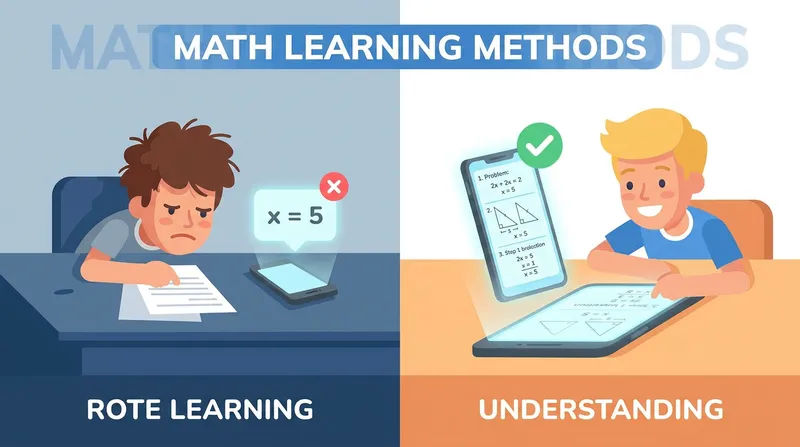
The answer depends entirely on the tool you choose and how your student uses it. There is a massive difference between using an app as a quick answer key (which is cheating) and using it as a 24/7 digital tutor (which is active learning).
Recent academic research highlights this exact divide. According to research published in the Proceedings of the National Academy of Sciences (PNAS), students who used an unrestricted AI interface performed 17 percent worse on subsequent tests when access was removed. However, the exact same study found that when AI is configured as a tutor with educational safeguards (like teacher-designed hints), it actually preserves human learning and improves outcomes.
When you use an app that only provides the final solution, students bypass the learning process. But when you use an educational AI platform that focuses on the "why" behind the answer, you are providing your child with personalized, on-demand academic support.
Actionable Tip for Parents: Reframe the conversation around technology. Instead of asking your child if they used an app to get the answer, ask them to use the app to explain the steps to you. If they can walk you through the process, they are learning. If they cannot, they need to review the step-by-step breakdown again.
The Psychology of Math: Why Students Need Friction to Learn
To truly master mathematics, the brain requires something educators call "productive struggle." This is the psychological friction that happens when a student wrestles with a difficult concept, makes a mistake, and eventually figures out the correct path.
Instant gratification from a basic math equation scanner eliminates this necessary friction. Experts highlighted in Science News Explores note that while AI is often designed to make tasks effortless, true learning requires working through difficult concepts before consulting an automated tool.
This is where an AI math solver designed for education shines. Instead of removing the friction entirely, a high-quality step-by-step math solver guides students through it. By utilizing a hint-based format, a true educational AI does not reveal the next step until the student has attempted it. This preserves the necessary productive struggle while reducing overwhelming math anxiety by breaking complex problems into logical, bite-sized pieces.
Actionable Tip for Students: Practice the "Five Minute Rule." When you get stuck on a problem, try to solve it on your own for five solid minutes. Write down your thought process. Only after those five minutes of productive struggle should you scan the problem to see the next step.
Homework Helper App vs. AI Math Tutor: Spotting the Difference
With so many apps on the market, it is crucial to understand the difference between a basic OCR calculator app (often used as a Photomath alternative) and a true AI educational platform.
A standard homework helper app uses basic optical character recognition to read an equation and spit out a number. These tools lack pedagogical guardrails. A study highlighted by Edutopia found that when students use AI without strict educational boundaries, they frequently ask for final answers but rarely check their understanding, leading to a significant drop in post-test scores.
Conversely, a true AI math tutor is built on the Socratic method. It does not just hand over the answer. It highlights the key formulas used, explains the reasoning behind each jump in logic, and tracks student progress to identify weak spots. If you are unsure which category your current app falls into, our guide on Homework Helper App vs. AI Tutor: Which Is Best for Your Student? breaks down exactly what to look for.
Tackling the Dreaded Math Word Problem
One of the most obvious places where basic calculators fail is with word problems. A standard app simply cannot comprehend a paragraph about two trains leaving a station at different speeds.
This is where advanced technology becomes indispensable. An AI math word problem solver can read the text, identify the core variables, and teach the student how to translate English sentences into actionable math equations. It bridges the gap between reading comprehension and mathematical logic.
If your student routinely panics when they see a paragraph of text on their math worksheet, learning Why your child freezes on math word problems (and how an AI math word problem solver helps) can completely change their approach to homework.
Actionable Tip for Students: Before scanning a word problem, underline the numbers and highlight the action words (like "total", "difference", or "product"). Then, use the AI tutor to see if your translation matches the correct equation setup.
The Parent Playbook: How to Use a Math Homework Helper at Home
Technology is only as effective as the boundaries set around it. Parents play a vital role in ensuring a math homework scanner is used for good. You do not need to know calculus to help your child, you just need to manage the process.
Experimental evidence from Stanford University demonstrates that an interactive, step-by-step AI math tutor can significantly improve student performance, resulting in an effect size equivalent to an extra year of learning. But this growth happens when the tool is used collaboratively.
Here is a simple, effective routine for using a math homework helper at home:
- The Paper First Rule: The student must attempt the problem on a physical scratchpad first. No phones allowed during the initial attempt.
- The Verification Scan: Once an answer is reached, the student uses the app to check their work.
- The Step-by-Step Review: If the answer is incorrect, parent and child look at the step-by-step breakdown together to find exactly where the error occurred.
By following this routine, you remove the temptation to cheat while still providing a safety net. For more strategies on co-piloting these study sessions, check out How to Help Your Child With Math Homework Using a Scanner App (Without Cheating).
Actionable Tip for Parents: Set up a "Homework Tech Zone" in a common area of the house (like the kitchen table or living room). Using apps in plain sight naturally discourages blind copying and encourages open questions.
Checklist: Finding the Best Math Scanner App for Your Family
Ready to transition from stressful homework battles to moments of real confidence building? Not every camera math solver is created equal. Use this checklist to evaluate any math picture solver before letting your child use it for their daily assignments.
- Does it show the steps? It must provide a detailed breakdown, not just the final number.
- Can it read handwriting? The app needs advanced OCR to understand messy middle school handwriting.
- Does it explain the "Why"? Look for tools that highlight formulas and explain the logic behind the math.
- Can it handle word problems? A true AI tutor will help translate text into equations.
- Does it offer progress tracking? Parents should be able to see which topics their child is struggling with over time.
- Does it work offline? Help should be available even without Wi-Fi.
- Does it adapt? Look for personalized learning paths that adapt to your child's specific weak spots.
If you want a deeper dive into evaluating these features, read our guide on AI Math Tutor vs. Math Problem Solver AI: Which Tool Does Your Child Actually Need?
From Frustration to Confidence
Finding the right math homework helper does not have to be a stressful trial-and-error process. As we have seen, relying on a simple answer-only scanner app often bypasses the learning process, leaving students unprepared for exams. However, an educational AI platform builds true understanding through step-by-step guidance, preserving the productive struggle that is essential for mastering math.
At Tutor AI, our philosophy is simple: Snap. Solve. Learn. We believe that with the right collaborative approach, any student can overcome math anxiety and build lasting academic confidence.
Actionable Tip for Families: Download Tutor AI today and test it out together. Take a photo of a problem you both find confusing, and read through the explanation side by side. Showing your child that you are learning alongside them is one of the most powerful ways to build their confidence.
Frequently Asked Questions
What is the best alternative to Photomath for high school students?
We recommend looking for an AI math solver that prioritizes step-by-step explanations and Socratic questioning rather than just giving the final answer. Tools like Tutor AI ensure the student actually learns the underlying concept, which is critical for high school level exams.
Is using a math photo solver considered cheating by teachers?
It depends entirely on how the tool is used. Copying the final answer to skip doing the work is considered cheating. However, using an AI math solver to check your work, find mistakes, and understand the steps is equivalent to having a private tutor and is widely encouraged for active learning.
Can an AI math solver help with complex word problems?
Yes. While basic calculators only compute numbers, an AI math word problem solver can read the text, identify the core variables, and teach the student how to set up the equation properly from scratch.
How can parents prevent their kids from just copying answers from apps?
Set clear household rules: students must show their scratchpad work first. The app should only be used to verify answers or to get hints when they are completely stuck. Keeping homework sessions in a shared family space also helps enforce these boundaries.
Do math homework scanners actually improve test scores?
Yes, provided they are used correctly. Academic research indicates that when an AI math tutor is used interactively with educational guardrails, like step-by-step breakdowns, it can significantly improve student comprehension and actual proctored test performance.
Note: Every student learns differently. While these strategies are research-backed, results may vary. Adapt these techniques to fit your unique learning style and circumstances.


