We have all been there: it is 11 PM on a Tuesday, your teenager is staring blankly at a complex algebra assignment, and the frustration in the room is palpable. As a parent, you want to help, but it has been years since you looked at polynomials or quadratic equations. In moments like this, students just want an immediate answer to get the assignment over with. Meanwhile, parents and teachers are terrified that using technology will lead to cheating and a complete bypass of actual learning.
This is the core pain point modern families face. How do you bridge the gap between providing instant academic relief and ensuring your child actually comprehends the material?
The answer lies in understanding the crucial differences between a basic AI homework solver and a comprehensive AI tutoring platform. In this guide, we will break down exactly what these tools do, how they impact your child's education, and how to choose the best AI tutor for students who need extra help.

What is an AI Homework Helper?
An AI homework helper, often packaged as a homework scanner app, is a digital tool designed to provide rapid answers to specific academic questions. If your child has ever used an app where they snap a photo of a worksheet and receive an instant answer, they have used a homework helper.
These applications are incredibly popular for a reason. They offer immediate gratification and can serve as a highly effective step-by-step math solver when a student is completely stuck. Tools in this category excel at reading complex equations through optical character recognition (OCR) and spitting out the final number.
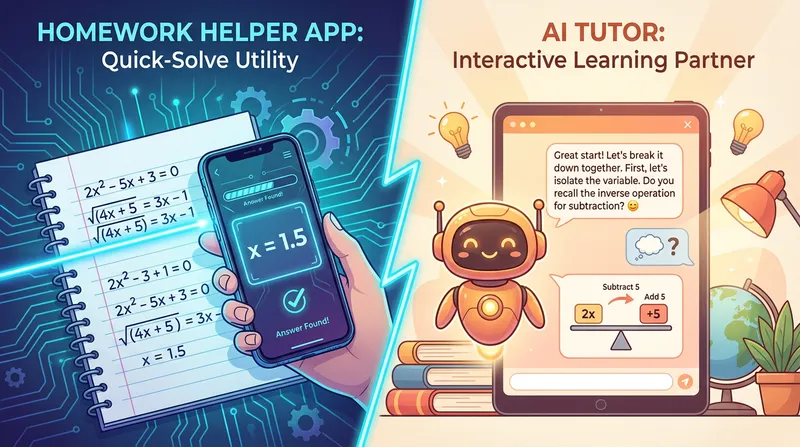
However, the primary weakness of a standard homework helper is its pedagogical depth. These apps act more like advanced calculators than educators. They do not ask questions, they do not check for understanding, and they do not adapt to a student's unique learning style. For parents, this creates a "black box" effect where you have no idea if your child actually learned the concept.
Actionable Tip for Parents: If your child uses a basic homework scanner app, require them to explain the final answer back to you. If they cannot articulate how the app arrived at the solution, they are likely just copying the work. For more insights on this dynamic, read our guide on The 11 PM Crisis: Finding a Math Homework Help App (That Actually Shows Steps) | Tutor AI Blog.
How AI Tutors are Changing Education
Unlike a simple solver, an AI tutor app is designed to replicate the experience of working with a human teacher. Instead of just giving the answer, an AI learning assistant focuses on the process of discovery. This shift represents a massive leap forward in educational technology.
A true Socratic AI tutor uses conversational prompts to guide students toward the answer, rather than handing it to them on a silver platter. According to research from the Brookings Institution, tutoring platforms that use generative AI can match the success of human tutoring when they employ a "teach, not tell" approach. This Socratic method guides students to identify their own mistakes and builds critical thinking skills.
When a student inputs a problem into an AI tutoring platform, the system might respond by asking, "What do you think the first step should be?" or "Can you identify the formula we need for this geometry problem?" This active engagement forces the brain to work, turning a passive copying exercise into an active learning session.
Actionable Tip for Students: When using an AI study buddy, do not just accept the first answer it gives you. Ask follow-up questions like, "Why did you use that specific formula?" or "Can you explain this to me like I am a beginner?" This conversational approach maximizes your learning retention.
The Core Difference: Spoon-Feeding vs. True Comprehension
The most significant gap in the current ed-tech landscape is the failure to distinguish between solving a problem and tutoring a student. The "Teach Me, Do Not Tell Me" approach is what separates a mediocre tool from the best AI tutor for students. Spoon-feeding answers creates a false sense of competence that leads to failed in-class exams.
True comprehension requires productive struggle and cognitive engagement. An effective AI learning assistant provides personalized AI learning paths that recognize when a student is struggling with a core foundational concept. Instead of just solving the current homework problem, the AI will pause and offer foundational practice exercises to close the knowledge gap.
To dive deeper into this distinction, check out our breakdown in AI Math Tutor vs. Math Problem Solver AI: Which Tool Does Your Child Actually Need? | Tutor AI Blog.
Actionable Tip for Teachers and Tutors: Encourage your students to use AI tools that mandate step-by-step breakdowns. Ask students to submit their AI chat logs alongside their homework to ensure they engaged in a meaningful dialogue with the technology.
Features to Look for in an AI Study Buddy
With so many options on the market, it can be overwhelming to choose the right platform. If you want a tool that actually supports academic growth, here are the non-negotiable features you need to look for:
1. Step-by-Step Explanations
The app must break down complex problems into logical, digestible steps. It should explain the reasoning behind each mathematical operation or scientific theory.
2. Personalized Learning Paths
The best platforms analyze a student's performance over time. They identify weak spots and adapt the difficulty level accordingly to ensure continuous growth.
3. Comprehensive Multi-Subject Support
While math is a common pain point, a robust tool should also support science and other core STEM subjects. This prevents families from needing multiple app subscriptions.
4. Curriculum-Aligned Daily Practice
Look for apps that offer daily practice challenges. These exercises reinforce core concepts and align with standard middle and high school curriculums.
5. 24/7 Availability with Offline Modes
Homework crises do not adhere to a schedule. Your chosen tool should be accessible whenever the student needs help, even if the internet connection is spotty.
6. Parental Dashboards
You need visibility into your child's learning. A robust platform provides progress tracking, showing you exactly which topics your child has mastered and where they need support.
7. Affordability and Value
At a fraction of the cost of private tutoring, AI platforms make personalized academic support accessible to more families. It is a highly cost-effective way to boost your teen's confidence.
It is also crucial to remember that technology alone is not a magic wand. A recent study by Stanford University found that merely offering AI tutoring tools to students is not enough. Active participation from parents and teachers is essential to keep students engaged.
Actionable Tip for Parents: Schedule a weekly 10-minute check-in with your child to review their app dashboard. Celebrate their learning streaks and discuss any topics where the app indicates they are struggling. You can learn more about this in The 'Black Box' of Homework Apps: Why Parents Need Dashboards | Tutor AI Blog.
What to Look for in a Step-by-Step Math App (And How TutorAI Fits)
When evaluating the landscape of educational apps, you will find a wide spectrum of functionality. Some platforms focus heavily on community-driven answers, which can sometimes be inaccurate or confusing. Others focus purely on rapid text generation, which is great for brainstorming but poor for learning factual math concepts.
Many students rely on a basic homework scanner app because it removes the friction of typing out long, complicated equations. However, the ideal solution is a hybrid approach. Students need the friction-free experience of a photo scanner combined with the pedagogical depth of a Socratic AI tutor.
This is exactly where TutorAI shines. Built on the philosophy of "Snap. Solve. Learn," TutorAI allows students to take a photo of any problem and receive instant, highly detailed step-by-step solutions. It does not just act as a calculator; it highlights key concepts, offers multiple solution methods, and tracks accuracy by topic.
If your teen is preparing for big exams, they need a tool that builds real confidence. Discover practical strategies in 5 Ways to Use a Free AI Math Solver to Boost Your Teen's Math Confidence Before Finals | Tutor AI Blog.
Actionable Tip for Students: Next time you are stuck on a math problem, snap a picture of it, but cover the final answer on your screen. Read through the first two steps provided by the AI, and then try to finish the rest of the problem on your own paper before checking the final result.
Is AI Safe for Students? A Parent-First Perspective
The primary concern for parents evaluating safe AI for students is academic integrity. Is this tool going to help my child learn, or is it just going to help them cheat?
Research from Instructure shows that 73 percent of parents say their child uses AI at least occasionally. However, parents and educators widely agree that the role of AI should be strictly defined for support tasks, such as explaining difficult concepts, rather than making final academic decisions.
Furthermore, the National Education Association (NEA) emphasizes that AI tools should only be adopted when there is data supporting their efficacy and alignment with high-quality teaching standards. Technology should never displace the human connection between a student and their educators or parents.
To ensure safety and integrity, parents should look for platforms that offer age-appropriate content filtering, secure data encryption, and strict privacy controls. A true AI tutoring platform will actively discourage cheating. For example, STEM-focused apps like TutorAI refuse to write essays from scratch, offering instead conceptual math and science explanations.
Actionable Tip for Families: Draft a "Technology Honor Code" at home. Agree that AI tools will be used for brainstorming, understanding complex topics, and checking completed work, but never for generating final assignments to be turned in as original work.
Curious about how teachers view these tools? Read our article on Can Teachers Tell You Used Photomath? How to Show Math Work Authentically | Tutor AI Blog.
Frequently Asked Questions
Is using an AI homework solver considered cheating?
It depends entirely on the application and the student's intent. If a student uses a basic homework scanner app to generate a final answer and copies it without attempting to understand the process, it crosses the line into cheating. However, when students use an AI study buddy to receive step-by-step explanations, identify where they made a mistake, and practice similar problems, it functions as a highly effective study tool that supports academic integrity.
What is the difference between an AI tutor and a regular homework app?
A regular homework app acts like a digital calculator: you put a problem in, and it spits an answer out. An AI tutor app acts like a human teacher. It uses Socratic questioning to guide students toward the answer, adapts to their specific learning style, provides personalized practice paths, and tracks their progress over time to ensure comprehension.
Which AI learning assistant is safest for middle school students?
The safest AI learning assistants are purpose-built for education, meaning they do not allow open-ended web browsing or unfiltered content generation. Parents should look for platforms like TutorAI that feature strict data privacy policies, age-appropriate content filters, and dedicated parent dashboards that allow families to monitor usage securely.
Can an AI tutor help with step-by-step math problems?
Absolutely. The best AI tutors are equipped with advanced Optical Character Recognition (OCR) technology. This allows students to take a photo of complex, handwritten math equations and receive a detailed, step-by-step breakdown of the solution. This visual, structured approach helps students understand the "why" behind each mathematical operation.
Are there good alternatives to Khanmigo or ChatGPT for students?
Yes, there are several specialized alternatives. While ChatGPT is a general-purpose tool that can sometimes hallucinate incorrect math answers, dedicated educational apps offer an excellent middle ground. They provide instant photo-based problem solving, highly accurate math and science explanations, and user-friendly interfaces designed specifically for middle and high school students.
How can parents monitor their child's use of an AI study buddy?
Top-tier AI tutoring platforms include built-in tracking features specifically for parents. Through a parent dashboard, you can view progress reports, monitor the amount of time spent studying, identify which subjects your child is struggling with, and see their accuracy rates. Setting up a weekly 10-minute review of this dashboard with your child is the best way to stay involved.
Conclusion: Making the Right Choice for Your Child
Navigating the world of educational technology does not have to be a source of stress for your family. While a basic AI homework solver might offer a quick fix for a late-night study crisis, it falls short when it comes to building long-term academic confidence.
The best AI tutor for students is one that combines the speed and convenience of a homework scanner app with the deep, personalized instruction of a human educator. By prioritizing platforms that offer step-by-step explanations, Socratic teaching methods, and transparent progress tracking for parents, you can transform homework time from a nightly battle into a genuine opportunity for growth.
Remember, the goal is not just to get the assignment done. The goal is to empower your child to learn independently, understand deeply, and succeed confidently.
Ready to experience the difference a true AI study buddy can make? Download TutorAI today from the iOS App Store or Google Play, and see how our "Snap. Solve. Learn." approach can eliminate homework stress and boost your child's grades.
Disclaimer: This article provides general information and is not a substitute for professional educational advice. Every student learns differently. Adapt these strategies to fit your unique learning style and circumstances.