
Every evening, millions of students retreat to their bedrooms, close the door, and open their laptops to do homework. As a parent, you want to trust that they are learning. But when you ask how it is going, you get the standard teenage response: "I am almost done."
This is the "black box" of modern education. Parents are paying for digital learning tools and monthly subscriptions, but they have zero visibility into whether their child is actually learning the material or simply copying answers to finish homework faster.
Quick Summary:
- The Problem: Many popular homework apps act as answer keys, not true tutors.
- The Solution: Educational platforms with a parent dashboard provide visibility into actual learning.
- Key Features to Look For: Step-by-step explanations, 24/7 offline availability, and progress tracking.
If you are searching for homework help apps for parents, you are likely feeling this exact frustration. You might be wondering, is Brainly safe for kids? Does Brainly actually teach? Or maybe you are looking for a reliable Chegg alternative for parents that offers actual transparency and 24/7 offline support for those late-night study sessions.
In this guide, we will unpack why popular platforms often act as cheat sheets rather than educational tools, and why educational apps with parent portals are the missing link to your child's academic success.
The "Black Box" Problem with Digital Homework
When you hire an in-person tutor, you get a progress report at the end of the session. You know what your child struggled with, what they mastered, and what needs more work. Digital homework apps have completely removed this vital feedback loop.
Parents feel immense pressure over managing screen time, especially when schools require online homework completion without providing adequate monitoring tools. According to Education Week, parents are struggling to manage this digital burden alone.
When kids are left alone with an app that provides instant answers, the temptation to take shortcuts is high. The core issue is not that students are inherently lazy. It is that students and faculty often do not share a similar definition of what constitutes "cheating", as highlighted by the American Psychological Association (APA). A student might think copying an answer is just "getting help", while a teacher (and a parent) knows it bypasses the learning process.
To solve this, parents need a parent dashboard for student progress. Without it, you are paying for a black box.
Is Brainly Safe for Kids? (And Does It Actually Teach?)
Brainly is one of the most popular homework platforms in the world. It uses a gamified, community-driven Q&A format where students answer each other's questions to earn points. While the free tier attracts millions of students, parents need to ask some hard questions about its safety and educational value.
The Danger of Unmoderated Peer Answers
Because Brainly relies heavily on community answers, the accuracy of the information is a major gamble. A middle schooler struggling with algebra might receive an answer from another middle schooler who is equally confused.
Furthermore, the platform's social nature raises safety concerns. Any platform that allows unmoderated peer-to-peer interactions carries risks. While Brainly has filters, the primary focus is not on structured, safe, step-by-step tutoring.
So, does Brainly actually teach? Rarely. It provides answers. It does not adapt to your child's learning style, it does not identify weak spots, and it certainly does not provide apps to monitor grades and assignments. It is an answer engine, not a tutor.
The Chegg Dilemma: Paying for a Cheat Sheet?
Chegg has massive brand recognition among high school and college students. It boasts a massive database of textbook solutions and expert Q&A. However, it is also widely known as a hub for academic dishonesty.
The Financial Angle for Parents
Here is the harsh reality for parents: you are likely the one paying the expensive monthly subscription for Chegg. But what are you actually buying?
Chegg does not offer a dedicated parent dashboard to monitor learning progress. There is no transparency for the payer. If your child is failing their exams despite finishing their homework every night, they might just be copying textbook solutions word-for-word.
Research from Stanford Graduate School of Education shows that 60 to 70 percent of students report at least one cheating behavior in a given month, and that this rate has stayed about the same or even decreased slightly since AI chatbots became widely available. The issue is not the technology itself, but the lack of boundaries and visibility. If you want to stop kids copying homework answers, you need a platform that refuses to give just the final answer. You need a Chegg alternative for parents that prioritizes the learning journey.
Apps That Explain Homework Step by Step
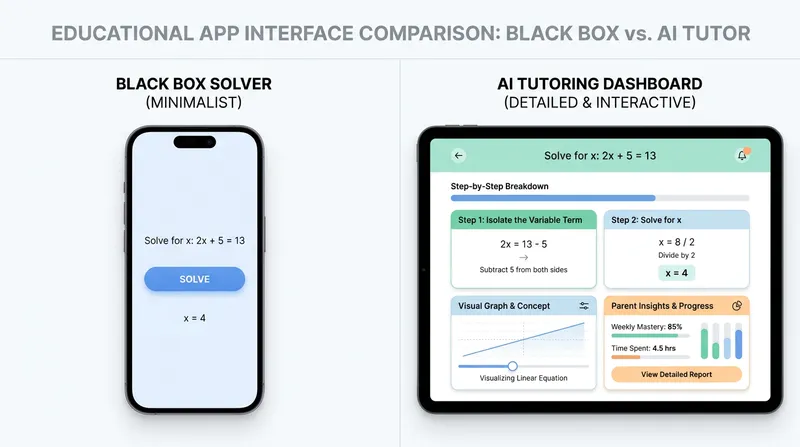
Many parents and students turn to specific solver apps to get unstuck. Let us look at a few heavy hitters in the industry.
Photomath and Mathway: Great Calculators, Poor Tutors
Photomath offers excellent optical character recognition (OCR) for scanning handwritten math. It is a great tool for parents to check their child's completed work. Mathway functions similarly, solving highly complex math problems instantly.
However, both have fatal flaws for parents who want their kids to learn. Mathway often paywalls the step-by-step explanations, giving free users only the final answer. Photomath is strictly limited to math, and neither app offers account linking or a parent portal. There is no way to track what your child is struggling with over time. They function more as calculators than educational tutors.
If you want to know how to use an AI calculus solver to ace AP Calculus, you need an app that forces the student to read and understand the steps.
Caktus AI: Built for Students, Not for Learning
Caktus AI is an artificial intelligence platform designed to write essays, translate languages, and generate code. It is highly appealing to students looking for fast content creation. But it has zero focus on parents or educators. It is highly susceptible to being used as an essay-writing cheat tool, and it completely lacks the step-by-step tutoring methodology required to ensure the student actually learns the material.
According to research from Northern Michigan University, generative AI is frequently used to provide direct answers to homework problems, allowing students to submit assignments without engaging with the content meaningfully.
The Missing Link in Homework Tech
When we look at platforms like Brainly, Chegg, and Photomath, a clear pattern emerges. They lack a parent dashboard, they prioritize final answers over the learning process, and they offer zero personalization. While apps like Photomath are incredible pieces of technology, they can create a false sense of mastery. A student might scan ten algebra problems, write down the answers, and feel like they finished their work. But when Friday's quiz arrives, they freeze. They never learned the underlying concepts.
This is exactly why parents need a platform that bridges the gap between getting the right answer and actually understanding the mathematical principles behind it.
What is the Best Chegg Alternative for Parents?
The core difference between an answer engine and an AI tutor is the methodology. An answer engine gives you the final number. A true educational platform guides you to the final number.
Built on the philosophy of "Snap. Solve. Learn.", Tutor AI was designed from the ground up to solve this exact problem. It is not just about getting the homework done; it is about building long-term academic confidence.
Feature Comparison: Chegg vs. A True AI Tutor
| Feature | Chegg | Tutor AI |
|---|---|---|
| Parent Dashboard | No | Yes |
| Step-by-Step Explanations | Often Paywalled | Included |
| Personalized Learning | No | Yes |
| 24/7 Offline Availability | No | Yes |
Features of a True Parent Homework Tracking App
If you are looking for safe homework apps for high school, here is what a proper parent dashboard should include:
- Progress Reports: Detailed insights into your child's learning over time. You should be able to see a clear timeline of their study sessions.
- Weak Spot Identification: See exactly which concepts (like fractions, quadratic equations, or stoichiometry) your child needs support with. This allows you to intervene before a bad grade happens.
- Activity Monitoring: Track daily engagement and study time. Know the difference between ten minutes of rushing and an hour of focused studying.
- Achievement Notifications: Celebrate milestones and stay informed. Positive reinforcement is crucial for building academic confidence.
- Historical Data Tracking: Compare performance metrics month over month to ensure long-term retention of the material.
With a dedicated dashboard, you are no longer in the dark. You can have informed, data-driven conversations with your child about their academics without the usual homework battles.
How to Monitor Your Child's Homework (Without Micromanaging)
Parents want to know how to monitor a child's homework without hovering over their shoulder and causing anxiety. Here are actionable tips to bridge the gap between independence and oversight:
- Set Clear Expectations: Sit down with your child and explain that homework time is about learning, not just finishing.
- Equip Them with the Right Tools: Instead of trying to relearn trigonometry yourself, provide them with a platform that offers 24/7 step-by-step explanations, and read up on how to build effective study habits for teens.
- Review the Dashboard Together: Once a week, look at the parent portal together. Say, "I see you spent a lot of time on algebra this week and your accuracy improved. Great job!" This turns monitoring into mentoring.
- Focus on the Process, Not the Grade: The Mayo Clinic advises parents to prioritize high-quality, interactive digital media over passive screen time. Ensure the apps they use require active engagement and problem-solving.
Stop Kids Copying Homework Answers
We all want to support our kids, but we cannot be awake at 11 PM every night to help them study. Furthermore, many parents simply do not remember the advanced calculus or chemistry concepts they learned decades ago. That is why having a 24/7 AI-powered homework helper with offline capabilities is a game changer.
A quality platform provides comprehensive coverage across math, science, and broader academic subjects. Whether your child needs help with basic arithmetic or you are looking for the best AI chemistry solvers, the right tool breaks down complex problems into logical steps.
It explains the reasoning behind each step, highlights key concepts, and provides multiple solution methods when applicable. This curriculum-aligned practice ensures that your child is actually preparing for their exams, not just copying answers.
Conclusion
The days of the homework "black box" need to end. As a parent, you deserve to know that the tools you are paying for are actually helping your child learn, grow, and build confidence. Platforms like Chegg and Brainly might offer quick fixes, but they fail to provide the transparency and step-by-step pedagogy that true education requires.
By choosing a platform that values the learning process over the final answer, you can stop the cycle of copying and start a new era of genuine understanding. You do not have to be a math expert to help your child succeed. You just need the right tools.
Ready to see real progress and end the nightly homework battles? Get peace of mind and help your child boost their grades. Download Tutor AI today and experience the difference of a true educational partner.
Frequently Asked Questions
Is Brainly safe for kids to use?
Brainly relies heavily on community-generated answers and peer-to-peer interactions. This open format can expose kids to unmoderated content, incorrect information, and off-topic social distractions. For a safer experience, look for apps that use controlled AI tutoring without a social networking component.
Does Brainly actually teach students or just give answers?
Brainly primarily functions as an answer engine. While it can provide quick solutions to specific problems, it lacks the structured, personalized learning paths required to build deep comprehension. It rarely explains the "why" behind the answer, making it difficult for students to learn the underlying concepts.
What is the best Chegg alternative for parents?
Tutor AI is the premier Chegg alternative for parents. Unlike Chegg, which is often used as a direct answer key for textbook problems, a true AI tutor focuses on step-by-step learning. It also provides parents with detailed analytics and a dedicated dashboard to monitor their child's understanding and identify weak spots.
How can I stop my child from copying homework answers?
The most effective way is to use educational apps with parent portals. When you have visibility into their learning process through a dashboard, you can see if they are spending time reading explanations or just skipping to the final answer. Setting clear expectations about learning versus just finishing is also crucial.
How can I monitor my child's homework progress online?
You can use a parent homework tracking app. By linking your account to your child's profile, you can view daily practice tracking, topic mastery, and study time analytics. This allows you to stay informed without having to hover over their shoulder or cause unnecessary anxiety.
Are there homework apps that explain problems step by step?
Yes. Several apps offer step-by-step explanations. However, the best options go a step further by integrating these explanations into a comprehensive learning platform. They force students to engage with the steps and provide progress tracking for parents, ensuring actual learning takes place.
Disclaimer: This article provides general information and is not a substitute for professional medical or mental health advice. If you or your child are experiencing serious mental health concerns, please consult a qualified healthcare provider. For crisis support, contact the National Suicide Prevention Lifeline at 988.
Note: Every student learns differently. While these strategies are research-backed, results may vary. Adapt these techniques to fit your unique learning style and circumstances.


