
Every evening, millions of households experience the exact same struggle. You are sitting at the kitchen table, watching your teenager scan their algebra worksheet with a smartphone app. Within seconds, the screen fills with complex equations and a final, neatly boxed answer. Your child hastily scribbles it down, closes their book, and declares that homework is finished.
As a parent, you are left feeling completely blind and overwhelmed. You suspect they might be using an AI homework helper, but you cannot tell if they are actually learning the concepts or just mindlessly copying answers to get the assignment done. This creates deep anxiety. You worry your child is falling behind, setting themselves up to fail their next proctored exam, or worse, facing academic penalties for cheating.
At the same time, you likely feel unqualified to teach high school math yourself, leaving you stuck between a rock and a hard place. If this sounds familiar, you are not alone. Educators and parents alike are grappling with how to stop kids cheating on math homework without completely removing the digital safety nets that struggling students rely on.
In this comprehensive guide, we will break down why teachers are frustrated, how to spot the warning signs of AI cheating, and how to find a responsible AI homework helper not cheating your child out of a real education.
Why Teachers Are Sounding the Alarm on AI Homework Cheating
If you browse any online forum for educators right now, you will find a recurring, viral complaint. Teachers are sounding the alarm because their classes are being fundamentally disrupted by homework-solving apps. The story is almost always the same. A student turns in flawless, complex homework assignments all week. However, when they sit down for a basic in-class quiz on Friday, they cannot solve the simplest problems.
It is easy to feel defensive as a parent. You want to help your child succeed, but modern math curriculums often look entirely different from how we were taught. When your teen is stressed and studying late into the night, an app that provides instant relief feels like a lifesaver.
However, the scale of this issue is massive, and it is actively harming student development. According to a Pew Research Center survey of US teens, 26 percent said they had used ChatGPT for schoolwork, double the share in 2023, making it increasingly difficult for teachers to assess genuine student understanding.
When a student uses an app to bypass the "productive struggle" of learning, they are not just cheating the teacher out of accurate grading data. They are cheating themselves out of the critical thinking skills required for higher-level math, standardized tests, and future careers.
Actionable Tip for Parents: Tonight, ask your child to explain a single homework problem to you out loud. You do not need to understand the math yourself. If they can confidently explain the steps they wrote down, they are learning. If they shrug and say they do not know, they are likely just copying from a screen.
Is Photomath Cheating? Answer Engines vs. Tutoring Engines
To understand the solution, we first have to understand the tools our kids are using. When parents ask, "Is Photomath cheating?" the answer depends entirely on how the app is built and how the student interacts with it. In the world of educational technology, there is a massive difference between an "answer engine" and a "tutoring engine."
Answer engines, like Photomath, Mathway, and Chegg, are designed for one primary purpose: to give the user the final solution as quickly as possible. While they may offer steps, those steps are often presented all at once, encouraging the student to simply transcribe the text from their phone to their paper. These tools do the cognitive heavy lifting for the student. If you want to understand why this is so detrimental, you can read more about The 'answer engine' trap: Why quick-fix math solvers fail.
On the other hand, a tutoring engine is designed to replicate the experience of sitting next to a human teacher. A Socratic AI math tutor uses guided questioning. Instead of just handing over the answer, it breaks the problem down and asks the student what they think the next step should be. It provides hints, identifies where the student made a mistake, and requires active participation.
When you use an AI that does homework vs teaches, the results are obvious. Answer engines build dependency. Tutoring engines build confidence.
Actionable Tip for Parents: Take five minutes to review the educational apps installed on your child's phone. Open them up and test a problem yourself. If the app immediately hands you the final answer without asking you to engage, it is an answer engine.
How to Tell if Your Child is Cheating with AI on Math Homework
Because teenagers are incredibly tech-savvy, it can be tough to spot when they are cutting corners. However, there are a few glaring warning signs that indicate your child might be relying too heavily on math apps that do not give the answer in a constructive way.
Here are the top three red flags to watch for:
- Record-Breaking Speed: If an assignment that usually takes an hour is suddenly finished in ten minutes, your child is likely scanning and copying rather than calculating.
- The Grade Disconnect: This is the most common sign teachers notice. If your child has a 100 percent average on their homework but is failing their in-class, proctored exams, there is a severe disconnect in their learning process.
- Unfamiliar Methods: If your child is using advanced calculus methods to solve a middle school algebra problem, they did not come up with that on their own. AI solvers often use the most direct mathematical route, which is frequently a method the student has not actually been taught yet.
Furthermore, AI is not perfect. Sometimes, these apps misinterpret messy handwriting and confidently provide a completely wrong answer. Teachers easily spot these bizarre, out-of-context errors. For more insight into this phenomenon, check out our guide on being Confident But Wrong: Why Math Scanners Misread Handwriting.
Actionable Tip for Parents: Compare your child's scratch paper to the steps written on their final assignment. If the scratch paper is completely blank but their final worksheet is filled with complex, multi-step equations, they are almost certainly copying from an AI solver.
The Problem with Blanket Bans on Math Apps
When parents discover their child is cutting corners, the knee-jerk reaction is often to confiscate the smartphone and ban all homework apps. While this is an understandable response, it is rarely effective.
Taking the phone away does not solve the root of the problem: your child is stuck, stressed, and needs help. If you remove their only lifeline without replacing it with a better support system, their anxiety will skyrocket. Consequently, their grades will likely drop further.
Educational experts agree that prohibition is not the answer. According to guidelines from TeachAI, attempting to enforce broad bans on AI widens the digital divide. Schools and parents must instead evaluate tools based on their alignment with learning goals. Similarly, the Virginia State Government emphasizes that AI should be integrated responsibly, prioritizing critical thinking rather than replacing human effort.
We need to teach responsible AI use for students. This means guiding them toward tools that act as a safety net rather than a shortcut.
Actionable Tip for Parents: Have an open, non-judgmental conversation with your teen. Ask them why they feel the need to use math solvers. Are they feeling intense time pressure? Do they have math anxiety? Are they genuinely confused by the teacher's lessons? Understanding the "why" is the first step to finding a healthy solution.
Top Photomath Alternatives for Parents and Teachers
If we are not going to ban technology, we need to upgrade it. Parents need apps that explain steps carefully, but more importantly, they need apps that offer parental visibility. When looking for the best free Photomath alternative, you want to prioritize tools that are widely recognized as apps teachers recommend for math.
Here is a breakdown of how the most popular options compare:
- Photomath and Mathway (Answer Engines): These tools are famous for instant scanning and fast results. However, they lack the educational guardrails parents desperately need. They are great for a quick check but often fail to teach the underlying concepts.
- Khan Academy (Traditional Tutoring): A fantastic, free resource for deep learning and comprehensive video lessons. The downside is that it lacks an instant scanner, meaning students cannot always get immediate help on the specific problem they are stuck on.
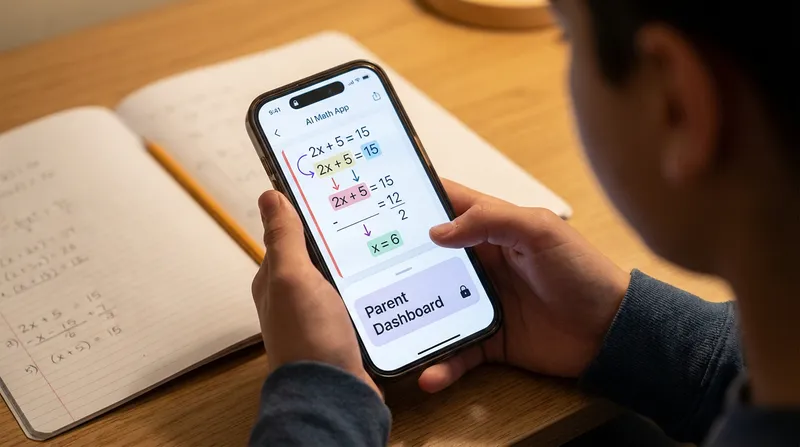
- Tutor AI (Interactive Tutoring Engine): This platform bridges the gap using a "Snap. Solve. Learn." philosophy. When a student scans a problem, the app provides interactive, step-by-step Socratic guidance tailored to their learning level. It features 24/7 availability and offline capabilities, making it perfect for late-night study sessions.
More importantly, Tutor AI features a dedicated Parent Dashboard. While the app offers a robust free tier for students, the Premium Parent Dashboard completely eliminates the "blind spot" parents feel during homework time. You can track daily practice, see exactly which concepts they are struggling with, and monitor progress over time.
If you want to see a deep dive into how these tools stack up, read our comprehensive comparison: Gauth vs Photomath (2026): Best AI STEM Solver & Alternatives.
Actionable Tip for Parents: Download a comprehension-first math app tonight. Sit down with your child and ask them to solve one challenging problem using the app with you. Experience the step-by-step tutoring process together so they know you support their learning journey.
How to Set Up a Responsible AI Homework Routine at Home
Having the right app is only half the battle. To truly stop kids cheating on math homework, you need to establish clear boundaries and a healthy study routine.
The National Education Association (NEA) advises that AI tools should only be adopted when there is data supporting their alignment with high-quality teaching standards. To bring this philosophy into your living room, here is a 5-step checklist for a responsible parent guide to AI homework:
- Study in Common Areas: Homework should be done at the kitchen table or in the living room, not behind closed bedroom doors. Visibility naturally discourages mindless copying.
- The 5-Minute Rule: Before opening any app, the student must attempt the problem on paper for at least five minutes.
- Use the Right Tools: Ensure they are using a tutoring engine rather than an answer engine. If they are transitioning away from older platforms, check out The 2026 Chegg Crackdown: How to Get Safe AI Homework Help.
- Check the Dashboard: Make it a weekly habit to review your app's parent tracking features together. Celebrate their progress and discuss the areas where they need more practice.
- Focus on the Process, Not the Grade: Praise your child for working hard to understand a tough concept, even if it took them longer than expected.
Actionable Tip for Parents: Implement the "try first, scan second" rule starting tomorrow. Require your child to show you their scratch paper with their initial attempt before they are allowed to use their phone for help.
Conclusion: Empowering Your Child to Learn Independently
Navigating the digital age of education is incredibly challenging for families. It is completely normal to feel overwhelmed by the rapid pace of technology. However, you do not need to be a math expert to help your child succeed. You just need to provide the right guardrails.
AI is a permanent part of our educational landscape. By shifting away from quick-fix answer engines and embracing tools that prioritize genuine comprehension, you can turn a source of anxiety into a powerful learning aid. An AI homework helper not cheating your student is entirely possible when you choose platforms designed with education in mind.
Ready to stop guessing and start seeing your child's real progress? Explore Tutor AI today and see how instant, step-by-step homework help can reduce your family's stress.
Disclaimer: Every student learns differently. While these strategies are research-backed, results may vary. Adapt these techniques to fit your child's unique learning style.
Frequently Asked Questions
Is using AI for math homework considered cheating?
It depends entirely on the tool and how it is used. Answer engines that just provide the final solution are often considered cheating because they bypass the learning process. Tutoring engines that guide students through the steps, ask questions, and require active engagement are viewed as highly effective study aids.
What are the best free math apps that show steps instead of just answers?
Interactive tutoring engines are top recommendations for parents and teachers. They use a Socratic method to ask guiding questions, breaking down complex math problems step-by-step so the student learns the "why" behind the math, rather than just copying a final number.
How can I monitor my child's AI app usage during homework time?
The best way to monitor usage is by choosing educational apps with built-in parental controls or dashboards. Premium features like a Parent Dashboard track your child's progress, highlight their weak spots, and show you exactly how much time they are spending on productive learning.
Why do teachers dislike apps like Photomath and Mathway?
Educators are frustrated because these apps allow students to bypass the productive struggle required to actually learn the material. When students use these apps to copy answers, they turn in perfect homework but consistently fail their proctored, in-class exams.
Is there a free Photomath alternative that actually teaches the concepts?
Many popular math apps hide their step-by-step explanations behind expensive paywalls, leaving free users with nothing but the final answer. You should look for alternatives that prioritize accessible, step-by-step learning and provide robust free tiers designed to help students actually understand the concepts.


