
It is 10 PM on a Tuesday. You are sitting at the kitchen table with your teenager, staring at an algebra worksheet that looks like it was written in an alien language. You want to help, but it has been years since you thought about polynomials or quadratic equations. The tension is rising, and the late-night homework battle is officially underway.
In moments like this, an AI homework helper seems like a lifesaver. With a quick search, you will find dozens of tools claiming to be the ultimate math AI app for high school and middle school students. But as a parent, you might feel a lingering sense of dread. Are these apps actually teaching your child, or are they just doing the work for them?
The truth is, not all educational technology is created equal. The market is flooded with basic scanner apps that simply spit out answers. Relying on these tools can create a false sense of security, leading to poor test scores and zero actual learning.
In this guide, we will break down the critical differences between a basic math problem solver AI and a true AI math tutor. You will learn how to identify which tool your child is using, why the distinction matters for their academic future, and how to choose a platform that builds lasting confidence.
What Is a Math Problem Solver AI? (The Answer Engine)
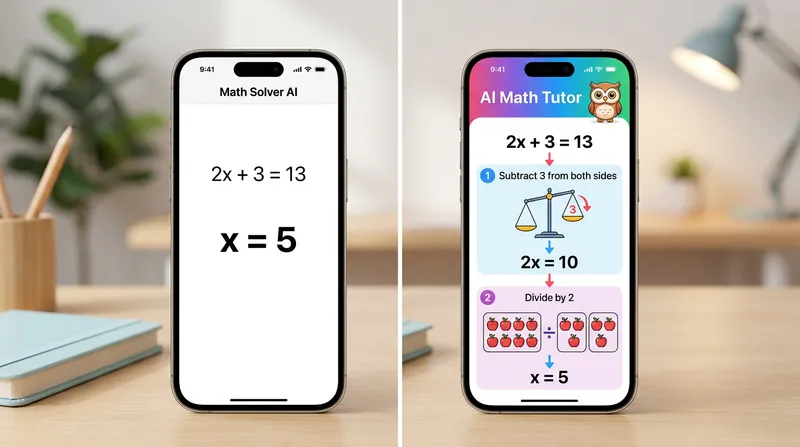
A math problem solver AI is essentially a digital answer engine. These tools are designed for one primary function: you scan a problem, and the app instantly provides the final answer. Many of these apps market themselves as a scan and solve math AI or a smart AI math calculator.
There are some pros to these tools. They are incredibly fast, making them somewhat useful for a student who wants to quickly check their completed work to see if their final answer is correct.
However, the cons far outweigh the pros when it comes to actual learning. These tools often act as an academic crutch. When a student is struggling, the cognitive effort of working through the problem is exactly what builds new neural pathways. By simply handing over the answer, a basic solver robs the student of that necessary struggle.
According to a study published in the Proceedings of the National Academy of Sciences, students relying on AI for direct answers underperformed when the AI was removed. On the other hand, AI configured to provide guided hints actually mitigated these negative effects and improved learning.
When students use a basic solver, they are not learning the material. They are just learning how to copy. If you are worried about how this impacts their grades, you might want to read our guide on Can Teachers Tell You Used Photomath? How to Show Math Work Authentically.
Actionable Tip for Parents: To spot if your child is using an app just to get the answers, look at their scratch paper. If they have the correct final answer written down but absolutely no intermediate steps or erased mistakes leading up to it, they might be using a basic solver. Ask them to explain how they arrived at the solution. If they cannot, it is time to switch tools.
What Is an AI Math Tutor? (The Learning Partner)
While a solver just gives the answer, a true AI math tutor acts as a supportive learning partner. These platforms are designed to replicate the experience of sitting next to a highly qualified human tutor.
Instead of instantly revealing the solution, the best AI math tutor will use Socratic questioning. This means the AI asks guiding questions to help the student figure out the next step on their own. If a student is stuck on an algebra equation, the AI tutor for middle school or high school might ask, "What do we need to do to get 'x' by itself on one side?"
This method builds long-term confidence and resilience. Research from Stanford University indicates that AI-powered tutoring assistants show immense promise in improving students' short-term performance in math when used to support the learning process, rather than supplanting the required cognitive effort.
An online math tutoring AI focuses on the "why" and the "how", rather than just the "what". It identifies where the student is stuck, offers targeted hints, and celebrates their progress when they finally grasp the concept.
Actionable Tip for Parents: When evaluating a new app, test it yourself with a simple math problem. Enter a wrong step on purpose. If the app just corrects you and gives the final answer, it is a solver. If the app tells you where you made the mistake and asks you to try again, you have found a true AI tutor.
Key Differences: AI Math Solver vs. AI Math Tutor
Understanding the broad definitions is helpful, but let us look at the specific feature differences. When you are looking for an AI math study tool or an AI math learning platform, these are the critical distinctions you need to keep in mind.
Instant Answers vs. Step-by-Step Understanding
The most obvious difference is the output. A basic solver gives instant gratification. A step-by-step math solver breaks the problem down into manageable chunks.
However, even seeing the steps is not enough if the app does not explain the reasoning behind them. An AI math solver with steps must explain the mathematical rules being applied. For example, a true math word problem solver AI will help the student translate English sentences into mathematical equations before solving anything.
If your child is working on complex shapes and proofs, they need a tool that explains the logical progression. You can learn more about this in our article on How to Use an AI Geometry Solver for Step-by-Step Proofs (Without Cheating).
Actionable Tip for Parents: Have your child explain a solved problem back to you out loud. If they can walk you through the steps and tell you why they did each one, the tool they are using is successfully building their comprehension.
One-Size-Fits-All vs. Personalized Learning Paths
Basic apps force one specific method. If your child scans a problem, the app might solve it using a method they have not even learned in class yet. This causes massive confusion.
Personalized AI learning adapts to the student's unique learning style and current curriculum. A Socratic math AI will recognize multiple ways to solve a problem and guide the student using the method they are most comfortable with.
Researchers at the Drexel University School of Education emphasize that timely, personalized feedback from AI is essential for helping students reflect on their thinking and build long-term conceptual understanding.
For a deeper dive into why forcing a single method is harmful, check out our post: Box Method, FOIL, or Grouping? Why Single-Solution Math Apps Confuse Students (And the Best Mathway Alternative).
Actionable Tip for Parents: Ask your child's teacher which specific methods they are focusing on this semester. Ensure the AI tool your child uses allows them to select or practice that specific method, rather than defaulting to the most complex path.
The Black Box vs. Parent Progress Tracking
One of the biggest frustrations for parents is the "black box" effect. Your child is in their room for two hours with their phone, supposedly studying. But are they actually learning, or just mindlessly scanning worksheets?
Basic solvers offer zero visibility. True AI math learning platforms offer dedicated parent dashboards. These dashboards allow you to track progress, monitor time spent on specific topics, and identify weak spots.
The U.S. Department of Education (Institute of Education Sciences) notes that pilot studies of automated AI math tutors featuring practice problems, formative feedback, and a progress dashboard resulted in increased pre-to-post math scores for learners.
If you want to know more about why this visibility is crucial, read The 'Black Box' of Homework Apps: Why Parents Need Dashboards (Chegg & Brainly Alternatives).
Actionable Tip for Parents: Never pay for a premium subscription to an educational app unless it includes a parent portal or weekly email reports detailing your child's activity and concept mastery.
How to Transition Your Child from Solving to Learning
If you have realized your child is relying too heavily on a basic answer engine, do not panic. You can guide them back to genuine learning without causing a massive argument. Here is a three-step actionable framework to transition them to an AI math tutor app.
Step 1: Set clear boundaries around homework app usage. Sit down with your child and explain the difference between checking work and cheating. Agree on a rule: they must attempt the problem on their own first. They can only use an app if they are genuinely stuck for more than five minutes, or to check their final answer after they have shown all their work.
Step 2: Introduce an AI tutor app and explain how to use it for hints. Replace their basic scanner with an online math tutoring AI that requires interaction. Sit with them for the first few problems. Show them how to ask the AI for a hint rather than the full solution. Praise them when they use the hint to figure out the next step themselves. If your teen resists, try framing it as a challenge: Can they explain the hint to you before moving on? Making it interactive reduces the feeling of being monitored and builds buy-in.
Step 3: Use formative assessments to find hidden knowledge gaps. Because basic solvers mask what a student does not know, your child might be missing foundational skills. Use an AI tutor's assessment feature to find these weak spots before a major exam, like the SAT or ACT. We explain this process in detail in The Hidden Knowledge Gap: How AI Math Assessments Forecast Your Next Test Score.
Why Tutor AI is the Ultimate Math Learning Partner
If you are looking for the best AI math tutor to help your child transition from mindless solving to genuine understanding, Tutor AI is designed with your child's learning journey in mind.
Our philosophy is simple: Snap. Solve. Learn.
When your child snaps a photo of a confusing problem, Tutor AI does not just hand over the answer. It provides detailed, step-by-step explanations that break down the "why" behind the math. It acts as a 24/7 supportive tutor, using Socratic guidance to ensure your child actually grasps the concepts. Many students find that earning achievement badges and maintaining daily streaks makes practice feel less like homework and more like a game.
Tutor AI is not just for basic math. Whether your child is tackling geometry, science, or preparing for high-stakes exams like the SAT, ACT, or AP tests, Tutor AI provides multi-subject support. Plus, it works even without a reliable internet connection thanks to its offline mode, so late-night help is always available.
Most importantly for busy parents, Tutor AI features a comprehensive parent dashboard. You can finally see exactly where your child is spending their study time. You can track their daily practice, monitor their topic mastery, and see exactly where they need extra support. Tutor AI even offers a free tier so you can experience the difference before committing, making it a low-risk alternative to expensive private tutoring.
Conclusion: Empowering Your Child's Math Journey
So, are these apps teaching your child or just doing the work for them? The answer depends entirely on which type of tool you choose.
The flood of AI homework helpers on the market can be overwhelming. But when you break it down, the choice is clear. Basic math problem solvers give answers, but true AI math tutors build minds.
By choosing a tool that prioritizes step-by-step understanding, personalized learning paths, and parent visibility, you are setting your child up for long-term academic success. You can end the late-night homework battles and replace frustration with confidence.
Take an active role in your child's educational technology today. Download Tutor AI to experience the difference a true learning partner makes, and explore our parent dashboard to see your child's progress in real time.
Note: Every student learns differently. While these strategies are research-backed, results may vary. Adapt these techniques to fit your unique learning style and circumstances.
Frequently Asked Questions
Is using an AI math solver considered cheating?
It depends entirely on the tool and how it is used. Using a basic app just to copy final answers without understanding the work is a form of cheating and severely hurts learning. However, using an AI tutor that provides hints and explains concepts step-by-step is a valid, highly effective study method.
What is the best AI math tutor for middle school and high school students?
The best tools offer Socratic questioning, step-by-step guidance, and parent tracking capabilities. Tutor AI is a top choice because it focuses on actual learning and comprehension rather than just providing instant answers, making it perfect for middle and high schoolers preparing for advanced classes or SAT and ACT exams.
How do I know if my child is actually learning or just copying AI answers?
The best test is to ask your child to explain a completed math problem out loud to you. If they cannot explain their reasoning, they are likely just copying. Additionally, using AI platforms with parent dashboards like Tutor AI allows you to track the time they spend on problems and highlight areas where they are struggling.
Can an AI math app really replace a human tutor?
While human tutors offer excellent emotional support and customized personal connection, a high-quality AI math tutor provides affordable, 24/7 assistance. It offers immediate feedback and personalized learning paths that make it a powerful alternative or supplement to traditional tutoring, especially with free tiers available to test the waters.
Are free math problem solver AIs safe for my child to use?
Many free solver apps lack educational guardrails, expose children to intrusive ads, and offer zero visibility for parents. It is usually much safer to invest in dedicated educational platforms that prioritize student data privacy, provide a distraction-free environment, and focus on genuine academic growth.