
Staring at a blank two-column proof chart is a universal high school nightmare. You have your "Given" information at the top and your "Prove" statement at the bottom, but the empty space in between feels like a complete mystery. For parents, this anxiety is often worse. You want to provide geometry homework help, but you probably forgot the intricacies of Euclidean geometry decades ago.
When frustration peaks, it is tempting to just look up the answer. However, copying a final proof does not help you understand the concepts, and it certainly will not help you pass your next exam. You need a tool that guides you step-by-step without just handing over the answer to copy.
This is where an AI math tutor comes in. When used correctly, a geometry proof solver can act as a personalized tutor available 24/7, even when you are offline. In this guide, we will show you exactly how to use a step-by-step geometry calculator to master your assignments, build real academic confidence, and keep the learning process completely cheat-free.
What is a Two-Column Geometry Proof?
Before you can use an AI geometry solver effectively, you need to understand the format of the problem. A formal two-column proof requires organizing logical steps into two distinct sides. According to the CK-12 Foundation, this method is the standard format in most US high school geometry courses.
The left column is labeled "Statements". This is where you list your mathematical claims. The right column is labeled "Reasons". This is where you provide the exact theorem, postulate, or definition that justifies each claim.
Every proof starts with your "Given" information. For example, if a problem states that a line bisects an angle, your first statement is exactly that fact, and your reason is simply "Given". From there, you must use deductive reasoning to reach your final conclusion. The challenge is figuring out the logical sequence of those middle steps.
The Core Problem: Why Standard Math Apps Fail at Euclidean Geometry
Many students try to use a basic geometry solver app or a general AI chatbot to complete their assignments. However, standard tools often struggle with complex spatial reasoning.
General language models are designed to predict the next word in a sentence, not to perform strict mathematical logic. Because of this, they might hallucinate intermediate steps or invent fake theorems. On the other hand, basic calculators might be great at algebra, but they fail to recognize the visual elements of a geometry picture solver.
This is why you need a symbolic AI math solver designed for precise logical deduction. A symbolic AI understands the rigid rules of mathematics and can trace logic without guessing. If you want to learn more about why basic tools fall short, check out our guide on why standard math apps fail the hardest high school exams.
How to Solve Geometry Proofs Step-by-Step Using AI
To get the most out of an AI math tutor, you need to use it as a collaborative study partner. Here is the ultimate framework for using a two-column proof solver to actually learn the material.
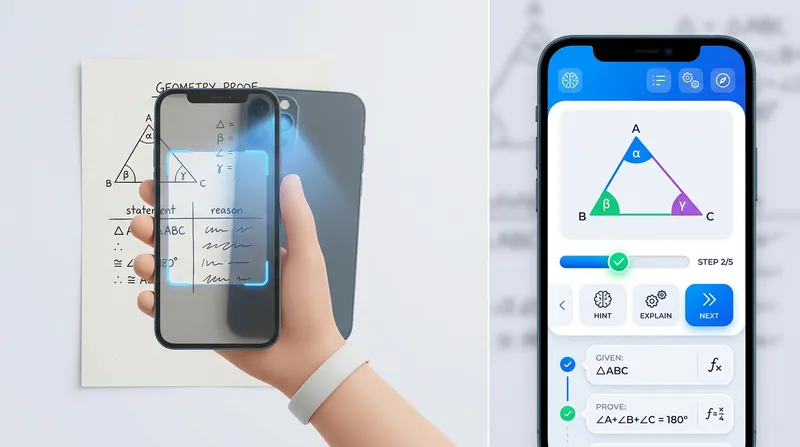
Step 1: Scan Your Diagram with a Geometry Picture Solver
Typing out geometry problems is frustrating. How do you type a symbol for "congruent" or "perpendicular" on a standard keyboard? The best geometry solver app will feature a photo-based problem solving tool.
With your AI tutor, you can simply snap a picture of your textbook diagram or handwritten notes. The advanced optical character recognition technology instantly processes the image, reading both the text and the visual geometric shapes. This removes the friction of getting help, allowing you to focus immediately on the logic rather than the formatting.
If you have ever had trouble with scanners misreading your work, you can read our tips on why math scanners misread handwriting and how to fix it.
Step 2: Set Up Your Statements and Reasons
Do not just ask the AI to solve the whole problem immediately. Instead, set up your two-column chart on your own paper first.
Write down your "Given" statements. For example, create a simple table. In the left column under "Statements", write "Angle A is congruent to Angle B." In the right column under "Reasons", write "Given." This gives you a concrete starting point. Then, look at the diagram and mark it up. Draw tick marks on congruent sides and arcs on congruent angles.
Once you have exhausted your own knowledge, use the app to check your initial setup. You can ask the AI: "Are my initial given statements correct, and what is one logical conclusion I can draw from them?"
Step 3: Prompt the AI Math Tutor for Hints, Not Answers
The secret to using AI without cheating is in how you prompt it. Instead of asking for the final proof, ask for the next step.
For example, if you know that two triangles share a side, you can ask the AI: "I see that these two triangles share side AB. What property justifies saying AB is congruent to AB?" The AI will respond with step-by-step explanations, teaching you that this is called the Reflexive Property of Congruence.
This method forces you to engage in active recall and critical thinking. You are still doing the heavy lifting, but the tool is acting as your safety net, ensuring you never stay stuck for too long.
Tips for Mastering Triangle Congruence Proofs
Triangle congruence proofs are the foundation of high school geometry. You will constantly be asked to prove that two triangles are identical in shape and size. Here are the five main postulates you need to master, and how an AI math tutor can help you identify them:
- Side-Side-Side (SSS): If three sides of one triangle are congruent to three sides of another triangle, the triangles are congruent.
- Side-Angle-Side (SAS): If two sides and the included angle of one triangle are congruent to the corresponding parts of another, the triangles are congruent.
- Angle-Side-Angle (ASA): If two angles and the included side are congruent, the triangles are congruent.
- Angle-Angle-Side (AAS): If two angles and a non-included side are congruent, the triangles are congruent.
- Hypotenuse-Leg (HL): This only applies to right triangles. If the hypotenuse and one leg of a right triangle are congruent to another right triangle, they are congruent.
When you are stuck on these, use your geometry picture solver to scan the triangle. Ask the AI: "Which congruence postulate applies to this image based on my given information?" The AI will highlight the specific sides and angles, helping you visualize the relationships.
Once you prove the triangles are congruent, you will often need to prove that specific parts of those triangles are equal. This is where you use CPCTC (Corresponding Parts of Congruent Triangles are Congruent). Your AI tutor can show you exactly how to format CPCTC in your final reason column.
Conquering Circle Theorems Proofs
Later in the school year, you will transition from triangles to circles. Circle theorems proofs introduce a whole new set of vocabulary: chords, secants, tangents, and inscribed angles.
Common circle theorems you will need to memorize include the Inscribed Angle Theorem, the Tangent-Radius Theorem, and the Intersecting Chords Theorem. For example, if you are given an inscribed angle of 30 degrees, the Inscribed Angle Theorem states the intercepted arc is exactly double, or 60 degrees. An AI math solver can help you trace these relationships step-by-step.
A geometry word problem solver is incredibly useful here. Word problems involving circles often require you to draw the diagram yourself. If you draw it incorrectly, your proof will fail. You can use your AI math tutor to verify your drawing. Simply sketch your interpretation of the word problem, scan it, and ask the AI if your visual representation matches the text. Personalized learning paths within the app will track which of these theorems you struggle with most and offer targeted practice problems to build your confidence.
What to Look for in a Geometry Proof Solver
If you search the app store for a step-by-step geometry calculator, you will find dozens of options. However, not all apps are created equal when it comes to formal proofs. When choosing a tool to help with your homework, look for these three critical features:
- Symbolic Reasoning Capabilities: Avoid tools that rely solely on language prediction. You need an app built specifically to act as an AI math tutor with a calculation engine that understands the rigid rules of Euclidean geometry.
- Robust Diagram Recognition: The app must feature advanced optical character recognition to read your unstructured visual diagrams, not just typed text or basic equations.
- Step-by-Step Explanations: A true educational tool prioritizes comprehension over memorization. It should explain the "why" behind the math rather than just handing over a final answer to copy.
To ensure you are using technology responsibly, read our post on how to get safe AI homework help while building real skills.
A Parent's Guide to Geometry Homework Help (The "Tutor, Not Cheater" Framework)
For parents, watching a child struggle with homework is painful. You want to help, but stepping in to do the work for them is counterproductive. Furthermore, many parents worry that giving their child an AI app is essentially giving them a cheating device.
However, educational experts agree that AI can be a powerful force for good when used responsibly. The U.S. Department of Education emphasizes that AI should enable adapting to a student's learning process as it unfolds step-by-step, rather than simply providing feedback on right or wrong answers.
This is the foundation of the "Tutor, Not Cheater" framework. Here is how parents can implement it at home:
- Embrace the Productive Struggle: Research from Carnegie Mellon University validates the effectiveness of AI math tutors built on cognitive science, showing that step-by-step AI guidance can successfully mimic a personal tutor. Allow your child to struggle with the problem for a few minutes before turning to the app. This struggle builds neural pathways.
- Review the Explanations Together: When your child uses the app to solve a proof, sit with them and read the step-by-step explanations aloud. Ask them to explain the reasoning back to you in their own words. If they can teach it to you, they truly understand it.
- Monitor Progress, Not Just Completion: Advanced tools feature comprehensive progress tracking for parents. You can view detailed insights into your child's learning, identifying their weak spots and tracking their daily engagement. This allows you to have informed, positive conversations about their academics without the stress of late-night homework battles.
According to research published in Frontiers in Education, AI must be a resource aligned with inclusive and personalized learning experiences. By using an app that prioritizes step-by-step learning, you are giving your child a tool that builds long-term academic confidence. For more insights on this topic, parents should read a parent's guide to AI homework cheating and alternatives.
Frequently Asked Questions
Can an AI solve two-column geometry proofs? Yes, but you need the right kind of AI. A symbolic AI math solver is designed specifically for precise logical deduction required for two-column proofs, whereas general language models often hallucinate incorrect theorems.
Is using a geometry picture solver considered cheating by teachers? It depends entirely on the execution. Submitting an AI-generated answer as your own original work without understanding it is cheating. However, using a step-by-step geometry calculator to check your completed work, identify where your logic went wrong, or get a hint for the next step is widely considered a smart, proactive study habit.
How do I type geometry symbols into a math solver? Typing symbols like "perpendicular" or "congruent" can be tedious. The most efficient method is to use a photo-based problem solving app. You just snap a picture of your handwritten work or textbook, and the AI instantly recognizes the mathematical notation.
What is the difference between a symbolic AI math solver and ChatGPT? ChatGPT is a large language model designed to generate human-like text based on patterns. A symbolic AI math solver is built on strict mathematical rules and calculation engines. This means a symbolic solver provides precise, reliable step-by-step logic without the risk of inventing fake math rules.
How do symbolic AI math solvers handle missing information in a geometry word problem? Unlike basic calculators, advanced AI math tutors can analyze the text of a word problem and identify implied given information. If a problem states a line is a perpendicular bisector, the AI knows to automatically apply both the 90-degree angle property and the equal segment property to the corresponding diagram.
Empower Your Learning Journey Today
Geometry does not have to be a source of tears and frustration. By shifting your mindset and using an AI geometry solver as a 24/7 study companion rather than an answer key, you can conquer even the most complex two-column proofs.
Remember to start with your given information, break the problem down into manageable steps, and always ask the AI for the "why" behind the answer. With consistent practice and the right tools, you will build the critical thinking skills necessary for high school success and beyond.
Ready to study smarter and reduce homework stress? Get unstuck instantly and learn for real with Tutor AI. [Download the App Today] Snap. Solve. Learn.
Note: Every student learns differently. While these strategies are research-backed, results may vary. Adapt these techniques to fit your unique learning style and circumstances.


