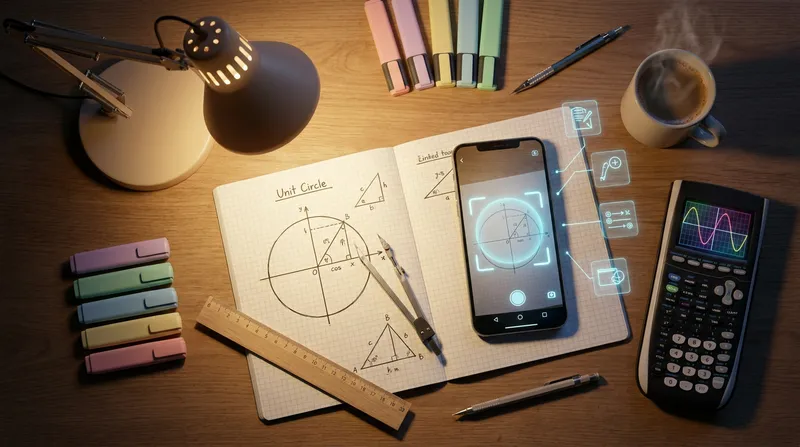
We have all been there: it is 10:30 PM, your precalculus worksheet is due first period tomorrow, and you are staring at a page full of Greek letters that might as well be ancient hieroglyphics. When you are learning how to prove trigonometric identities step by step, the frustration hits a whole new level.
Why? Because in trigonometry, knowing the "final answer" is completely useless. When a homework problem asks you to verify that $\sec(\theta) - \cos(\theta) = \sin(\theta)\tan(\theta)$, the question literally hands you both sides of the equation! Your teacher is grading you 100% on the intermediate algebraic steps used to get from the Left-Hand Side (LHS) to the Right-Hand Side (RHS).
Yet if you type that equation into some calculators, you may only get "True", or find that the intermediate steps are behind a paywall. Some tools also manipulate both sides of the equals sign at once, which many precalculus teachers don't accept.
Whether you are a high school student trying to survive honors precalculus, a tutor looking for clear frameworks, or a busy parent wondering how to check your teen's math when you have not seen a cosine since high school, you are in the right place. In this complete guide, we will walk through right-triangle SOHCAHTOA, the 60-second Unit Circle hack (in radians and degrees), a foolproof 5-step decision tree for proving trig identities, and how to use a free online trigonometry homework helper like Tutor AI to master every step.
Right Triangle Trigonometry: SOHCAHTOA & Inverse Trig Functions Explained
Before you can conquer the unit circle or complex precalculus proofs, you need rock-solid footing in right-triangle trigonometry. Every trig function is simply a ratio comparing two sides of a right triangle relative to a specific acute angle, which we call theta ($\theta$).
To keep the three primary ratios straight, generations of math students have relied on the mnemonic SOHCAHTOA:
- SOH (Sine = Opposite / Hypotenuse): $\sin(\theta) = \frac{\text{Opposite}}{\text{Hypotenuse}}$
- CAH (Cosine = Adjacent / Hypotenuse): $\cos(\theta) = \frac{\text{Adjacent}}{\text{Hypotenuse}}$
- TOA (Tangent = Opposite / Adjacent): $\tan(\theta) = \frac{\text{Opposite}}{\text{Adjacent}}$
How to Find a Missing Side vs. a Missing Angle
One of the most common places students get stuck when solving right triangles with SOHCAHTOA is knowing when to use a standard trig button ($\sin, \cos, \tan$) versus an inverse trig function ($\sin^{-1}, \cos^{-1}, \tan^{-1}$, also written as $\arcsin, \arccos, \arctan$).
According to a peer-reviewed study in the Journal of Mathematics and Science Teacher that used Newman's Error Hierarchy, most high school trigonometry errors occurred at the transforming, processing, and encoding stages, rather than when students first read the problem.
Use this simple two-rule checklist every time you need to find a missing side or angle in a right triangle:
- Have an Angle, Need a Side? Use Regular Trig ($\sin, \cos, \tan$).
Example: You have a right triangle with an angle of $35^\circ$ and a hypotenuse of $10$. You need to find the opposite side ($x$).
Setup: $\sin(35^\circ) = \frac{x}{10} \implies x = 10 \cdot \sin(35^\circ) \approx 5.74$. - Have Two Sides, Need an Angle? Use Inverse Trig ($\sin^{-1}, \cos^{-1}, \tan^{-1}$).
Example: You know the side opposite to $\theta$ is $3$ and the adjacent side is $4$. You need to find the angle $\theta$.
Setup: $\tan(\theta) = \frac{3}{4} \implies \theta = \arctan\left(\frac{3}{4}\right) \approx 36.87^\circ$.
Actionable Calculator Tip: Before pressing enter on any right-triangle problem, check the top corner of your screen! Right-triangle word problems (like angles of elevation and depression) almost always use Degrees (DEG), while graphing and calculus problems use Radians (RAD). Being in the wrong mode is a common and easily avoidable cause of lost points on quizzes, especially when preparing for standardized exams using the best Digital SAT module practice websites.

Bridging the Gap: How SOHCAHTOA Becomes the Unit Circle
A huge mistake in most math textbooks is treating SOHCAHTOA and the Unit Circle like two completely unrelated chapters. In reality, the Unit Circle is just SOHCAHTOA placed on an $(x, y)$ coordinate grid!
As Khan Academy's trigonometry curriculum explains, right-triangle SOHCAHTOA definitions only work for acute angles between $0^\circ$ and $90^\circ$. To evaluate trig functions for obtuse angles (like $135^\circ$), negative angles (like $-60^\circ$), or multiple rotations, mathematicians place a circle of radius $r = 1$ centered at the origin $(0,0)$.
Imagine drawing a right triangle inside that circle, starting from the origin $(0,0)$ up to a point $(x, y)$ on the edge of the circle:
- The horizontal leg along the x-axis has length $x$.
- The vertical leg going straight up has length $y$.
- The Hypotenuse is the radius of the unit circle, which is always $1$.
Now apply SOHCAHTOA to that triangle inside the circle:
- $\cos(\theta) = \frac{\text{Adjacent}}{\text{Hypotenuse}} = \frac{x}{1} = x$
- $\sin(\theta) = \frac{\text{Opposite}}{\text{Hypotenuse}} = \frac{y}{1} = y$
- $\tan(\theta) = \frac{\text{Opposite}}{\text{Adjacent}} = \frac{y}{x} = \frac{\sin(\theta)}{\cos(\theta)}$
That is the big secret! On the Unit Circle, every $(x, y)$ coordinate pair is simply $(\cos\theta, \sin\theta)$. Even better, as noted in OpenStax Algebra and Trigonometry 2e by Rice University, because the equation of a unit circle is $x^2 + y^2 = 1$, substituting $x = \cos(\theta)$ and $y = \sin(\theta)$ directly proves the most famous formula in trigonometry: $\cos^2(\theta) + \sin^2(\theta) = 1$.
The 60-Second Unit Circle Hack (Radians, Degrees & Exact Values)
When your teacher announces a timed Unit Circle quiz with no calculator allowed for radians and degrees, do not panic and try to rote-memorize 16 random coordinate pairs. Instead, memorize just Quadrant I using the $\frac{\sqrt{n}}{2}$ pattern, and mirror it across the other three quadrants.
Step 1: The $\frac{\sqrt{n}}{2}$ Pattern for Quadrant I
Write down the five key angles in Quadrant I from bottom to top: $0^\circ, 30^\circ, 45^\circ, 60^\circ, 90^\circ$.
To find $\sin(\theta)$ (the $y$-value), simply count up from $0$ to $4$ inside a square root divided by $2$: $\frac{\sqrt{0}}{2}, \frac{\sqrt{1}}{2}, \frac{\sqrt{2}}{2}, \frac{\sqrt{3}}{2}, \frac{\sqrt{4}}{2}$.
To find $\cos(\theta)$ (the $x$-value), count backward from $4$ down to $0$! Here is how cleanly that simplifies for your exact values on the unit circle:
| Degrees | Radians | $\cos(\theta)$ ($x$-coordinate) | $\sin(\theta)$ ($y$-coordinate) | $\tan(\theta) = \frac{\sin(\theta)}{\cos(\theta)}$ |
|---|---|---|---|---|
| $0^\circ$ | $0$ | $\frac{\sqrt{4}}{2} = 1$ | $\frac{\sqrt{0}}{2} = 0$ | $0$ |
| $30^\circ$ | $\frac{\pi}{6}$ | $\frac{\sqrt{3}}{2}$ | $\frac{\sqrt{1}}{2} = \frac{1}{2}$ | $\frac{\sqrt{3}}{3}$ |
| $45^\circ$ | $\frac{\pi}{4}$ | $\frac{\sqrt{2}}{2}$ | $\frac{\sqrt{2}}{2}$ | $1$ |
| $60^\circ$ | $\frac{\pi}{3}$ | $\frac{\sqrt{1}}{2} = \frac{1}{2}$ | $\frac{\sqrt{3}}{2}$ | $\sqrt{3}$ |
| $90^\circ$ | $\frac{\pi}{2}$ | $\frac{\sqrt{0}}{2} = 0$ | $\frac{\sqrt{4}}{2} = 1$ | Undefined |
Step 2: Reference Angles and the ASTC Sign Rule
What if your homework asks for the exact value of $\sin\left(\frac{5\pi}{6}\right)$ or $\cos(225^\circ)$? According to OpenStax Algebra and Trigonometry 2e, any angle on the unit circle whose reference angle is $30^\circ (\frac{\pi}{6})$, $45^\circ (\frac{\pi}{4})$, or $60^\circ (\frac{\pi}{3})$ has the exact same numbers as Quadrant I. You only need to adjust the positive or negative sign based on the quadrant!
Use the acronym ASTC ("All Students Take Calculus") moving counterclockwise from Quadrant I to Quadrant IV to know which functions are positive:
- Quadrant I ($0^\circ$ to $90^\circ$): All trig functions are positive $(+, +)$.
- Quadrant II ($90^\circ$ to $180^\circ$): Sine (and $\csc$) are positive; Cosine and Tangent are negative $(-, +)$.
- Quadrant III ($180^\circ$ to $270^\circ$): Tangent (and $\cot$) are positive; Sine and Cosine are negative $(-, -)$.
- Quadrant IV ($270^\circ$ to $360^\circ$): Cosine (and $\sec$) are positive; Sine and Tangent are negative $(+, -)$.
Radian Shortcut: When looking at reduced radian fractions:
- Anything with a denominator of $6$ (like $\frac{5\pi}{6}, \frac{7\pi}{6}, \frac{11\pi}{6}$) uses the $30^\circ$ values.
- Anything with a denominator of $4$ (like $\frac{3\pi}{4}, \frac{5\pi}{4}, \frac{7\pi}{4}$) uses the $45^\circ$ values.
- Anything with a denominator of $3$ (like $\frac{2\pi}{3}, \frac{4\pi}{3}, \frac{5\pi}{3}$) uses the $60^\circ$ values.
Fundamental Trig Identities Cheat Sheet (And How to Derive Them)
Looking at a back-of-the-textbook sheet with 36 trigonometric formulas is overwhelming. Fortunately, as Clark University's Department of Mathematics points out, you do not need to memorize every single identity off the top of your head. If you know the core building blocks, you can derive the secondary formulas in five seconds flat on the top corner of your test paper.
1. Reciprocal & Quotient Identities
Every trig expression can be broken down into $\sin(\theta)$ and $\cos(\theta)$:
- $\csc(\theta) = \frac{1}{\sin(\theta)}$ and $\sec(\theta) = \frac{1}{\cos(\theta)}$ (Tip: Notice that "S" pairs with "C"!)
- $\cot(\theta) = \frac{1}{\tan(\theta)}$
- $\tan(\theta) = \frac{\sin(\theta)}{\cos(\theta)}$ and $\cot(\theta) = \frac{\cos(\theta)}{\sin(\theta)}$
2. The 3 Pythagorean Identities (Derive Two for Free!)
You only need to memorize one Pythagorean identity: $$\sin^2(\theta) + \cos^2(\theta) = 1$$
Need the other two for Pythagorean identities practice problems? Just divide every term in that equation by $\cos^2(\theta)$ or $\sin^2(\theta)$:
- Divide everywhere by $\cos^2(\theta)$:
$\frac{\sin^2(\theta)}{\cos^2(\theta)} + \frac{\cos^2(\theta)}{\cos^2(\theta)} = \frac{1}{\cos^2(\theta)} \implies \mathbf{\tan^2(\theta) + 1 = \sec^2(\theta)}$ - Divide everywhere by $\sin^2(\theta)$:
$\frac{\sin^2(\theta)}{\sin^2(\theta)} + \frac{\cos^2(\theta)}{\sin^2(\theta)} = \frac{1}{\sin^2(\theta)} \implies \mathbf{1 + \cot^2(\theta) = \csc^2(\theta)}$
Pro Tip for Proofs: Always look for rearranged versions of the main identity! Whenever you see $1 - \sin^2(\theta)$, replace it immediately with $\cos^2(\theta)$. Whenever you see $1 - \cos^2(\theta)$, replace it with $\sin^2(\theta)$.
3. Double-Angle & Half-Angle Identities
When your class reaches double-angle and half-angle identities, keep these core transformations handy:
- Sine Double Angle: $\sin(2\theta) = 2\sin(\theta)\cos(\theta)$
- Cosine Double Angle (3 Forms):
$$\cos(2\theta) = \cos^2(\theta) - \sin^2(\theta) = 2\cos^2(\theta) - 1 = 1 - 2\sin^2(\theta)$$ - Half-Angle Identities:
$$\sin\left(\frac{\theta}{2}\right) = \pm\sqrt{\frac{1 - \cos(\theta)}{2}} \quad \text{and} \quad \cos\left(\frac{\theta}{2}\right) = \pm\sqrt{\frac{1 + \cos(\theta)}{2}}$$
How to Prove Trig Identities in Precalculus: The 5-Step Decision Tree
Why do smart students freeze up when asked how to prove trig identities in precalculus? Because unlike solving a linear equation where you always follow the same order of operations, proving an identity is like solving a puzzle where five different doors are unlocked, and only one leads to the exit.
First, remember the Golden Teacher Rule validated by OpenStax Precalculus: Never work across the equals sign. You cannot add a term to both sides or cross-multiply across the $=$ sign, because you have not proved the two sides are equal yet! Instead, draw a vertical wall down from the equals sign, pick ONE side (almost always the more complicated side), and transform it step-by-step until it matches the other side.
Whenever you need to simplify trigonometric expressions step by step, run through this "If You See X, Do Y" Decision Tree:
- Start with the More Complicated Side: It is much easier to tear down a complex fraction into a single term than to build a single term up into a complex fraction.
- See Squared Terms ($\sin^2x, \sec^2x$) with a $1$? Check Pythagorean Identities First: Before changing anything to sines and cosines, check if $\sec^2(x) - 1$ can immediately become $\tan^2(x)$.
- See Two Fractions Being Added or Subtracted? Find a Common Denominator: Combine them into one single fraction. Often, the numerators will simplify into a Pythagorean identity right away (just like combining equations when you solve systems of equations step-by-step).
- See $1 \pm \sin(x)$ or $1 \pm \cos(x)$ in a Denominator? Multiply by the Conjugate: Multiply the top and bottom of the fraction by the opposite sign (e.g., multiply $1 - \sin(x)$ by $1 + \sin(x)$). This creates $1 - \sin^2(x)$, which turns into $\cos^2(x)$!
- Still Stuck? Convert Everything to $\sin(x)$ and $\cos(x)$: Replace every $\tan, \cot, \sec,$ and $\csc$ with its sine/cosine definition and simplify the complex fraction.
3 Worked Practice Problems (Step-by-Step)
Let's put our 5-Step Decision Tree into action with three classic homework problems, moving from foundational to exam-level difficulty.
Problem 1: Simplifying via Sine/Cosine Conversion
Verify the identity: $\cot(\theta)\sin(\theta) = \cos(\theta)$
- Step 1 (Pick the more complicated side): We choose the Left-Hand Side (LHS), $\cot(\theta)\sin(\theta)$, because it has two functions multiplied together.
- Step 2 (Convert to $\sin$ and $\cos$): Using the Quotient Identity, replace $\cot(\theta)$ with $\frac{\cos(\theta)}{\sin(\theta)}$:
$$\text{LHS} = \left(\frac{\cos(\theta)}{\sin(\theta)}\right) \cdot \sin(\theta)$$ - Step 3 (Cancel common factors): The $\sin(\theta)$ in the denominator cancels with the $\sin(\theta)$ in the numerator:
$$\text{LHS} = \cos(\theta)$$ - Conclusion: $\text{LHS} = \text{RHS}$. Identity verified!
Problem 2: Combining Fractions with a Common Denominator
Verify the identity: $\frac{\sin(x)}{\cos(x)} + \frac{\cos(x)}{\sin(x)} = \sec(x)\csc(x)$
- Step 1 (Pick the LHS): The LHS has two separate fractions being added together.
- Step 2 (Find a common denominator): The common denominator of $\cos(x)$ and $\sin(x)$ is $\cos(x)\sin(x)$. Multiply the first fraction by $\frac{\sin(x)}{\sin(x)}$ and the second by $\frac{\cos(x)}{\cos(x)}$:
$$\text{LHS} = \frac{\sin^2(x) + \cos^2(x)}{\cos(x)\sin(x)}$$ - Step 3 (Apply the Pythagorean Identity): Replace the numerator $\sin^2(x) + \cos^2(x)$ with $1$:
$$\text{LHS} = \frac{1}{\cos(x)\sin(x)}$$ - Step 4 (Apply Reciprocal Identities): Split the fraction into $\frac{1}{\cos(x)} \cdot \frac{1}{\sin(x)}$, which equals $\sec(x)\csc(x)$.
- Conclusion: $\text{LHS} = \text{RHS}$. Identity verified!
Problem 3: Multiplying by the Conjugate (The Teacher Favorite!)
Verify the identity: $\frac{\cos(x)}{1 - \sin(x)} = \sec(x) + \tan(x)$
- Step 1 (Spot the trigger on the LHS): We see $1 - \sin(x)$ in the denominator. Decision Tree Rule #4 says: multiply top and bottom by the conjugate, $1 + \sin(x)$.
- Step 2 (Multiply by the conjugate):
$$\text{LHS} = \frac{\cos(x)}{1 - \sin(x)} \cdot \frac{1 + \sin(x)}{1 + \sin(x)} = \frac{\cos(x)(1 + \sin(x))}{1 - \sin^2(x)}$$ (Important Tip: Do NOT distribute the numerator $\cos(x)$! Leave it factored so it can cancel out in the next step.) - Step 3 (Pythagorean substitution in the denominator): Replace $1 - \sin^2(x)$ with $\cos^2(x)$:
$$\text{LHS} = \frac{\cos(x)(1 + \sin(x))}{\cos^2(x)}$$ - Step 4 (Cancel and split the fraction): Cancel one $\cos(x)$ from the top and bottom, then split the remaining fraction into two terms:
$$\text{LHS} = \frac{1 + \sin(x)}{\cos(x)} = \frac{1}{\cos(x)} + \frac{\sin(x)}{\cos(x)} = \sec(x) + \tan(x)$$ - Conclusion: $\text{LHS} = \text{RHS}$. Identity verified! Writing out every intermediate justification clearly will also help you earn full partial credit on high school precalculus and AP exams.
How to Use an AI Photo Math Solver for Trigonometry (Without Losing Credit)
What happens when you try all five steps of the Decision Tree at 11:00 PM and your expression still looks like a tangled mess? That is where an AI photo math solver for trigonometry becomes a lifesaver, provided you use the right tool.
As we uncovered in our deep-dive comparison of Mathway vs. Photomath vs. Tutor AI, some older math apps either lock their identity proof steps behind a paywall or use computer-algebra shortcuts that skip the steps your teacher expects to see.
With Tutor AI ("Snap. Solve. Learn."), you can snap a photo of any handwritten or printed trigonometry problem and get an instant, teacher-friendly breakdown 24/7. Here is how to use Tutor AI to get unstuck and actually learn the material:
- Snap Your Current Work, Not Just the Question: If you are three steps into a proof and stuck, snap a photo of the problem with Tutor AI's Photo-Based Problem Solving. Its advanced OCR reads complex mathematical notation ($\theta, \pi, \sqrt{}, \sin^2$) in seconds.
- Study the Reasoning for Each Step: Follow Tutor AI's step-by-step explanation, which breaks the problem into logical steps and explains the reasoning and key formulas behind each one, then write your own proof working on a single side of the equation.
- Target Your Weak Spots: If you realize you keep missing Quadrant III reference angles or factoring trig quadratics, Tutor AI's Personalized Learning Paths identify your weak spots and recommend targeted, curriculum-aligned practice problems that adjust in difficulty as you improve.
If you are comparing different study tools this semester, you can also check out our breakdown of Gauth vs. Symbolab vs. Tutor AI to see how the step-by-step explanations compare.
A Quick Guide for Busy Parents & Tutors: How to Check Trig Homework in 10 Seconds
Let's be honest: many parents haven't used the Unit Circle in years. When your teenager is frustrated at the kitchen table, you want to support them without turning homework time into a family battle.
Here are two stress-free ways parents can check trigonometry homework in 10 seconds:
- The $30^\circ$ Test-Angle Trick (For Simplifying Expressions): Suppose your teen simplified a huge trig expression down to $\cos(\theta)$, and they want to know if they made an algebra mistake. Have them plug a test angle like $\theta = 30^\circ$ into the original expression on their calculator, and then calculate $\cos(30^\circ) \approx 0.866$. If both decimals match, that's a good sign their algebra is right (though one test angle can't prove it). If they don't match, there's definitely a mistake to find. (Just avoid $0^\circ, 45^\circ,$ and $90^\circ$, where sine and cosine overlap or divide by zero.)
- Use Tutor AI's Family Ecosystem: Instead of trying to re-learn precalculus at midnight, let your student use Tutor AI independently to get step-by-step guidance. Through Tutor AI's Progress Tracking & Reporting, parents get visual insights into daily study streaks, topic mastery, and weak spots. If you have more than one student at home, explore our guide to the 7 best tutoring apps for multiple kids to compare affordable alternatives to expensive hourly tutoring.
Frequently Asked Questions (FAQ)
What are the 5 main strategies for proving trigonometric identities in precalculus?
The five core strategies are: (1) Always start with the more complicated side of the equation, (2) Look for squared terms ($\sin^2x, \sec^2x$) to substitute Pythagorean identities, (3) Combine separate fractions using a common denominator, (4) Multiply by the conjugate when you see $1 \pm \sin(x)$ or $1 \pm \cos(x)$ in a denominator, and (5) Convert all functions into $\sin(x)$ and $\cos(x)$.
Why is knowing the final answer useless when verifying trig identities?
Unlike standard algebra equations where you solve for an unknown $x$, a trigonometric identity verification problem gives you both the starting expression and the final answer in the prompt. Teachers grade these problems 100% on the logical, step-by-step algebraic transformations linking the Left-Hand Side (LHS) to the Right-Hand Side (RHS). If a tool only tells you "True" without showing the intermediate substitutions, that won't earn you credit on most homework or exams.
Can you work on both sides of the equation when verifying a trig identity?
No! Most high school and college precalculus teachers will deduct points if you add, subtract, or multiply across the equals sign when verifying an identity. Because you are trying to prove the two sides are equal, you cannot assume equality at the start. Always transform the Left-Hand Side (LHS) until it matches the Right-Hand Side (RHS), or vice versa.
How do you derive the 3 Pythagorean identities from $\sin^2(\theta) + \cos^2(\theta) = 1$?
You only need to memorize the primary identity $\sin^2(\theta) + \cos^2(\theta) = 1$ to derive the other two on the spot. First, divide every term in the equation by $\cos^2(\theta)$: since $\frac{\sin(\theta)}{\cos(\theta)} = \tan(\theta)$ and $\frac{1}{\cos(\theta)} = \sec(\theta)$, this simplifies directly to $\tan^2(\theta) + 1 = \sec^2(\theta)$. Second, go back to the original equation and divide every term by $\sin^2(\theta)$: since $\frac{\cos(\theta)}{\sin(\theta)} = \cot(\theta)$ and $\frac{1}{\sin(\theta)} = \csc(\theta)$, you get $1 + \cot^2(\theta) = \csc^2(\theta)$.
When should you multiply by the conjugate in a trig identity proof?
You should multiply the numerator and denominator by the conjugate whenever you see a binomial containing $1$ plus or minus a trig function in a fraction, such as $1 - \sin(x)$, $1 + \cos(x)$, or $\sec(x) - 1$. Multiplying $(1 - \sin x)$ by its conjugate $(1 + \sin x)$ creates a difference of squares, $1 - \sin^2(x)$, which immediately collapses into a single squared term, $\cos^2(x)$, via the Pythagorean identity.
How do you memorize the unit circle in radians and degrees fast?
Instead of memorizing 16 separate points, memorize only Quadrant I ($0^\circ, 30^\circ, 45^\circ, 60^\circ, 90^\circ$) using the $\frac{\sqrt{n}}{2}$ pattern: $\sin(\theta)$ counts up from $\frac{\sqrt{0}}{2}$ to $\frac{\sqrt{4}}{2}$, and $\cos(\theta)$ counts down from $\frac{\sqrt{4}}{2}$ to $\frac{\sqrt{0}}{2}$. Then use the ASTC rule (All Students Take Calculus) to determine whether the coordinates are positive or negative in Quadrants II, III, and IV.
What is the easiest way to convert between degrees and radians without a calculator?
Remember that a full circle is $360^\circ = 2\pi$ radians, which means a half-circle is $180^\circ = \pi$ radians. To convert from degrees to radians, multiply the degree measure by $\frac{\pi}{180^\circ}$ and reduce the fraction (for example, $60^\circ \cdot \frac{\pi}{180^\circ} = \frac{\pi}{3}$). To convert from radians to degrees, multiply by $\frac{180^\circ}{\pi}$, or simply substitute $180^\circ$ wherever you see $\pi$ (for example, $\frac{5\pi}{6} = \frac{5(180^\circ)}{6} = 150^\circ$).
When do you use SOHCAHTOA vs. Inverse Trig Functions ($\arcsin, \arccos, \arctan$)?
Use regular SOHCAHTOA functions ($\sin, \cos, \tan$) when you know an angle and a side and need to find a missing side length. Use inverse trig functions ($\sin^{-1}, \cos^{-1}, \tan^{-1}$) when you know two side lengths of a right triangle and need to solve for a missing interior angle.
How do I know if my calculator should be in Radians or Degrees?
Check the context of the problem. If the problem involves geometry, right-triangle word problems (like ladders, shadows, or angles of elevation), or numbers with a degree symbol ($^\circ$), set your calculator to Degrees (DEG). If the problem involves $\pi$, unit circle arc length, graphing trig functions, or calculus, set your calculator to Radians (RAD).
How can an AI photo math solver help with trigonometry word problems?
With an AI homework helper like Tutor AI, you can snap a photo of printed or handwritten trigonometry word problems. Instead of just spitting out a decimal, Tutor AI gives a step-by-step explanation that shows the reasoning and key formulas behind each step of the solution.
Ready to Conquer Trigonometry Without the Tears?
Trigonometry does not have to be a late-night guessing game. Once you see how SOHCAHTOA connects directly to the Unit Circle, and you follow a structured decision tree for proving identities, even the toughest precalculus worksheets become solvable puzzles.
Whenever you hit a roadblock on a tricky trig proof or unit circle problem, you do not have to wait until tomorrow's class to get unstuck. Download Tutor AI today on iOS or Android (learn more at tutoraisolver.com) to snap a photo of any homework problem, see every intermediate step clearly explained, and build real math confidence 24/7.
Note: Every student learns differently. While these strategies are research-backed, results may vary. Adapt these techniques to fit your unique learning style and circumstances.