
Why your child freezes on math word problems (and how an AI math word problem solver helps)
It is 11 PM on a Tuesday. You are sitting at the kitchen table watching your child stare blankly at a single math problem. They are completely frozen. The tears are welling up, and as a parent, you feel entirely helpless and frustrated.
You want to help, but modern math methods look like a foreign language to you. If you are wondering why students struggle with math word problems so deeply, you are certainly not alone. Math anxiety word problems cause real physical and emotional stress in households across the country.
But here is the secret: word problems are not just math tests. They are reading comprehension tests that cause massive cognitive overload. When a child freezes, it is not a sign that they are not smart enough. It is a sign that their brain is trying to process too much information at once.
The good news is that there is a modern, effective solution. By using a step-by-step math AI problem solver, you can bridge the gap between confusing text and clear equations. This technology acts as a patient, 24/7 guide, turning homework tears into triumphs and restoring peace to your evening routine.
Actionable Tip: The next time you see your child freeze up, immediately close the book for five minutes. A quick brain break resets their nervous system and prepares them to try a new strategy.
The hidden trap of math word problems
When a student shuts down over a word problem, parents often assume the math itself is too difficult. However, the difficulty is rarely the actual arithmetic, like addition, subtraction, or basic algebra. Word problems require a completely different skill set than standard equations on a worksheet.
They demand dual processing. Your child is forced to read, decode vocabulary, and calculate all at the exact same time. This hidden trap explains why students struggle with math word problems even when they can easily solve the exact same mathematical equations when presented simply as numbers.
Actionable Tip: To prove to your child that they know how to do the math, write out the final equation from the word problem on a separate piece of paper without any words. Watch how quickly they solve it when the linguistic pressure is removed.
It is a reading comprehension test in disguise
Before a student can even touch a calculator, they must decode sentences, filter out irrelevant information, and find the actual question being asked. According to research from Reading Rockets, word problems require students to identify key terminology and translate written content into numerical equations, which acts as a major barrier for many learners.
Middle school math help often centers around translating confusing vocabulary. Consider these common traps:
- "Fewer than": Students often subtract in the wrong order.
- "Product of": Students might add instead of multiply.
- "Difference": Students struggle to know which number comes first.
For example, read this problem: "Sarah has 5 apples. She has 3 fewer apples than John. How many apples do they have together?" A student might see "fewer" and immediately subtract 5 minus 3.
But the text actually means John has 8 apples. The math is easy, but the reading is tricky.
Actionable Tip: Have your child highlight math vocabulary words in one color and the actual numbers in another color before they try to solve anything. This visually separates the reading task from the math task.
The science behind the freeze: cognitive overload
To understand the freeze response, we have to look at how the brain works. Cognitive load refers to the amount of information your working memory can hold at one time. Think of working memory like a small bucket.
When that bucket is overwhelmed by holding numbers, rules, and vocabulary simultaneously, it spills over. When a student's working memory is overwhelmed by new or complex content, such as multi-step word problems, it directly triggers high levels of math anxiety. The brain literally hits a wall and shuts down to protect itself from the stress.
Actionable Tip: Break the word problem into three separate tasks: reading, translating, and solving. Do not let your child move to the next task until the current one is entirely finished.
Why traditional help often fails at 11 PM
We have all experienced this scenario. You try to help your child by showing them the way you learned it in school twenty years ago. Unfortunately, this usually confuses the child even more, leading to arguments and frustration.
The "new math" curriculum focuses heavily on conceptual understanding, which looks very different from the memorization tactics many parents grew up with. If you just give them the final answer to end the misery, you are not building long-term understanding.
This is a classic scenario detailed in our guide to surviving The 11 PM Crisis: Finding a Math Homework Help App (That Actually Shows Steps). Parents need an ai math homework helper that can guide the student gently, rather than just acting as an answer key. Modern technology offers a stress-free alternative that keeps the peace in your home.
And unlike searching for help online, offline-capable apps work even with spotty Wi-Fi. A slow connection at midnight is never a barrier to getting unstuck.
Actionable Tip: If you feel your own frustration rising while trying to explain a concept, step away for five minutes. A calm environment is essential for learning, and it is okay to admit that you need help explaining the material.
How an AI math word problem solver changes the game
Many parents hesitate to use an ai math word problem solver because they worry it is just a shortcut for their child to cheat. However, the best ai math solver acts as a personalized, 24/7 tutor.
Unlike a basic calculator that only crunches numbers, a true AI educational tool reads the context, understands the linguistic traps, and explains the reasoning behind the math. If you are unsure which tool fits your needs, our breakdown of AI Math Tutor vs. Math Problem Solver AI: Which Tool Does Your Child Actually Need? can help clarify the differences.
These tools break down the barrier of entry for overwhelmed students by providing immediate, non-judgmental support exactly when they need it.
Actionable Tip: Set a rule in your house that the AI tool is used exclusively for checking work and understanding steps, not for rushing through assignments to get outside faster.
Translating confusing text into simple equations
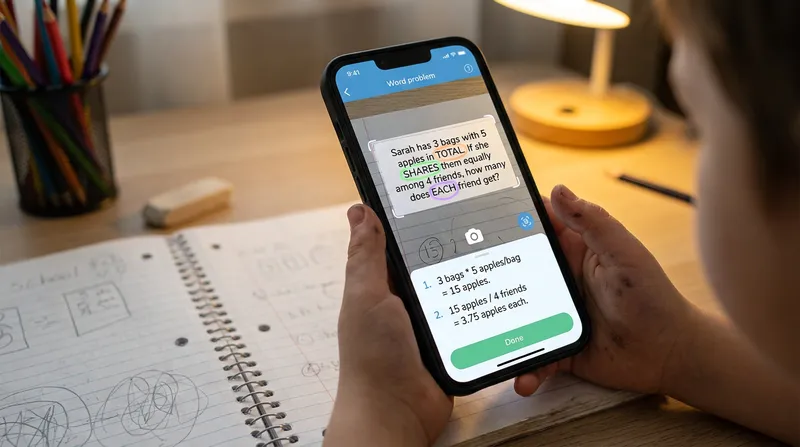
The real magic happens when the math word problem solver online translates English into math. Using an ai math scanner like TutorAI, your child simply snaps a photo of the confusing paragraph. The AI immediately extracts the text, highlights key terms, and maps them to mathematical symbols.
For example, the phrase "twice the sum of a number and four" is instantly translated into the equation "2(x + 4)". Seeing this translation happen in real-time teaches the student how to look for those keywords in the future.
Even if your child's school restricts mobile devices, you can learn No Phone Allowed? How to Use a Scanner Math Solver Online (Chromebook & PC) to keep the learning going at home.
Actionable Tip: Have your child guess the equation first on a piece of scratch paper, then use the scanner to see if their translation matches the AI's translation.
Breaking down the steps to reduce math anxiety
Seeing only a final answer can feel paralyzing for a student who does not understand how to get there. It makes them feel inadequate. Conversely, seeing a logical, step-by-step breakdown is calming.
Research published by the National Institutes of Health (NIH) proves that students with high math anxiety struggle significantly more with the linguistic demands of word problems rather than just the arithmetic complexity. By using a step-by-step math solver, you free up the student's cognitive load.
They can focus on understanding one small piece of the puzzle at a time. When they solve math word problems step by step, the anxiety naturally dissipates.
Actionable Tip: Use a piece of paper to cover the screen of your phone or tablet, revealing only one step of the AI's explanation at a time to prevent visual overwhelm.
A parent's guide to using a step-by-step math solver collaboratively
Handing a smartphone to a frustrated teenager and walking away is not an effective teaching strategy. To get the absolute most out of a math ai problem solver, parents and students need to work as a team.
You can act as the supportive facilitator while the ai math tutor provides the heavy academic lifting. This collaborative approach is highly effective, as discussed in our article Homework Helper App vs. AI Tutor: Which Is Best for Your Student?.
Here is exactly how to structure your homework sessions for maximum success.
Actionable Tip: Sit next to your child at the table, not across from them. This physical positioning creates a sense of partnership rather than opposition.
Step 1: Scan and identify the core question
First, instruct your child to read the problem out loud. Hearing the words spoken can sometimes trigger comprehension much better than silent reading. Next, use the app to scan the problem.
When the AI generates the first step, it usually involves defining the variables (like letting "x" equal the number of apples). Stop right there. Ask your child, "Does it make sense why the app chose x for this?"
This ensures they are using the tool to actively ai solve math problems rather than passively copying numbers onto their worksheet.
Actionable Tip: Always have your child write down the core question at the top of their paper (e.g., "Find the total cost of the apples") before looking at any of the AI's generated steps.
Step 2: Review the explanations together
Guide your child to write down each step exactly as the math word problem solver with steps explains it. As they write, ask them why the app performed that specific operation.
According to educational experts at Education Week, freeing a student's cognitive load from basic processing allows them to focus on higher-order conceptual understanding. This is exactly what reviewing explanations together achieves.
Be sure to celebrate the small wins. If they understand step two, praise that understanding before moving to step three. After your session, check the parent dashboard to see which topics your child engaged with to turn invisible homework struggles into visible, trackable progress.
Actionable Tip: Have your child teach the step back to you. If they can explain the logic to you, they have truly mastered the concept.
Building long-term confidence (without cheating)
The most common fear parents have about an ai math homework helper is that it will make their child lazy or dependent on technology. It is vital to understand that there is a massive difference between copying final answers in the hallway before class and using an AI tool at home to learn the process.
True learning happens when the tool is used to verify work, get unstuck on a specific step, or study for an upcoming test. Advanced apps even identify weak spots and adapt practice accordingly with personalized learning paths. This reinforces that the app is not just an answer key, but a custom tutor.
Furthermore, teachers want to see the thought process. If you are worried about academic integrity, read our comprehensive guide on Can Teachers Tell You Used Photomath? How to Show Math Work Authentically. Showing work authentically builds long-term confidence for the next exam, proving to the student that they are capable of success.
Actionable Tip: After using the AI for one problem, require your child to attempt the next similar problem entirely on their own before checking it with the app.
Note: Every student learns differently. While these strategies are research-backed, results may vary. Adapt these techniques to fit your unique learning style and circumstances. If math anxiety persists, consider seeking support from a school counselor.
Conclusion: turning tears into triumphs
Math word problems are incredibly tough because they combine reading comprehension with mathematical calculation, leading to severe cognitive overload. When your child freezes at the kitchen table, it is not because they lack intelligence; their working memory is simply overwhelmed by the demands of the text.
Using an ai math word problem solver is a smart, stress-reducing strategy for modern families. It acts as a patient, 24/7 tutor that breaks complex paragraphs into manageable, logical steps. By using this technology collaboratively, you can remove the anxiety and focus on real learning.
For more tips on exam preparation, check out 5 Ways to Use a Free AI Math Solver to Boost Your Teen's Math Confidence Before Finals.
Actionable Tip: Ready to turn tonight's homework from a battle into a breakthrough? Download TutorAI on iOS or Android today to snap, solve, and learn together without the stress. Experience the difference a patient, step-by-step guide makes.
Frequently asked questions
What is the best AI math word problem solver for middle and high school students?
The best solvers go beyond just giving the final answer. They provide clear, step-by-step explanations, scan complex text accurately, and offer personalized learning paths. They act like a patient, 24/7 tutor with offline access rather than just a basic calculator.
How do I help my child with math anxiety caused by word problems?
The most effective method is breaking the problem down into smaller, manageable parts. We recommend using an AI step-by-step math solver to reduce cognitive overload. This allows the child to focus on understanding one logical step at a time without feeling overwhelmed by the entire paragraph.
Can an AI math scanner read handwriting or just printed text?
Advanced AI math scanners are designed to easily read both printed textbook problems and handwritten notes. This makes it incredibly simple to get help with worksheets, study guides, or notes taken directly during class.
Will using an AI math homework helper make my child lazy?
When used correctly, the answer is no. By focusing on the "why" and the individual steps rather than just copying the final answer, AI tools actually promote independent learning. Features like progress tracking and personalized quizzes help build deep understanding, much like having a private tutor sitting beside them.
Are there step-by-step math solvers that explain the reading comprehension part?
Yes, modern AI tools are specifically designed to bridge the gap between English and Math. They help identify key vocabulary words (like "sum" or "fewer than") and show exactly how those specific words translate into mathematical symbols.


