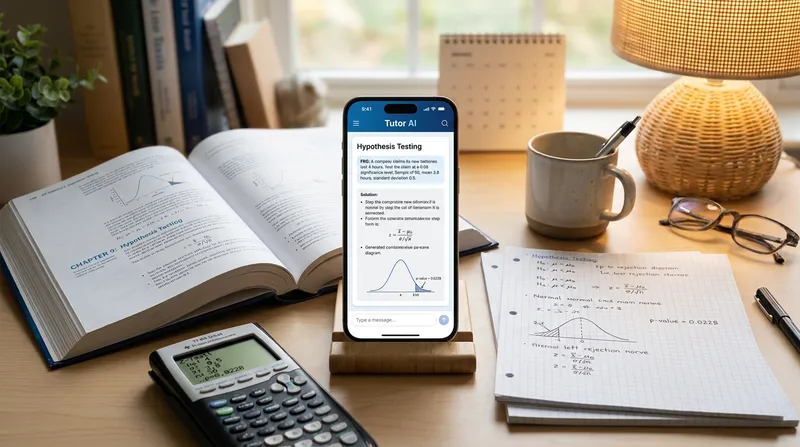
It is a familiar and incredibly frustrating scenario for many high school students. You stay up late studying for your AP Statistics exam. You memorize the formulas, you calculate the exact test statistic, and you find the correct p-value. Yet, when you get your graded Free Response Question (FRQ) back, you see a score of 1 out of 4.
How does this happen? The core problem is that AP Statistics requires much more than just crunching numbers. It demands strict, context-heavy vocabulary to earn full credit. Students often get the math perfectly right but fail the exam because they do not know how to write their conclusions using the specific phrasing required by the College Board rubric.
Whether you are a student trying to pass AP Statistics on your first attempt or a busy parent looking for the right tools to help your teen succeed, this guide is for you. We will break down exactly how to master hypothesis testing, perfectly format your FRQ conclusions, and use a smart AI math solver for statistics to practice the right way.
For Parents: If your teen is getting the math right but still losing points, the problem is not a lack of effort. The issue is knowing exactly what the grader is looking for. A tool with a Family Plan, like Tutor AI, allows you to track progress across different AP subjects and see exactly which concepts (like one-sample vs. two-sample tests) need more practice.
Why Good Math Is Not Enough to Pass AP Statistics
In most math classes, getting the correct number at the end of the page means you get an A. AP Statistics is an entirely different beast. Graders are not just testing your ability to use a calculator. They are testing your ability to act like a real-world statistician, which means you must prove you understand what the numbers actually mean in context.
This emphasis on written context is only becoming more important. According to the College Board, for the 2026-27 school year, the AP Statistics exam is revising its Free-Response Section to include four questions, each worth 10 points. There will be a massive focus on inference skills like hypothesis tests and confidence intervals. If you cannot explain your math in plain English, you will lose the majority of those points.
Many students try to prepare by looking at past exams, which is a great strategy. In fact, learning How to Ace AP & SAT Exams: Using HSC & VCE Trial Papers with a Step-by-Step AI Solver can give you a massive advantage. However, when practicing, you must focus just as much on the grading rubric as you do on the mathematical steps.
💡 Actionable Tip: Before you take your next practice test, download the official AP Statistics scoring guidelines for past FRQs. Read the "Grading Notes" section carefully. You will notice that graders are explicitly instructed to dock points if a student forgets to define a variable or fails to mention the specific real-world context of the problem.
Mastering the 4-Step Process for AP Statistics Inference FRQs
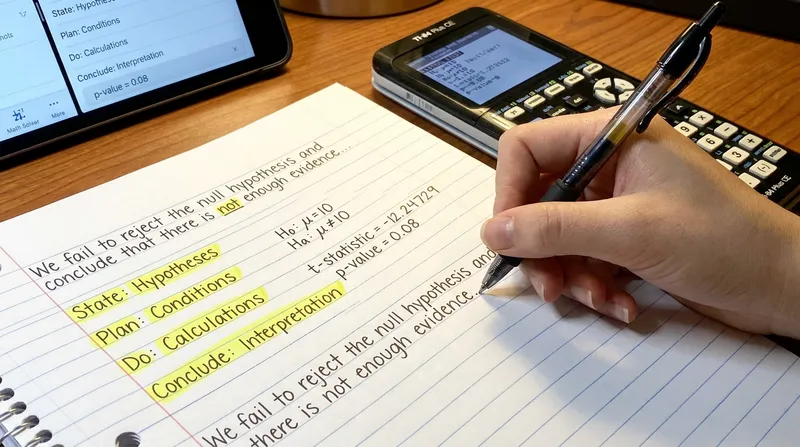
To ensure students provide all the necessary context, AP Statistics teachers use a mandatory four-step framework for every inference problem. Memorizing this framework is your ultimate AP Statistics hypothesis testing cheat sheet.
The framework is simple: State, Plan, Do, Conclude.
1. State This is where you define your null and alternative hypotheses. You cannot just write "mu = 5". You must define what "mu" represents in the context of the problem.
- Example: "Let mu equal the true mean weight of all apples in the orchard, measured in grams."
2. Plan Before you can do any math, you must state which specific inference test you are using (like a 1-Sample T-Test) and check your conditions. You must explicitly write out that the data is Random, meets the 10% condition for independence, and satisfies the Normal/Large Counts condition.
3. Do This is the calculation phase. You will write down your test statistic, your degrees of freedom, and your p-value. This is the only step where a basic calculator is the main star.
4. Conclude This is where you bring it all together. You will compare your p-value to your alpha level to make a final decision in the context of the original question.
💡 Actionable Tip: Create a physical checklist on your scratch paper for the "Plan" step every time you take a test. Write "R, 10, N" in the corner of your page. Check them off only after you have written the proof for the Random, 10%, and Normal conditions.
How to Write AP Stats FRQ Conclusions That Earn Full Credit
The "Conclude" step is where the most points are lost. Graders are looking for a very specific formula. To get it right, you first need to understand exactly what you are calculating.
According to the National Institutes of Health (NIH), the p-value is the probability of obtaining a sample statistic as extreme as or more extreme than the test statistic, assuming the null hypothesis is true. Because we are dealing with probabilities, we can never be 100% certain. Therefore, you must never use the word "prove" in your conclusion.
Instead, use these exact fill-in-the-blank templates for your FRQs:
When the p-value is LOW (Reject the Null): "Because our p-value of [insert p-value] is less than our alpha level of [insert alpha level], we reject the null hypothesis. We have convincing evidence to conclude that [insert alternative hypothesis in context]."
When the p-value is HIGH (Fail to Reject the Null): "Because our p-value of [insert p-value] is greater than our alpha level of [insert alpha level], we fail to reject the null hypothesis. We do not have convincing evidence to conclude that [insert alternative hypothesis in context]."
💡 Actionable Tip: Memorize this rhyme: "If the p is low, the null must go." This will help you remember that a low p-value means you reject the null hypothesis.
Don't Forget About Confidence Intervals
While hypothesis tests tell you if there is a statistically significant difference, confidence intervals estimate what that difference actually is. The State, Plan, Do, Conclude framework applies here as well.
You must always interpret your interval using strict phrasing. The golden rule is to write: "We are 95% confident that the true population parameter [describe parameter in context] lies between [Value A] and [Value B]."
What to Look for in a Statistics AI Homework Helper
When students get stuck on homework at 11 PM, they need more than just a final numerical answer. If you scan a word problem into a basic tool and it spits out "p = 0.034", handing that in will earn you a failing grade. You need an AI tutor that explains the written context, parameter definitions, and condition checks.
Learning requires effort. As noted by researchers at Boston University, generative AI tools have moved to daily use faster than any education technology in recent memory. This rapid adoption means students and educators must treat AI as a tool for thoughtful design and deep understanding, not just a shortcut.
This is exactly Why a Basic Math Scanner App Isn't Enough: Finding an AI Math Solver That Actually Teaches. You need a tool that provides step-by-step explanations and allows you to check your contextual writing.
💡 Actionable Tip: Use the photo feature of your AI solver to your advantage. Snap a photo of your handwritten FRQ attempt and ask your AI tutor to evaluate whether your conclusion uses the proper context language required by the AP rubric.
How to Prompt Your AI Tutor for the 4-Step Rubric
If you want to use AI to study effectively, you have to know how to ask the right questions. The U.S. Department of Education recommends using AI to support teaching and learning by automating reasoning based on associations, provided it is guided by strong educational standards.
Parents often wonder, Is Crowdsourced Homework Help Reliable? What Parents Need to Know About Verified Answers and AI Tutors. The answer is that AI is incredibly reliable when you guide it to follow the AP rubric.
💡 Actionable Tip: When reviewing a problem with your AI tutor, use this exact prompt to test yourself: "Solve this AP Statistics hypothesis test using the State, Plan, Do, Conclude method. Please define all variables in the context of the word problem and explicitly check the Random, 10%, and Normal conditions."
Essential AP Stats Calculator Commands for the TI-84
During the "Do" step of your FRQ, your TI-84 calculator is your best friend. However, memorizing when to use specific TI-84 functions is confusing and stressful under time limits.
Here is a quick breakdown of how to find the p-value on a TI-84 for the most common tests. First, press the STAT button, then scroll over to the TESTS menu. (Note that menu option numbers may vary slightly depending on your calculator's operating system version).
- Z-Test (Option 1): Use this for a hypothesis test about a population mean when the population standard deviation is KNOWN (this is very rare in real life).
- T-Test (Option 2): Use this for a hypothesis test about a population mean when the population standard deviation is UNKNOWN (you only have the sample standard deviation). This is incredibly common on the AP exam.
- 2-SampTTest (Option 4): Use this when comparing the means of two independent groups.
- 1-PropZTest (Option 5): Use this for a hypothesis test about a single population proportion (percentages or fractions).
Knowing your way around the calculator saves precious minutes. If you want to explore more ways technology can speed up your workflow, check out our guide on the Best AI math solver apps: How AI tutors are replacing expensive math help.
💡 Actionable Tip: Write down the calculator command you used on your scratch paper to keep your thoughts organized. If you forget how to navigate to a specific test like the 1-PropZTest, you can ask your AI tutor to walk you through the TI-84 keystrokes step-by-step.
Understanding Type 1 and Type 2 Errors in AP Stats
Even with the perfect 4-step process, you might be asked a follow-up question about errors. Because statistics is based on probability, our conclusions can sometimes be wrong, even if we did all the math perfectly.
- Type 1 Error (False Positive): This happens when you reject a null hypothesis that is actually true. You found convincing evidence for something that isn't really there. The probability of making a Type 1 error is exactly equal to your alpha level (usually 0.05).
- Type 2 Error (False Negative): This happens when you fail to reject a null hypothesis that is actually false. You missed a real effect or difference.
These concepts can be incredibly confusing, especially for students who struggle with abstract word problems. This is especially true for neurodivergent students, as explored in our post about AI Math Help for ADHD & Dyscalculia: Why Traditional Solvers Fail (And What Actually Works).
💡 Actionable Tip: Memorize this phrase: "Type 1 is rejecting a true null." When practicing, force yourself to write out the real-world consequence of the error. For example: "A Type 1 error means we conclude the new medicine works better when it actually does not, leading the hospital to waste money on an ineffective drug."
What to Expect on Exam Day: A Quick Checklist
Before you sit for your exam, make sure you can confidently check off these crucial rubric requirements:
- Did you define all parameters in the context of the word problem?
- Did you explicitly verify the Random, 10%, and Normal conditions?
- Did you write your final conclusion in plain English using the exact context of the prompt?
- Did you completely avoid using the word "prove"?
Snap, Solve, and Pass: Your Next Steps
Passing AP Statistics requires a blend of solid mathematical calculation and precise, context-driven writing. You can master hypothesis testing FRQs by sticking strictly to the State, Plan, Do, Conclude framework and practicing your phrasing until it becomes second nature.
Remember, getting the math right is only half the battle. You need tools that support your learning process from start to finish. If you are preparing for big exams, integrating technology the right way is key. You can learn more about building your testing stamina in our guide on How to Take a Free Digital SAT Practice Test at Home (And Review It With AI).
💡 Actionable Tip: Want to practice the full 4-step process with instant feedback on your written conclusions? Tutor AI's step-by-step explanations walk you through every inference problem exactly how your AP grader expects to see it. Download Tutor AI today to get 24/7 access to context-rich help when your teacher is not available.
Note: Every student learns differently. While these strategies are research-backed, results may vary. Adapt these techniques to fit your unique learning style and circumstances.
Frequently Asked Questions
What is the 4-step process in AP Statistics?
The 4-step process is a mandatory framework required by the College Board for all inference Free Response Questions (FRQs). It consists of State (defining parameters and hypotheses in context), Plan (stating the test and checking conditions), Do (calculating the test statistic and p-value), and Conclude (making a final decision in context).
How do I find the p-value on a TI-84 calculator?
To find a p-value, press the STAT button, scroll right to the TESTS menu, and select the appropriate test for your data (such as a T-Test for means or a 1-PropZTest for proportions). Enter your sample data or summary statistics, hit calculate, and the calculator will output the p-value (labeled as "p").
Can an AI math solver help with AP Statistics FRQs?
Yes, but only if you use a step-by-step solver that explains the "why" behind the math. Basic math scanners only give you the final numerical output, which will cause you to fail the FRQ rubric. You must use an AI tutor that explains the written context, parameter definitions, and condition checks.
What is the difference between a Type 1 and Type 2 error?
A Type 1 error occurs when you reject a true null hypothesis (a false positive). A Type 2 error occurs when you fail to reject a false null hypothesis (a false negative). Both represent times when statistical evidence leads you to the wrong real-world conclusion.
How do you write a good conclusion for a hypothesis test?
A good conclusion must compare the p-value to the alpha level, clearly state whether you reject or fail to reject the null hypothesis, and explain what that means using the real-world context of the original word problem. Never use the word "prove" in your conclusion.