
It is 11 PM on a Tuesday, and your teenager is staring blankly at a complex algebra worksheet. As a busy parent, you want to help, but it has been years since you last factored a polynomial. In a moment of panic, your child turns to a crowdsourced homework app like Brainly, types in the question, and instantly finds an answer with a shiny "Verified" badge next to it. They copy the answer, close their books, and finally go to sleep.
Everyone feels relieved, at least until the assignment comes back with a failing grade and a note from the teacher about using incorrect methods not taught in class.
This scenario plays out in many families across the country every night. Students are receiving poor grades because they trust highly rated but fundamentally incorrect crowdsourced answers. Meanwhile, parents feel frustrated paying for subscriptions to peer-to-peer apps that enable shortcuts rather than actually helping their children understand the material.
If you have ever wondered if these platforms are truly reliable, you are not alone. In this guide, we will break down why community-driven apps often fail students, explore the reality of verified answers, and explain why dedicated AI tutors are a safer, more effective choice for your family.
The Late-Night Homework Struggle: Why We Turn to Crowdsourced Apps
We have all been there. The late-night homework panic is a universal experience for middle and high school students. When the clock is ticking and a deadline is looming, the pressure to just get the assignment done overrides the desire to truly learn the material.
When parents are unable to help with advanced subjects, students naturally look for lifelines. Crowdsourced homework apps and peer-to-peer homework help platforms seem like the perfect solution at first glance. They promise a massive community of students and experts ready to answer questions at a moment's notice. The appeal is obvious: it feels like having thousands of classmates available to help you out in a pinch.
However, this convenience comes with a significant hidden cost. Because these platforms rely on the general public to generate content, the quality of the help varies wildly. Students are often forced to sift through dozens of conflicting answers, guessing which one might be correct. When you are tired and stressed, you are much more likely to just pick the first answer that looks professional, regardless of its actual accuracy.
Actionable Tip: Audit the homework apps your student currently uses on their phone. Sit down with them and ask where they typically go for help when they get stuck. Understanding their current habits is the first step to introducing better study tools.
What Is Brainly and How Does It Actually Work?
To understand why inaccuracies happen, we first need to look at how collaborative platforms operate. At its core, Brainly uses a community learning model. A student posts a question, and other users (who are mostly other students) provide answers.
To encourage people to answer questions, the platform uses a gamification system. Users earn points and increase their rank by answering questions quickly and frequently. While gamification can be a great way to motivate learning in the right context, it creates a massive quality control issue when applied to crowdsourced answers.
Instead of taking the time to carefully work through a math problem or explain a science concept, users are incentivized to post the fastest answer possible. This rush to be the first to reply means that answers are often incomplete, poorly explained, or completely wrong. The focus shifts from helping a peer understand a concept to simply scoring more points for their own profile.
Actionable Tip: Sit down with your child and look at the point system on their favorite homework app together. Discuss what motivates users to post answers. Helping your child see the mechanics behind the app will make them more critical of the information they find there.
The Truth Behind Verified Answers
When a student sees a green "Verified Answer" badge, they naturally assume the solution is 100% accurate and approved by a teacher or subject matter expert. Unfortunately, this is one of the biggest misconceptions in peer-to-peer homework help.
The reality of the verification process is much less rigorous than it appears. According to Reviewed (USA Today Network), because users gain points for answering questions, platforms are flooded with error-laden or irrelevant responses posted solely to increase user rankings.
The moderators who verify these answers are often just other high-ranking students or volunteers, not credentialed educators. They have to sift through thousands of submissions a day. As a result, the point-farming flaw allows many incorrect, outdated, or poorly reasoned answers to slip through the cracks and earn that coveted verified badge.
Actionable Tip: Teach your student to cross-check verified answers with their textbook or class notes instead of blindly copying the first result they see. If the online answer uses a completely different formula than the one taught in class, it is a major red flag.
The Real Cost of Inaccurate Homework Help: Grades and Confidence
When a student trusts a bad answer, the impact goes beyond just a lower score on a single assignment. There is a profound psychological impact when a student thinks they finally understand a concept, only to be penalized for doing it wrong. It shatters their academic confidence and increases their anxiety around that subject. They begin to doubt their own ability to identify correct information.
When we compare the high rate of human error on community platforms to the consistent logic of a dedicated AI system, the difference is staggering. Crowdsourced apps suffer from typos, misunderstood questions, and deliberate trolling. AI tutors, on the other hand, use structured logic to break down problems.
Actionable Tip: Review a recently graded assignment with your teen. Look for any errors that stemmed from trusting an unverified online source, and use this as a gentle teaching moment about digital literacy.
The Plagiarism Problem in Peer-to-Peer Homework Help
Beyond simple inaccuracy, there is another concerning side to crowdsourced homework apps: they often function as vehicles for plagiarism rather than genuine learning environments.
When a student is stressed, the temptation to copy an answer word-for-word is incredibly high. Research from Embry-Riddle Aeronautical University (Scholarly Commons) shows that up to 60 percent of students self-report internet-based plagiarism, which is heavily facilitated by online crowdsourced study platforms.
Teachers are highly skilled at spotting when a student uses methods or vocabulary they have not learned in class. This leads to massive anxiety over academic dishonesty. For a parent, finding out your child is being investigated for cheating because they used a "homework helper" app is a highly stressful situation.
Actionable Tip: Have an open, non-judgmental discussion with your student about the critical difference between researching a concept to understand it and copying a peer's answer word-for-word.
AI Tutors vs. Crowdsourced Apps: A Safer Path for Students
Because of the risks associated with point-farming and plagiarism, families are increasingly looking for safer alternatives. Unlike crowdsourced platforms that rely on the whims of random internet users, a dedicated AI tutor provides consistent, curriculum-aligned accuracy.
The educational benefits of AI are becoming widely recognized by experts. Rigorous studies from the Brookings Institution show that tutoring systems integrating generative AI can deliver learning gains and efficiency that match the success of human tutoring.
Here is a quick look at how the two options compare:
| Feature | Crowdsourced Apps | Dedicated AI Tutors |
|---|---|---|
| Accuracy | Inconsistent, depends on the user | Highly consistent and logic-based |
| Learning Method | Often provides only the final answer | Focuses on step-by-step comprehension |
| Plagiarism Risk | High risk of copying peer work | Low risk, encourages active problem solving |
| Availability | Depends on community response times | Available instantly, 24/7 |
If you want to understand more about how these modern tools compare to older platforms, check out our complete breakdown on Homework Helper App vs. AI Tutor: Which Is Best for Your Student?.
Actionable Tip: Run a side-by-side test with your child. Take a complex middle school math problem and plug it into both a community app and an AI tutor. Visually compare the difference in reasoning, clarity, and helpfulness.
Step-by-Step Learning vs. Just Getting the Final Answer
One of the most significant differences between a crowdsourced app and an AI homework helper is how the answer is delivered. Community apps usually just give the final answer. This enables cheating because the student does not have to engage with the material at all.
Educational AI tools force step-by-step comprehension. According to The Hunt Institute, AI tutors successfully track learner mastery and identify knowledge gaps before presenting new concepts, allowing students to complete core academics efficiently.
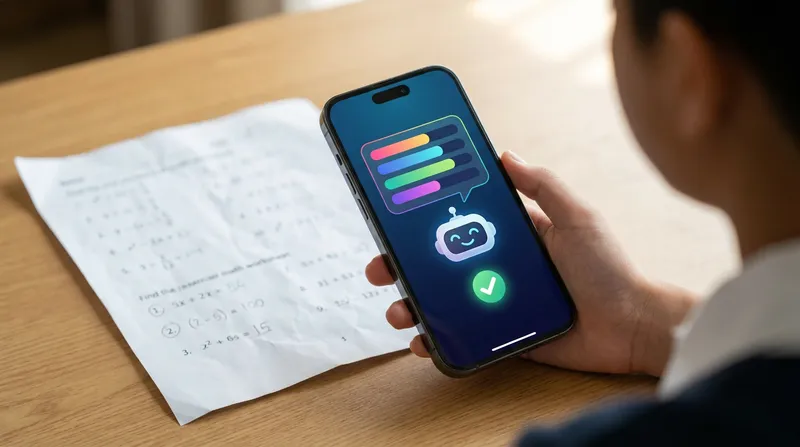
For example, TutorAI uses a "Snap. Solve. Learn." approach. When a student takes a photo of a problem, the AI does not just spit out a number. It breaks down the exact methodology needed to solve it, highlighting the formulas and logic along the way. While no AI system is perfect, and AI works best as a learning companion alongside classroom instruction, this structured approach ensures students learn the "why" behind the answer.
To learn more about why this matters, read our guide on Why a Basic Math Scanner App Isn't Enough: Finding an AI Math Solver That Actually Teaches.
Actionable Tip: The next time your child asks for help, ask them to explain the steps to you using their AI tool, rather than just showing you the final result. If they can teach it to you, they truly understand it.
Best Alternatives for Safe, Reliable Homework Help
Parents are actively searching for alternatives that prioritize safety and actual learning. Dedicated AI tutors have emerged as the safest, most reliable alternative to ad-heavy, peer-driven platforms.
Many free community platforms bombard students with distracting advertisements and hide their best features behind confusing, auto-renewing paywalls. A quality AI tutor provides a distraction-free study environment where the sole focus is on academic growth. Furthermore, top AI platforms often include parent-specific features like progress tracking, allowing you to identify your child's weak spots and monitor their improvement over time.
Apps like TutorAI offer transparent pricing and 24/7 availability. Whether your child is stuck on statistics at 4 PM or chemistry at midnight, they have a safe, reliable place to turn. For a deeper dive into the top tools available today, explore our list of the Best AI math solver apps: How AI tutors are replacing expensive math help.
Actionable Tip: Download a highly rated AI math solver to your own phone first. Practice using its photo-scan feature on a sample problem to see how the step-by-step explanations work before introducing it to your child.
How to Transition Your Child to an AI Homework Helper
Breaking the habit of using quick-fix apps takes time, but transitioning to a safe homework app for students is entirely possible with the right approach.
The key is to frame the AI not as a shortcut, but as a 24/7 personal tutor that builds confidence. Explain to your child that you understand how stressful homework can be, and that you want to give them a tool that will actually help them pass their tests, rather than just survive the nightly homework routine.
Start by replacing their current apps with an AI tutor for just one subject, like math. Show them how to use it to check their work. For more strategies on making this shift smoothly, read our guide on How to Help Your Child With Math Homework Using a Scanner App (Without Cheating).
Actionable Tip: Set up a dedicated study zone in your home. Introduce the new AI tool specifically for checking work and breaking down difficult concepts, making it a regular part of their healthy study routine.
Conclusion
Navigating the world of digital homework help can be overwhelming for any parent. While crowdsourced apps may offer the illusion of quick fixes, the reality of unverified answers and plagiarism risks makes them a gamble for your child's grades and confidence. By understanding these hidden costs, you can make informed decisions about the tools your family uses. Transitioning to a dedicated AI tutor provides a safer, distraction-free environment that prioritizes step-by-step comprehension over merely copying the final answer.
Ready to eliminate late-night homework stress? Download TutorAI today on iOS or Android and help your child build real academic confidence.
Note: Every student learns differently. While these strategies are research-backed, results may vary. Adapt these techniques to fit your unique learning style and circumstances.
Frequently Asked Questions
Is Brainly safe for kids to use?
While it has community guidelines, the free tier is heavily ad-supported and relies on unmoderated peer interactions. There is also a significant academic danger in relying on inaccurate crowdsourced answers. We highly recommend ad-free AI alternatives for a safer, distraction-free environment.
Why are Brainly answers sometimes incorrect?
The platform uses a gamified point-farming system. Users are incentivized to post quick, often incorrect answers just to earn points and rank up on the platform, leading to a high volume of low-quality responses.
Are verified answers 100% accurate?
No. The verified badge simply means the answer was reviewed by a top-tier user or moderator, who is often just another student. It does not guarantee a subject matter expert reviewed it, leaving plenty of room for outdated or flawed information.
Can teachers tell if you use crowdsourced homework apps?
Yes. Teachers can easily spot when a student uses advanced methods, incorrect formulas, or specific vocabulary copied straight from the internet. Furthermore, many schools use software that flags word-for-word text from popular homework sites.
What is the best AI alternative to crowdsourced apps?
The best alternatives are dedicated AI tutors that focus on step-by-step explanations and mastery tracking. These tools ensure students actually learn the material rather than just copying the final answer, providing a much safer and more effective learning experience.