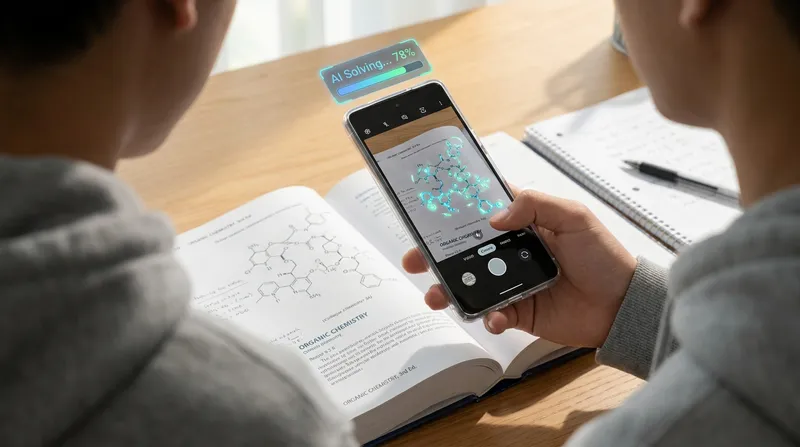
It is 10 PM on a Tuesday. You or your child are staring at a chemistry worksheet, and the frustration is building. You have tried typing the complex chemical equations into a standard search engine, but it is impossible to format the tiny subscript numbers or draw the hexagonal rings of an organic chemistry molecule on a standard keyboard.
This is the core pain point that millions of families face every night. Standard math solvers fail completely at chemistry theory, and text-based AI cannot read visual chemical formulas or textbook diagrams from a photo. When students and parents need help, they need a tool that understands visual chemistry instantly.
Fortunately, educational technology has evolved. A chemistry problem solver camera can now look at your handwritten notes, recognize complex molecular structures, and provide a detailed breakdown of the solution.
In this comprehensive guide, we will explore how to use the best chemistry ai picture solver app to transform late-night homework battles into moments of genuine learning. We will also review the top free chemistry ai solver online tools, explain how to scan a chemistry problem with AI, and show busy parents how to use these tools to support their children without needing a science degree of their own.
The Core Problem: Why Standard Math Apps Fail at Chemistry
If you have ever tried to use a basic math scanner for a chemistry assignment, you already know the struggle. While math apps are fantastic for algebra and calculus, chemistry introduces a completely different visual language.
Chemistry is not just about numbers; it is about spatial relationships, electron dots, reaction arrows, and complex organic structures. When you try to use a standard math solver to balance chemical equations or identify a molecule, the app usually gets confused. It might read a chemical symbol as an algebraic variable, leading to completely incorrect answers.
According to Pew Research Center, 64% of U.S. teens say they use an AI chatbot, and about three in ten use them daily for tasks like schoolwork and math problems. However, because general chatbots lack specialized visual recognition for science, students often receive inaccurate information that only deepens their confusion.
This is where a dedicated chemistry picture answer ai becomes essential. These specialized tools are trained on millions of chemical diagrams, allowing them to understand the difference between a math variable and a chemical element.
Actionable Tip for Students
Before downloading any app, check its core features. If the app only advertises "math solutions," it will likely fail your chemistry test. Look specifically for an ai chemistry homework helper that mentions science, stoichiometry, or chemical equations in its description.
How to Use a Chemistry AI Picture Solver
Using an AI chemistry solver is incredibly straightforward, but getting the most accurate results requires a bit of technique. Here is the best way to snap a photo and solve a chemistry problem.
Step 1: Prepare Your Workspace
AI cameras need a clear view to read your problem correctly. Ensure your workspace is well-lit. Avoid harsh shadows that might obscure a decimal point or a chemical bond. If you are scanning handwritten work, make sure your handwriting is as legible as possible.
Step 2: Snap the Photo
Open your chosen chemistry problem solver camera. Frame the specific problem you want to solve within the app's crop box. Do not try to scan an entire page of twenty questions at once. Focus on one equation or one molecule at a time. This helps the AI isolate the exact problem without getting distracted by surrounding text.
Step 3: Review the Step-by-Step Solution
The biggest mistake students make is skipping straight to the final answer. A high-quality step-by-step chemistry solver will break down the process. Read through each step carefully. If the app balances an equation, look at how it calculated the molar mass or how it applied the law of conservation of mass.
Step 4: Practice Similar Problems
Once you understand the steps, try solving the next problem on your worksheet without the app. Then, use the app to check your work. This transitions the tool from a quick-fix answer key into a true chemistry ai tutor.
Actionable Tip for Better Scans
If the AI struggles to read your handwriting, try writing the equation on a blank piece of white paper using a dark pen. Avoid lined paper if possible, as the camera can sometimes mistake the lines for fraction bars or chemical bonds.
Best Free Apps to Scan and Solve Chemistry Problems
The app store is flooded with homework helpers, but not all are created equal. We analyzed the top competitors in the market to help you find the best chemistry ai picture solver app for your specific needs.
1. Photomath
Photomath is legendary for its math OCR (Optical Character Recognition). It is brilliant at reading handwritten numbers and providing step-by-step math breakdowns.
- Strengths: Excellent user interface and highly accurate mathematical calculation steps.
- Limitations to Consider: It is strictly a math solver. While it can handle the basic arithmetic of chemistry like unit conversions, it cannot explain chemical theory, identify elements, or understand organic chemistry structures. For a deeper dive into math-specific tools, check out our guide on Is Photomath Plus Worth It? Mathway vs. Photomath vs. Gauth Plus Review.
2. Mathway
Mathway features a dedicated chemistry keyboard, making it easier to type complex formulas. It handles balancing chemical equations and stoichiometry very well.
- Strengths: Specialized keyboard inputs and broad subject coverage.
- Limitations to Consider: The crucial step-by-step explanations are locked behind a premium paywall. The free version only gives you the final answer, which does not help you learn for your upcoming test. Furthermore, it struggles with advanced visual theory.
3. Brainly
Brainly offers a "Scan to Solve" function and combines AI answers with a massive community knowledge base. It is a great place to find explanations from other students and teachers.
- Strengths: Peer-to-peer explanations and a massive database of previously answered school questions.
- Limitations to Consider: Community answers can be highly inconsistent in quality. Additionally, the free version is heavily restricted and cluttered with ads, which can be highly distracting during a focused study session.
4. Chegg Study
Chegg is a giant in the educational space, offering verified textbook solutions and access to human experts.
- Strengths: Expert verification and deep textbook integration.
- Limitations to Consider: It is built on a very expensive monthly subscription model. Furthermore, submitting a photo to an expert can take 30 to 45 minutes for a response. It is not an instant AI solver, making it frustrating for late-night study emergencies.
Organic Chemistry and Beyond: Solving Visual Theory
Organic chemistry is often considered the most difficult science class a high school or college student will take. It relies heavily on visual diagrams known as skeletal structures.
Standard text AI cannot help you here. If you type "hexagon with a circle inside and an OH group attached" into a chatbot, you might get a confusing answer. You need an organic chemistry ai solver picture tool that features advanced OCR capable of handling both mathematical notation and scientific diagrams.
The American Chemical Society highlights that AI applications in chemical research and education are rapidly expanding. AI has been recognized as a top emerging technology in the field, making AI literacy essential for modern chemistry students.
By using an app that can scan a chemistry problem with AI, students learn how to interact with the same types of diagnostic tools used by professional chemists. Advanced vision models can identify functional groups, predict reaction mechanisms, explain the "why" behind electron movement, and even support AP and SAT chemistry curriculum preparation.
Actionable Tip for Organic Chemistry
When drawing organic molecules for an AI to scan, make sure your bonds (the lines between atoms) are clearly defined. Ensure your letters (like O for Oxygen or N for Nitrogen) are capitalized and easy to read, so the AI does not confuse a lowercase "l" with an uppercase "I".
Step-by-Step Explanations: Learning vs. Cheating
One of the biggest concerns parents and teachers have about homework apps is cheating. If an app just gives the student the final answer, it robs them of the learning process. This leads to a phenomenon known as "cognitive debt," where a student appears to be completing their homework but fails their exams because they never actually learned the material.
For more on this topic, parents should read our article on The AI 'Cognitive Debt' Crisis: Why MIT Warns That Standard Math Solvers Are Deskilling Students.
The U.S. Department of Education recommends a "humans in the loop" approach where AI tools support and augment student learning rather than replacing human judgment and critical thinking.
This is why finding a step-by-step chemistry solver is non-negotiable. A quality app acts as a 24/7 tutor. It breaks down the problem into digestible pieces. For example, if you need to balance chemical equations using AI, the app will not just give you the final coefficients. It will show you:
- The initial count of atoms on the reactant side.
- The initial count of atoms on the product side.
- The logical steps to multiply molecules until the sides are equal.
This approach builds student confidence. Clear, sequenced explanations are what make the difference between just getting the assignment done and actually understanding the chemistry. If you are worried about school policies regarding these tools, read our guide on the Expected School AI Bans: What NYCPS and LAUSD Policies Mean for Your Child's Homework.
Actionable Tip for Building Good Habits
Parents, encourage your child to write down the steps the AI provides in their own words. If they can explain the steps back to you, they have successfully learned the concept, proving they are using the tool to learn, not cheat.
A Parent's Guide: How to Be an AI Chemistry Tutor
Many parents feel helpless when their middle or high schooler brings home advanced chemistry homework. You might not remember Avogadro's number or how to calculate molarity, and that is completely okay.
You do not need a science degree to help your child; you just need the right tools. By using a chemistry ai tutor app, parents can step into the role of an academic coach rather than an on-call expert.
Here is how parents can use these tools effectively:
- Check Their Work: Have your child complete their assignment first. Then, use the app to scan their answers. If the app shows a different result, you can sit down together and review the step-by-step breakdown to see where the mistake happened.
- Manage Multi-Child Households: If you have two kids in different grades tackling different science subjects simultaneously, look for tools with a family plan and a shared parent dashboard. This allows you to track progress across different subjects without hovering.
- Utilize 24/7 Availability: Unlike a human tutor who needs to be scheduled, a quality AI chemistry solver is available at 10 PM on a Tuesday when the homework crisis actually happens.
- Reduce Homework Friction: Late-night homework battles often stem from mutual frustration. When neither you nor your child knows the answer, tensions rise. Introducing an AI solver diffuses the tension by providing an immediate, neutral source of help.
For more advice on navigating online resources safely, check out our Best Free Online Homework Help: A Parent's Guide to Safe Sites & Apps.
Actionable Tip for Parents
Set a "15-Minute Rule." If your child is stuck on a single chemistry problem for more than 15 minutes, allow them to use the AI solver. This prevents burnout and keeps the homework session moving productively.
Free vs. Premium: Which Solver is Right for You?
When searching for a free chemistry ai solver online, it is important to understand the difference between free tiers and premium subscriptions.
Free Solvers Usually Offer:
- Basic math calculations
- Final answers without the steps
- Limited daily scans
Premium Solvers Offer:
- Detailed, step-by-step explanations
- Advanced visual recognition for complex diagrams
- Offline mode capabilities for students studying in areas with limited Wi-Fi
- Personalized learning paths and parent reporting
If your child only needs occasional help checking a final answer, a free tier might be sufficient. However, if they are actively struggling with the concepts and need a tool to explain the "why" behind the chemistry, investing in a premium step-by-step solver is far more cost-effective than hiring a private tutor at fifty dollars an hour.
If you are looking for broader science help, you might also enjoy our roundup of The Best AI Science Solvers: Step-by-Step Homework Help for Physics, Chemistry, and Biology.
Conclusion: Empowering Students to Learn Independently
Chemistry does not have to be the subject that causes nightly stress in your household. By leveraging a high-quality chemistry ai picture solver app, students can get unstuck instantly and learn the material thoroughly.
The key is choosing the right tool. Avoid generic chatbots and math-only scanners that will only cause more confusion. Look for a dedicated platform that understands visual theory, provides step-by-step explanations, and keeps parents in the loop.
Ready to transform homework time? Download the Tutor AI app today to experience the power of instant, step-by-step chemistry help. Snap a photo, solve the problem, and start truly learning.
Note: Every student learns differently. While these strategies are research-backed, results may vary. Adapt these techniques to fit your unique learning style and circumstances.
Frequently Asked Questions
Can an AI app solve organic chemistry picture problems?
Yes, but only if you choose an app equipped with advanced scientific optical character recognition (OCR). Standard math solver apps will fail to understand visual diagrams. However, a dedicated educational tool like Tutor AI can accurately read skeletal structures, identify complex functional groups, and explain reaction mechanisms step-by-step.
What is the best free app to scan and solve chemistry problems?
While apps like Mathway and Photomath are popular free options for basic calculations, they often lock their step-by-step explanations behind paywalls or fail completely at visual chemistry theory. The best app for you depends on your goal. If you want true learning rather than just an answer key, look for an app that provides detailed, step-by-step breakdowns of both math and visual theory, even if full access requires a premium tier.
How accurate are AI chemistry solvers compared to human tutors?
Top-tier AI solvers are incredibly accurate for middle school, high school, and early college-level chemistry. They use strict algorithmic rules to balance equations, calculate molar mass, and identify molecular structures without human error. However, human tutors remain highly valuable for providing emotional support, motivation, and highly customized teaching methods for students with specific learning disabilities.
Can Photomath or Mathway solve chemistry theory questions?
No, they generally cannot. Photomath is designed strictly for numbers, arithmetic, and algebra. Mathway can handle typed chemical formulas using its specialized keyboard, but it struggles significantly with visual theory, textbook diagrams, and conceptual questions that do not involve a direct mathematical calculation.
Is using an AI chemistry homework helper considered cheating?
It depends entirely on how you or your child uses the tool. If a student scans a problem and simply copies the final answer onto their worksheet, it is considered cheating and will hurt their exam performance. However, if they use a step-by-step chemistry solver to break down the process, review their mistakes, and genuinely learn the concept, it becomes an incredibly powerful, ethical study aid.
How do I balance chemical equations using an AI camera solver?
Balancing chemical equations is simple with the right app. First, write the unbalanced equation clearly on a piece of paper. Open your AI solver app, frame the equation in the camera view, and snap the photo. The app will instantly identify the reactants and products, and provide the balanced coefficients along with a detailed breakdown of how it counted and matched the atoms on each side of the equation.